


Voice Automation in Warehousing: Benefits & Best Practices
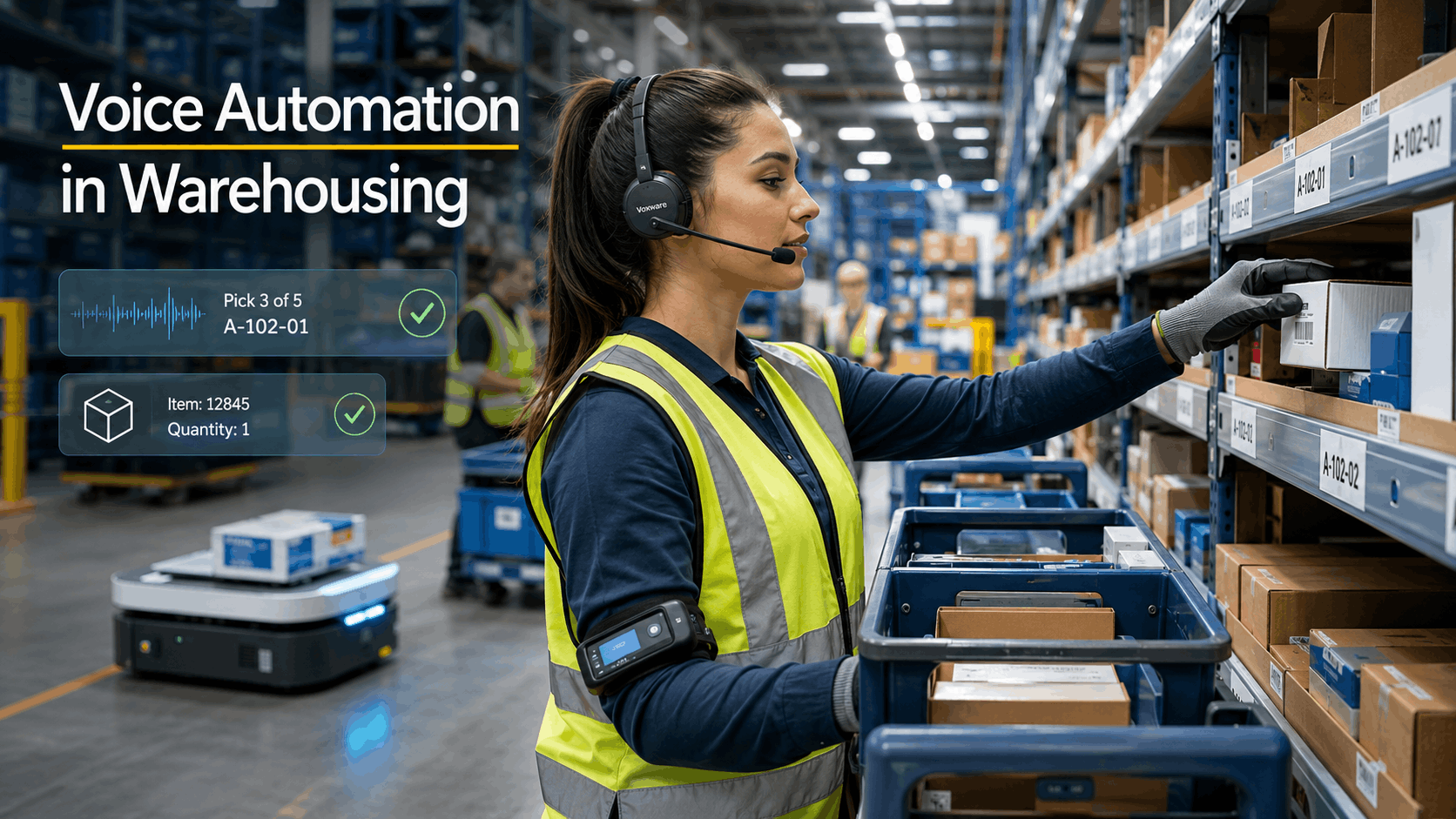
Warehouse operations have become increasingly complex. More SKUs, tighter delivery windows, labor constraints, higher customer expectations, and growing order volumes are putting pressure on warehouse and distribution center teams to do more without sacrificing accuracy.
For warehouse managers and supply chain leaders, improving productivity is no longer simply about moving faster. The real objective is to create workflows that allow employees to work efficiently while maintaining accuracy, visibility, and consistency.
This is where voice automation in warehousing can provide practical value.
Voice technology enables warehouse workers to receive instructions and confirm completed tasks through spoken commands rather than relying primarily on paper lists, handheld scanners, or visual screens. When integrated into warehouse workflows, voice-directed technology can help create a more streamlined approach to picking, replenishment, receiving, cycle counting, and other operational processes.
What Is Voice Automation in a Warehouse?
Voice automation uses speech-based technology to communicate work instructions directly to warehouse employees.
Instead of repeatedly looking at a device to determine the next task, a worker can receive an instruction through a headset, complete the task, and verbally confirm the result. The warehouse system can then process that confirmation and provide the next instruction.
This creates a hands-free workflow that can be particularly useful for operations where employees need to move continuously or handle products with both hands.
Importantly, voice automation is not simply about replacing a scanner or adding headsets to a warehouse. Its value comes from connecting voice-directed workflows with existing warehouse management systems, processes, and operational requirements.
1. Improving Picking Accuracy
Picking errors can have consequences far beyond a single incorrect order.
An inaccurate pick may result in returns, additional transportation costs, customer complaints, inventory discrepancies, and unnecessary labor. For distribution centers and 3PL operations handling high order volumes, these costs can quickly accumulate.
Voice-directed picking can help reduce errors by providing workers with step-by-step instructions and requiring verbal confirmation during the process.
For example, a worker may be directed to a specific location, asked to pick a particular quantity, and then prompted to confirm the quantity verbally. This creates an additional verification step within the workflow.
The goal is not simply to make employees work faster. It is to make the correct action easier to follow consistently.
2. Creating a Hands-Free Picking Process
Traditional warehouse workflows often require workers to repeatedly shift their attention between the product, location, paperwork, and technology device.
That constant switching can introduce unnecessary interruptions.
Voice picking allows workers to keep their eyes focused on the physical environment while receiving instructions through a headset. Their hands remain available for handling products, carts, containers, or equipment.
For warehouse managers, this can create a workflow that feels more natural and continuous.
The benefit becomes particularly relevant in operations where employees are picking frequently throughout a shift and small interruptions can compound into significant amounts of lost time.
3. Supporting Warehouse Productivity
Warehouse productivity should be measured carefully. Simply increasing picks per hour does not necessarily indicate an improvement if accuracy decreases or employees experience more rework.
A better approach is to consider productivity alongside accuracy, task completion time, travel, and overall workflow consistency.
Voice automation can support productivity by reducing unnecessary interactions with technology and providing workers with clear task sequences.
When workers know where to go, what to pick, and what action to confirm next, there may be fewer pauses between tasks.
For operations managers, this can make voice-directed workflows worth evaluating as part of a broader warehouse productivity strategy.
4. Reducing Training Complexity
Employee turnover remains an operational challenge for many warehouses, particularly during seasonal peaks and periods of rapid growth.
New employees must learn warehouse layouts, processes, product locations, safety requirements, and technology systems. Complex interfaces can add another layer to that learning curve.
Voice workflows can simplify certain tasks by presenting instructions sequentially rather than requiring employees to understand an entire software interface at once.
This does not eliminate the need for proper training. Instead, it can help structure the work itself into clear, repeatable steps.
For large distribution centers and 3PL companies onboarding employees regularly, that consistency can be valuable.
5. Extending Beyond Picking
Although voice picking is one of the most common applications, voice-directed technology does not have to stop at order fulfillment.
Depending on the warehouse environment and software integration, voice workflows can support activities such as:
- Receiving and putaway
- Replenishment
- Cycle counting
- Inventory verification
- Shipping processes
- Quality checks
- Stock movements
This broader application is important for warehouse directors considering automation investments.
Rather than evaluating voice technology as a single-purpose picking tool, decision-makers should consider whether it can support multiple operational workflows across the facility.
6. Helping Managers Build More Consistent Processes
Technology is most useful when it improves the underlying process.
If different employees perform the same warehouse task in significantly different ways, productivity and accuracy can vary from shift to shift. Voice-directed workflows can help standardize how instructions are presented and how task completion is confirmed.
For operations managers and supply chain executives, standardization can provide a stronger foundation for measuring performance.
It can also make it easier to identify where bottlenecks occur and where additional process improvements may be required.
7. Integrating Voice Automation With Existing Systems
One of the most important considerations when evaluating a voice automation solution is integration.
Most established warehouses already depend on systems such as warehouse management systems (WMS), enterprise resource planning (ERP) platforms, order management systems, and other operational software.
Replacing those systems simply to introduce voice technology may not be practical.
A better approach is often to evaluate how voice-directed workflows can work with the technology infrastructure already in place.
Decision-makers should therefore ask questions about system compatibility, implementation requirements, workflow configuration, scalability, reporting, and ongoing support before selecting a solution.
What Should Warehouse Leaders Consider Before Implementing Voice Technology?
Voice automation is not automatically the right answer for every warehouse.
Before implementation, warehouse managers should examine the specific operational problem they are trying to solve.
Consider:
Where are the most frequent errors occurring?
Identify whether picking, replenishment, receiving, or another process is responsible for significant rework.
How much time is lost to technology interaction?
Look for workflows where employees repeatedly stop to look at screens, handle devices, or process paperwork.
Which processes are highly repetitive?
Voice technology generally has the greatest potential where tasks follow predictable sequences.
Can the solution integrate with existing systems?
Integration should be evaluated before selecting a technology platform.
How will success be measured?
Establish baseline metrics for accuracy, productivity, training time, and task completion before implementation.
The Bigger Role of Voice Automation in Modern Warehousing
Warehouse automation is increasingly becoming less about one large technology investment and more about combining technologies that solve specific operational challenges.
Voice-directed workflows can coexist with barcode scanning, warehouse management software, mobile devices, robotics, automated storage systems, and autonomous mobile robots (AMRs).
For many facilities, this creates a more flexible path toward modernization.
The objective is not to automate every warehouse task. It is to identify where technology can remove unnecessary friction while allowing employees to perform their work more accurately and efficiently.
For warehouse managers, distribution center leaders, manufacturing managers, and supply chain executives, that distinction is important.
The strongest automation strategy starts with the workflow—not the technology.
Final Thoughts
Voice automation can provide a practical way to improve warehouse operations without requiring every process to be completely redesigned.
By delivering clear instructions, enabling hands-free work, supporting task verification, and creating more consistent workflows, voice technology can contribute to better picking accuracy and operational productivity.
However, the technology should be evaluated as part of a broader warehouse strategy.
The most successful implementation is likely to be one that aligns voice-directed workflows with existing systems, employee needs, operational goals, and measurable performance outcomes.
For organizations managing growing order volumes, labor challenges, or increasingly complex distribution operations, voice automation in warehousing is worth considering—not because it is the latest technology, but because the right application can address some of the fundamental challenges that warehouse teams face every day.

 English
 Arabic
 French
 Spanish
 Portuguese
 Deutsch
 Turkish
 Dutch
Dutch
 Italiano
 Russian
 Romaian
 Greek
Greek
