


The Role of Technical SEO in Website Performance and Rankings
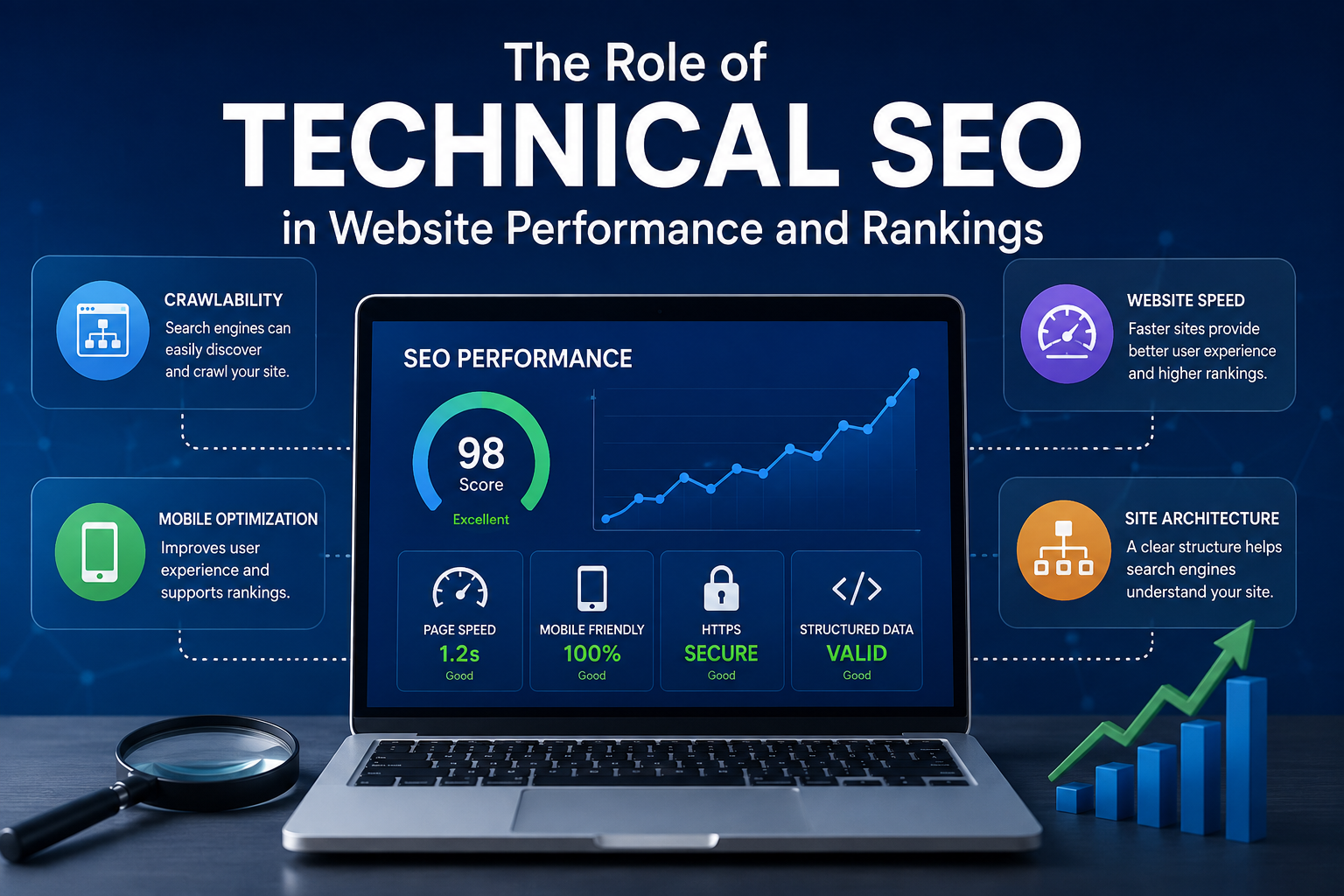
Search rankings are no longer influenced by content alone. A website can publish valuable articles, target relevant keywords, and build quality backlinks, yet still struggle to gain visibility if its technical foundation is weak. Search engines need to access, understand, crawl, and index a website efficiently before its content can compete effectively in search results.
This is where technical SEO becomes essential. Technical SEO focuses on the structure and performance of a website, helping search engines discover important pages while making the site faster, more accessible, and easier to navigate. From page speed and mobile usability to crawlability, indexing, structured data, and site architecture, technical improvements can influence both organic visibility and user experience.
For businesses investing in long-term growth, technical website optimization is not simply a one-time task. It is an ongoing process that keeps a website healthy as it grows and search technology evolves.
What Is Technical SEO and Why Does It Matter?
Technical SEO involves optimizing the behind-the-scenes elements of a website that affect how search engines crawl and interpret its pages. Unlike content SEO, which focuses heavily on topics, keywords, and relevance, technical SEO concentrates on the website's infrastructure.
A technically sound website gives search engines clear signals about which pages matter, how those pages are connected, and which content should appear in search results. At the same time, it creates a smoother experience for visitors.
Consider two websites offering similar information. One loads quickly, works well on mobile devices, has a logical structure, and provides clean internal links. The other loads slowly, contains broken links, has duplicate URLs, and makes important pages difficult to access. Even if both publish excellent content, the technically stronger website has a much better foundation for sustainable organic growth.
Technical SEO therefore supports the entire search strategy rather than operating as a separate activity.
How Website Performance Influences SEO
Website performance has become an important part of modern search optimization because users expect pages to respond quickly. Slow websites can create frustration, increase abandonment, and reduce the number of visitors who engage with a page.
Google uses several page-experience signals, including Core Web Vitals, to evaluate aspects of loading performance, responsiveness, and visual stability. These signals are designed to reflect real user experience rather than simply measuring how quickly a page technically loads.
Several factors can affect website performance, including oversized images, unnecessary JavaScript, inefficient CSS, excessive third-party scripts, poor hosting configuration, and browser caching problems.
Effective website performance SEO addresses these technical barriers. Image compression, modern image formats, code optimization, caching, content delivery networks, and reduced server response times can all contribute to a faster experience.
However, performance should not be treated as a race to achieve perfect scores. The goal is to create a website that loads efficiently and responds smoothly for real users across different devices and network conditions.
Crawlability, Indexing, and Site Architecture
Search engines rely on automated crawlers to discover and process website content. If important pages cannot be crawled efficiently, they may have limited opportunities to appear in search results.
A strong technical structure starts with logical site architecture. Important pages should be easy to reach through internal links, while categories and subcategories should have a clear relationship. Internal linking also helps distribute authority and provides search engines with additional context about page importance.
XML sitemaps can help search engines discover important URLs, particularly on large or frequently updated websites. Robots.txt can also guide crawler access, although it should be configured carefully because incorrectly blocking resources or pages can create SEO problems.
Indexing is another critical area. A page being accessible to crawlers does not automatically mean it should be indexed. Technical SEO professionals need to identify duplicate pages, incorrect canonical tags, thin pages, accidental noindex directives, and other issues that can interfere with search visibility.
This is why a detailed SEO site audit is valuable. It can reveal technical problems that are difficult to identify through ordinary content analysis.
Mobile Experience and Technical Website Optimization
Mobile usability is now fundamental to effective SEO. Most websites receive traffic from a mixture of mobile and desktop users, making responsive design and mobile performance essential.
A technically optimized website should adapt its layout to different screen sizes without creating usability problems. Text should remain readable, navigation should be easy to use, and interactive elements should provide enough space for users to tap comfortably.
Mobile optimization also requires attention to performance. Mobile users may rely on slower or less stable connections, so unnecessary page elements can have a noticeable effect on their experience.
Technical website optimization should therefore evaluate both desktop and mobile environments. A website that performs well on a powerful desktop computer may still provide a poor experience on a smartphone.
Businesses should regularly test important landing pages, forms, navigation elements, and conversion paths on different devices. Small technical improvements can make the website more accessible while supporting broader SEO objectives.
Technical SEO Elements That Support Search Visibility
Technical SEO includes a wide range of interconnected elements. HTTPS provides secure communication between browsers and websites, while proper canonicalization helps search engines understand preferred versions of URLs.
Redirect management is equally important. Poorly configured redirects can create chains, loops, or unnecessary delays. Broken links can also damage navigation and make it harder for users and crawlers to reach valuable content.
Structured data can provide search engines with additional information about certain types of content, such as products, organizations, articles, events, and other entities. While structured data does not guarantee enhanced search features, accurate implementation can help search engines interpret page information more effectively.
URL structure also deserves attention. Descriptive and consistent URLs make websites easier to understand and manage. When combined with clear headings, internal links, metadata, and organized content, technical signals create a stronger overall framework for search engines.
These elements work together. Fixing one technical issue while ignoring several others may produce limited results, which is why technical SEO should be approached systematically.
Why Regular SEO Site Audits Are Essential
A website is never truly finished from a technical SEO perspective. New pages are published, plugins and software are updated, developers change templates, redirects are added, and site structures evolve. Each change can potentially introduce new technical problems.
Regular SEO site audits help identify these issues before they become major obstacles. An audit can review crawlability, indexation, page speed, mobile usability, redirects, broken links, canonical tags, sitemap configuration, structured data, internal linking, and other technical elements.
The most useful audits do more than produce a list of errors. They prioritize problems according to their potential impact and provide a practical roadmap for fixing them.
For example, a critical indexing problem should generally receive attention before a minor metadata inconsistency. Likewise, a performance issue affecting hundreds of important pages may deserve higher priority than an isolated problem on a low-value URL.
A recurring audit process allows businesses to monitor technical health over time rather than reacting only after rankings or traffic decline.
Building a Stronger SEO Foundation for Long-Term Growth
Technical SEO does not replace high-quality content or authoritative links. Instead, it creates the foundation that allows those investments to perform more effectively.
When search engines can efficiently crawl and understand a website, users can navigate it easily, and pages load reliably across devices, the entire organic search strategy becomes stronger. Technical improvements can also reduce obstacles that prevent valuable content from reaching its intended audience.
The most effective approach is continuous optimization. Businesses should monitor performance, conduct periodic audits, resolve high-impact technical issues, and ensure that future website development follows SEO-friendly standards.
At Dexora Digital, technical SEO can be viewed as part of a broader digital growth strategy: a healthy technical foundation supports content visibility, better user experiences, and sustainable organic performance. By treating technical SEO as an ongoing investment rather than a one-time checklist, businesses can build websites that are easier for both search engines and people to use.
In a competitive search environment, strong content may attract attention, but strong technical foundations help ensure that search engines can actually find, understand, and deliver that content. That makes technical SEO an essential part of modern website performance and long-term search success.

 English
 Arabic
 French
 Spanish
 Portuguese
 Deutsch
 Turkish
 Dutch
Dutch
 Italiano
 Russian
 Romaian
 Greek
Greek
