


Airbnb Clone Development Guide for a Scalable Vacation Rental Marketplace
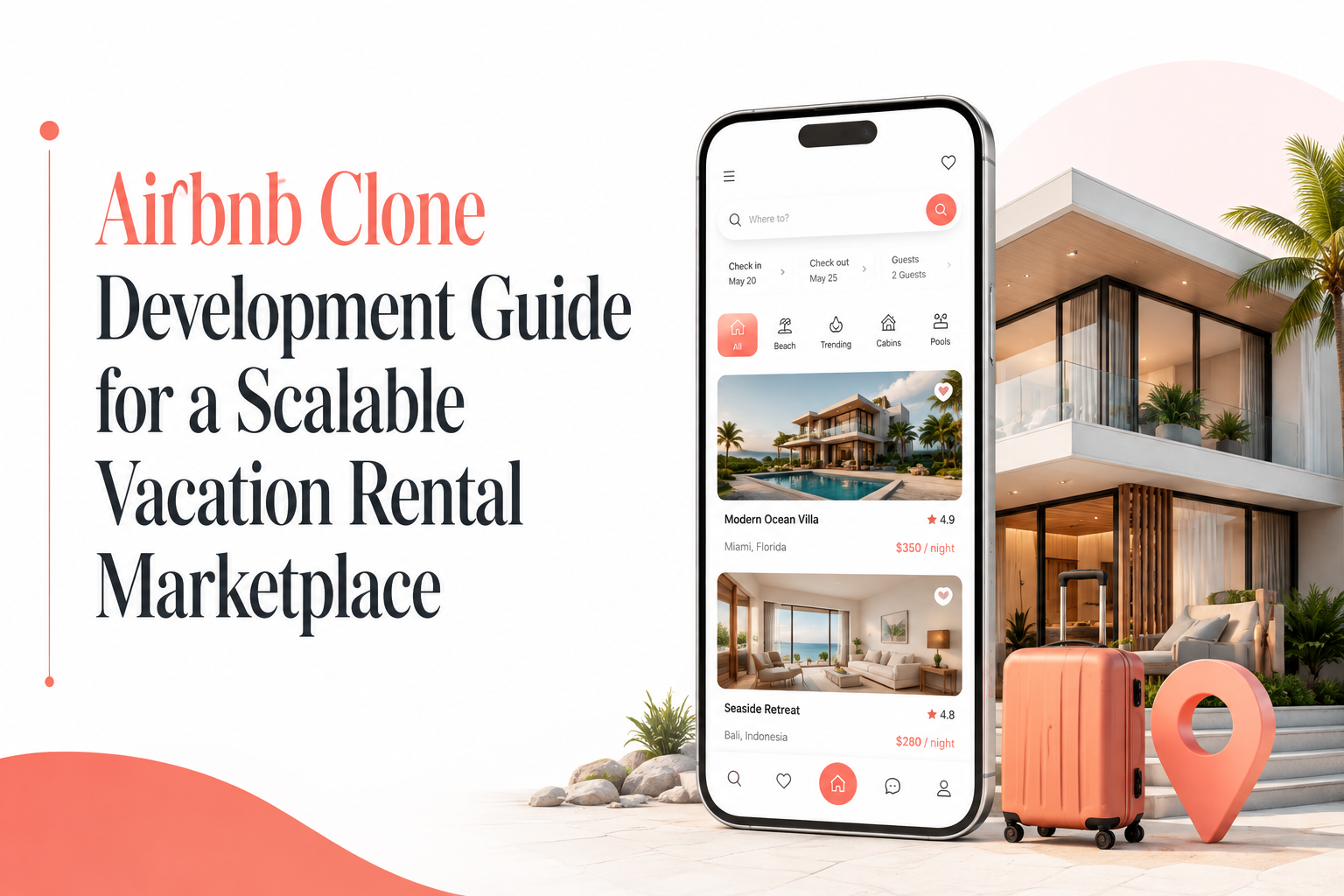
The vacation rental industry has changed how travelers discover accommodation and how property owners generate income from unused spaces. Instead of depending only on traditional hotels, travelers can now choose apartments, villas, cabins, holiday homes, farm stays, and other unique properties according to their location, budget, and travel preferences.
For entrepreneurs, this creates an opportunity to develop specialized rental marketplaces that connect hosts and guests through one digital platform. An Airbnb Clone provides the technological foundation required to manage property listings, availability, reservations, payments, communication, reviews, and marketplace administration.
However, creating a successful rental platform requires more than copying the visible features of an established application. Founders need to understand how hosts, guests, listings, calendars, payments, commissions, and trust systems work together.
A well-planned vacation rental marketplace can be customized around a specific region, accommodation niche, customer segment, commission model, and operational strategy.
This guide explains how Airbnb Clone development works, the features founders should prioritize, potential revenue models, operational requirements, and the factors that influence long-term marketplace growth.
What Is an Airbnb Clone?
An Airbnb Clone is a digital rental marketplace that allows property owners or hosts to list accommodation while travelers search, compare, and reserve suitable stays.
The platform normally connects three important participants:
- Hosts
- Guests
- Marketplace administrators
Hosts manage properties, pricing, availability, booking requests, and earnings.
Guests search for accommodation, review property information, check availability, complete payments, communicate with hosts, and manage reservations.
Administrators oversee the entire marketplace, including users, listings, bookings, commissions, transactions, reviews, disputes, and platform policies.
The model can be customized beyond traditional vacation rentals. Businesses can adapt it for villas, serviced apartments, cabins, homestays, corporate accommodation, luxury stays, student housing, eco-retreats, or other specialized rental categories.
Why Entrepreneurs Choose the Vacation Rental Marketplace Model
A rental marketplace is different from a conventional hotel booking website because the platform operator does not necessarily own the available properties.
Instead, independent property owners contribute supply while the marketplace provides technology and customer access.
Growing the Property Catalogue Through Hosts
Marketplace operators can expand their accommodation catalogue by onboarding new hosts instead of purchasing or managing every property themselves.
Each host may contribute one or multiple listings.
As the host network grows, customers receive more choices across locations, accommodation types, budgets, and amenities.
This creates a network-driven business model where both supply and demand are important.
Creating Opportunities for Niche Marketplaces
Founders do not need to compete across every travel category.
A more focused platform may target a specific audience.
Examples include:
- Luxury villa rentals
- Pet-friendly accommodation
- Eco-friendly stays
- Remote-work accommodation
- Farm stays
- Beach rentals
- Mountain cabins
- Corporate apartments
- Student accommodation
- Long-stay rentals
A defined niche can make host acquisition and customer marketing more focused.
Core Features of an Airbnb Clone
The quality of a rental marketplace depends on how well its features support the complete booking journey.
Adding unnecessary functionality can make the platform complicated. Founders should prioritize features that directly improve discovery, booking, trust, communication, and marketplace administration.
Property Search and Location Discovery
Property discovery is one of the first stages of the guest journey.
Travelers should be able to enter a destination, select travel dates, specify the number of guests, and view available accommodation.
Search can also include location suggestions, nearby areas, popular destinations, and map-based discovery.
A strong search system helps users move quickly from general travel intent to relevant property options.
Advanced Property Filters
Different travelers have different accommodation requirements.
Filters can help guests narrow results using factors such as:
- Property type
- Price range
- Number of rooms
- Guest capacity
- Amenities
- Instant booking availability
- Accessibility
- Pet-friendly options
- Parking
- Location
The filtering system should remain simple enough for mobile users.
Detailed Property Listings
Every property page should provide enough information for guests to evaluate the stay before booking.
Important listing details can include photographs, descriptions, accommodation type, amenities, location information, pricing, house rules, availability, host information, reviews, and cancellation policies.
Clear property information reduces uncertainty and helps customers make informed booking decisions.
Founders evaluating Airbnb clone features should consider how each feature improves either guest convenience, host efficiency, or marketplace control.
Availability Calendar and Reservation Management
The calendar is one of the most important components of a vacation rental marketplace.
A beautiful listing has limited value if availability information is inaccurate.
Real-Time Availability
Hosts should be able to block unavailable dates and update availability when reservations are confirmed.
Guests should only see accommodation that can actually be booked for their selected dates.
Accurate calendars help reduce booking conflicts and unnecessary cancellations.
Booking Requests and Instant Reservations
Different rental businesses may support different reservation models.
Some properties may allow immediate booking, while others may require host approval.
Providing configurable booking rules gives hosts more control over how reservations are accepted.
Reservation Management
Guests and hosts should be able to access booking information through their dashboards.
Relevant details can include:
- Check-in date
- Check-out date
- Number of guests
- Reservation status
- Payment information
- Property details
- Cancellation status
A structured reservation system reduces dependence on manual communication.
Host Features for Managing Rental Properties
Hosts are an essential supply-side participant in the marketplace.
If property management is complicated, hosts may struggle to maintain accurate listings.
Host Registration and Verification
The onboarding process should collect essential host information before properties become available publicly.
Depending on marketplace requirements, operators may review host profiles or request additional verification.
A structured onboarding process can also help administrators maintain marketplace quality.
Property Management Dashboard
Hosts should have a dedicated dashboard where they can manage rental operations.
They may need to:
- Add properties
- Upload photographs
- Edit descriptions
- Update amenities
- Adjust prices
- Manage availability
- Review bookings
- Communicate with guests
- Monitor earnings
Centralizing these activities makes the platform easier for property owners to manage.
Pricing Controls
Hosts may want to adjust pricing depending on weekends, seasons, events, demand, or property availability.
Flexible pricing tools can allow property owners to manage rates without requesting administrative changes.
More advanced marketplaces can also introduce recommendation or automation systems to support pricing decisions.
Guest Experience and Booking Convenience
Guests expect more than a large collection of properties.
They need a booking experience that feels clear and trustworthy.
Wishlist and Saved Properties
Users may explore several accommodations before choosing where to stay.
A wishlist allows guests to save interesting properties and compare options later.
Saved listings can also support future notifications or personalized recommendations.
Secure Payments
Payment should be integrated naturally into the reservation workflow.
Guests should clearly understand accommodation charges, service fees, taxes where applicable, and the final booking amount before confirming payment.
Supporting suitable payment methods for the target region can also improve checkout accessibility.
Booking Confirmation
After a successful reservation, guests should receive clear confirmation.
Relevant information may include property details, dates, payment summary, host contact options, and check-in information.
Reducing uncertainty after payment helps create a better customer experience.
Host and Guest Communication
Communication is essential in short-term rentals because travelers may need information before arrival.
Guests may want to ask about check-in procedures, amenities, parking, directions, or property rules.
Hosts may need to confirm arrival details or share instructions.
Integrated messaging keeps communication connected to the reservation instead of forcing users to rely entirely on external channels.
It also gives the marketplace greater visibility into booking-related interactions when support is required.
Reviews, Ratings, and Marketplace Trust
Travelers often cannot physically inspect a rental property before making a reservation.
Trust systems therefore play an important role.
Guest Reviews
Reviews provide future travelers with information about previous stays.
Guests may evaluate cleanliness, location, communication, property accuracy, or overall experience.
Host Ratings
Hosts can also benefit from reputation signals based on previous bookings and guest interactions.
Consistent positive feedback can make well-performing hosts easier for travelers to identify.
Marketplace Moderation
Reviews should not be the only trust mechanism.
Administrators may also need systems for reporting suspicious users, reviewing problematic listings, managing complaints, and resolving booking disputes.
A broader short-term rental platform strategy should therefore include trust and operational systems alongside standard booking features.
Admin Panel for Marketplace Operators
The admin dashboard gives the business owner centralized control over marketplace activity.
As the number of hosts, guests, listings, and bookings increases, strong administrative tools become increasingly important.
User and Host Management
Administrators should be able to review profiles, approve hosts where required, suspend accounts, and investigate reported activity.
Listing Management
Admins may review, approve, edit, or remove properties according to marketplace policies.
Listing moderation helps maintain consistent marketplace standards.
Booking Oversight
Marketplace operators should have visibility into reservations and their status.
This becomes especially useful when handling cancellations, refund requests, disputes, or customer support issues.
Commission and Payment Management
The platform should allow administrators to configure marketplace fees and monitor transactions.
Clear financial records are important for both the business and participating hosts.
Revenue Models for an Airbnb Clone
A vacation rental marketplace can generate revenue through several approaches.
Founders should select a model that supports marketplace growth without creating unnecessary friction for hosts or guests.
Booking Commission
The platform can collect a percentage from completed reservations.
This model connects marketplace revenue directly with transaction volume.
Guest Service Fees
The platform may apply an additional service charge to guests during checkout.
Fee structures should remain transparent so customers understand the final booking amount.
Host Subscription Plans
Property owners may pay monthly or annual fees for premium marketplace access.
Higher plans could provide additional listings, promotional tools, analytics, or enhanced host capabilities.
Featured Listings
Hosts may pay for additional property visibility within search results, destination pages, or promotional sections.
Paid placements should still remain relevant to users.
Additional Services
Marketplace operators may eventually monetize supplementary services such as cleaning partnerships, travel experiences, insurance integrations, concierge services, or property-management support.
Mobile-First Vacation Rental Experience
Travel planning frequently happens on mobile devices.
Guests may search properties while commuting, compare accommodation during a trip, or manage reservations after arriving at their destination.
An Airbnb Clone should therefore provide a responsive mobile experience.
Users should comfortably be able to:
- Search destinations
- Apply filters
- View property images
- Check calendars
- Message hosts
- Make payments
- Review bookings
- Save properties
Miracuves can customize these customer and host workflows according to the requirements of a particular rental business rather than treating every vacation marketplace as identical.
Scalability for Growing Rental Marketplaces
A platform may begin with a small number of hosts in one city and later expand across multiple destinations.
The technology and operations should be prepared for this growth.
Scalability involves more than handling website traffic.
The platform also needs to manage increasing:
- Property listings
- Search queries
- Reservations
- Payments
- Images
- Messages
- Reviews
- Host accounts
- Customer-support requests
Operational systems must scale as well.
Manual host approvals or booking interventions that work with 20 properties may become inefficient with thousands of listings.
Automation and structured administrative workflows become more important as marketplace activity increases.
How to Differentiate an Airbnb Clone Business
Copying an existing rental marketplace feature by feature does not create a strong competitive position.
Founders should identify a clear reason why hosts and travelers would use their platform.
Focus on a Specific Geography
A regional platform can provide stronger local support, languages, payment methods, and destination expertise.
Serve a Specific Traveler Segment
Platforms can specialize in families, remote workers, business travelers, students, luxury customers, or budget travelers.
Focus on Unique Properties
A marketplace can differentiate through cabins, farmhouses, villas, eco stays, heritage properties, or other distinctive accommodation.
Improve Host Services
Better host onboarding, local support, flexible commissions, or property-management tools can become a supply-side advantage.
Ready-Made Platform or Custom Development?
Founders generally have two development approaches.
A completely custom platform provides maximum freedom but requires every feature and workflow to be designed and developed independently.
A ready-made foundation already includes standard marketplace architecture that can be customized.
The right choice depends on business complexity, feature requirements, integration needs, available resources, and long-term strategy.
Miracuves can adapt an existing rental marketplace foundation around branding, booking logic, host workflows, payment requirements, and other business-specific requirements.
The objective should be to retain useful proven workflows while customizing the elements that differentiate the new marketplace.
Planning Before Airbnb Clone Development
Before development begins, founders should clearly answer several questions.
Who are the target hosts?
Which type of properties will be accepted?
Which destinations will the marketplace cover?
How will users be verified?
How will the platform generate revenue?
Who will handle disputes and cancellations?
What payment methods are required?
How will host payouts work?
What makes the marketplace different?
Will the platform support one country or multiple regions?
These decisions influence development far more than visual design alone.
Final Thoughts
An Airbnb Clone can provide a strong foundation for creating a digital marketplace that connects property owners with travelers. However, long-term success depends on how effectively the platform connects listings, availability, bookings, payments, communication, reviews, and marketplace administration.
Founders should think beyond creating property pages and booking screens.
Hosts need simple property-management tools. Guests need fast discovery and transparent reservations. Administrators need control over users, listings, payments, commissions, and disputes.
Miracuves can support this marketplace model by customizing the technology around specific rental categories, target regions, business models, and operational requirements.
The strongest opportunity is not simply to reproduce Airbnb. It is to take the proven vacation rental marketplace concept and apply it to a clear niche, audience, or regional opportunity where hosts and travelers have needs that are not being served effectively.
With the right positioning, operational structure, and technology foundation, an Airbnb Clone can become a scalable marketplace connecting hosts, properties, guests, and bookings through one organized digital ecosystem.

 English
 Arabic
 Spanish
 Portuguese
 Deutsch
 Turkish
 Dutch
Dutch
 Italiano
 Russian
 Romaian
 Portuguese (Brazil)
 Greek
Greek
