


Passive House Design Principles: How to Build an Ultra-Low Energy Home
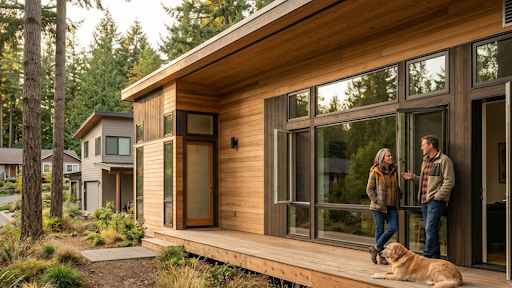
Building a modern home often comes down to balancing aesthetic ambition with long-term performance. While traditional construction focuses primarily on meeting minimum building codes, passive house design reimagines how a home consumes energy from the ground up. By focusing on thermal efficiency, airtightness, and solar alignment, passive homes consume up to 90% less heating and cooling energy than standard builds. Partnering with forward-thinking design professionals—such as those at Timeline Design—ensures that these architectural principles are seamlessly woven into the preliminary planning phase long before breaking ground.
What Is Passive House Design?
Originally developed in Germany as Passivhaus, this standard represents a rigorous, performance-based approach to ultra-low energy building. Rather than relying heavily on complex mechanical systems like large furnaces or high-tonnage air conditioners, a passive house maintains a comfortable interior climate through structural design, high-performance materials, and natural energy sources.
The 5 Core Principles of Passive House Design
Achieving ultra-low energy performance requires an interconnected system where every component supports the whole structure.
1. Continuous High-Performance Thermal Insulation
Think of insulation as a winter coat for your home. Standard construction often leaves gaps or uses thin insulating layers that allow indoor heat to escape during winter and outdoor heat to invade during summer. Passive house design uses an uninterrupted envelope of high-R-value insulation across all walls, roofs, and foundation slabs. This keeps interior temperatures stable year-round with minimal energy input.
2. Thermal Bridge-Free Construction
A thermal bridge occurs when a highly conductive material (like a steel beam, wood stud, or concrete balcony) creates a direct path for heat to transfer across the insulation layer. Passive building techniques eliminate thermal bridging by utilizing continuous insulation wraps, isolated structural connections, and specialized building assemblies, preventing cold spots and moisture condensation inside the walls.
3. High-Performance Windows and Doors
Windows are traditionally the weakest link in a building’s thermal envelope. Passive homes utilize triple-pane insulated glass units (IGUs) filled with noble gases like argon or krypton, paired with thermally isolated frames. While standard windows typically feature double-pane glass, standard air fills, aluminum or metal spacer bars, and a U-value between 0.30 and 0.50, passive house windows feature triple-pane glass, argon or krypton gas fills, warm-edge composite spacer bars, and an ultra-insulating U-value of 0.14 or lower.
4. Extreme Airtightness
Drafts aren't just uncomfortable; they are a primary source of energy loss and structural moisture damage. Passive design establishes a continuous, sealed airtight barrier around the entire living space. Before certification, every passive house must undergo a blower door test to ensure air leakage does not exceed 0.6 air changes per hour (ACH) at 50 Pascals of pressure—making it significantly tighter than standard new construction.
5. Heat Recovery Ventilation (HRV / ERV)
Because passive homes are airtight, fresh air must be supplied mechanically. A Heat Recovery Ventilator (HRV) or Energy Recovery Ventilator (ERV) constantly extracts stale indoor air while introducing fresh, filtered outside air. In winter, the outgoing warm air transfers its heat to the incoming cold air without the two air streams ever mixing. This guarantees continuous indoor air quality while retaining up to 90% of the interior thermal energy.
Passive Solar Orientation: Harnessing the Sun
Beyond the physical building envelope, passive homes rely heavily on site orientation and solar geometry:
-
South-Facing Orientation: Positioning primary living areas and large windows within 30 degrees of true south maximizes passive solar heat gain during winter months when the sun sits lower in the sky.
-
Shading Strategies: Deep roof overhangs, exterior louvers, and strategic tree placement block the high summer sun, preventing overheating without needing heavy mechanical air conditioning.
-
Thermal Mass: Incorporating dense materials like concrete floors or stone walls inside the insulated envelope allows the home to absorb heat during the day and release it slowly at night.
Key Benefits of Ultra-Low Energy Living
-
Substantial Energy Savings: Heating and cooling energy consumption drops by 75% to 90% compared to standard code-built homes.
-
Superior Comfort: Eliminates drafts, temperature swings between rooms, and cold interior wall surfaces.
-
Exceptional Indoor Air Quality: ERV systems continuously filter out pollen, dust, particulate matter, and outdoor pollutants.
-
Acoustic Insulation: Dense wall assemblies and triple-pane windows make interior spaces remarkably quiet.
-
Resilience & Durability: Controlled moisture management prevents mold, dry rot, and long-term structural degradation.
Building for the Future
Adopting passive house standards is one of the most effective ways to lower carbon emissions, eliminate skyrocketing utility expenses, and create healthier living environments. By focusing on insulation, airtightness, high-performance glazing, thermal bridge prevention, and smart ventilation, ultra-low energy homes prove that high comfort and minimal environmental impact can exist in perfect harmony.

 English
 Arabic
 French
 Spanish
 Portuguese
 Deutsch
 Turkish
 Italiano
 Russian
 Romaian
 Portuguese (Brazil)
 Greek
Greek
