


NFT Development in 2026: From Collectibles to Real-World Applications
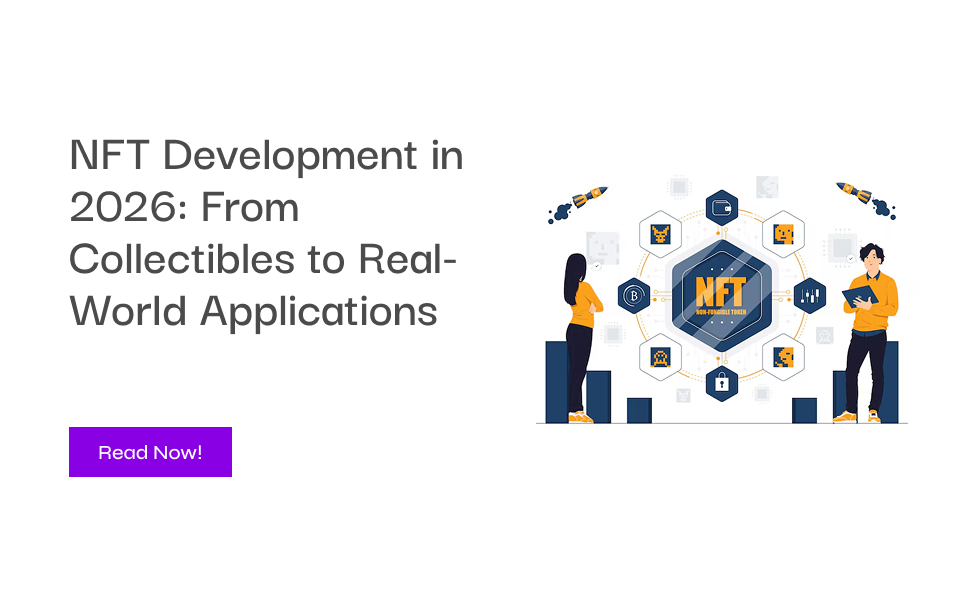
NFTs have started their journey to maturity. The era of digital art, profile pictures, and collectibles is giving way to an infrastructure that will provide ownership, authenticity, access, and digital representation.
By 2026, companies have realized the potential of NFTs in real-world use cases instead of viewing them as a novelty. Real estate tokens, ticketing, gaming assets, and IP are some examples where NFTs can prove ownership and create programmable connections between users and digital assets.
How NFTs Are Evolving Beyond Digital Collectibles
Contemporary NFTs have little to do with the notion of scarcity as such but have everything to do with utility. The smart contract will enable the token to be associated with membership, certificates, physical assets, licenses, reward programs, or any other type of rights.
The contemporary NFT ecosystem will enable:
-
Ownership proof and identification
-
Membership and loyalty programs
-
Authenticity and provenance of asset
-
Content gated by token
-
Digital certificates and credentials
A utility-oriented approach is becoming increasingly industry-related to NFT development.
Real-World Applications of NFTs in 2026
More and more, NFTs are being tied to practical business. NFT could serve as a digital certificate for any assets, agreements, credentials, or entitlements, allowing the blockchain network to provide a provable certificate of ownership.
Examples of industries applying this kind of technology include:
Real Estate: NFTs may represent fractional ownerships or property rights if there is a proper legal framework.
Luxury and Retail: The brands can use NFTs on their products to certify their provenance and authenticity and offer digital experiences post-purchase to their customers.
Education: Educational institutions may issue immutable certificates and credentials to their students that could be checked without total dependence on centralized database management.
Events: NFTs as tickets would be a combination of access rights, identity certification, collectibles, and loyalty program.
NFTs and Real-World Asset Tokenization
NFT applications like real-world tokenization are starting to become some of the most significant uses for NFTs. This involves representing physical assets like property, collectibles, artwork, and any other kind of asset that is legally defined in digital form through blockchain tokens.
The important thing here is not just creating an NFT. Ownership, custody, regulation, valuation, and redemption must all match up to the technical structure of the NFT.
For this reason, NFT development needs to take a multidisciplinary approach.
NFTs in Gaming, Entertainment, and Intellectual Property
Utility-oriented NFTs will always be part of gaming due to the ability for players to own digital entities such as characters, equipment, lands, or other types of assets that exist outside any particular game ecosystem in case interoperability becomes possible.
Entertainment firms could also leverage NFTs for fostering fan engagement through music drops, exclusive experiences, digital merchandize, memberships, and authenticated memorabilia.
From a creators or intellectual property owner perspective, NFTs could be used to facilitate licensing and provenance among others.
NFT Marketplaces and the Shift Toward Utility
The NFT marketplace is progressing from a straightforward market where people buy and sell digital art pieces to a more complicated one that caters to different kinds of assets.
Modern solutions may include such features as advanced search engines, auctions, royalties, integration with wallets, analytics, asset validation, and multi-chain support. White label NFT marketplace development is also an option available to businesses seeking faster deployment.
Good platforms concentrate on resolving user problems rather than just adding more assets to the list.
Key Technologies Powering Modern NFT Development
Technology stack plays a significant role in defining the scalability of the NFT platform.
Use of smart contracts for automating the transfer of ownership, transactions within marketplaces, royalty systems, etc. Blockchain-based networks offer the transactional layer, and decentralized storage may come in handy for managing the metadata and digital assets related to it.
Interoperability tools, account abstraction, L2 networks, use of AI for content discovery, and improved wallets are the other factors that affect the future generation of NFT platforms.
When choosing the NFT development solution for businesses, it is important to consider several factors rather than sticking to the one-size-fits-all model.
Security, Compliance, and User Trust
NFT platforms deal with valuable digital assets, which makes security critical. Weak smart contracts, hacked wallets, fraudulent NFTs, and poor access control may jeopardize the whole ecosystem.
An effective approach to development must include:
-
Smart contract testing and audit
-
Secured wallet and transactions architecture
-
Role-based administration
-
Metadata and asset protection tools
-
KYC, AML, tax, and other compliance rules depending on the situation
Requirements for compliance can be very different depending on the jurisdiction and token itself. Therefore, technical development must be compliant with the legal and business context of the project from the start.
Why Choose Justtry Technologies for NFT Development?
Partner selection ultimately entails much more than simply implementation. Organizations require the services of a team that can help in bringing their idea to fruition while keeping into account all the issues of usability, scalability, security, and commercial goals.
Justtry Technologies can provide organizations the right kind of development assistance if they are looking for NFT Marketplace Development Services and custom NFT platforms. Regardless of whether the goal is related to the creation of a marketplace, tokenized assets ecosystem, gaming platform, or some form of enterprise-level NFT solution, the development process needs to be in sync with business goals.
At the same time, it is necessary that there should be enough leeway for customization.
Conclusion
NFT creation in 2026 is a clear break from the collectible focus of past years. NFTs have started to be used in areas of ownership, authentication, tokenization, membership, gaming, entertainment, and corporate processes.
In companies, the key to success will be finding a solution to an existing problem through digital ownership. Great products will be easy for customers and safe thanks to smart contracts, proper blockchain, regulation knowledge, and real usefulness.
Could the next revolution in the world of NFTs be something that becomes a normal part of business life?

 English
 Arabic
 French
 Spanish
 Portuguese
 Deutsch
 Dutch
Dutch
 Italiano
 Russian
 Romaian
 Portuguese (Brazil)
 Greek
Greek
