


Plant-Based Tzatziki and Labneh Ferment Bases Market to Reach USD 140.0 Million by 2036 Driven by Clean-Label Cultured Dips
The global plant-based tzatziki and labneh ferment bases market is undergoing a decisive formulation shift as commercial food manufacturers replace synthetic hydrocolloid networks and modified starches with targeted lactic acid bacteria (LAB) starter cultures that build texture and viscosity naturally in non-dairy matrices, according to latest insights by Future Market Insights. Driven by rising consumer adoption of cultured dairy alternatives, clean-label scrutiny across chilled dips, and the expansion of plant-based Mediterranean mezze formats across retail and foodservice, these functional B2B ferment systems are redefining plant-based savory dairy formulation.
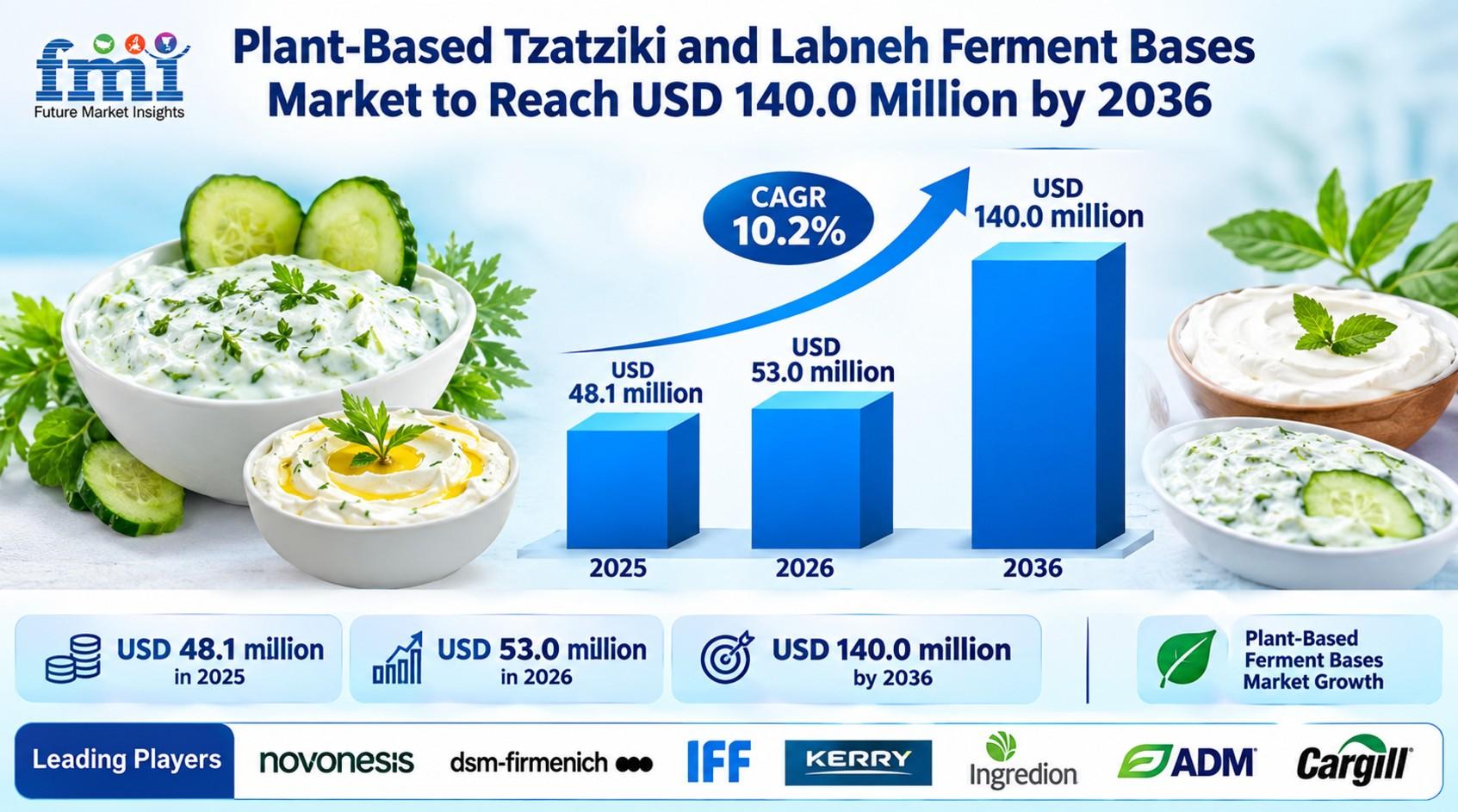
The global market, valued at USD 48.1 million in 2025, is projected to reach USD 53.0 million in 2026. Advancing at a double-digit Compound Annual Growth Rate (CAGR) of 10.2% over the ten-year forecast period, total market valuation is anticipated to achieve USD 140.0 million by 2036, delivering an absolute incremental opportunity of USD 87.0 million.
Request a Sample Report: https://www.futuremarketinsights.com/reports/sample/rep-gb-32768
Market Performance Overview (2026–2036)
To map out the leading product types, core base materials, primary formulation formats, and regional growth vectors guiding this USD 87.0 million market expansion, key segment allocations highlight where global commercial demand is concentrated:
· Labneh Bases Product Type Segment (52.0% share): Commands product category revenue in 2026. Developing dense, strained-style labneh textures requires robust bacterial strains that build high viscosity during incubation rather than relying on late-stage mechanical separation or artificial thickeners.
· Tzatziki & Hybrid Bases (48.0% combined share): Form vital secondary product pillars, specifically engineered to maintain emulsion stability and resist water separation (syneresis) when mixed with high-moisture fresh cucumber, garlic, and oils.
· Oat Base Material Segment (30.0% share): Dominates botanical substrates in 2026, favored because oat starch gelatinization and retrogradation provide natural cooling-set viscosity, shortening line adjustment times and supporting clean-label decks.
· Coconut, Soy, Pulse, & Almond Substrates (70.0% combined share): Offer alternative protein-rich architectures, with soy and pulse systems delivering high protein density and coconut providing traditional fat-melt richness.
· Complete Formulation Bases (46.0% share): Lead formulation formats over modular blends, as mid-scale co-packers and food brands prefer all-in-one powder systems (combining proteins, texture components, and cultures) that simplify plant-floor batching.
· Retail Brands End-Use Segment (57.0% share): Represents the primary commercial sales channel, serving as the main launchpad for branded refrigerated vegan spreads and private-label supermarket lines.
· United Arab Emirates & Turkey Regional Leadership: Lead national expansion rates at 11.8% CAGR and 10.9% CAGR respectively through 2036, driven by premium hospitality demand for dairy-free mezze in the GCC and export-scale Mediterranean dip manufacturing in Turkey.
Technical Drivers and Formulation Shifts
The commercial expansion and operational scaling of plant-based tzatziki and labneh ferment bases are propelled by three primary industry catalysts:
Clean-Label Viscosity and Natural Texturization
Consumers and retail category buyers increasingly reject long ingredient lists containing chemical emulsifiers, carrageenan, and modified food starches. Specialized fermentation bases deploy exopolysaccharide (EPS)-producing lactic acid bacteria to synthesize natural texturizing networks during fermentation, creating rich, spreadable mouthfeel with minimal additives.
Syneresis Resistance Under High-Moisture Inclusions
Formulating plant-based tzatziki presents unique water-activity challenges; fresh cucumber, salt, and garlic paste rapidly alter osmotic balance and trigger weeping (syneresis). Advanced ferment bases provide high water-binding capacity and shear tolerance, preventing phase separation during high-speed blending and extended refrigerated shelf life.
Modular Turnkey Formulation Systems
To accelerate speed-to-market and avoid costly batch-to-batch failures, co-manufacturers are adopting complete, standardized base systems. These pre-balanced powders streamline production scheduling, lower recipe changeover errors, and ensure repeatable acidification curves across large commercial fermentation vats.
Industrial Constraints & Processing Kinetics
Plant-based dip manufacturers, fermentation refiners, and ingredient blenders navigate specific operational hurdles:
· Pumping Shear and Texture Breakdown on Industrial Lines: Dense labneh-style plant matrices can experience gel fracture and irreversible thinning when subjected to high-shear positive displacement pumps and packaging filling lines, requiring careful viscosity calibration.
· Substrate Flavor Masking (Cereal and Beany Off-Notes): Fermenting oat, pea, or fava bases can accentuate lingering grassy or cereal notes that clash with fresh garlic and dill profiles, necessitating precise culture-pairing and natural flavor-modulation systems.
Regional Growth Profile
Regional demand reflects authentic mezze culture in the Middle East and Mediterranean alongside clean-label retail expansion across Western markets:
· United Arab Emirates (11.8% CAGR): The global growth frontrunner, driven by luxury hotel dining, upscale casual restaurants, and premium prepared retail foods requiring authentic, dairy-free mezze alternatives.
· Turkey (10.9% CAGR): Spurring rapid volume expansion through large-scale, export-oriented manufacturing that supplies dairy-free Mediterranean dips to European retail chains.
· Spain (10.6% CAGR) & France (9.9% CAGR): Lead European demand, supported by established culinary familiarity with savory cultured spreads, strong mainstream vegan retail adoption, and high standards for texture parity.
· Germany (9.1% CAGR): Anchored by mature clean-label snacking habits and consumer demand for organic-certified, additive-free savory spreads.
· United Kingdom (8.8% CAGR): Expanding through aggressive private-label supermarket lines seeking cost-effective, turnkey complete base powders for quick rollouts.
· United States (8.5% CAGR): Driven by high-protein snacking trends, where formulators integrate pulse-protein ferment bases to deliver nutritional claims alongside classic tzatziki flavors.
Competitive Landscape
The global plant-based tzatziki and labneh ferment bases landscape features a combination of industrial biotechnology pioneers, multinational ingredient conglomerates, and specialized savory flavor houses.
Key market participants profiled in the report include Novonesis, dsm-firmenich, IFF, Kerry Group, Ingredion, ADM, and Cargill. Leading suppliers compete by developing characterized culture libraries tolerant of high-salt environments, formulating clean-label oat and pulse texturizing blends, integrating bioprotective cultures to inhibit mold without chemical preservatives, and providing comprehensive pilot-plant co-development support.
Exclusive Discounts on Full Report: https://www.futuremarketinsights.com/reports/plant-based-tzatziki-and-labneh-ferment-bases-market
Frequently Asked Questions
What is the projected valuation of the global plant-based tzatziki and labneh ferment bases market by 2036?
The global plant-based tzatziki and labneh ferment bases market is projected to reach USD 140.0 million by 2036, expanding from an estimated baseline valuation of USD 53.0 million in 2026 at a CAGR of 10.2%.
Why do Labneh Bases lead the Product Type segment with a 52.0% share?
Labneh bases lead in 2026 because replicating the dense, strained texture of traditional Middle Eastern labneh requires specialized high-viscosity bacterial fermentation systems that deliver a premium, spoonable body without breaking down under shear.
What is the primary base material used in these ferment bases?
Oat leads base materials with a 30.0% market share in 2026, as its natural starch behavior provides cooling-set viscosity and a neutral sensory canvas that supports clean-label ingredient decks.
FMI Custom Research: Strategic Intelligence for Confident Decision-Making
In today's rapidly evolving business environment, leadership teams need clear, actionable intelligence tailored to their strategic objectives. FMI's Custom Research solutions are designed around specific business questions, enabling executives to evaluate growth opportunities, validate investments, assess competitive dynamics, and reduce uncertainty before making critical decisions.
Key Executive Benefits
· Decision-Ready Insights: Research tailored to your specific business challenges, growth plans, and investment priorities.
· Reduced Strategic Risk: Validate market opportunities, customer demand, and competitive positioning before committing resources.
· Market Entry Confidence: Assess opportunity size, regulatory barriers, channel dynamics, and competitive landscapes with precision.
· Competitive Advantage: Gain proprietary intelligence unavailable through syndicated reports or internal datasets.
· Faster Growth Decisions: Accelerate expansion, product development, portfolio optimization, and investment planning.
· Primary Market Validation: Access real-world customer, buyer, and stakeholder insights that support high-confidence decision-making.
Business Impact
FMI helps organizations transform market complexity into strategic clarity, enabling leadership teams to identify growth opportunities faster, optimize resource allocation, strengthen competitive positioning, and make high-stakes business decisions with confidence.
To explore how FMI Custom Research can support your strategic priorities, connect with our team at - sales@futuremarketinsights.com
About Future Market Insights (FMI)
Future Market Insights (FMI) delivers actionable, decision-focused market intelligence that goes beyond traditional research reports. The company provides:
· In-depth pricing and cost benchmarking analysis
· Demand forecasting based on real industry inputs
· Procurement and buyer behavior insights
· Supply chain and trade flow intelligence
· Technology and application trend analysis across industries
FMI follows a robust bottom-up research methodology, combining insights from industry experts, procurement leaders, manufacturers, and technical professionals to ensure accurate and practical market intelligence.

 English
 Arabic
 French
 Spanish
 Portuguese
 Deutsch
 Turkish
 Dutch
Dutch
 Italiano
 Russian
 Romaian
 Portuguese (Brazil)
