


Ceramic Fiber Blankets Supplier for High-Temperature Applications
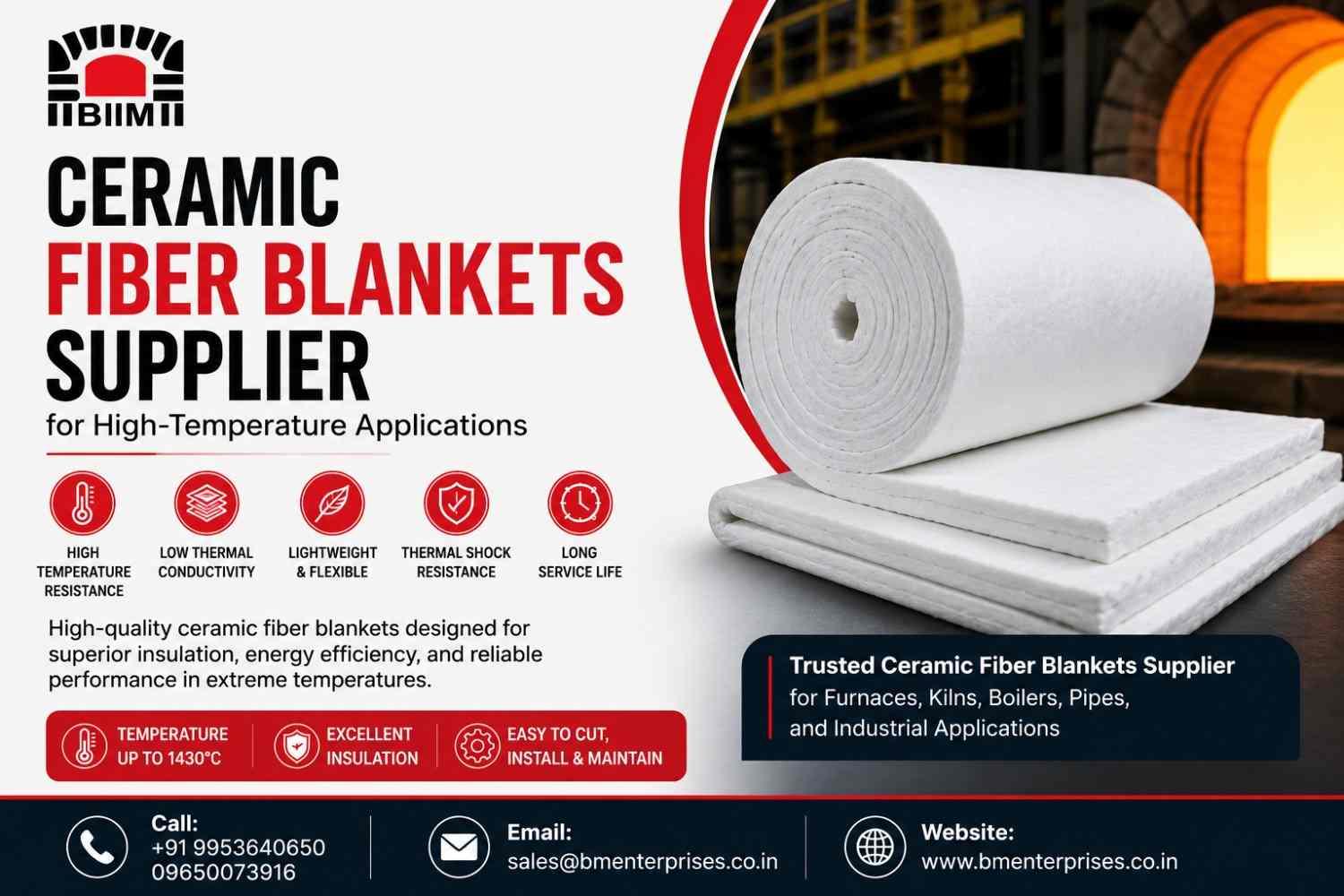
In cases where industrial machinery works under heated conditions, insulation becomes an integral component of the complete thermal system. Ceramic fiber blankets are refractory insulations made to minimize heat loss in addition to giving reliable service. The insulating blankets are used in furnaces, kilns, boilers, heaters, pipes, ducting, and other heated industrial machinery requiring flexibility combined with insulation qualities. According to the type, the blankets available in the market can have classification temperatures ranging between about 1260°C and 1450°C or even more, while densities of the commercially available blankets include 64, 96, 128, and 160 kg/m³.
BM Enterprises offers refractory and insulation materials for industrial use, where the ceramic blankets are chosen when efficient thermal insulation, ease of handling and temperature resistance are needed. The company strives to offer suitable material according to the needs of the user rather than treating all the insulating requirements in one way. This becomes important since the furnace lining, boiler insulation, pipe wrapping, and maintenance needs require different thicknesses, densities, and temperature grades. Using the correct material, it becomes possible to make an insulation system that controls the heat loss and protects the surrounding machinery.
Why Ceramic Fiber Blankets Are Used for High-Temperature Insulation
The main benefit of using ceramic fiber blankets as the material for the insulating lining is their capability of providing insulation properties without being heavy and rigid as most refractories do. The material comes as a flexible fibrous blanket that can be supplied in rolls that allows it to accommodate itself to any curved surfaces or geometries of equipment. Data from the technical specification provided by producers shows that grades of 128 kg/m³ can possess fairly good properties of thermal conductivity and sufficient mechanical strength to perform a variety of insulation applications.
Such flexibility becomes highly appreciated in cases where an insulation system must be mounted on pipes, shells of furnaces, ducts, parts of boilers, equipment with bends and joints. Rather than cutting out rigid shapes from some refractory material, installers can easily cut flexible blankets in the necessary shape and put them in place. This results in a much easier mounting procedure with a minimal number of complicated joints. The lightweight of ceramic blankets, as compared to dense refractory linings, is also worth mentioning in this context.
Lightweight Construction and Low Thermal Conductivity
Thermal conductivity is one of the key parameters that should be considered when assessing the insulation. The use of a material having a low value of thermal conductivity could help to prevent the passage of heat energy through the insulation and ensure that there will be a temperature difference between the hot side and the cool surface outside. Thermal conductivity of 128 kg/m³ ceramic fiber blanket grades, according to published technical literature, is influenced by temperature and type of material. According to some Indian technical literature, the thermal conductivity is 0.15 W/mK at a mean temperature of 600°C.
Lower losses of heat energy through the walls of equipment could help with improving thermal conditions. For an industrial enterprise where equipment operates continuously for a very long period of time, it could be an important advantage. This is the reason why ceramic insulation blankets are used as thermal insulation materials for high temperatures.
BM Enterprises as a Ceramic Fiber Blankets Supplier in India
BM Enterprises provides industrial refractories and insulating products to those clients who want reliable materials suitable for high temperatures. As a ceramic fiber blanket manufacturer in India, BM Enterprises will assist customers in identifying the right blanket, taking into account their temperature, density, thickness, equipment, and installation conditions. Customers need to pay attention not only to the temperature rating of the product, but to its full specification and application conditions.
A standard ceramic fiber blanket could have several grades in terms of density and thickness. Product information obtained from Indian manufacturers indicates that 128 kg/m³ blankets could come in several thicknesses such as 12 mm, 20 mm, 25 mm, and 50 mm. Other manufacturers offer their blankets in standard and customized dimensions according to the grade and order condition.
Product Quality and Technical Selection
Insulation should first be correctly specified. A blanket with a classification temperature of 1260°C should not just be chosen in every case when there is a need to insulate something at the proximity of this temperature, since the maximum classification temperature and the suggested continuous operating temperature are not always the same.
For instance, a published product line offers a classification temperature of 1260°C with an operating temperature of about 1050°C in one grade, while other grades offer higher performance with different operating temperatures.
Thus, BM Enterprises can deliver material based on the industrial demand. It will help potential buyers to evaluate technical aspects before buying. The buyer should provide the operating temperature, thickness of insulation, equipment dimensions, and its purpose.
Key Features of Ceramic Fiber Blankets
- Resistance to high temperatures: Intended for use in demanding insulation for high temperatures in different temperature grades.
- Low thermal conductivity: Aids in minimizing thermal losses from the system.
- Lightweight construction: Easier to handle, transport, cut, and install than many heavy refractory materials.
- Flexible and soft: Conforms easily to different shaped and irregular surfaces.
- Good thermal insulation: Provides good insulation for keeping process temperature in control.
- Resistance to thermal shock: Applicable in applications that have repeated heating and cooling of material.
- Less heat storage: Lightweight fibrous structure allows quick heating and cooling of equipment.
- Easy installation: Can be cut to desired size and shape and fitted on different equipment.
- Chemical stability: Can be used in most industrial applications if the proper grade is chosen.
- Different density and thickness: Can be selected depending upon temperature, insulation requirement, and application.
Ceramic Fiber Blanket Density and Specifications
- Standard densities: There are four options available based on the type of products: 64, 96, 128, and 160 kg/m³.
- 128 kg/m³ density: One of the most common types that provides a good balance of insulating properties, flexibility, and tensile strength.
- Temperature grades: Various grades are available, usually starting from about 1260°C to 1430°C.
- Thickness grades: Most common thicknesses are: 12 mm, 20 mm, 25 mm, 50 mm, and others based on the need.
- Roll Form: Rolls of flexible material that can be easily cut to fit.
- Sizes: Standard sizes are available, but special sizes can be provided as per the needs.
- Heat conductivity: Provides low heat transfer to ensure good high-temperature insulation.
- Fiber composition: There are two types of fibers based on the need, including alumino-silicate and higher types of fibers.
- Low shrinkage: Special types of products are available that ensure dimensional stability under prolonged use.
- Selection of Specifications: Density, thickness, temperature grade, and operational conditions must be taken into account.
Ceramic Fiber Blanket Density 128 kg/m3 Supplier
128 kg/m³ blanket is the density of a commonly used ceramic fiber blanket in industry. This is evident from the published uses of a ceramic blanket of this density, which include furnace door seal, glass furnace crown insulation, heat processing systems, boiler and incinerator lining, and general insulation applications.
When buying from a Ceramic fiber blanket density 128 kg/m3 supplier, it is important that one provides full details of their needs rather than just asking for density. The temperature grade, thickness, width, length, and application are all determining factors. BM Enterprises can help you identify the right specification for your requirements.
Common Industrial Applications
- Insulation for furnaces: Ideal for use on walls, roof, doors, backup insulation, and selected repair jobs.
- Insulation for kilns: Ideal for industrial kilns and heat treatment.
- Boiler insulation: Ideal for reducing heat loss in boilers and high-temperature components.
- Pipe insulation: Flexibility of design allows use on pipes and other curved surfaces.
- Insulation for ductwork: Ideal for use on high-temperature ductwork and exhaust systems where appropriate.
- Heat-treatment equipment: Thermal insulation for equipment running at high temperatures.
- Foundry applications: Selected furnace, ladle, and thermal processes insulation.
- Glass industry: Use in suitable high-temperature furnace and process equipment.
- Ceramic industry: Used for Kiln lining, insulation, and maintenance of furnaces.
- Industrial maintenance and repairs: Ideal for replacement or additional insulation in damaged areas.
- Insulation for furnace doors and expansion joints: The flexible nature allows some expansion.
- Back-up insulation: Can be installed behind suitable refractory hot-face materials to improve the overall insulation system.
Benefits of Using Insulation Ceramic Blankets
One of the strongest reasons why many industries use Insulation ceramic blankets is the possibility to provide high-temperature properties along with lightness and flexibility. They can serve as an efficient solution to decrease heat transmission, provide energy savings, and facilitate installation in places where stiff materials are not appropriate. In product descriptions from manufacturing companies, low thermal conductivity, resistance to thermal shock, chemical stability, and heat loss reduction were mentioned among the properties.
The economic gain can be seen not only in the course of installation but also later on due to better heat management resulting in decreased heat loss and, therefore, saving the energy needed for the process temperature maintenance.
Energy Efficiency and Heat-Loss Reduction
Let us assume a situation where an industrial furnace is continuously losing energy due to its walls—the entire system must continuously replenish the energy lost. Appropriate insulation acts as a barrier against heat loss and assists in maintaining the required temperature level inside. Here, the Insulation ceramic blankets could help in achieving an effective thermal system.
The extent of energy saved will depend on aspects such as the amount of insulation, temperature, design of the equipment, surroundings, and installation, among others. In this case, a blanket should be regarded as just part of a total insulation system and not necessarily as an assurance of energy savings.
Ceramic Blankets for Maintenance and Repairs
Maintenance is required at some point in time for industrial refractory systems. Relining the whole surface each time there is some damage in a particular area will cost you both time and money. The application of ceramic blankets may be recommended for selected repair and maintenance applications since they are lightweight and flexible.
They can be easily cut and fitted in the damaged area. According to the product literature, repair of furnaces is one of the applications of ceramic fiber blankets. The proper procedure for repair will depend on the equipment and its working conditions, especially if the blanket is applied near the hot face.
How to Select the Right Ceramic Fiber Blanket
Selection of a blanket should be based on the environmental situation. Start by assessing the normal operating temperature as well as any peak temperatures experienced. After this, the class temperature, continuous operating temperature, density, thickness, dimensions, and environment must be considered.
For instance, where flexibility and strength while handling are key considerations, a 128 kg/m³ blanket can be recommended, but temperature class has to match the environment. Customers should take into account thermal conductivity and shrinkage while planning to insulate for high temperature operations. Technical data sheets have shown that these specifications differ from one grade to another; hence, one blanket specification cannot be used as representative of all ceramic fiber blankets.
Why Choose BM Enterprises
BM Enterprises is oriented towards providing refractory and thermal insulating materials to its industrial clients. Being a Ceramic fiber blanket manufacturer and a supplier-based firm, BM Enterprises provides a convenient solution to the clients for their insulation needs along with other refractories. The company can assist in determining appropriate material specifications depending on the application rather than basing the selection purely on cost or temperature ratings.
Industrial clients in need of a ceramic fiber blanket supplier in India can approach BM Enterprises with their equipment specifications as well as the dimensions and specifications required.
Ordering Ceramic Fiber Blankets from BM Enterprises
Ordering gets simplified when the buyer gives the proper information at the start of the process. Give the type of equipment, operating temperature, thickness of insulation needed, quantity estimated, and location where delivery will be done. If there is an existing technical specification or drawing, sending that can assist in choosing the correct product.
BM Enterprises can assist in selecting the product suitable for the need and give the necessary commercial information. No matter what the need is – whether furnace insulation, kiln maintenance, boiler insulation, pipe wrapping, or other high-temperature need – specifying the use makes sure there is no wrong product chosen.
Conclusion
Selecting the proper material to be used in the insulation can directly affect the thermal efficiency and durability of the equipment. Ceramic fiber blankets provide an excellent balance of flexibility, light weight, insulation capability, and high temperature resistance. This makes them ideal for many applications. There are various grades and types of ceramic fiber blankets, with 128 kg/m³ as one of the commonly available ones.
BM Enterprises is your partner in providing refractory and insulation material needs. For those looking for a Ceramic fiber blanket density 128 kg/m3 supplier or furnace insulation material, please get in touch with us, and we will be able to supply you with our high-temperature insulation material.
Contact us now for a quick consultation and quotation for your project!
Call: +91 9953640650, 09650073916
Email: sales@bmenterprises.co.in
Website: www.bmenterprises.co.in
Google My Business Store: https://share.google/o2L3PelahoZ0IY1Up
FAQs
Q1. What are the applications for ceramic fiber blankets?
They are often employed for high-temperature insulation in furnaces, kilns, boilers, pipes, ducts, etc., and their flexible nature means they can be used for various maintenance and repair work.
Q2. What are the possible densities?
The common densities offered are 64, 96, 128 and 160 kg/m³, but it will depend on the type and grade of ceramic blanket being supplied.
Q3. Can I use ceramic blankets in my furnace?
Yes, appropriate types are used for insulation of furnaces and kilns, including backup insulation and some lining. However, the grade and installation process should be compatible with the furnace design.
Q4. How do I select the right temperature grade?
It will depend upon the temperature of operation and peak exposure, along with the classification temperature, operating temperature, shrinkage, and conductivity figures quoted by the manufacturer. Only consider the maximum temperature figure.
Q5. Where can I purchase ceramic fiber blankets in India?
Contact BM Enterprises, who supply refractories and insulating materials for industrial purposes. They should be able to suggest an appropriate product based on density, thickness, temperature grade, and quantity required.

 English
 Arabic
 French
 Spanish
 Portuguese
 Deutsch
 Turkish
 Dutch
Dutch
 Italiano
 Romaian
 Portuguese (Brazil)
 Greek
Greek
