


Pharmacy Admission Insider Guide Lucknow
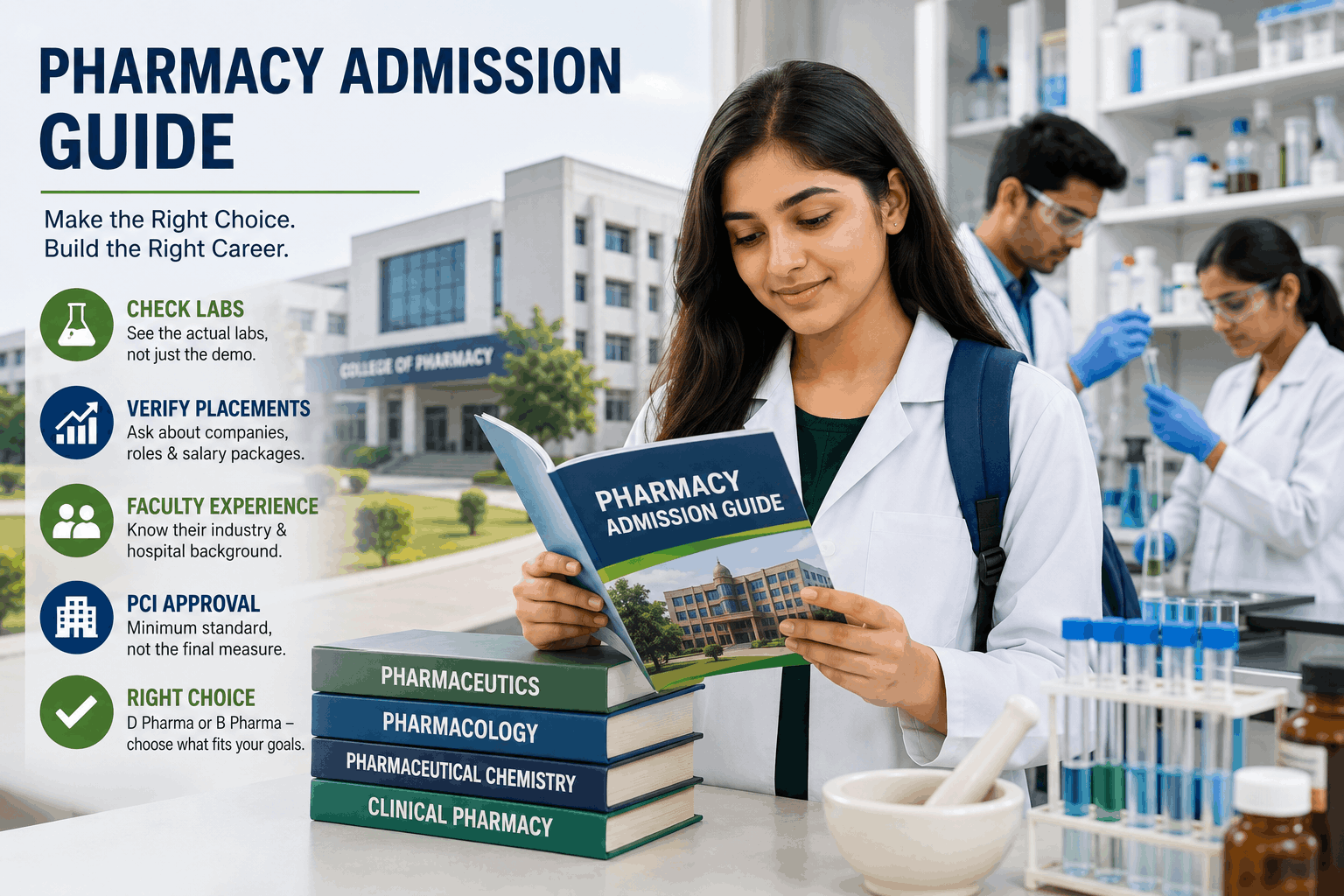
The Pharmacy Admission Guide Nobody Gives You
There's a version of pharmacy college selection that most students go through — campus visit, brochure review, fee negotiation, seat confirmation. It produces a decision, but not necessarily a good one. The information provided during this process is selected by institutions to support enrollment, not to support the student's best interest. The campus looks well-maintained in photographs. The brochure lists impressive-sounding facilities. The admission counsellor is helpful and available.
What this process consistently fails to provide is the specific, verifiable information that actually predicts whether a pharmacy program will produce a graduate who is job-ready, clinically competent, and positioned for the career they enrolled expecting. This guide covers what that information is, how to get it, and what to do when a college can't or won't provide it.
The Difference Between What's Claimed and What's Verifiable
Pharmacy colleges in India are required to meet Pharmacy Council of India standards to receive and maintain approval. PCI approval is the floor — it establishes that minimum requirements have been met, not that the program is excellent or even particularly good above the minimum.
The claims in most pharmacy college marketing materials live in the space above the PCI floor without being verifiable from outside the institution. "State-of-the-art laboratories" appears in brochures for institutions with equipment purchased at PCI minimum standards fifteen years ago. "Industry connections and strong placements" appears in materials for colleges that had two or three good placement years and have been trading on that reputation since.
The students who make good pharmacy college decisions are those who treat these claims as hypotheses to be verified rather than facts to be accepted. The verification process is straightforward — it just requires asking different questions than the ones admission processes are designed to answer.
The Laboratory Question That Reveals Everything
For pharmacy programs — which depend on hands-on laboratory competency at a level that most academic programs don't — the laboratory question is the most revealing single inquiry a prospective student can make.
Ask specifically: what instruments are available in the pharmaceutical chemistry and pharmacology labs, when were they last upgraded, and can we see the labs during the visit rather than only the demonstration area prepared for prospective student tours?
The distinction between a demonstration lab and the working labs where students actually conduct their practical sessions is significant and often deliberately obscured during campus visits. A well-maintained demonstration lab with current equipment doesn't guarantee that the teaching labs have the same standard. Asking to see the labs where regular practical sessions happen — not the showcase version — and observing the equipment age and condition directly provides more information than any brochure claim.
The Placement Question That Most Students Ask Wrong
Most prospective students ask "what is your placement rate?" This is the wrong question because it's easy to answer in ways that sound impressive while revealing nothing useful. "90% placement" could mean 90% of graduates who actively used the placement cell found any pharmacy-adjacent employment within twelve months — a figure that includes positions that have nothing to do with the training the program provided.
The right placement questions are specific: Which pharmaceutical companies recruited from your last three batches? What were the roles — retail pharmacist, QA executive, production officer, clinical research associate? What were the starting compensation packages across these roles? And can you connect us with two or three recent graduates currently working in those positions?
A college confident in its placement outcomes will answer these questions specifically. One that isn't will respond with aggregate statistics, general claims about industry connections, and redirection toward other aspects of the campus. The quality of the answer is as informative as the content.
The Faculty Background Question
Pharmacy faculty credentials are publicly available through the institution's PCI approval documentation, which lists faculty qualifications and designations. But qualifications tell you less than experience — specifically, whether faculty members have worked in pharmaceutical manufacturing, hospital pharmacy, quality assurance, or clinical pharmacy contexts beyond their academic careers.
Ask directly: how many of your permanent faculty members have worked in the pharmaceutical industry or hospital pharmacy settings outside academic positions? For how long, and in what functions?
Faculty who have spent time in pharmaceutical manufacturing QA know how industry quality systems work from the inside. Faculty who have practised in hospital pharmacies understand clinical pharmacy contexts that purely academic training doesn't replicate. This practical experience depth is what distinguishes programs that produce industry-ready graduates from those that produce academically credentialed ones.
Researching Lucknow's Options With the Right Framework
For students in Uttar Pradesh researching pharmacy options, Lucknow's position as the state capital provides more access to verifiable information than smaller city alternatives — more accessible alumni networks, more transparent local reputation, and more industry connections that can be independently verified.
When beginning the shortlisting process for top 10 pharmacy colleges in lucknow, the framework above — laboratory verification, specific placement data, faculty experience depth — should be the filter applied to every institution under consideration before any other comparison. Narrowing the list to institutions that can answer these questions specifically and confidently produces a shortlist that actually reflects program quality rather than marketing effectiveness.
The B Pharma vs D Pharma Question — What Counsellors Often Get Wrong
Admission counsellors at institutions offering both qualifications sometimes steer students toward B Pharma over D Pharma on the basis that "it's a better qualification" — which is true in some contexts and irrelevant in others. The better qualification for a given student depends on career direction, financial constraints, and timeline — not on an abstract hierarchy between degree and diploma.
A student who needs to enter the workforce within two years, whose family has a retail pharmacy context to enter, or who wants to evaluate the profession before a longer academic commitment is often better served by D Pharma than B Pharma regardless of what the counsellor's bias toward higher-fee programs suggests.
Students researching b pharma in lucknow should apply the same verification questions to degree programs that they apply to diploma programs — the qualification level doesn't change the practical quality questions. And students considering D Pharma shouldn't be steered away from it by institutional preference for the more expensive option.
What Red Flags Actually Look Like
A few specific patterns consistently indicate that a pharmacy program is unlikely to deliver on its promises.
Inability to name specific placement companies from recent batches is a strong signal. An institution with genuine industry connections can name the companies and roles without hesitation. One that can't is either trading on historical reputation or has placement outcomes that don't bear scrutiny.
Resistance to showing working labs during campus visits — as opposed to a prepared demonstration area — suggests the working labs don't match the marketed standard. Institutions with quality practical facilities are comfortable showing them without preparation.
Faculty lists heavy with recently appointed junior faculty and light on senior faculty with industry experience suggest the program is meeting headcount requirements without delivering the experience depth that quality teaching requires.
D Pharma — The Qualification That Counsellors Undersell
D Pharma's two-year timeline and direct employment pathway make it genuinely appropriate for a significant share of pharmacy aspirants — but it's often undersold at institutions that earn more from B Pharma enrollment and prefer to direct students toward the higher-fee option.
Students whose career interest is in retail pharmacy practice, hospital dispensing, or the pharmaceutical community health functions that expand as UP's healthcare infrastructure grows are well-served by D Pharma from a quality institution. The qualification produces registered pharmacists who can begin practising and earning within two years, with the lateral entry option preserving the B Pharma pathway if career direction changes later.
For students researching d pharma in lucknow, applying the same laboratory, placement, and faculty verification questions to diploma programs as to degree programs produces a shortlist of institutions where the D Pharma program is taken seriously rather than treated as a secondary enrollment stream below the institution's main degree focus.
MCSGOC's Programs in Context
Dr. M.C. Saxena College of Pharmacy, part of MCSGOC, offers D Pharma, B Pharma, and Pharm D programs in Lucknow. For students applying the verification framework outlined above — asking about specific placements, requesting access to working labs, and asking about faculty industry experience depth — MCSGOC's pharmacy programs provide the specific, verifiable answers that the framework is designed to elicit from quality institutions.
The Decision That Deserves the Research
A pharmacy program occupies two to four years of a student's life and shapes the career that follows for decades. The thirty minutes spent asking the right questions during campus visits and the additional time spent verifying answers through alumni and independent sources is the most productive research investment available before the admission decision is finalised.

 English
 Arabic
 French
 Spanish
 Portuguese
 Turkish
 Dutch
Dutch
 Italiano
 Russian
 Romaian
 Portuguese (Brazil)
 Greek
Greek
