


Infrastructure Specialty Silicone Market Set to Hit USD 5,500 Million by 2034 at 6.8% CAGR
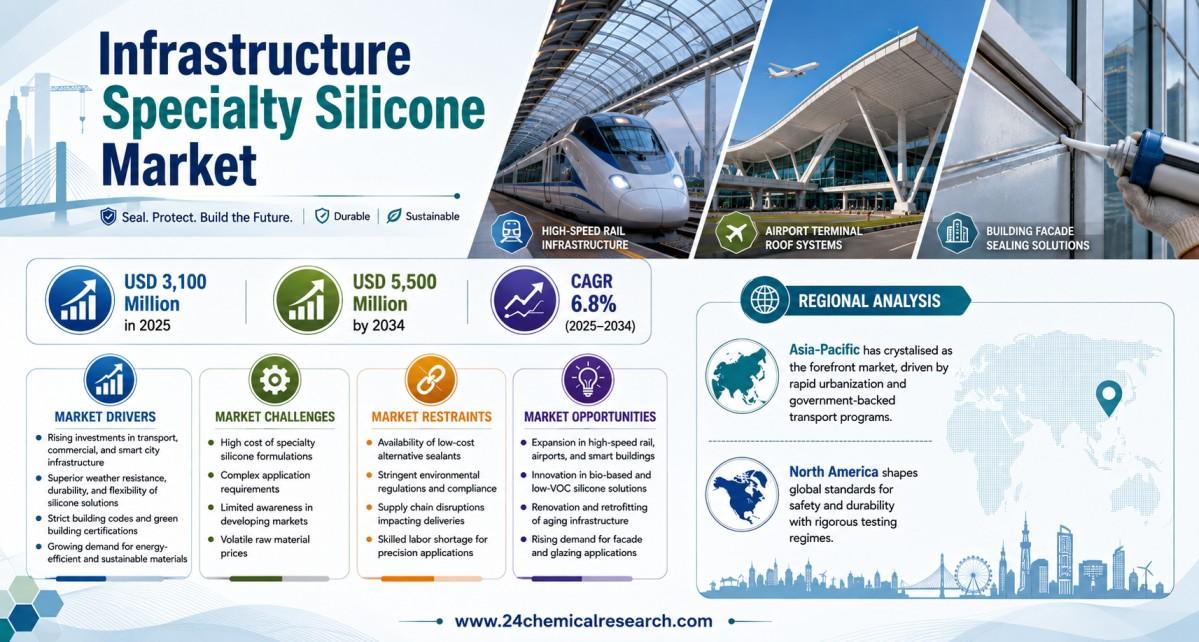
According to 24ChemicalResearch latest industry analysis, the global Infrastructure Specialty Silicone market was valued at USD 3,100 Million in 2025 and is projected to reach USD 5,500 Million by 2034, growing at a compound annual growth rate (CAGR) of 6.8% during the forecast period. The market's expansion is fueled by the demand for durable, low-maintenance construction materials, expanding high-speed rail and airport infrastructure projects, and increasing emphasis on sustainability and climate-resilient building solutions.
View the complete report: https://www.24chemicalresearch.com/reports/304948/infrastructure-specialty-silicone-market
Infrastructure Specialty Silicones are engineered for high-performance construction, providing superior weather resistance, durability, and structural integrity. Key products include Silane Coupling Agents for bonding, Silicone Oils as lubricants, High-Temperature Vulcanized (HTV) Silicone Rubber for seals, and Liquid Silicone Rubber (LSR) for precision moulding, all of which are critical for airports, high-speed rail stations, and office buildings. As one industry expert noted, "Projects incorporating certified fire-resistant silicone see project overruns drop by up to 12%, reinforcing its adoption appeal."
What Is Driving the Infrastructure Specialty Silicone Market?
The global infrastructure specialty silicone market is propelled by a confluence of factors, ranging from surging infrastructure development in emerging economies to regulatory push for fire-resistant materials and the expansion into residential energy efficiency projects.
Surging Infrastructure Development in Emerging Economies
Projects in Southeast Asia and Africa are scaling at a pace that outstrips traditional construction outputs. As governments commit to green and resilient frameworks, the demand for fire-safe, weather-resistant materials like specialty silicone is steadily climbing. In 2025 alone, new municipal and industrial sites accounted for over 18% of the region's construction spend, creating a consistent pipeline of silicone applications. Asia-Pacific remains the most dynamic expansion market, propelled by China's Belt & Road Initiative and massive high-speed rail investments.
Regulatory Push for Fire-Resistant Materials
The latest revisions to building codes across Europe mandate high-performance fire barriers in hospitals and transport hubs. Specialty silicone's inherent fire-stopping properties make it a natural fit; installers now preferentially quote silicone over less compliant grades. This regulatory backdrop compounds the trend toward a more predictable, long-term demand curve. Beyond safety, the material's low permeability and UV resistance are key to extending asset lifespan. Facilities managers report lubrication and maintenance costs falling by roughly three months of operational budget.
Expansion into Residential Energy Efficiency Projects
The rapid adoption of solar panels and advanced HVAC systems in private homes boosts demand for resilient, low-maintenance sealing solutions. Specialty silicone's ability to maintain performance across temperature extremes aligns perfectly with the growing emphasis on energy-efficient constructions. The shift toward modular and prefabricated building components presents a new avenue where manufacturers can integrate silicone sealants at the factory floor, streamlining supply chains and reducing on-site labor.
Market Segmentation Insights
The infrastructure specialty silicone market is diversified across product types, applications, end-users, functions, and project phases, with each dimension revealing unique competitive dynamics and investment opportunities. Analyzing these categories helps stakeholders tailor their strategies effectively and pinpoint specific areas of growth.
By Product Type
The market is segmented into Silane Coupling Agent, Silicone Oil, High Temperature Vulcanized Silicone Rubber, Liquid Silicone Rubber, Silicone Resin, and Other. Silane Coupling Agent is the chief driver within the type category, owing to its indispensable role in forging durable bonds between inorganic substrates and organic finishes. This component is indispensable for concrete admixtures, metal cladding, and composite masonry, ensuring long-term adhesion that resists crack propagation and corrosion. Its adaptability to high-temperature and chemically aggressive environments makes it an attractive choice for critical civil structures such as bridges, tunnels, and high-performance facades.
By Application
In terms of application, the market is segmented into Airport, High Speed Rail Station, Bus Station, Hotel, Office Building, and Others. High Speed Rail Station emerges as the preeminent application, driven by the need for resilient seals that withstand rapid temperature swings, intense vibration, and high footfall. Airports also represent significant use due to stringent fire safety codes and variable climate conditions, demanding both fire-retardant sealants and vibration-damping systems. The synergy between these transportation hubs positions specialty silicone formulations at the forefront of infrastructure-grade construction.
Regional Market Analysis
Asia-Pacific has crystallised as the forefront of the infrastructure specialty silicone market. The region's rapid urbanisation, coupled with government-backed transport and public-works programmes, underpins a front-loaded demand for high-performance sealants and protective coatings. In China, a wave of new airports, high-speed rail corridors, and smart-city initiatives has demanded materials that can tolerate extreme climate cycles. Meanwhile, Japan and South Korea are setting benchmarks for water-tightness and fire-retardancy in ageing infrastructure retrofits. The proximity of raw-material suppliers and a mature silicone-production base provide a resilient supply chain that balances lead times against project demands. As regulatory frameworks converge on sustainability, the shift to zero-VOC formulations drives an uptick in eco-conscious product adoption across the market.
North American developments shape how the global market thinks about safety and durability. In the United States, federal infrastructure funding under separate transportation and energy legislation has spurred targeted retrofits of bridges and airports. Canadian projects increasingly emphasize energy-efficient building envelopes, where silicone coatings reduce heat loss. The region's approach to encapsulating compliance—maintaining rigorous fire-safety, structural integrity, and lifecycle cost metrics—has produced a rigorous testing regime that many suppliers now meet globally. Adoption of reusable and high-temperature resistant silicone blends is being driven by the need to integrate new mechanical systems into legacy structures without compromising their original design life. This focus on extendibility and regulatory alignment makes North America a benchmark for the broader industry.
Report Summary
The global infrastructure specialty silicone market is on a robust growth trajectory, underpinned by the expanding need for durable, fire-safe, weather-resistant materials in airports, high-speed rail stations, and commercial buildings. The market is witnessing a deliberate pivot toward low-VOC, solvent-free formulations that meet LEED, BREEAM, and emerging "Zero-Carbon" construction standards. While Asia-Pacific leads in terms of growth driven by rapid urbanization and infrastructure megaprojects, North America shapes global standards for safety and durability with its rigorous testing regimes. The increasing adoption of sensor-silicone composites for real-time structural health monitoring and UV-tuned formulations for extreme climates are set to redefine market dynamics, making innovation and sustainability key differentiators.
Key Report Highlights:
-
The global Infrastructure Specialty Silicone Market was valued at USD 3,100 Million in 2025 and is projected to reach USD 5,500 Million by 2034.
-
The market is expected to expand at a CAGR of 6.8% during the 2026–2034 forecast period.
-
Asia-Pacific remains the most dynamic expansion market, driven by rapid urbanization, government-backed transport programs, and smart-city initiatives.
-
The Silane Coupling Agent product type segment is the chief driver due to its indispensable role in bonding inorganic substrates with organic finishes.
-
The High Speed Rail Station application segment is the preeminent application, driven by the need for resilient seals that withstand rapid temperature swings and high footfall.
-
The competitive landscape is dominated by Dow, Wacker Chemie, Momentive, Shin-Etsu, and Elkem (over 65% footprint), with niche players such as Evonik, KCC, Milliken, and HGS expanding within specific application niches.
-
The report provides comprehensive insights into market size, growth forecasts, emerging technologies, regional trends, competitive analysis, key growth opportunities, and strategic developments shaping the global Infrastructure Specialty Silicone Market through 2034.
Frequently Asked Questions Infrastructure Specialty Silicone Market
Q: What is the current size of the global Infrastructure Specialty Silicone market?
A: According to 24 Chemical Research, the global Infrastructure Specialty Silicone market was valued at USD 3,100 Million in 2025 and is projected to reach USD 5,500 Million by 2034, growing at a CAGR of 6.8%.
Q: Which region dominates the Infrastructure Specialty Silicone market?
A: Asia-Pacific has crystallised as the forefront of the market, driven by rapid urbanization, government-backed transport programmes, and a mature regional supply chain.
Q: What are the key growth drivers of the Infrastructure Specialty Silicone market?
A: The primary growth drivers include surging infrastructure development in emerging economies, regulatory push for fire-resistant materials, and expansion into residential energy efficiency projects.
Q: Which segment leads the market by product type?
A: Silane Coupling Agent is the chief driver due to its indispensable role in forging durable bonds between inorganic substrates and organic finishes.
Q: Who are the leading companies in this market?
A: The top companies include Dow, Wacker Chemie, Momentive, Shin-Etsu, and Elkem, with other significant players including Evonik, KCC, Milliken, Specialty Silicone Products Inc., and HGS Chemicals.
View the complete report: https://www.24chemicalresearch.com/reports/304948/infrastructure-specialty-silicone-market
Download the free sample report: https://www.24chemicalresearch.com/download-sample/304948/infrastructure-specialty-silicone-market
About 24 Chemical Research
Founded in 2015, 24 Chemical Research has established itself as a leading provider of chemical market intelligence, serving clients including over 30 Fortune 500 companies across North America, Europe, and Asia-Pacific. The company delivers data-driven insights through rigorous primary and secondary research methodologies.
Contact: +91 9169162030
Website: https://www.24chemicalresearch.com

 English
 Arabic
 French
 Spanish
 Portuguese
 Turkish
 Dutch
Dutch
 Italiano
 Russian
 Romaian
 Portuguese (Brazil)
 Greek
Greek
