


EU Demand for Powdered Cellulose to Reach USD 59.3 Million by 2036
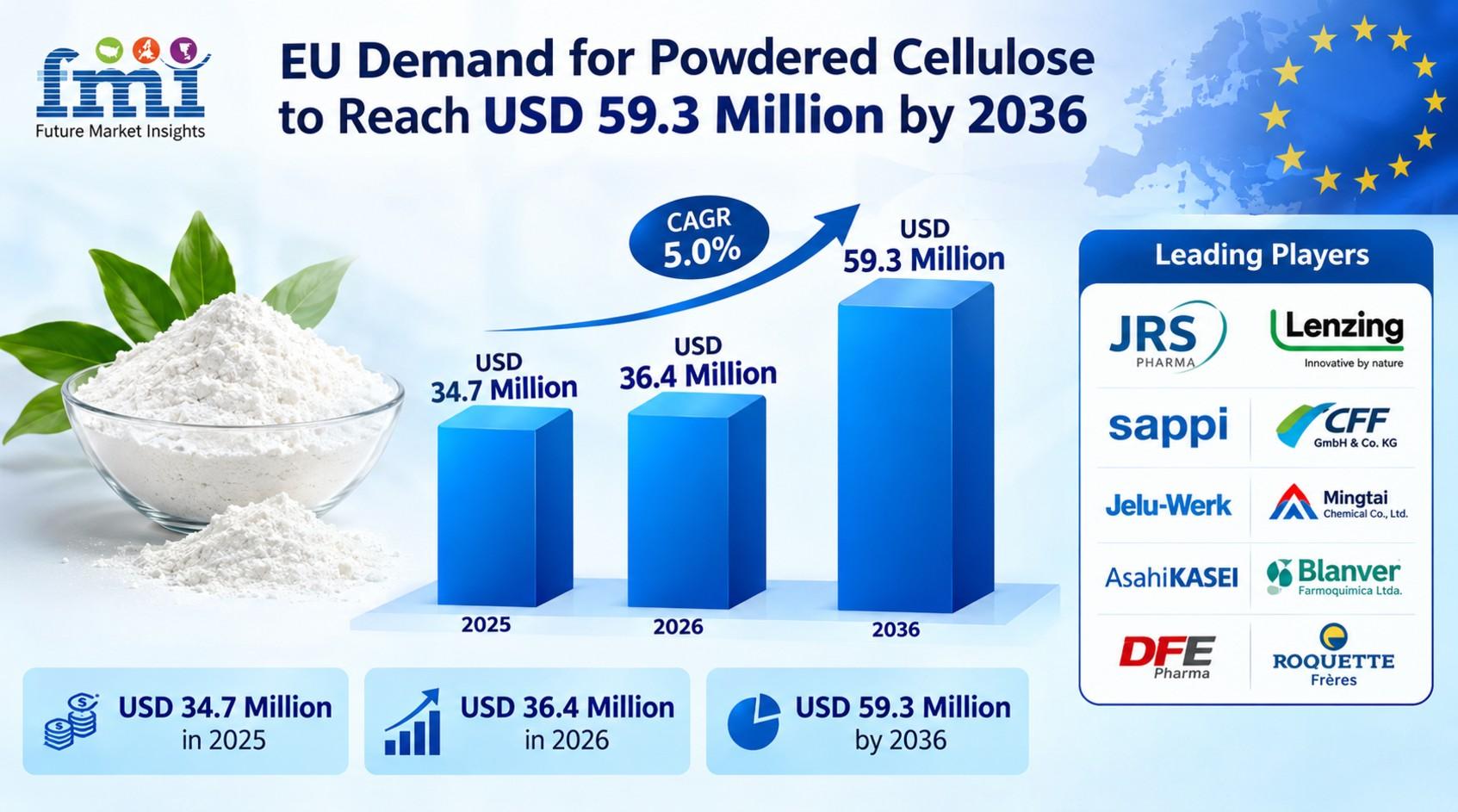
The demand for powdered cellulose across the European Union is undergoing steady, specification-driven expansion as food processors and pharmaceutical manufacturers transition toward biocompatible, natural, and certified excipients and functional additives, according to latest insights by Future Market Insights. Derived from purified, mechanically processed wood pulp, powdered cellulose operates across food-grade (E460), pharmaceutical-grade (European Pharmacopoeia-compliant), and industrial-grade specifications functioning as an anti-caking agent, bulking aid, dietary fiber source, and tablet binder/disintegrant.
The EU regional market, valued at USD 34.7 million in 2025, is projected to reach USD 36.4 million in 2026. Advancing at a Compound Annual Growth Rate (CAGR) of 5.0% over the ten-year forecast period, total market valuation across the EU is anticipated to achieve USD 59.3 million by 2036, delivering an absolute incremental opportunity of USD 22.9 million.
Request a Sample Report: https://www.futuremarketinsights.com/reports/sample/rep-gb-27164
Market Performance Overview (2026–2036)
To map out the leading product grades, primary application sectors, dominant distribution channels, and regional growth vectors guiding this USD 22.9 million market expansion across the European Union, key segment allocations highlight where commercial demand is concentrated:
· Food-Grade Product Type Segment (38.0% share): Commands the grade category in 2026, favored for its versatility as a calorie-free anti-caking agent in shredded/grated cheese, spice blends, and powdered supplements, as well as an insoluble dietary fiber fortifier in bakery and snack formulations.
· Pharmaceutical-Grade Segment: Represents the highest margin-generating and fastest-growing grade tier, where GMP-certified cleanroom processing and strict particle size distributions command pricing premiums for tablet compression and controlled drug release.
· Food & Beverage Application Segment (37.0% share): Leads end-use consumption in 2026, driven by reformulation programs aimed at clean-label positioning, fat replacement, and EU Regulation 1924/2006 dietary fiber claims.
· Direct-to-Manufacturers Distribution (60.0% share): Dominates distribution routes in 2026, reflecting the need for technical collaboration, custom particle specifications, and long-term quality validation between cellulose refiners and CPG/pharma manufacturers.
· Conventional vs. Certified Nature: Conventional products hold 82.0% share in 2026, but sustainably certified grades (FSC/PEFC) are growing rapidly (projected to reach 28.0% share by 2036) as EU retailers mandate zero-deforestation compliance.
· Netherlands & Spain Regional Leadership: Lead national growth rates at 5.7% CAGR and 5.5% CAGR respectively through 2036, driven by specialized pharmaceutical manufacturing clusters and ingredient gateway logistics in the Netherlands, alongside expanding food processing and generic drug manufacturing in Spain.
Technical Drivers and Processing Shifts
The steady commercial utilization of powdered cellulose across European food and pharmaceutical manufacturing lines is propelled by three primary industry catalysts:
Clean-Label Anti-Caking and Dietary Fiber Enrichment
Under EU food labeling rules, food-grade powdered cellulose (E460) serves as an effective, inert physical barrier preventing moisture absorption and clumping in shredded cheese and dry seasoning blends. Concurrently, commercial bakers leverage its high water-binding capacity and insoluble fiber density to achieve "source of fiber" or "high in fiber" nutritional claims without compromising loaf crumb structure.
Pharmaceutical Solid-Dosage Tablet Excipient Demand
Tablet and capsule formulators across European pharmaceutical hubs specify European Pharmacopoeia-compliant powdered cellulose for its consistent particle size classification, high compressibility, and rapid disintegration properties. Its chemical inertness ensures compatibility with sensitive active pharmaceutical ingredients (APIs), preventing drug degradation during commercial shelf life.
Sustainable Forestry and Chain-of-Custody Certification
European food and drug conglomerates increasingly mandate sustainable sourcing across wood-derived ingredients. Producers holding Forest Stewardship Council (FSC) and Programme for the Endorsement of Forest Certification (PEFC) accreditations gain preferential vendor qualification, establishing a two-tier market where certified cellulose commands pricing premiums over non-traceable pulp.
Industrial Constraints & Operational Challenges
Powdered cellulose processors, pharmaceutical formulators, and supply chain managers navigate specific operational hurdles:
· Pulp Feedstock Availability and Energy Costs: Powdered cellulose manufacturing requires controlled mechanical grinding, precision air-classification, and chemical washing of dissolving wood pulp, exposing refiners to European timber supply cycles and industrial energy price swings.
· Differentiation and Margin Pressure in Commodity Tiers: At the uncertified food and industrial grade level, powdered cellulose faces intense price competition from substitute hydrocolloids and synthetic silicas, necessitating continuous investment in high-purity pharmaceutical certification to maintain operating margins.
Country-Level Growth Profile in the EU
Demand across European economies reflects established pharmaceutical infrastructure in Central Europe alongside dynamic processing clusters in Southern and Western Europe:
· Netherlands (5.7% CAGR): The fastest-growing EU market, driven by advanced pharmaceutical chemical infrastructure, innovative generic drug production, and Rotterdam's role as a major specialty ingredient distribution gateway.
· Spain (5.5% CAGR): Spurring rapid volume expansion through pharmaceutical capacity additions, generic drug manufacturing, and a modernized industrial food processing sector.
· Italy (5.3% CAGR): Driven by specialized pharmaceutical manufacturing districts in Milan and Rome alongside traditional industrial bakery and dairy processing applications.
· France (5.2% CAGR): Supported by major pharmaceutical conglomerates (Sanofi, Servier), strict clean-label food reformulation initiatives, and dietary fiber supplement innovation.
· Germany (4.6% CAGR): Holds the largest market volume share (27.7% in 2026), anchored by world-class pharmaceutical giants (Bayer, Boehringer Ingelheim, Merck), precision chemical manufacturing, and stringent quality assurance standards.
Competitive Landscape
The EU powdered cellulose landscape is defined by competition among specialized pharmaceutical excipient houses, vertically integrated wood pulp refiners, and natural fiber processors.
Key market participants profiled in the report include JRS Pharma (leading with ~14% EU share), Lenzing AG (~8% share), Sappi Limited (~7% share), CFF GmbH & Co. KG (~5% share), Jelu-Werk (~4% share), Mingtai Chemical Co., Ltd., Asahi Kasei Corporation, Blanver Farmoquímica Ltda., DFE Pharma, and Roquette Frères. Leading players compete by securing GMP pharmaceutical-grade site certifications, engineering custom particle distributions, maintaining FSC/PEFC chain-of-custody traceability, and providing dedicated on-site application development support to pharmaceutical tablet presses and food extruders.
Exclusive Discounts on Full Report: https://www.futuremarketinsights.com/reports/demand-for-powdered-cellulose-in-eu
Frequently Asked Questions
What is the projected valuation of the EU powdered cellulose market by 2036?
Demand for powdered cellulose in the EU is projected to reach USD 59.3 million by 2036, expanding from an estimated baseline valuation of USD 36.4 million in 2026 at a CAGR of 5.0%.
Why does Food-Grade powdered cellulose lead the Product Type category?
Food-grade powdered cellulose commands a 38.0% market share in 2026 because it is widely utilized across dairy (anti-caking in shredded cheese), bakery (dietary fiber fortification and moisture retention), and seasoning blends as a safe, clean-label, and inert additive.
What is the primary difference between powdered cellulose and microcrystalline cellulose (MCC)?
Powdered cellulose is produced by the mechanical purification and milling of native wood pulp, resulting in long, fibrous particles primarily used for fiber fortification and anti-caking. Microcrystalline cellulose (MCC) undergoes acid hydrolysis to remove amorphous cellulose regions, leaving crystalline aggregates tailored specifically for high-hardness pharmaceutical tablet compression.
FMI Custom Research: Strategic Intelligence for Confident Decision-Making
In today's rapidly evolving business environment, leadership teams need clear, actionable intelligence tailored to their strategic objectives. FMI's Custom Research solutions are designed around specific business questions, enabling executives to evaluate growth opportunities, validate investments, assess competitive dynamics, and reduce uncertainty before making critical decisions.
Key Executive Benefits
· Decision-Ready Insights: Research tailored to your specific business challenges, growth plans, and investment priorities.
· Reduced Strategic Risk: Validate market opportunities, customer demand, and competitive positioning before committing resources.
· Market Entry Confidence: Assess opportunity size, regulatory barriers, channel dynamics, and competitive landscapes with precision.
· Competitive Advantage: Gain proprietary intelligence unavailable through syndicated reports or internal datasets.
· Faster Growth Decisions: Accelerate expansion, product development, portfolio optimization, and investment planning.
· Primary Market Validation: Access real-world customer, buyer, and stakeholder insights that support high-confidence decision-making.
Business Impact
FMI helps organizations transform market complexity into strategic clarity, enabling leadership teams to identify growth opportunities faster, optimize resource allocation, strengthen competitive positioning, and make high-stakes business decisions with confidence.
To explore how FMI Custom Research can support your strategic priorities, connect with our team at - sales@futuremarketinsights.com
About Future Market Insights (FMI)
Future Market Insights (FMI) delivers actionable, decision-focused market intelligence that goes beyond traditional research reports. The company provides:
· In-depth pricing and cost benchmarking analysis
· Demand forecasting based on real industry inputs
· Procurement and buyer behavior insights
· Supply chain and trade flow intelligence
· Technology and application trend analysis across industries
FMI follows a robust bottom-up research methodology, combining insights from industry experts, procurement leaders, manufacturers, and technical professionals to ensure accurate and practical market intelligence.

 English
 Arabic
 Spanish
 Portuguese
 Deutsch
 Turkish
 Dutch
Dutch
 Italiano
 Russian
 Romaian
 Portuguese (Brazil)
 Greek
Greek
