


Food Minerals Market to Reach USD 12.41 Billion by 2036
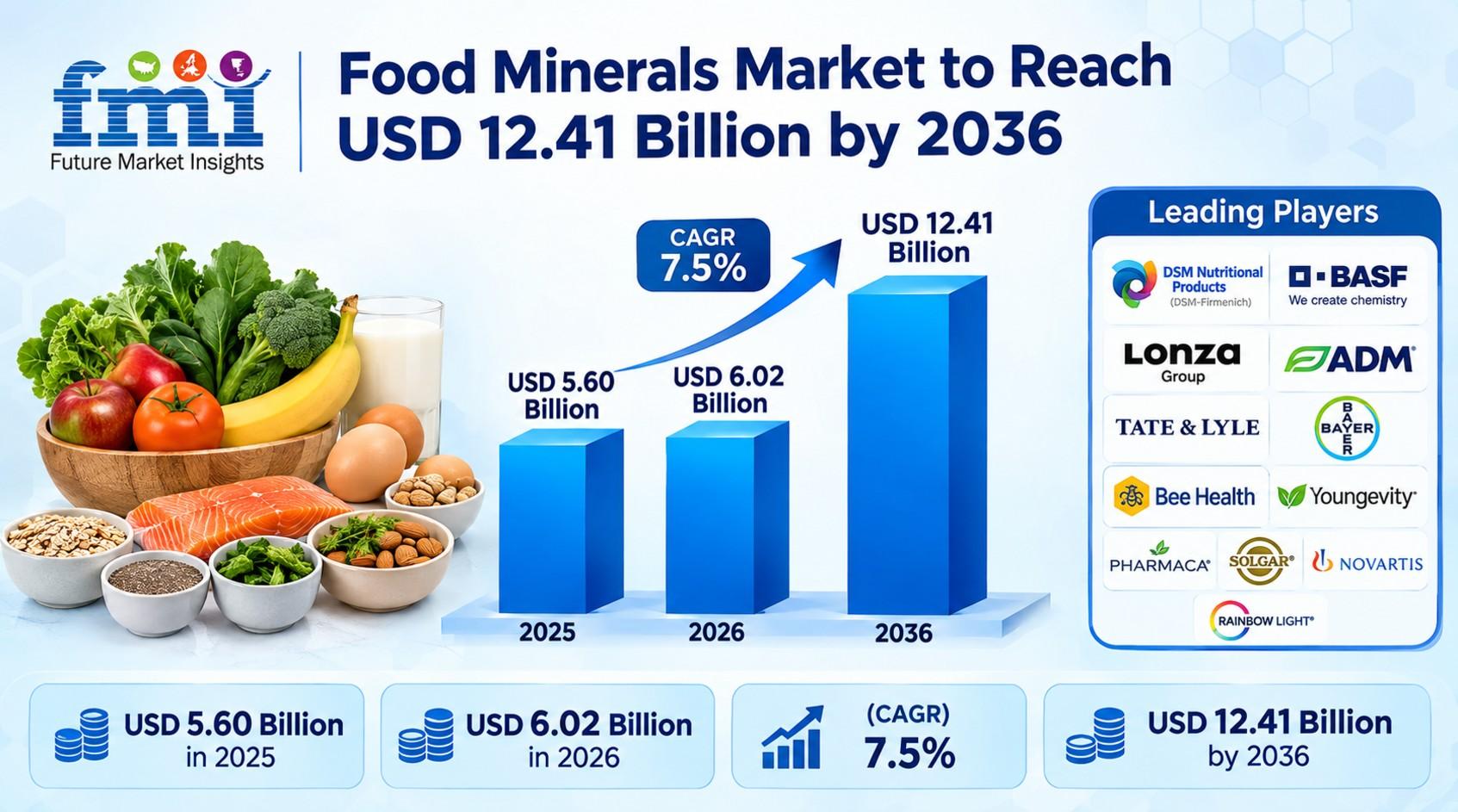
The global food minerals market is undergoing a structural evolution, transitioning from a commodity bulk salt business into a high-specification, bioavailability-driven ingredient sector, according to latest insights by Future Market Insights. Driven by permanent consumer adoption of immune-support supplements, expanding clinical validation for organic chelates (glycinates, citrates, threonate), government-enforced staple food fortification mandates in emerging markets, and strict regulatory substantiation requirements enforced by the US FDA and EFSA, mineral fortification has become a cornerstone of modern nutrition.
The global market, valued at USD 5.60 billion in 2025, is projected to reach USD 6.02 billion in 2026. Advancing at a Compound Annual Growth Rate (CAGR) of 7.5% over the ten-year forecast period, total market valuation is anticipated to achieve USD 12.41 billion by 2036, delivering an absolute incremental opportunity of USD 6.39 billion.
Request a Sample Report: https://www.futuremarketinsights.com/reports/sample/rep-gb-25941
Market Performance Overview (2026–2036)
To map out the key mineral product categories, structural supply chain tiers, and regional growth vectors guiding this USD 6.39 billion market expansion, key segment allocations highlight where global commercial demand is concentrated:
· Zinc Product Segment (32.4% share): Commands product category revenue in 2026, driven by sustained post-pandemic consumer mindshare around immune health, cell growth, and metabolic regulation across dietary supplements, functional beverages, and infant nutrition.
· Magnesium, Calcium, & Iron (67.6% combined share): Represent high-volume and high-growth mineral pillars. Magnesium is expanding fastest, propelled by rising consumer demand for stress management, sleep quality, and athletic muscle recovery.
· Chelated Mineral Tier: Represents the primary value-growth engine, commanding prices $3\times$ to $5\times$ higher than inorganic mineral salts due to superior gastrointestinal tolerability, enhanced cellular absorption, and regulatory clinical dossier backing.
· China & India Regional Leadership: Lead national expansion rates at 10.1% CAGR and 9.4% CAGR respectively through 2036, supported by government-enforced staple food fortification programs (rice, wheat flour, edible oils), expanding middle-class wellness spending, and booming e-commerce accessibility.
Technical Drivers and Upstream Formulation Shifts
The commercial scaling and premiumization of food minerals across functional food and supplement manufacturing lines are propelled by three primary industry catalysts:
The Shift Toward Organic Chelates and Enhanced Bioavailability
Inorganic mineral salts (oxides, sulfates, carbonates) often suffer from poor intestinal bioavailability, metallic off-flavors, and gastrointestinal irritation. Formulators are actively switching to chelated amino acid forms (such as zinc bisglycinate, magnesium glycinate, and ferrous bisglycinate). These complexes shield mineral ions from dietary phytates and gastric acid degradation, ensuring superior cellular absorption.
Persistent Multi-Demographic Health Positioning
Mineral demand is diversifying rapidly across targeted consumer lifestyle categories:
· Zinc: Maintains durable 60% to 70% repeat purchase rates among everyday wellness and immune supplement buyers.
· Magnesium: Reaching across sports performance (electrolyte balancing), executive wellness (stress/cortisol control), and healthy aging (bone mineral density and sleep architecture).
· Iron & Calcium: Serving as foundational ingredients in maternal health, pediatric nutrition, and mandatory national food fortification programs.
Microencapsulation and Taste-Masking Innovations
Adding reactive minerals to functional beverages, dairy products, or gummies historically triggered lipid oxidation, color discoloration, and astringent metallic notes. Advanced microencapsulation techniques (lipid spray-chilling, fluid-bed coating) effectively barrier-protect mineral cores, enabling high-dose fortification without altering finished food sensory profiles.
Industrial Constraints & Supply Chain Bifurcation
Mineral refiners, supplement formulators, and procurement directors navigate specific operational hurdles:
· Two-Tier Supplier Dynamics and Margin Compression: The market is structurally divided between low-cost commodity salt manufacturers in China and India and specialized chelate innovators in Europe and North America. Commodity salt producers face intensifying price competition, while premium chelate suppliers must invest heavily in clinical pharmacokinetic trials.
· Complex Multi-Jurisdictional Labeling Compliance: Varying national regulations regarding maximum allowable levels (MAL), permitted salt forms under EU Regulation 1170/2009, and strict FDA label-claim substantiation require multinational brands to manage region-specific SKU formulations.
Regional Growth Profile
Regional demand reflects large-scale public health fortification and urban wellness adoption in Asia alongside clean-label specialty chelate expansion in Western economies:
· China (10.1% CAGR): The global growth frontrunner, driven by state-backed nutrition improvement initiatives, surging functional dairy production, and high urban consumer demand for bioavailable immunity supplements.
· India (9.4% CAGR): Spurring rapid volume expansion through mandatory staple food fortification programs (FSSAI +F initiatives for rice and wheat), expanding pharmaceutical manufacturing, and rising middle-class wellness awareness.
· Germany (8.6% CAGR) & France (7.9% CAGR): Lead European demand, characterized by high consumer preference for clean-label, plant-derived mineral complexes, strict EFSA regulatory compliance, and aging population bone-health nutrition.
· United Kingdom (7.1% CAGR): Driven by functional beverage growth, sports nutrition recovery powders, and digital direct-to-consumer (DTC) subscription supplement platforms.
· United States (6.4% CAGR): Represents a mature, high-value demand center anchored by premium sports nutrition lines, personalized daily vitamin packs, and clinically backed chelated mineral gummies.
· Brazil (5.6% CAGR): Growing through expanding middle-class consumption, fortified dairy/cereal adoption, and rising dietary enrichment awareness.
Competitive Landscape
The global food minerals landscape features a combination of multinational nutrition conglomerates, active pharmaceutical ingredient (API) refiners, and specialized mineral chelation houses.
Key market participants profiled in the report include DSM Nutritional Products (DSM-Firmenich), BASF SE, Lonza Group, Archer Daniels Midland (ADM), Tate & Lyle PLC, Bayer AG, Bee Health, Youngevity, Pharmaca, Solgar, Novartis, and Rainbow Light. Leading players compete by publishing clinical absorption trials, developing non-reactive microencapsulated powders, providing turn-key custom premix solutions, and maintaining global regulatory compliance dossiers across EU, FDA, and Asian standards.
Exclusive Discounts on Full Report: https://www.futuremarketinsights.com/reports/food-minerals-market
Frequently Asked Questions
What is the projected valuation of the global food minerals market by 2036?
The global food minerals market is projected to reach USD 12.41 billion by 2036, expanding from an estimated baseline valuation of USD 6.02 billion in 2026 at a CAGR of 7.5%.
Why does Zinc lead the Product category with a 32.4% share?
Zinc dominates in 2026 due to its proven, clinically validated role in immune defense, cellular metabolism, and DNA synthesis, maintaining high consumer demand across dietary supplements, functional beverages, and clinical nutrition.
What is the advantage of chelated food minerals over standard inorganic mineral salts?
Chelated minerals bind inorganic mineral ions to organic amino acids (such as glycine). This molecular structure prevents binding with dietary inhibitors, enhances intestinal absorption, reduces gastrointestinal side effects (like nausea or constipation), and eliminates metallic off-tastes in food and beverage matrices.
FMI Custom Research: Strategic Intelligence for Confident Decision-Making
In today's rapidly evolving business environment, leadership teams need clear, actionable intelligence tailored to their strategic objectives. FMI's Custom Research solutions are designed around specific business questions, enabling executives to evaluate growth opportunities, validate investments, assess competitive dynamics, and reduce uncertainty before making critical decisions.
Key Executive Benefits
· Decision-Ready Insights: Research tailored to your specific business challenges, growth plans, and investment priorities.
· Reduced Strategic Risk: Validate market opportunities, customer demand, and competitive positioning before committing resources.
· Market Entry Confidence: Assess opportunity size, regulatory barriers, channel dynamics, and competitive landscapes with precision.
· Competitive Advantage: Gain proprietary intelligence unavailable through syndicated reports or internal datasets.
· Faster Growth Decisions: Accelerate expansion, product development, portfolio optimization, and investment planning.
· Primary Market Validation: Access real-world customer, buyer, and stakeholder insights that support high-confidence decision-making.
Business Impact
FMI helps organizations transform market complexity into strategic clarity, enabling leadership teams to identify growth opportunities faster, optimize resource allocation, strengthen competitive positioning, and make high-stakes business decisions with confidence.
To explore how FMI Custom Research can support your strategic priorities, connect with our team at - sales@futuremarketinsights.com
About Future Market Insights (FMI)
Future Market Insights (FMI) delivers actionable, decision-focused market intelligence that goes beyond traditional research reports. The company provides:
· In-depth pricing and cost benchmarking analysis
· Demand forecasting based on real industry inputs
· Procurement and buyer behavior insights
· Supply chain and trade flow intelligence
· Technology and application trend analysis across industries
FMI follows a robust bottom-up research methodology, combining insights from industry experts, procurement leaders, manufacturers, and technical professionals to ensure accurate and practical market intelligence.

 English
 Arabic
 French
 Spanish
 Portuguese
 Deutsch
 Turkish
 Dutch
Dutch
 Italiano
 Russian
 Romaian
 Portuguese (Brazil)
