


Food Technology Market to Reach USD 543.02 Billion by 2036
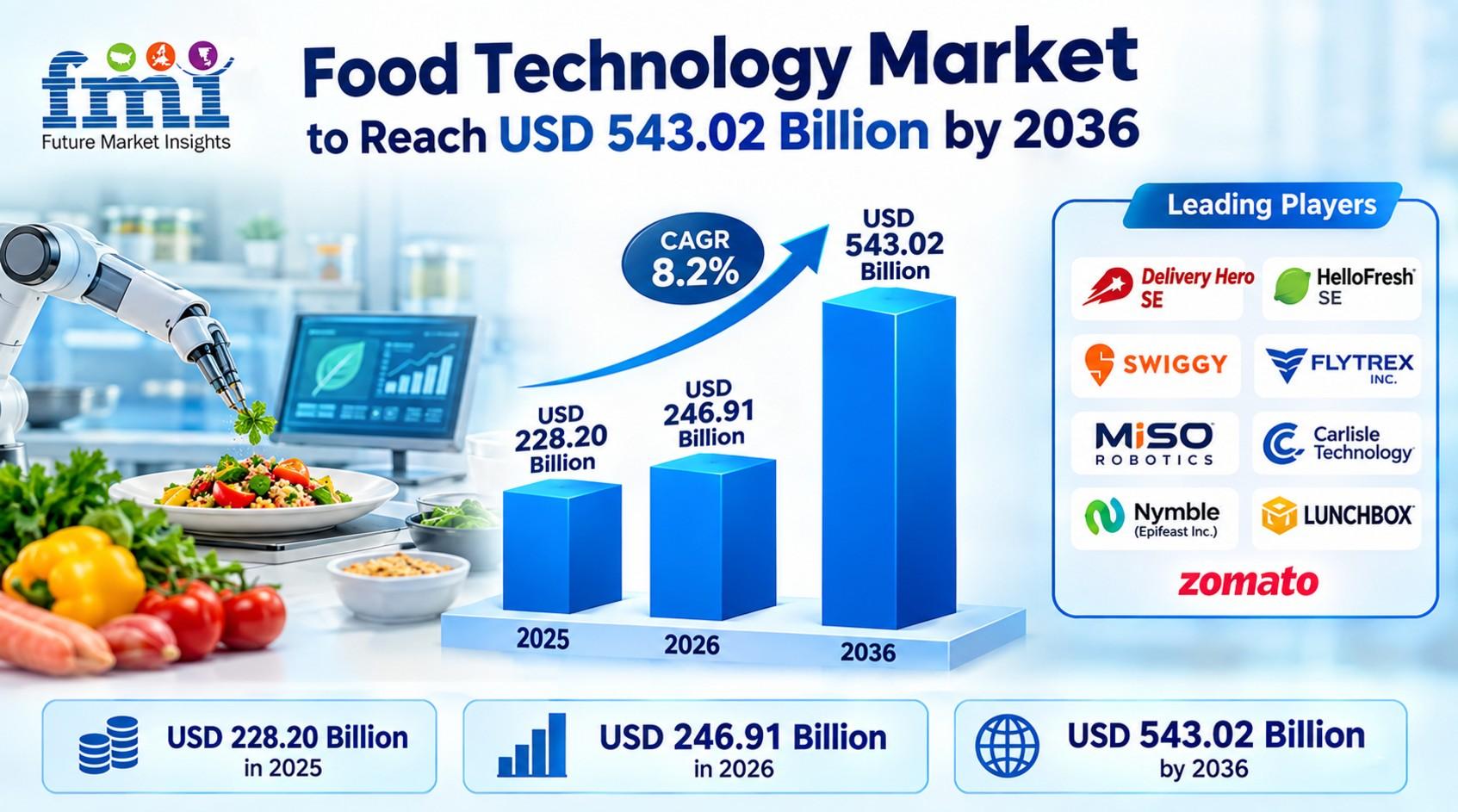
The global food technology market is experiencing an unprecedented capital expenditure acceleration as food manufacturers, commercial kitchens, and distribution networks deploy end-to-end automation and digital solutions, according to latest insights by Future Market Insights. Driven by rising factory labor costs, mandatory digital traceability regulations (such as FDA FSMA Section 204 and EU Regulation 178/2002), and the rapid expansion of automated fulfillment in ghost kitchens and dark stores, advanced hardware and software technologies are transforming the entire farm-to-fork value chain.
The global market, valued at USD 228.20 billion in 2025, is projected to reach USD 246.91 billion in 2026. Advancing at a Compound Annual Growth Rate (CAGR) of 8.2% over the ten-year forecast period, total market valuation is anticipated to achieve USD 543.02 billion by 2036, delivering an absolute incremental opportunity of USD 296.11 billion.
Request a Sample Report: https://www.futuremarketinsights.com/reports/sample/rep-gb-25978
Market Performance Overview (2026–2036)
To map out the leading technology types, dominant end-use industries, core application sectors, and regional growth vectors guiding this USD 296.11 billion market expansion, key segment allocations highlight where global commercial demand is concentrated:
· Food Processing Technology Segment (26.7% share): Commands the technology type category in 2026, driven by widespread adoption of high-speed robotics, automated sorting/grading, high-pressure processing (HPP), and inline IoT quality inspection systems.
· Food Distribution & Preparation Technologies: Represent the fastest-growing technology categories as dark stores, automated cloud kitchens, and autonomous last-mile delivery systems transition from pilot projects to full commercial scale.
· Food Science Application Segment (29.4% share): Dominates application demand in 2026, underpinning novel ingredient formulation, precision nutritional profiling, bio-preservation, and AI-accelerated product R&D.
· Beverages End-Use Industry (22.0% share): Represents the leading industrial vertical, heavily deploying aseptic filling, IoT continuous quality monitoring, and high-speed robotic bottling/canning lines for functional and ready-to-drink (RTD) beverages.
· China & India Regional Leadership: Lead national expansion rates at 11.1% CAGR and 10.3% CAGR respectively through 2036, driven by massive investments in smart food manufacturing parks, automated cold-chain logistics, and booming food delivery ecosystems.
Technical Drivers and Capital Investment Cycles
The exponential growth of the food technology landscape is propelled by the convergence of three major structural investment cycles:
Manufacturing Automation and Labor Shortage Offsets
Persistent manufacturing labor shortages and wage inflation across North America, Western Europe, and East Asia have drastically shortened the payback period on food robotics and automation. Automated secondary packaging, vision-guided sorting, and robotic palletizing systems ensure uninterrupted line throughput while eliminating contamination risks.
Regulatory Digital Traceability Mandates
Strict compliance frameworks most notably the US FDA Food Safety Modernization Act (FSMA) Section 204 and the EU General Food Law mandate granular digital record-keeping and rapid end-to-end tracebacks. Food processors and retailers are rapidly integrating blockchain ledgers, RFID sensors, and automated compliance management software to ensure real-time supply chain transparency.
Ghost Kitchens and Hyper-Local Fulfillment Tech
The permanent shift toward on-demand meal delivery and 15-minute grocery deliveries has spurred heavy capital allocation toward tech-dense micro-fulfillment hubs. Operators utilize kitchen automation (robotic fryers, automated dispensers), algorithm-driven kitchen display systems (KDS), and AI route optimization to minimize order-to-door delivery cycles.
Industrial Constraints & Integration Hurdles
Food manufacturers, restaurant tech integrators, and software providers navigate specific operational challenges:
· Technology Fragmentation and Data Silos: Deploying isolated point solutions across disparate processing lines, warehouse management systems (WMS), and enterprise platforms creates data interoperability bottlenecks, often requiring costly middleware integration.
· High Upfront Capital Intensity: Transitioning legacy processing plants to fully automated Industry 4.0 standards demands significant upfront CAPEX and 12-to-24-month retooling windows, posing financial hurdles for small-to-medium food enterprises (SMEs).
Regional Growth Profile
Regional demand reflects high-velocity digitization and delivery platform adoption across Asian growth hubs alongside advanced Industry 4.0 automation in Western economies:
· China (11.1% CAGR): The global growth frontrunner, supported by state-backed smart manufacturing initiatives, nationwide automated cold-chain rollout, and massive digital food delivery platforms.
· India (10.3% CAGR): Spurring rapid volume expansion through booming quick-commerce (q-commerce) logistics, organized food processing modernization, and rising adoption of smart retail platforms.
· Germany (9.4% CAGR) & France (8.6% CAGR): Lead European demand, characterized by high adoption of industrial robotics, AI-driven quality inspection, and strict adherence to EU circular-economy and food safety mandates.
· United Kingdom (7.8% CAGR): Expanding through automated grocery fulfillment centers, dark kitchen software integration, and online delivery innovations.
· United States (7.0% CAGR): Represents a mature, high-value demand center anchored by venture-backed food-tech development, widespread FSMA 204 digital compliance upgrades, and kitchen robotics deployments.
· Brazil (6.2% CAGR): Growing through the modernization of domestic meat/grain processing facilities and expanding urban food delivery networks.
Competitive Landscape
The global food technology landscape features a dynamic mix of global platform providers, industrial automation conglomerates, specialized robotics innovators, and digital on-demand delivery giants.
Key market participants profiled in the report include Delivery Hero SE, HelloFresh SE, Swiggy, Flytrex Inc., Miso Robotics, Carlisle Technology, Nymble (Epifeast Inc.), LUNCHBOX, and Zomato. Leading players compete by expanding full-stack software and hardware integration, developing AI-driven predictive demand planning algorithms, commercializing autonomous delivery drones and kitchen robots, and building unified digital traceability platforms.
Exclusive Discounts on Full Report: https://www.futuremarketinsights.com/reports/food-technology-market
Frequently Asked Questions
What is the projected valuation of the global food technology market by 2036?
The global food technology market is projected to reach USD 543.02 billion by 2036, expanding from an estimated baseline valuation of USD 246.91 billion in 2026 at a CAGR of 8.2%.
Why does Food Processing Technology hold a 26.7% market share?
Food processing technology dominates in 2026 because industrial automation, robotic sorting, and advanced preservation techniques (such as HPP) are essential to addressing manufacturing labor shortages, reducing food waste, and maintaining strict safety compliance.
What is driving the rapid expansion of Food Science applications?
Food science commands a 29.4% share in 2026 as manufacturers leverage advanced ingredient profiling, sensory analysis, and AI-driven simulation tools to rapidly formulate clean-label, functional, and alternative protein products.
FMI Custom Research: Strategic Intelligence for Confident Decision-Making
In today's rapidly evolving business environment, leadership teams need clear, actionable intelligence tailored to their strategic objectives. FMI's Custom Research solutions are designed around specific business questions, enabling executives to evaluate growth opportunities, validate investments, assess competitive dynamics, and reduce uncertainty before making critical decisions.
Key Executive Benefits
· Decision-Ready Insights: Research tailored to your specific business challenges, growth plans, and investment priorities.
· Reduced Strategic Risk: Validate market opportunities, customer demand, and competitive positioning before committing resources.
· Market Entry Confidence: Assess opportunity size, regulatory barriers, channel dynamics, and competitive landscapes with precision.
· Competitive Advantage: Gain proprietary intelligence unavailable through syndicated reports or internal datasets.
· Faster Growth Decisions: Accelerate expansion, product development, portfolio optimization, and investment planning.
· Primary Market Validation: Access real-world customer, buyer, and stakeholder insights that support high-confidence decision-making.
Business Impact
FMI helps organizations transform market complexity into strategic clarity, enabling leadership teams to identify growth opportunities faster, optimize resource allocation, strengthen competitive positioning, and make high-stakes business decisions with confidence.
To explore how FMI Custom Research can support your strategic priorities, connect with our team at - sales@futuremarketinsights.com
About Future Market Insights (FMI)
Future Market Insights (FMI) delivers actionable, decision-focused market intelligence that goes beyond traditional research reports. The company provides:
· In-depth pricing and cost benchmarking analysis
· Demand forecasting based on real industry inputs
· Procurement and buyer behavior insights
· Supply chain and trade flow intelligence
· Technology and application trend analysis across industries
FMI follows a robust bottom-up research methodology, combining insights from industry experts, procurement leaders, manufacturers, and technical professionals to ensure accurate and practical market intelligence.

 English
 Arabic
 French
 Portuguese
 Deutsch
 Turkish
 Dutch
Dutch
 Italiano
 Russian
 Romaian
 Portuguese (Brazil)
 Greek
Greek
