


Gluten Feed Market to Reach USD 2.34 Billion by 2036
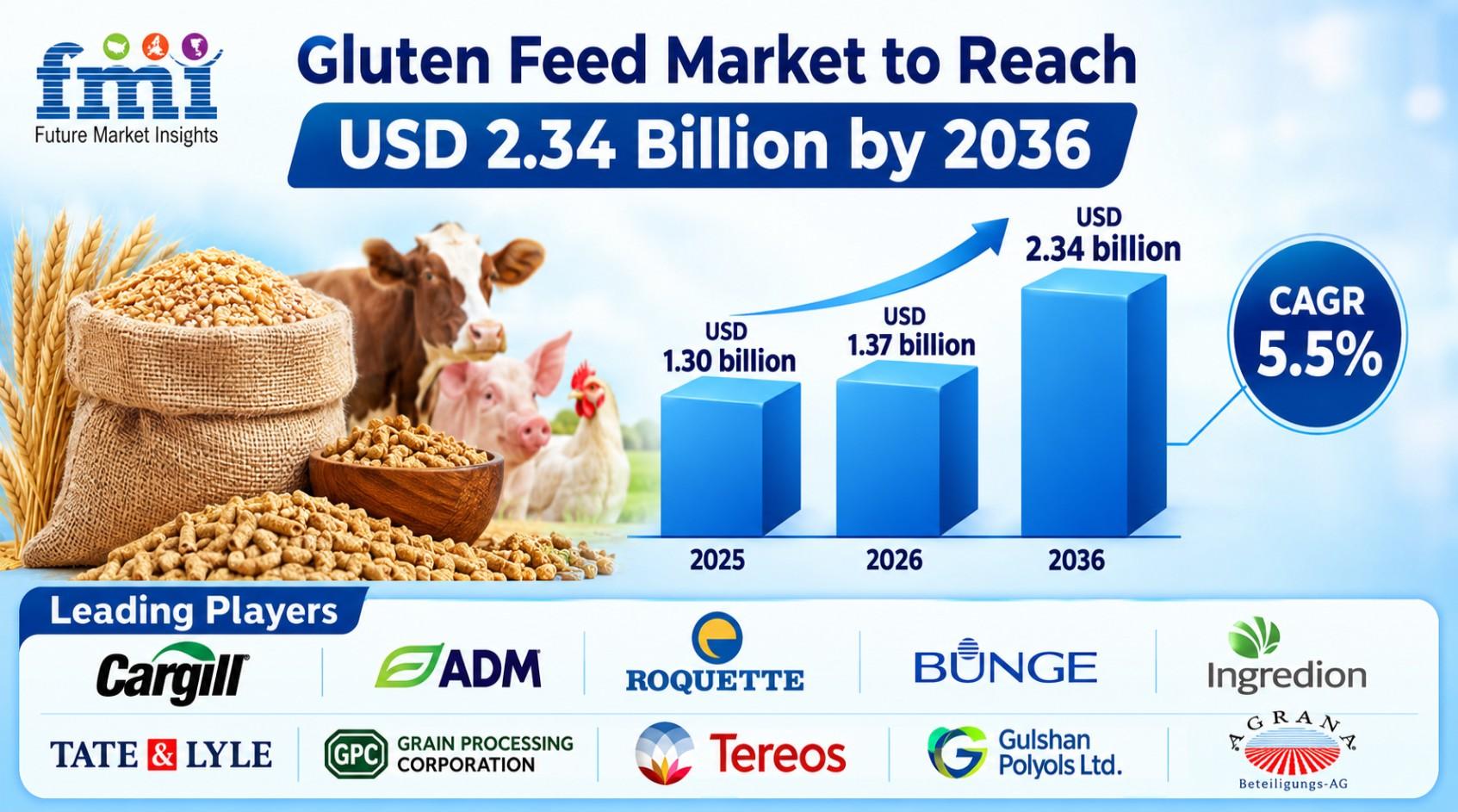
The global gluten feed market is experiencing steady, volume-driven growth as livestock integrators, commercial feed mills, and animal nutritionists optimize compound feed formulation costs against whole-grain price volatility, according to latest insights by Future Market Insights. Produced as a valuable co-product of corn and wheat wet-milling operations (consisting of bran, steep liquor solubles, and residual gluten fractions), gluten feed provides a balanced medium-protein (18% to 22%) and high-digestible-fiber energy source that serves as a counter-cyclical cost optimizer across poultry, ruminant, swine, and aquaculture rations.
The global market, valued at USD 1.30 billion in 2025, is projected to reach USD 1.37 billion in 2026. Advancing at a Compound Annual Growth Rate (CAGR) of 5.5% over the ten-year forecast period, total market valuation is anticipated to achieve USD 2.34 billion by 2036, delivering an absolute incremental opportunity of USD 0.97 billion.
Request a Sample Report: https://www.futuremarketinsights.com/reports/sample/rep-gb-22977
Market Performance Overview (2026–2036)
To map out the leading botanical sources, primary physical forms, dominant livestock sectors, and regional growth vectors guiding this USD 0.97 billion market scale-up, key segment allocations highlight where global commercial demand is concentrated:
· Corn-Based Gluten Feed Segment (64.3% share): Commands the source category in 2026, supported by extensive global corn wet-milling infrastructure, high starch/sweetener co-production volumes in the US, China, and Brazil, and balanced nutrient profiles.
· Wheat- & Barley-Based Feeds (35.7% combined share): Represent vital secondary source pillars, widely utilized in European and Canadian livestock feeding systems co-located near wheat starch and bioethanol distilleries.
· Dry Form Segment (59.2% share): Dominates physical format revenue in 2026, favored over wet feed for its extended storage stability, resistance to mycotoxin and microbial spoilage, and superior freight economics in long-distance rail and ocean transport.
· Poultry Livestock Segment (61.5% share): Represents the largest animal application category in 2026, driven by broiler and layer ration optimization where corn gluten feed is integrated at 5% to 10% inclusion rates to replace costlier soybean meal and corn grain.
· Ruminants & Swine Applications: Form key secondary demand sectors, where high digestible neutral detergent fiber (NDF) supports rumen fermentation in dairy cattle without causing acidosis.
· China & India Regional Leadership: Lead national expansion rates at 7.4% CAGR and 6.9% CAGR respectively through 2036, driven by compound feed industrialization, domestic poultry scaling, and expanding grain processing capacity.
Technical Drivers and Upstream Milling Economics
The commercial utilization and specification of gluten feed across global animal agriculture are propelled by three primary industry catalysts:
Derivative Supply Economics from Wet Milling
Gluten feed production is entirely governed by primary starch, high-fructose corn syrup (HFCS), and bioethanol processing volumes. Feed formulators cannot independently stimulate primary supply; rather, they capitalize on wet-milling capacity additions in major corn-growing basins to secure high-volume, cost-discounted protein and fiber streams.
Counter-Cyclical Ruminant and Monogastric Ration Optimization
When whole corn and soybean meal commodity prices surge, nutritionists adjust least-cost feed formulation matrices. Incorporating corn gluten feed into total mixed rations (TMR) lowers per-ton feed costs while maintaining energy density and supplying bypass protein and digestible fiber that reduce ruminal acidosis in high-producing dairy cows and feedlot beef cattle.
Broadening Poultry Inclusion Matrices
Intensive poultry integrators in India, Brazil, and Southeast Asia are broadening approved feed matrices to include corn gluten feed in grower and finisher diets. When balanced with synthetic lysine and methionine, gluten feed maintains feed conversion ratios (FCR) while cushioning operations against oilseed meal supply shortages.
Industrial Constraints & Logistics Bottlenecks
Feed compounders, grain merchandisers, and procurement directors navigate specific operational hurdles:
· Wet Form Perishability vs. Drying Energy Costs: Wet gluten feed (40% to 60% moisture) must be consumed within 7 to 10 days of production to avoid mold growth, restricting its use to feedlots within a 100-mile radius of the wet mill. Conversely, dehydrating wet feed into pellets requires significant thermal energy, exposing processors to natural gas price fluctuations.
· Upstream Processing Shifts and Allocation Constriction: When wet millers redirect production lines toward modified industrial starches or higher-protein corn gluten meal (60% protein), residual gluten feed output can temporarily contract, introducing spot-market allocation deficits for feed mills lacking long-term offtake agreements.
Regional Growth Profile
Regional demand reflects intensive compound feed scaling across emerging Asian markets alongside established grain-milling infrastructure in the Americas and Europe:
· China (7.4% CAGR): The global growth frontrunner, driven by massive domestic livestock consolidation, state-supported corn processing hubs, and protein source diversification to lessen dependence on imported soybeans.
· India (6.9% CAGR): Spurring rapid volume expansion as commercial poultry integrators and modern dairy cooperatives adopt standardized compound feed formulations containing corn-milling co-products.
· Germany (6.3% CAGR) & France (5.8% CAGR): Lead European demand, where non-GMO European wheat and corn gluten feeds are utilized in precision dairy nutrition under strict EU sustainability and traceability standards.
· United Kingdom (5.2% CAGR): Driven by silage-based dairy feeding programs and contract-based supply agreements with domestic bioethanol and starch mills.
· United States (4.7% CAGR): Represents a mature, high-volume production and consumption powerhouse, anchored by the Midwest Corn Belt wet-milling corridor, extensive beef cattle feedlots, and long-haul rail logistics.
· Brazil (4.1% CAGR): Expanding through the rapid scaling of corn-based ethanol production facilities that generate expanding co-product streams for local beef and poultry production.
Competitive Landscape
The global gluten feed landscape is dominated by vertically integrated agricultural processing corporations, wet-milling conglomerates, and regional agribusiness cooperatives.
Key market participants profiled in the report include Cargill, Incorporated, Archer Daniels Midland Company (ADM), Roquette Frères, Bunge Ltd., Ingredion Incorporated, Tate & Lyle Plc, Grain Processing Corporation (GPC), Tereos Syral, Gulshan Polyols Ltd., and AGRANA Beteiligungs-AG. Leading producers compete by co-locating feed pelleting lines directly adjacent to wet-milling and ethanol facilities, optimizing drying energy efficiencies, securing multi-year offtake contracts with commercial feed mills, and maintaining integrated railcar and barge logistics networks.
Exclusive Discounts on Full Report: https://www.futuremarketinsights.com/reports/gluten-feed-market#report-description
Frequently Asked Questions
What is the projected valuation of the global gluten feed market by 2036?
The global gluten feed market is projected to reach USD 2.34 billion by 2036, expanding from an estimated baseline valuation of USD 1.37 billion in 2026 at a CAGR of 5.5%.
Why does Corn-Based Gluten Feed lead with a 64.3% market share?
Corn-based gluten feed dominates in 2026 due to the massive global infrastructure for corn wet milling (producing starch, sweeteners, and ethanol), which generates a reliable, high-volume supply of consistent, nutrient-dense co-products.
What is the difference between corn gluten feed and corn gluten meal?
Corn gluten feed is a medium-protein (18–22%) and high-fiber co-product composed of corn bran and condensed steep liquor, primarily used in ruminant and poultry diets. Corn gluten meal is a separate, high-protein (60%) fraction containing mostly pure protein, primarily specified in aquaculture, pet food, and high-density poultry rations.
FMI Custom Research: Strategic Intelligence for Confident Decision-Making
In today's rapidly evolving business environment, leadership teams need clear, actionable intelligence tailored to their strategic objectives. FMI's Custom Research solutions are designed around specific business questions, enabling executives to evaluate growth opportunities, validate investments, assess competitive dynamics, and reduce uncertainty before making critical decisions.
Key Executive Benefits
· Decision-Ready Insights: Research tailored to your specific business challenges, growth plans, and investment priorities.
· Reduced Strategic Risk: Validate market opportunities, customer demand, and competitive positioning before committing resources.
· Market Entry Confidence: Assess opportunity size, regulatory barriers, channel dynamics, and competitive landscapes with precision.
· Competitive Advantage: Gain proprietary intelligence unavailable through syndicated reports or internal datasets.
· Faster Growth Decisions: Accelerate expansion, product development, portfolio optimization, and investment planning.
· Primary Market Validation: Access real-world customer, buyer, and stakeholder insights that support high-confidence decision-making.
Business Impact
FMI helps organizations transform market complexity into strategic clarity, enabling leadership teams to identify growth opportunities faster, optimize resource allocation, strengthen competitive positioning, and make high-stakes business decisions with confidence.
To explore how FMI Custom Research can support your strategic priorities, connect with our team at - sales@futuremarketinsights.com
About Future Market Insights (FMI)
Future Market Insights (FMI) delivers actionable, decision-focused market intelligence that goes beyond traditional research reports. The company provides:
· In-depth pricing and cost benchmarking analysis
· Demand forecasting based on real industry inputs
· Procurement and buyer behavior insights
· Supply chain and trade flow intelligence
· Technology and application trend analysis across industries
FMI follows a robust bottom-up research methodology, combining insights from industry experts, procurement leaders, manufacturers, and technical professionals to ensure accurate and practical market intelligence.

 English
 Arabic
 French
 Spanish
 Portuguese
 Deutsch
 Turkish
 Italiano
 Russian
 Romaian
 Portuguese (Brazil)
 Greek
Greek
