


In-Content Advertising vs Traditional Advertising: Key Differences
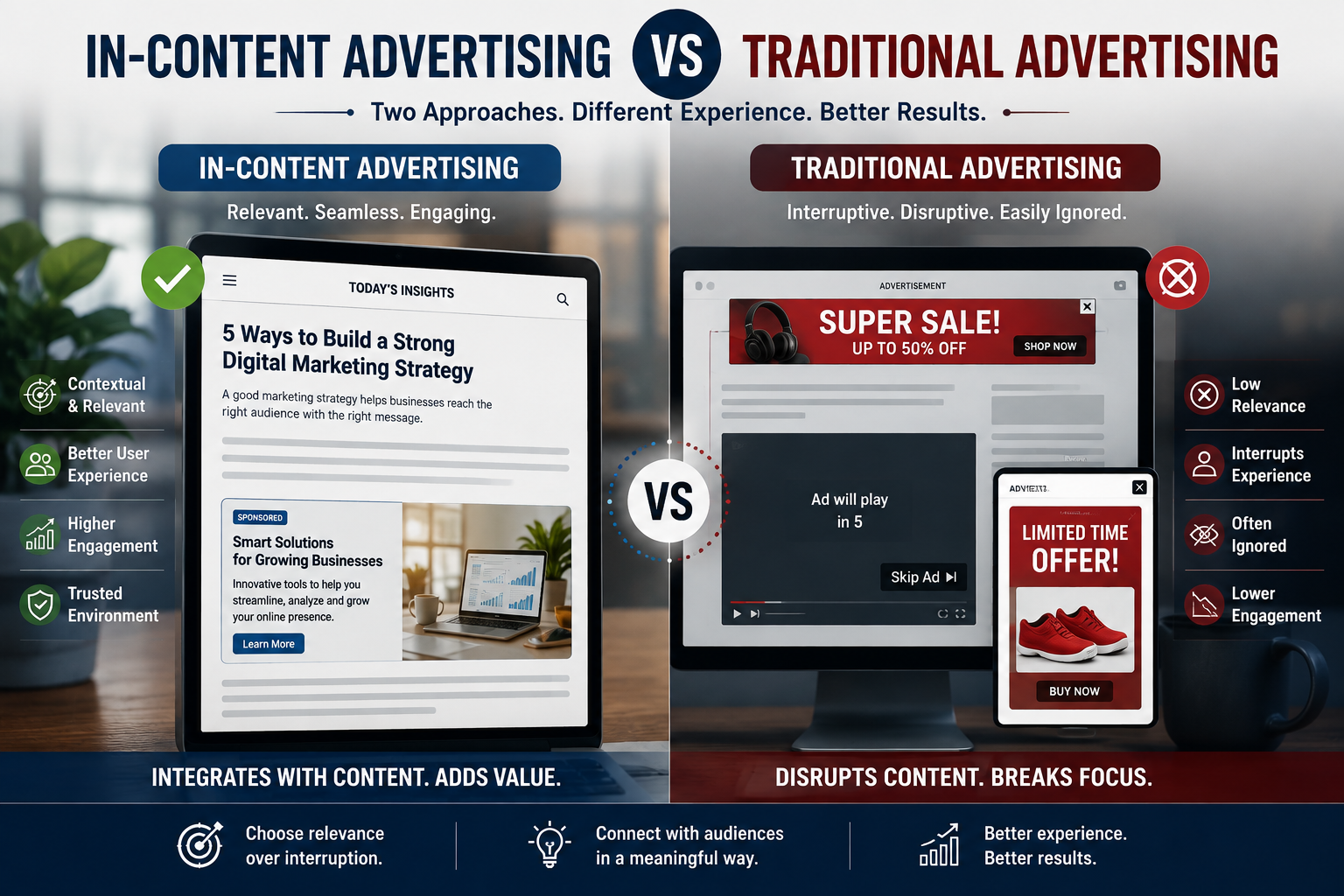
Advertising has changed significantly as audiences spend more time with digital content, streaming platforms, social media, and online publications. Brands now have more options than traditional display ads and television commercials. One approach gaining attention is in-content advertising, which places brand messages within or around relevant content.
Understanding the difference between in-content advertising vs traditional advertising can help marketers choose an approach that better matches their campaign goals and audience expectations.
What Is In-Content Advertising?
In-content advertising integrates a promotional message into an existing content experience. Examples include sponsored content, native advertising, contextual product placement, branded entertainment, in-article advertisements, and virtual product integration.
The main idea is relevance. Instead of appearing completely separate from the content, the advertisement is connected to the topic, format, or viewing environment.
For example, a brand could be integrated into a streaming video, article, music video, or other digital content where the product naturally fits the audience and context.
What Is Traditional Advertising?
Traditional advertising generally uses formats that are clearly separated from the content consumers are watching or reading. Television commercials, radio advertisements, print ads, billboards, and standard display banners are common examples.
These formats can provide strong reach and brand visibility. However, they can also interrupt the user's experience, particularly when advertisements appear between sections of content or during a program.
Traditional advertising remains useful for campaigns focused on broad awareness, reach, and repeated brand exposure.
In-Content Advertising vs Traditional Advertising
The biggest difference is how the advertisement interacts with the content.
| Factor | In-Content Advertising | Traditional Advertising |
|---|---|---|
| Placement | Within or alongside relevant content | Separate from main content |
| Experience | More integrated | Often interruptive |
| Relevance | Strong focus on context | Often based on audience or placement |
| Formats | Native ads, product placement, sponsored content | TV, radio, banners, print |
| Creative approach | Content-led and contextual | Standalone creative |
| Technology | Increasingly AI-powered | Often uses established media systems |
| Measurement | Can include engagement and integration metrics | Often focuses on reach, impressions, and conversions |
Neither approach is automatically better. The right choice depends on the campaign objective, audience, content environment, and measurement strategy.
Why Context Matters in Modern Advertising
Contextual relevance is becoming increasingly important. In 2026, IAB reported that targeting had overtaken content quality as the top criterion for TV and video investment. Its research also highlights growing use of AI to understand video through signals such as scenes, tone, emotion, and environment.
This development gives advertisers more opportunities to match advertising with suitable content environments without relying only on traditional audience targeting.
The Role of AI in In-Content Advertising
AI is also changing how advertising campaigns are planned, produced, and optimized. Multimodal AI can analyze visual, audio, speech, and metadata signals to understand digital video more deeply.
For brands, this can support contextual targeting, creative adaptation, virtual product placement, and more efficient campaign workflows.
Businesses exploring AI-powered creative and advertising technology can learn more through Artcube, which focuses on modern visual content and brand integration solutions.
Which Advertising Approach Should Brands Choose?
Traditional advertising can be effective when a brand needs broad exposure and simple, memorable messaging. In-content advertising can be more suitable when the campaign depends on contextual relevance, storytelling, product integration, or a less disruptive experience.
A strong digital strategy can also combine both approaches. For example, a brand may use traditional video advertising for awareness while using in-content placements to reinforce the product within relevant entertainment or editorial environments.
Digital video is becoming especially important. IAB projects U.S. digital video advertising to surpass $80 billion in 2026, growing 11% year over year.
Conclusion
The difference between in-content advertising vs traditional advertising is primarily the relationship between the advertisement and the surrounding content. Traditional formats place advertising separately, while in-content approaches focus on integration and contextual relevance.
As AI improves content understanding and advertising technology, brands have more opportunities to create campaigns that combine relevance, creativity, measurement, and user experience. The strongest strategy is not necessarily choosing one format, but selecting the approach that best supports the campaign's audience and business objective.

 English
 Arabic
 French
 Spanish
 Portuguese
 Deutsch
 Turkish
 Dutch
Dutch
 Italiano
 Russian
 Portuguese (Brazil)
 Greek
Greek
