


Real Estate Software Development Company: Services, Benefits & How to Choose the Right Partner
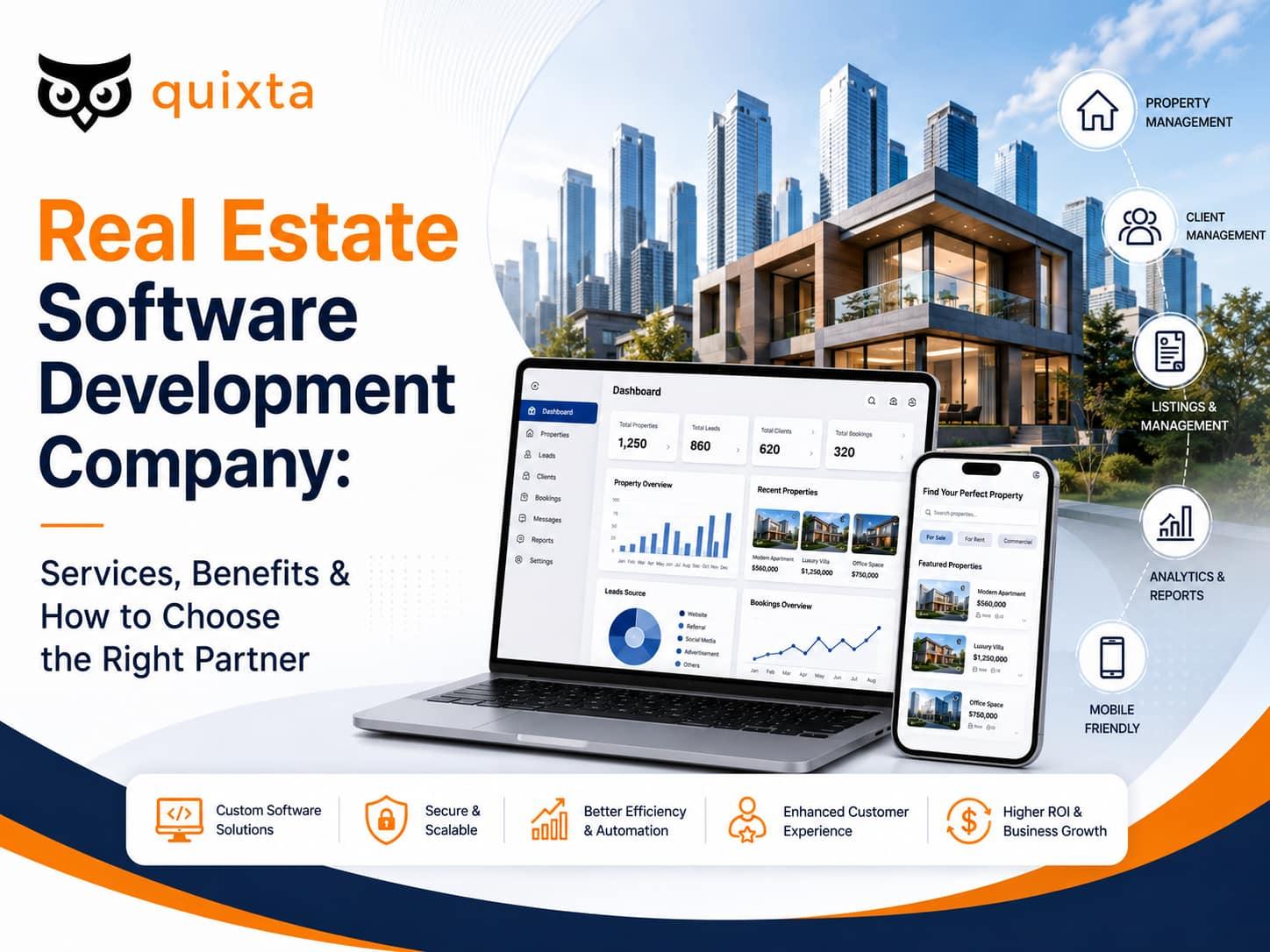
The real estate industry is undergoing a major digital transformation. Property buyers, sellers, agents, brokers, landlords, and property managers increasingly rely on digital platforms to search for properties, manage listings, communicate with customers, process transactions, and analyze market trends. As competition grows, real estate businesses need technology that can simplify operations while delivering better customer experiences.
This is where a Real Estate Software Development Company can help. From property management platforms and real estate marketplaces to CRM systems and mobile applications, specialized software can help businesses automate processes, improve productivity, and create scalable digital experiences.
What Is Real Estate Software Development?
Real estate software development involves designing and building digital solutions specifically for the property industry. These solutions can support different stages of the real estate lifecycle, including property discovery, listing management, sales, leasing, customer relationship management, property administration, and analytics.
Depending on business requirements, a real estate software solution may include:
-
Property listing and management platforms
-
Real estate marketplace applications
-
Property management software
-
Real estate CRM systems
-
Property search websites and mobile apps
-
Agent and broker management platforms
-
Rental management software
-
Real estate investment platforms
-
Virtual property tour applications
-
Real estate analytics and reporting solutions
The goal is to create software that addresses specific business challenges instead of relying entirely on generic tools.
Key Real Estate Software Development Services
A professional development partner can provide a wide range of real estate software development services, from initial planning to post-launch maintenance.
1. Custom Real Estate Software Development
Every real estate business has different workflows and objectives. Custom software can be developed around specific requirements, whether the goal is managing thousands of property listings, improving lead conversion, or automating rental operations.
Custom platforms can include features such as property listings, advanced search, user profiles, document management, notifications, payment integration, dashboards, and reporting.
2. Real Estate CRM Development
Customer relationships are essential for real estate businesses. A CRM can help agents and brokers organize leads, track communications, manage follow-ups, schedule activities, and monitor sales pipelines.
A customized CRM can also integrate with websites, property portals, marketing tools, email platforms, and other business systems.
3. Property Management Software
Property managers often need to coordinate tenants, owners, maintenance teams, rent collection, documentation, and property records.
A property management platform can centralize these activities and provide dashboards that make it easier to monitor properties and manage daily operations.
4. Real Estate Mobile App Development
Mobile applications allow buyers and tenants to search for properties and interact with agents from anywhere. At the same time, agents can use mobile apps to manage listings, respond to leads, schedule property visits, and communicate with customers.
A real estate app may include location-based property searches, filters, maps, image galleries, saved listings, notifications, chat, and appointment scheduling.
5. Real Estate Marketplace Development
Property marketplaces connect buyers and sellers, landlords and tenants, or customers and agents through a single digital platform.
A marketplace can provide property listings, advanced search and filtering, user accounts, agent profiles, inquiry forms, messaging, reviews, payment features, and administrative dashboards.
6. Real Estate Software Integration
Real estate businesses often use multiple systems for marketing, accounting, customer management, payments, property listings, and communication.
Software integration can connect these systems and reduce repetitive data entry. APIs can also enable real-time communication between different platforms, creating a more connected technology ecosystem.
Benefits of Real Estate Software Development
Investing in custom software can provide several advantages for real estate businesses.
Improved Operational Efficiency
Automation can reduce repetitive administrative work. Tasks such as lead assignment, appointment scheduling, notifications, reporting, and property updates can be streamlined through software.
This allows real estate professionals to spend more time on customer relationships and revenue-generating activities.
Better Customer Experience
Today's property buyers and tenants expect convenient digital experiences. They want to search for properties, view images and virtual tours, compare options, contact agents, and schedule visits without unnecessary delays.
A well-designed platform can make the entire property discovery process easier and more engaging.
Centralized Property Data
Real estate software can bring property information, customer details, documents, transactions, and communications into a centralized system.
Having organized information in one place can make it easier for teams to access relevant data and make informed decisions.
Increased Scalability
Off-the-shelf tools may become restrictive as a company grows. Custom software can be designed with scalability in mind, allowing businesses to add new properties, users, locations, integrations, and features over time.
Data-Driven Decision Making
Analytics and reporting tools can provide insights into property performance, customer behavior, lead sources, sales activity, and market trends.
Real estate businesses can use these insights to improve marketing strategies, optimize operations, and identify new opportunities.
Enhanced Security
Real estate platforms may handle personal information, financial data, property documents, and transaction details. Security should therefore be considered throughout the development process.
Features such as role-based access, secure authentication, encryption, activity logs, and secure data storage can help protect sensitive information.
How to Choose the Right Real Estate Software Development Company
Selecting the right technology partner is one of the most important decisions when starting a software project. Consider the following factors before making a decision.
1. Industry Experience
Look for a company that understands real estate workflows and has experience developing property-related digital solutions. Review its portfolio and previous projects to understand its capabilities.
2. Technical Expertise
Your development partner should have expertise across relevant technologies, including web and mobile development, cloud platforms, databases, APIs, cybersecurity, analytics, and third-party integrations.
3. Customization Capabilities
Avoid choosing a company that simply offers the same solution to every client. Your partner should be able to understand your specific business requirements and develop features accordingly.
4. UI/UX Expertise
Real estate platforms are highly visual. Property images, maps, search filters, listings, and property details need to be presented clearly.
A strong UI/UX team can create an intuitive experience that helps users find information quickly and complete actions with minimal friction.
5. Scalability and Performance
Ask how the proposed architecture will handle increasing users, listings, traffic, and data. Scalable cloud infrastructure and efficient application architecture can help ensure consistent performance as your business expands.
6. Communication and Development Process
A reliable development partner should have a transparent process covering discovery, planning, design, development, testing, deployment, and maintenance.
Regular communication and progress updates can help keep the project aligned with business objectives.
7. Post-Launch Support
Software requires ongoing maintenance after launch. Updates, bug fixes, security improvements, performance optimization, and new features may become necessary as business requirements change.
Choose a partner that can provide long-term technical support rather than ending the relationship after deployment.
Why Custom Real Estate Software Can Be a Strategic Investment
Real estate businesses operate in a competitive environment where speed, customer experience, and operational efficiency can influence growth. Generic software can provide basic functionality, but it may not always address the unique workflows of a particular business.
Custom real estate software development services provide greater flexibility. Businesses can prioritize the features that matter most to their operations and gradually expand the platform as their requirements evolve.
For example, a real estate company may initially require property listings and CRM functionality. As the business grows, it could introduce AI-powered recommendations, virtual tours, automated lead scoring, online payments, analytics dashboards, or advanced property management features.
This approach allows technology to evolve alongside the business.
Conclusion
Digital transformation is becoming increasingly important for real estate companies looking to improve efficiency, customer engagement, and competitiveness. From property management systems and CRMs to marketplaces and mobile applications, the right software can simplify complex processes and create better digital experiences.
Choosing an experienced Real Estate Software Development Company can make a significant difference to the success of your project. The ideal partner should combine real estate industry understanding with technical expertise, strong UI/UX capabilities, scalable architecture, security practices, and reliable post-launch support.
By investing in the right real estate software development services, businesses can build technology that not only addresses today's operational challenges but also provides a strong foundation for future growth.
Quixta
Website: https://quixta.com/

 English
 Arabic
 French
 Spanish
 Portuguese
 Deutsch
 Turkish
 Dutch
Dutch
 Russian
 Romaian
 Portuguese (Brazil)
 Greek
Greek
