


Premium Bottled Water Market to Reach USD 84.08 Billion by 2036
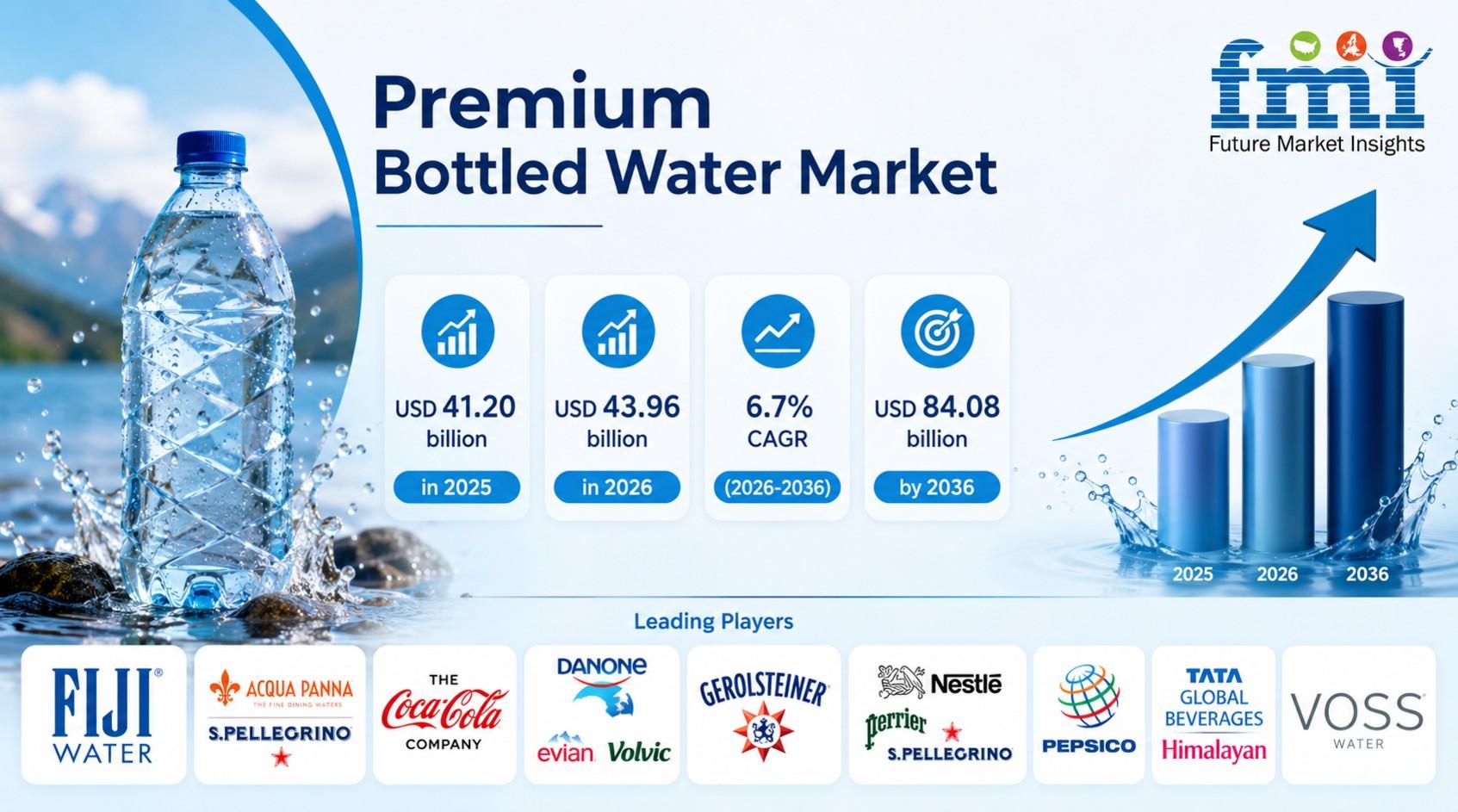
The global premium bottled water market is experiencing a sustained structural expansion as consumers trade up from commodity plastic-packaged water to natural spring and mineral waters with certified geological provenance, according to latest insights by Future Market Insights. Driven by rising health and wellness awareness, the expansion of curated "water menus" in luxury hospitality and fine-dining environments, and strict regulatory classifications (such as EU Directive 2009/54/EC for Natural Mineral Waters), the category is transitioning into a high-value lifestyle and functional beverage segment.
The global market, valued at USD 41.20 billion in 2025, is projected to reach USD 43.96 billion in 2026. Advancing at a Compound Annual Growth Rate (CAGR) of 6.7% over the ten-year forecast period, total market valuation is anticipated to achieve USD 84.08 billion by 2036, delivering an absolute incremental opportunity of USD 40.12 billion.
Request a Sample Report: https://www.futuremarketinsights.com/reports/sample/rep-gb-25948
Market Performance Overview (2026–2036)
To map out the leading product types, core packaging substrates, primary retail distribution channels, and regional growth vectors guiding this USD 40.12 billion market expansion, key segment allocations highlight where global commercial demand is concentrated:
· Spring Water Product Type Segment (28.6% share): Commands product category revenue in 2026, favored for its unadulterated purity, natural mineral balance, and consumer association with protected, remote alpine or volcanic sources.
· Mineral, Sparkling, Flavored, & Functional Waters (71.4% combined share): Represent high-growth and high-margin pillars, with functional water (enhanced with electrolytes, vitamins, collagen, and adaptogens) expanding rapidly as a hybrid between premium hydration and functional wellness.
· Glass Bottles Packaging Segment (52.1% share): Dominates packaging choices over plastic in 2026, serving as an essential tactile and visual luxury signal in hotels, Michelin-starred restaurants, and high-end retail, while addressing anti-plastic sustainability preferences.
· Supermarkets and Hypermarkets Channel (47.0% share): Represents the primary retail volume driver, supported by expanding premium beverage fixtures, dedicated imported water aisles, and grocery home delivery.
· China & India Regional Leadership: Lead national expansion rates at 9.0% CAGR and 8.4% CAGR respectively through 2036, driven by rising disposable incomes, urban lifestyle shifts away from carbonated sodas, and expanding luxury tourism infrastructure.
Technical Drivers and Source Governance
The commercial expansion and premiumization of the bottled water market across retail and hospitality channels are propelled by three primary industry catalysts:
Source Exclusivity and Geological Moats
Unlike purified municipal tap water, premium natural mineral and spring waters are bound to unique, non-replicable subterranean aquifers, glacial springs, or artesian basins. This geological origin creates a natural supply constraint governed by the aquifer's sustainable recharge rate rather than factory bottling speed, supporting inelastic premium pricing.
Hospitality Curation and "Water Sommelier" Menus
Luxury hotels and upscale restaurants across Europe, East Asia, and the Middle East are establishing dedicated water menus. These lists detail Total Dissolved Solids (TDS), pH balance, and mineral profiles (calcium, magnesium, silica), presenting water like fine wine with curated pairings for gourmet dishes.
Sustainable Packaging and Plastic Reduction
With tightening municipal single-use plastic restrictions and extended producer responsibility (EPR) regulations, premium water brands leverage embossed, recyclable glass bottles and infinitely recyclable aluminum formats to project environmental stewardship and superior taste preservation.
Industrial Constraints & Supply Chain Risks
Premium water bottlers, beverage conglomerates, and hospitality procurement directors navigate specific operational hurdles:
· Single-Source Extraction Risks and Climate Vulnerability: Brands tied to a single geographical spring face severe vulnerability to regional droughts, aquifer depletion, regulatory extraction permit caps, or groundwater contamination events, driving leading players toward multi-source acquisition strategies.
· Logistics Weight and Fragility of Glass Packaging: Glass bottles carry significantly higher tare weights and breakability risks compared to PET, inflating maritime shipping and road freight costs by 15% to 25% across long-distance export corridors.
Regional Growth Profile
Regional demand reflects high-velocity urban wealth accumulation in Asia alongside established terroir-driven consumption in Western economies:
· China (9.0% CAGR): The global growth frontrunner, driven by booming demand for imported European waters, domestic high-altitude spring development (e.g., Nongfu Spring premium lines), and digital grocery sales.
· India (8.4% CAGR): Spurring rapid volume expansion through urban modern trade retail, fitness and corporate wellness adoption, and the introduction of natural mineral and alkaline waters by domestic beverage leaders.
· Germany (7.7% CAGR) & France (7.0% CAGR): Anchor the mature European market (which accounts for over 35% of global consumption), supported by long-standing mineral water bathing and drinking traditions, strict EU natural mineral water certifications, and high sparkling water penetration.
· United Kingdom (6.4% CAGR): Expanding through on-premise dining revival, sustainable glass bottle mandates, and functional water innovation.
· United States (5.7% CAGR): Represents a mature, high-value demand center focused on electrolyte-enhanced artesian waters (FIJI, Smartwater), alkaline waters, and luxury glass bottle delivery subscriptions.
· Brazil (5.0% CAGR): Growing through upscale restaurant adoption and expanding retail distribution of regional spring waters.
Competitive Landscape
The global premium bottled water landscape features a mix of multinational beverage conglomerates, traditional European mineral water estates, and niche luxury lifestyle brands.
Key market participants profiled in the report include FIJI Water, Acqua Panna, The Coca-Cola Company (Smartwater), Danone (Evian, Volvic), Gerolsteiner Brunnen GmbH & Co. KG, Nestlé S.A. (Perrier, S.Pellegrino), PepsiCo, Inc., Tata Global Beverages (Himalayan), and Voss Water. Leading houses compete by securing exclusive distribution contracts with five-star hotel chains, developing limited-edition designer bottles, introducing functional electrolyte/botanical infusions, and obtaining third-party carbon-neutral facility certifications.
Exclusive Discounts on Full Report: https://www.futuremarketinsights.com/reports/premium-bottled-water-market
Frequently Asked Questions
What is the projected valuation of the global premium bottled water market by 2036?
The global premium bottled water market is projected to reach USD 84.08 billion by 2036, expanding from an estimated baseline valuation of USD 43.96 billion in 2026 at a CAGR of 6.7%.
Why do Glass Bottles dominate the packaging segment with a 52.1% share?
Glass bottles lead in 2026 because glass acts as a visual and tactile quality signal in fine dining and luxury retail, preserves pure water taste without chemical leaching, and provides a sustainable, recyclable alternative to single-use plastics.
What is the difference between premium bottled water and commodity bottled water?
Commodity bottled water typically consists of treated municipal tap water packaged in lightweight plastic bottles, whereas premium bottled water is sourced directly from protected, certified natural springs or artesian aquifers, featuring distinct natural mineral profiles (TDS) and premium glass or designer packaging.
FMI Custom Research: Strategic Intelligence for Confident Decision-Making
In today's rapidly evolving business environment, leadership teams need clear, actionable intelligence tailored to their strategic objectives. FMI's Custom Research solutions are designed around specific business questions, enabling executives to evaluate growth opportunities, validate investments, assess competitive dynamics, and reduce uncertainty before making critical decisions.
Key Executive Benefits
· Decision-Ready Insights: Research tailored to your specific business challenges, growth plans, and investment priorities.
· Reduced Strategic Risk: Validate market opportunities, customer demand, and competitive positioning before committing resources.
· Market Entry Confidence: Assess opportunity size, regulatory barriers, channel dynamics, and competitive landscapes with precision.
· Competitive Advantage: Gain proprietary intelligence unavailable through syndicated reports or internal datasets.
· Faster Growth Decisions: Accelerate expansion, product development, portfolio optimization, and investment planning.
· Primary Market Validation: Access real-world customer, buyer, and stakeholder insights that support high-confidence decision-making.
Business Impact
FMI helps organizations transform market complexity into strategic clarity, enabling leadership teams to identify growth opportunities faster, optimize resource allocation, strengthen competitive positioning, and make high-stakes business decisions with confidence.
To explore how FMI Custom Research can support your strategic priorities, connect with our team at - sales@futuremarketinsights.com
About Future Market Insights (FMI)
Future Market Insights (FMI) delivers actionable, decision-focused market intelligence that goes beyond traditional research reports. The company provides:
· In-depth pricing and cost benchmarking analysis
· Demand forecasting based on real industry inputs
· Procurement and buyer behavior insights
· Supply chain and trade flow intelligence
· Technology and application trend analysis across industries
FMI follows a robust bottom-up research methodology, combining insights from industry experts, procurement leaders, manufacturers, and technical professionals to ensure accurate and practical market intelligence.

 English
 Arabic
 French
 Spanish
 Deutsch
 Turkish
 Dutch
Dutch
 Italiano
 Russian
 Romaian
 Portuguese (Brazil)
 Greek
Greek
