When a couple is preparing for IVF, attention often focuses on egg quality, embryo development and the woman's reproductive health. However, sperm quality is also an important part of the fertility picture.
A standard semen analysis evaluates characteristics such as sperm concentration, movement and morphology. But these measurements do not directly show whether the genetic material inside sperm is damaged.
This is where sperm DNA fragmentation and IVF become relevant.
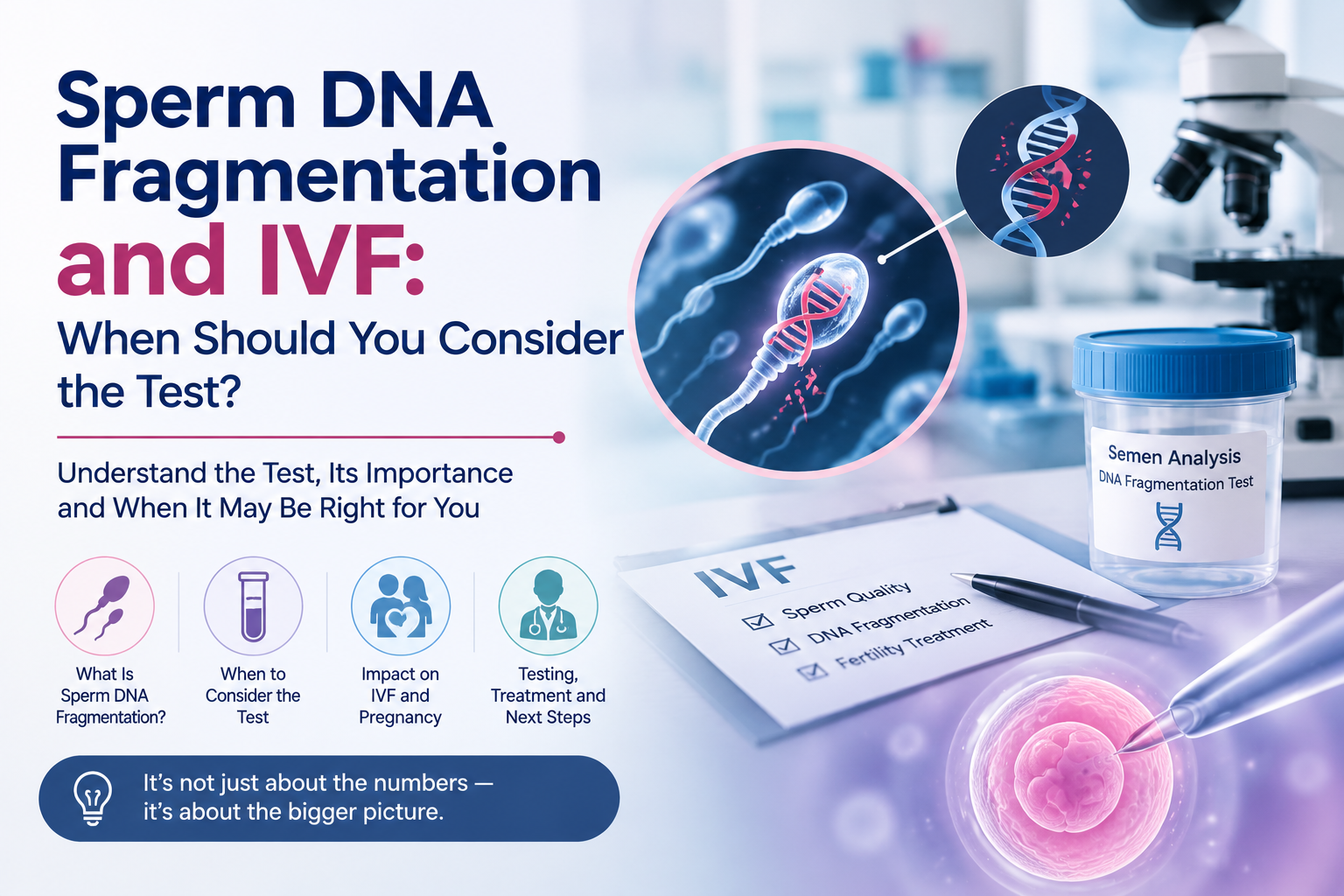
A sperm DNA fragmentation test evaluates damage or breaks in the DNA carried by sperm. Higher levels of DNA fragmentation have been associated with some adverse reproductive outcomes, although the clinical usefulness of testing varies between patients and situations.
Importantly, sperm DNA fragmentation testing is not recommended as a routine test for every couple starting IVF. Current AUA/ASRM guidance does not recommend it as part of the initial infertility evaluation, while it specifically recommends considering the test in couples experiencing recurrent pregnancy loss.
Understanding when the test may be useful—and when it may not be—can help couples make more informed decisions about fertility testing.
What Is Sperm DNA Fragmentation?
Sperm DNA fragmentation refers to breaks or damage in the DNA contained within sperm cells.
Sperm deliver half of the genetic material needed to create an embryo. Although the egg has mechanisms that can repair some types of sperm DNA damage, higher levels of fragmentation may affect reproductive outcomes in certain circumstances.
DNA fragmentation is different from the standard parameters measured in a semen analysis.
A routine semen analysis generally looks at:
- Sperm concentration
- Sperm motility
- Sperm morphology
- Semen volume
- Other basic semen characteristics
A man can have a relatively normal semen analysis while still having elevated sperm DNA fragmentation.
This is one reason sperm DNA fragmentation and IVF may be discussed when a couple experiences unexpected fertility difficulties despite apparently acceptable conventional semen parameters.
What Is a Sperm DNA Fragmentation Test?
A sperm DNA fragmentation test measures the proportion or extent of sperm carrying damaged DNA.
Several laboratory techniques can be used, including:
- Sperm Chromatin Structure Assay (SCSA)
- TUNEL assay
- Sperm Chromatin Dispersion (SCD)
- Comet assay
These tests do not all measure DNA damage in exactly the same way, and results can vary depending on the testing method and laboratory. ASRM laboratory guidance recognises several methods for assessing sperm DNA fragmentation.
Some reports provide a DNA Fragmentation Index (DFI) or another numerical measurement. However, there is no single universally applicable cutoff that can be interpreted identically across every test and laboratory.
Therefore, a sperm DNA fragmentation result should be interpreted by a fertility specialist rather than viewed as an isolated pass-or-fail number.
How Is Sperm DNA Fragmentation Different from a Semen Analysis?
This is an important distinction.
A semen analysis evaluates the physical characteristics of sperm and semen.
A DNA fragmentation test evaluates the integrity of sperm DNA.
For example, sperm may have:
- Normal concentration
- Good motility
- Acceptable morphology
while still showing increased DNA fragmentation.
Conversely, abnormal semen parameters do not automatically mean that DNA fragmentation is high.
The two tests therefore provide different information and should not be considered interchangeable.
Does Sperm DNA Fragmentation Affect IVF?
Research has found associations between elevated sperm DNA fragmentation and certain reproductive outcomes, including pregnancy loss and some forms of assisted reproduction failure. However, the relationship is complex, and a high result does not mean that IVF cannot succeed.
The AUA/ASRM guideline notes that very high sperm DNA fragmentation may have a greater adverse impact on pregnancy outcomes with IVF and may be associated with an increased risk of miscarriage. However, the guideline also highlights limitations in the evidence, including differences between testing methods and cutoff values.
This means sperm DNA fragmentation and IVF should be viewed as one part of a broader fertility assessment rather than as a standalone explanation for treatment failure.
When Should You Consider a Sperm DNA Fragmentation Test?
Because the test is not routinely recommended for every fertility patient, the decision should be based on the couple's clinical history.
1. Recurrent Pregnancy Loss
One of the clearest situations in which sperm DNA fragmentation testing may be considered is recurrent pregnancy loss (RPL).
The AUA/ASRM guideline recommends evaluating the male partner for sperm DNA fragmentation in couples with recurrent pregnancy loss. It notes that higher sperm DNA fragmentation is associated with pregnancy loss.
If a couple has experienced repeated miscarriages without an obvious explanation, discussing sperm DNA fragmentation with a fertility specialist may therefore be reasonable.
2. Repeated IVF Failure
Some couples may consider testing after repeated unsuccessful IVF attempts, particularly when other potential causes have been evaluated.
However, it is important not to assume that sperm DNA fragmentation is responsible for every failed embryo transfer.
Current ASRM guidance on recurrent implantation failure states that sperm DNA fragmentation testing is not currently recommended routinely in this setting because there is insufficient evidence that testing or treatment improves live-birth outcomes.
Therefore, repeated IVF failure should generally prompt a comprehensive review rather than automatically leading to a DNA fragmentation test.
3. Unexplained Infertility
A fertility specialist may sometimes discuss advanced sperm testing when standard fertility evaluation does not explain the difficulty conceiving.
However, ASRM does not recommend advanced sperm function testing, including DNA fragmentation testing, as part of the routine initial infertility evaluation without a specific clinical indication.
The decision should therefore be individualised.
4. Significant Male-Factor Concerns
In some cases, a specialist may consider sperm DNA fragmentation alongside a conventional semen analysis when there are significant male-factor fertility concerns.
The purpose is not simply to add another test but to determine whether the result could meaningfully change the treatment strategy.
What Can Cause Sperm DNA Damage?
Several factors may be associated with increased sperm DNA damage.
Potential contributors include:
- Oxidative stress
- Varicocele
- Smoking
- Certain infections or inflammation
- Advanced paternal age
- Heat exposure
- Some medical conditions
- Environmental exposures
- Certain medications or treatments
- Poor overall health
However, identifying a possible risk factor does not automatically mean it is the cause of an individual's elevated DNA fragmentation.
A male fertility specialist can help assess the patient's medical history, lifestyle and reproductive history to identify potentially modifiable factors.
Can Sperm DNA Fragmentation Be Reduced?
In some situations, doctors may identify potentially modifiable contributors to sperm DNA damage.
Depending on the cause, management may involve:
- Stopping smoking
- Addressing significant alcohol or substance use
- Managing medical conditions
- Treating certain infections when present
- Evaluating and treating a clinically significant varicocele
- Improving general lifestyle habits
- Reviewing medications with a healthcare professional
- Considering the timing and frequency of ejaculation
The AUA/ASRM guideline notes that reduced abstinence may be considered as an intervention to limit sperm DNA damage in some circumstances.
However, there is no universally proven treatment that guarantees a reduction in DNA fragmentation or improved IVF outcomes.
Can Antioxidants Improve Sperm DNA Fragmentation?
Antioxidants are frequently marketed for male fertility and sperm health.
Oxidative stress is one mechanism that may contribute to sperm DNA damage, which is why antioxidant supplements have attracted interest.
However, evidence regarding fertility supplements is not conclusive enough to recommend a specific supplement regimen for every man with elevated sperm DNA fragmentation.
Patients should speak with their fertility specialist before taking high-dose supplements, particularly if they are already taking medications or have underlying health conditions.
What Happens If the Test Shows High DNA Fragmentation?
A high result does not mean that IVF is impossible.
Instead, the fertility specialist may review the entire reproductive history and determine whether there are identifiable causes that should be addressed.
Depending on the situation, the discussion may include:
- Repeating the test when appropriate
- Reviewing lifestyle and medical factors
- Evaluating for varicocele
- Reviewing previous IVF fertilisation and embryo-development results
- Considering different sperm-selection or fertilisation strategies
- Discussing ICSI in appropriate circumstances
- Considering testicular sperm retrieval in selected cases
Importantly, these options are not appropriate for everyone with a high DNA fragmentation result.
For example, evidence supporting specific interventions to improve live-birth outcomes in couples with high sperm DNA fragmentation remains limited.
Can ICSI Help With Sperm DNA Fragmentation?
Intracytoplasmic sperm injection (ICSI) involves injecting a single sperm directly into an egg.
ICSI is commonly used when there is significant male-factor infertility or previous fertilisation problems.
It may also be discussed in certain cases involving sperm DNA fragmentation. However, using ICSI does not automatically eliminate DNA damage in sperm.
The decision to use ICSI should depend on the couple's individual circumstances.
ASRM's 2026 committee opinion notes that ICSI is well established for overcoming low or absent fertilisation in couples with clear sperm abnormalities, but its routine use for other indications is less certain.
What About Using Testicular Sperm?
In selected men with elevated sperm DNA fragmentation, a fertility specialist may discuss retrieving sperm directly from the testicle and using it with ICSI.
The reasoning is that sperm retrieved from the testicle may have different levels of DNA damage compared with ejaculated sperm in certain situations.
However, this approach is not a standard solution for everyone with high sperm DNA fragmentation. Evidence is still developing, and the procedure has its own considerations.
A male reproductive specialist should evaluate whether this approach is appropriate.
Should Everyone Undergoing IVF Have a DNA Fragmentation Test?
No.
This is one of the most important points about sperm DNA fragmentation and IVF.
Routine DNA fragmentation testing is not currently recommended for every man undergoing IVF.
The AUA/ASRM guideline specifically states that sperm DNA fragmentation analysis is not recommended during the initial evaluation of an infertile couple.
Similarly, ASRM's fertility evaluation guidance lists advanced sperm function testing, including DNA fragmentation testing, among tests that should not routinely be ordered without a specific indication.
The test is more likely to be considered when there is a particular clinical question—for example, recurrent pregnancy loss.
What Other Male Fertility Tests May Be Needed?
Before moving to advanced testing, doctors generally begin with a detailed medical and reproductive history and a conventional semen analysis.
Depending on the results, additional evaluation may include:
Semen Analysis
This remains a fundamental part of male fertility evaluation.
Physical Examination
A male reproductive specialist may look for conditions such as varicocele or other abnormalities.
Hormonal Testing
Hormone testing may be recommended when semen parameters or medical history suggest an endocrine problem.
Genetic Testing
In certain severe male-factor conditions, genetic testing may be appropriate.
Sperm DNA Fragmentation Testing
This is considered selectively rather than as a routine first-line test.
A structured evaluation can help prevent unnecessary testing and ensure that the results will actually influence treatment decisions.
Frequently Asked Questions About Sperm DNA Fragmentation and IVF
Is sperm DNA fragmentation testing necessary before IVF?
Not for everyone. Current AUA/ASRM and ASRM guidance does not recommend routine sperm DNA fragmentation testing as part of the initial infertility evaluation.
When should sperm DNA fragmentation testing be done?
It may be considered in selected situations, particularly couples experiencing recurrent pregnancy loss. Your fertility specialist can determine whether the test is appropriate based on your history.
Can high sperm DNA fragmentation cause IVF failure?
High sperm DNA fragmentation may be associated with some adverse reproductive outcomes, but it does not prove that sperm DNA damage caused a particular IVF failure. Other factors can affect fertilisation, embryo development and implantation.
Can sperm DNA fragmentation be treated?
Potential contributors such as smoking, certain medical conditions or varicocele may sometimes be addressed. However, there is no single treatment guaranteed to normalise sperm DNA fragmentation or improve IVF outcomes.
Does a normal semen analysis mean sperm DNA is healthy?
Not necessarily. A conventional semen analysis and DNA fragmentation test measure different characteristics.
Can IVF work with high sperm DNA fragmentation?
Yes. A high sperm DNA fragmentation result does not mean that IVF cannot result in pregnancy. Treatment decisions should be based on the complete clinical picture.
Is sperm DNA fragmentation testing recommended after recurrent pregnancy loss?
Yes, it can be considered. AUA/ASRM guidance specifically recommends sperm DNA fragmentation evaluation in couples with recurrent pregnancy loss.
Final Thoughts
Sperm DNA fragmentation and IVF is an increasingly discussed topic in fertility care, but the test should not automatically be included in every IVF evaluation.
A conventional semen analysis remains an important part of assessing male fertility, while sperm DNA fragmentation provides additional information about the integrity of sperm genetic material.
Testing may be particularly relevant in situations such as recurrent pregnancy loss, while routine testing before an initial IVF cycle is generally not recommended by current professional guidance.
If you have experienced repeated miscarriages, unexplained fertility difficulties or unsuccessful IVF treatment, discuss your history with a fertility specialist or male reproductive specialist. They can determine whether sperm DNA fragmentation testing is likely to provide useful information and whether the result would actually change your treatment plan.
A high DNA fragmentation result is not a verdict on fertility. It is one piece of information that may help your fertility team understand the bigger picture and choose an appropriate treatment strategy.




 English
 Arabic
 French
 Spanish
 Portuguese
 Deutsch
 Turkish
 Dutch
Dutch
 Italiano
 Romaian
 Portuguese (Brazil)
 Greek
Greek
