


Uncooked Pasta and Noodles Market to Reach USD 110.22 Billion by 2036
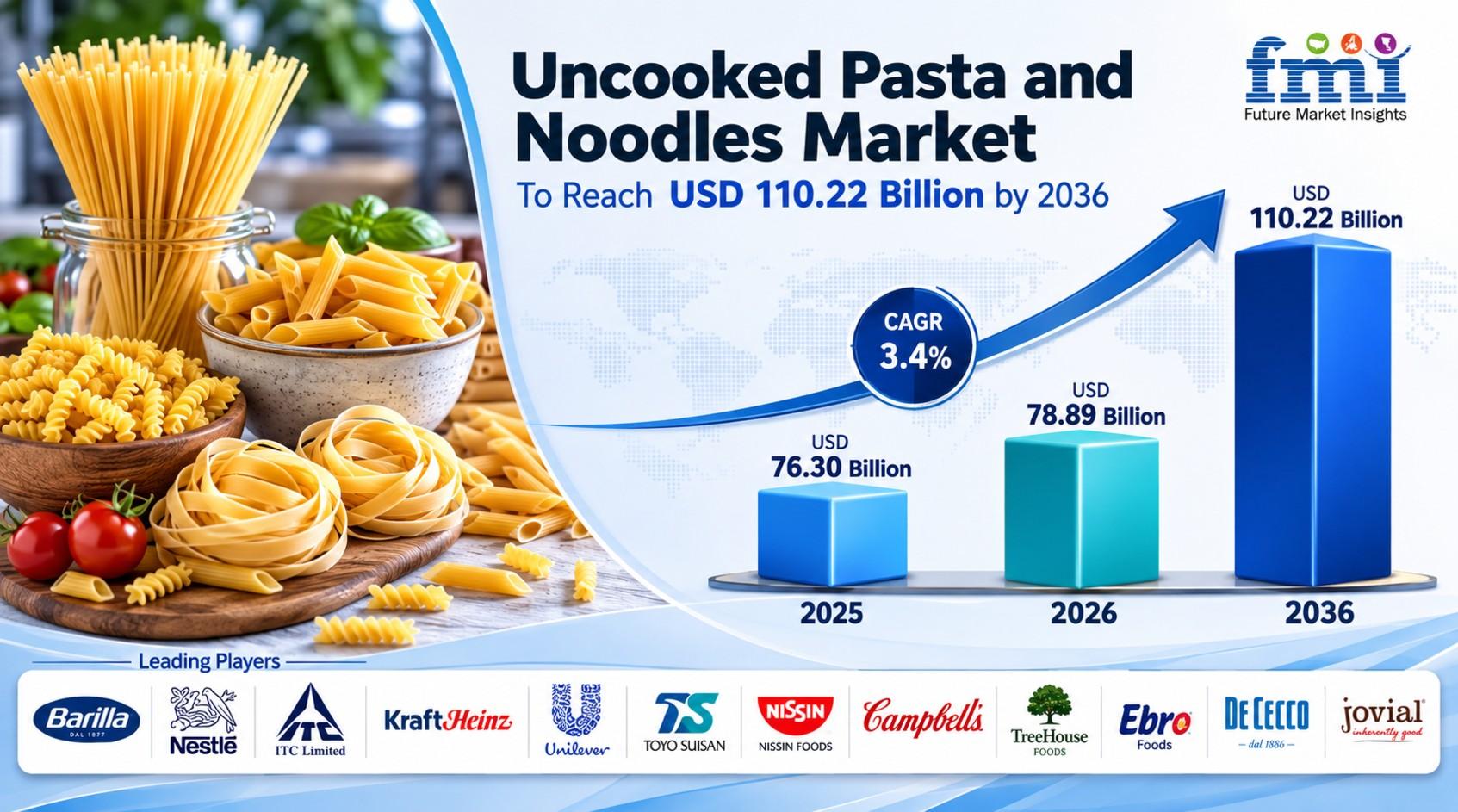
The global uncooked pasta and noodles market is undergoing sustained structural expansion, transitioning from a low-cost culinary staple into a diversified category characterized by premium fresh merchandising, dietary specialty reformulations, and urban convenience demand, according to latest insights by Future Market Insights. Driven by global population growth, fast-paced urban lifestyles, expanding modern grocery retail infrastructure, and rising consumer adoption of international Italian-style and Asian noodle cuisines, manufactured dry, ambient, and chilled pasta products remain fundamental pantry essentials worldwide.
The global market, valued at USD 76.30 billion in 2025, is projected to reach USD 78.89 billion in 2026. Advancing at a Compound Annual Growth Rate (CAGR) of 3.4% over the ten-year forecast period, total market valuation is anticipated to achieve USD 110.22 billion by 2036, delivering an absolute incremental opportunity of USD 31.33 billion.
Request a Sample Report: https://www.futuremarketinsights.com/reports/sample/rep-gb-25953
Market Performance Overview (2026–2036)
To map out the leading product formats, dominant raw material sources, primary retail distribution channels, and regional growth vectors guiding this USD 31.33 billion market expansion, key segment allocations highlight where global commercial demand is concentrated:
· Dried Pasta and Noodles Form Segment (46.7% share): Commands the product form category in 2026, driven by its multi-year ambient shelf stability, cost-effective per-serving economics, minimal shipping constraints, and universal pantry-ready positioning.
· Chilled/Frozen & Ambient Formats (53.3% combined share): Represent high-growth and premium segments, with chilled fresh pasta (e.g., stuffed ravioli, tortellini, fresh tagliatelle) expanding rapidly across European and North American supermarket perimeter sections at price points $2\times$ to $3\times$ higher than dried equivalents.
· Semolina Raw Material Segment (38.9% share): Leads raw material consumption in 2026, favored for its high protein concentration, optimal gluten matrix, and superior al dente cooking resilience across commercial extrusion lines.
· Supermarkets and Hypermarkets Distribution Channel (54.2% share): Dominates retail sales volume in 2026, supported by extensive center-store dry pasta planograms, dedicated fresh pasta refrigerated displays, and high private-label penetration.
· China & India Regional Leadership: Lead national expansion rates at 4.6% CAGR and 4.3% CAGR respectively through 2036, driven by rapid urbanization, westernized dietary adoption among younger demographics, and modern trade supermarket expansion.
Technical Drivers and Product Formulation Shifts
The commercial growth and premiumization of uncooked pasta and noodles across retail and foodservice supply chains are propelled by three primary industry catalysts:
Urbanization and Meal Preparation Time Compression
In high-growth emerging economies across East and South Asia, urban workforce expansion has compressed domestic cooking time. Manufactured dry and fresh pasta/noodle products provide versatile, shelf-stable, and rapid-cooking meal foundations that integrate easily into traditional stir-fries, curries, and modern Italian dishes.
Category Bifurcation (Commodity Volume vs. Premium Fresh)
The market operates on a dual-tier structure:
1. Commodity Dry Pasta: High-volume, price-sensitive center-store dry pasta with heavy private-label penetration where profitability is dictated by durum wheat procurement discipline and large-scale automated extrusion efficiency.
2. Premium Fresh & Stuffed Pasta: High-margin chilled pasta in supermarket refrigerated perimeters, where artisanal brand storytelling, protected geographic origin (PGI/PDO), and gourmet fillings drive consumer trade-up.
Health-Conscious, Gluten-Free, and Legume Reformulation
Consumers managing celiac disease, wheat sensitivities, or high-protein/low-glycemic diets are driving substantial demand for alternative-grain pasta. Formulations utilizing chickpea, red lentil, brown rice, and pea flours provide high fiber and plant-protein density while modern extrusion technologies eliminate the crumbly texture historically associated with gluten-free pasta.
Industrial Constraints & Commodity Volatility
Pasta and noodle manufacturers, commercial grain millers, and grocery buyers navigate specific operational hurdles:
· Durum Wheat Harvest and Milling Volatility: Sourcing high-protein durum wheat (Triticum durum) leaves manufacturers vulnerable to agricultural weather shocks, droughts in major wheat-growing belts (North America, Mediterranean), and international export tariffs.
· Short Shelf-Life and Cold-Chain Costs for Fresh Pasta: Unlike ambient dried noodles, chilled and stuffed fresh pasta formats require continuous cold-chain logistics and modified atmosphere packaging (MAP) to prevent mold growth and maintain barrier integrity across a 30-to-60-day shelf-life window.
Regional Growth Profile
Regional demand reflects high-velocity dietary diversification in Asia alongside premiumization and replacement demand across Western markets:
· China (4.6% CAGR): The global growth frontrunner, driven by rising disposable incomes, expanding modern trade grocery, and urban consumer integration of western-style pasta and specialty noodle formats.
· India (4.3% CAGR): Spurring rapid volume growth through urban convenience adoption, domestic manufacturing of fortified and multigrain pasta variants, and rapid QSR/café menu integration.
· Germany (3.9% CAGR) & France (3.6% CAGR): Lead European demand, characterized by high per-capita pasta consumption, strong demand for organic/clean-label durum semolina, and expanding retail shelf space for fresh gourmet pasta.
· United Kingdom (3.2% CAGR): Driven by convenience-oriented quick-cook meals, supermarket private-label lines, and gluten-free/legume pasta adoption.
· United States (2.9% CAGR): Represents a mature, high-value demand center supported by steady staple consumption, specialty organic/non-GMO pasta lines, and meal kit subscription partnerships.
· Brazil (2.6% CAGR): Growing through the modernization of domestic wheat milling infrastructure and expanding retail distribution in metropolitan centers.
Competitive Landscape
The global uncooked pasta and noodles landscape is characterized by multinational food conglomerates, traditional Italian pasta houses, Asian noodle specialists, and private-label copackers.
Key market participants profiled in the report include Barilla Group, Nestlé S.A., ITC Limited, The Kraft Heinz Company, Unilever, Toyo Suisan Kaisha, Ltd., Nissin Foods Holdings Co., Ltd., Campbell Soup Company, TreeHouse Foods, Ebro Foods, S.A., Pastificio De Cecco S.p.A., and Jovial Foods. Leading players compete by securing direct durum wheat contract farming, investing in high-speed bronze-die extrusion machinery, expanding gluten-free/legume-based product lines, and deploying sustainable, fully recyclable paperboard packaging.
Exclusive Discounts on Full Report: https://www.futuremarketinsights.com/reports/uncooked-pasta-and-noodles-market
Frequently Asked Questions
What is the projected valuation of the global uncooked pasta and noodles market by 2036?
The global uncooked pasta and noodles market is projected to reach USD 110.22 billion by 2036, expanding from an estimated baseline valuation of USD 78.89 billion in 2026 at a CAGR of 3.4%.
Why does Dried Pasta and Noodles lead the Form category with a 46.7% share?
Dried pasta and noodles dominate in 2026 due to their long ambient shelf stability, low cost per serving, ease of international bulk transportation, and universal status as a foundational pantry staple for home cooking.
What raw material accounts for the largest share of pasta production?
Semolina leads the raw material category with a 38.9% market share in 2026, favored for its high protein content, optimal gluten structure, and ability to deliver authentic al dente cooking performance.
FMI Custom Research: Strategic Intelligence for Confident Decision-Making
In today's rapidly evolving business environment, leadership teams need clear, actionable intelligence tailored to their strategic objectives. FMI's Custom Research solutions are designed around specific business questions, enabling executives to evaluate growth opportunities, validate investments, assess competitive dynamics, and reduce uncertainty before making critical decisions.
Key Executive Benefits
· Decision-Ready Insights: Research tailored to your specific business challenges, growth plans, and investment priorities.
· Reduced Strategic Risk: Validate market opportunities, customer demand, and competitive positioning before committing resources.
· Market Entry Confidence: Assess opportunity size, regulatory barriers, channel dynamics, and competitive landscapes with precision.
· Competitive Advantage: Gain proprietary intelligence unavailable through syndicated reports or internal datasets.
· Faster Growth Decisions: Accelerate expansion, product development, portfolio optimization, and investment planning.
· Primary Market Validation: Access real-world customer, buyer, and stakeholder insights that support high-confidence decision-making.
Business Impact
FMI helps organizations transform market complexity into strategic clarity, enabling leadership teams to identify growth opportunities faster, optimize resource allocation, strengthen competitive positioning, and make high-stakes business decisions with confidence.
To explore how FMI Custom Research can support your strategic priorities, connect with our team at - sales@futuremarketinsights.com
About Future Market Insights (FMI)
Future Market Insights (FMI) delivers actionable, decision-focused market intelligence that goes beyond traditional research reports. The company provides:
· In-depth pricing and cost benchmarking analysis
· Demand forecasting based on real industry inputs
· Procurement and buyer behavior insights
· Supply chain and trade flow intelligence
· Technology and application trend analysis across industries
FMI follows a robust bottom-up research methodology, combining insights from industry experts, procurement leaders, manufacturers, and technical professionals to ensure accurate and practical market intelligence.

 English
 Arabic
 French
 Spanish
 Portuguese
 Deutsch
 Turkish
 Dutch
Dutch
 Italiano
 Romaian
 Portuguese (Brazil)
 Greek
Greek
