


How US Enterprises Can Modernize Their Content Operations with Adobe Experience Manager
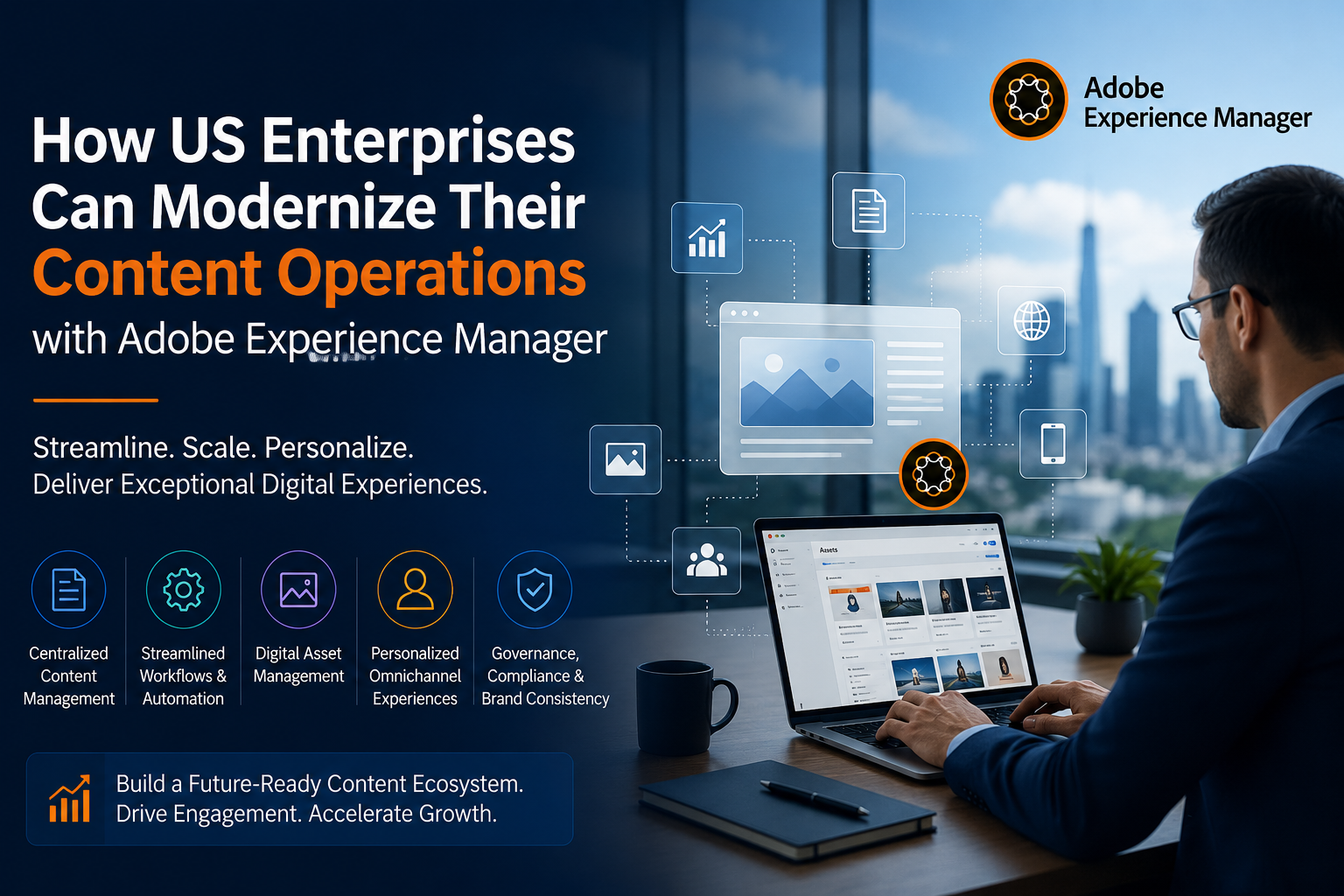
For large US enterprises, managing digital content has become increasingly complex. Organizations often operate multiple websites, mobile applications, regional experiences, commerce platforms, and customer touchpoints while trying to maintain consistent brand messaging. At the same time, customers expect relevant, fast, personalized, and seamless digital experiences across every channel.
Traditional content management approaches can struggle to meet these expectations. Disconnected systems, manual workflows, duplicated content, slow publishing processes, and limited collaboration can prevent marketing and digital teams from responding quickly to changing customer needs.
This is where Adobe Experience Manager services can help enterprises modernize their content operations. Adobe Experience Manager (AEM) provides a scalable platform for managing, creating, organizing, delivering, and optimizing digital content across channels. By combining structured content management, digital asset management, personalization capabilities, and workflow automation, enterprises can build a more efficient content ecosystem.
Why US Enterprises Need Modern Content Operations
Content operations involve much more than publishing web pages. Enterprise teams must manage content creation, approvals, localization, asset management, compliance, distribution, analytics, and ongoing optimization.
For organizations operating across the United States and international markets, these challenges become even more significant. Different business units may use separate tools and processes, making it difficult to maintain consistency. Marketing teams may also depend on developers for simple content changes, increasing publishing timelines.
A modern content operation should allow teams to:
-
Create and reuse content efficiently
-
Maintain consistent brand standards
-
Automate approval and publishing workflows
-
Manage digital assets from a centralized environment
-
Deliver content across multiple channels
-
Support personalization and customer experiences
-
Scale content production without proportionally increasing operational costs
Adobe Experience Manager services can provide the technological foundation for achieving these objectives.
Centralizing Enterprise Content Management
One of the biggest advantages of modernizing with AEM is the ability to bring content management into a more unified environment.
Large organizations frequently have thousands of pages, documents, images, videos, product assets, and other digital resources. Without centralized governance, teams may create duplicate assets or use outdated versions of content.
AEM helps organizations establish structured content repositories and standardized workflows. Teams can organize content according to business requirements while making approved resources easier to discover and reuse.
This can be particularly valuable for enterprises with multiple departments, brands, locations, or business units. Instead of every team developing its own content process, organizations can establish common standards while allowing appropriate flexibility.
Streamlining Content Creation and Publishing
Speed is increasingly important in digital marketing. When a campaign, product update, or regulatory change needs to go live, lengthy manual processes can create unnecessary delays.
Adobe Experience Manager services can help simplify content creation and publishing by supporting reusable components, templates, workflows, and authoring capabilities.
Marketing teams can work with predefined page structures and approved components instead of building every experience from scratch. Content can move through defined review and approval stages before publication, reducing the risk of inconsistent or unauthorized updates.
For enterprises, this creates a more predictable content lifecycle:
Create → Review → Approve → Publish → Analyze → Optimize
A structured process helps marketing, legal, compliance, design, and development teams collaborate more effectively.
Improving Digital Asset Management
Images, videos, PDFs, graphics, product photography, documents, and other media are critical components of modern digital experiences. However, managing these assets across different systems can become difficult as organizations grow.
AEM's digital asset management capabilities can help enterprises establish a centralized approach to organizing and managing digital assets.
Teams can improve asset discoverability through metadata, categorization, and standardized naming practices. Centralized management can also help organizations reduce duplication and make it easier for teams to identify approved assets.
This becomes especially useful for US enterprises managing multiple campaigns or regional websites. Instead of repeatedly recreating assets, teams can reuse existing materials while maintaining brand consistency.
Creating Consistent Omnichannel Experiences
Customers rarely interact with a company through only one channel. A typical journey may begin with a search engine, continue on a website, move to a mobile experience, and eventually involve email, social media, or another digital touchpoint.
A modern content strategy therefore needs to support omnichannel delivery.
Adobe Experience Manager services can help enterprises create content that can be adapted and delivered across different digital experiences. Structured content and reusable components can reduce the need to manually recreate the same information for every channel.
This approach helps organizations maintain consistent messaging while adapting content to the requirements of individual platforms.
For enterprise marketing teams, the objective is not simply to publish more content. It is to make existing content more useful, reusable, and accessible across the customer journey.
Supporting Personalization at Enterprise Scale
Modern customers increasingly expect brands to understand their interests and provide relevant experiences. Generic content can make digital interactions feel disconnected, particularly for organizations serving large and diverse customer bases.
AEM can work as part of a broader Adobe technology ecosystem to support personalized digital experiences.
Enterprises can use audience insights, behavioral information, and customer data to determine which content or experience is most relevant to different audiences. When integrated with other Adobe Experience Cloud solutions, organizations can create a more connected approach to personalization.
For example, a financial services company could present different content to first-time visitors and existing customers. Similarly, a retailer could adapt experiences based on customer interests, product interactions, or previous engagement.
Personalization becomes more effective when content operations and customer data work together rather than operating as separate functions.
Automating Enterprise Content Workflows
Manual processes can consume significant amounts of time. A content update may require coordination between writers, designers, marketers, developers, legal teams, and regional stakeholders.
Without workflow automation, these processes can become difficult to track.
Adobe Experience Manager services can help enterprises establish structured workflows for activities such as content review, approval, asset management, and publishing. Clearly defined responsibilities can reduce bottlenecks and improve accountability.
Automation does not mean removing human oversight. Instead, it allows teams to automate repetitive steps while keeping important decisions under appropriate human control.
This can help content teams spend more time on strategy, creativity, and optimization rather than administrative tasks.
Strengthening Governance and Brand Consistency
Enterprise content must often comply with brand guidelines, legal requirements, accessibility standards, and industry-specific policies.
As organizations scale, maintaining these standards manually becomes increasingly challenging.
AEM can support governance through reusable templates, components, workflows, permissions, and structured content practices. Enterprises can establish centralized standards while giving authorized teams the ability to create and update content efficiently.
For national and global organizations, this balance is particularly important. Local teams may need flexibility to address regional audiences, while corporate teams need visibility and control over brand standards.
A structured content operation makes it easier to achieve both objectives.
Using Data to Improve Content Performance
Modern content operations should not end when content is published. Enterprises need to understand how customers interact with content and use those insights to improve future experiences.
Integration between AEM and other Adobe Experience Cloud technologies can provide organizations with opportunities to connect content management with analytics, customer journey insights, experimentation, and personalization.
Teams can evaluate which content performs well, where customers encounter friction, and which experiences need improvement.
This creates a continuous optimization cycle:
Publish → Measure → Learn → Improve → Republish
Instead of treating content as a one-time marketing deliverable, enterprises can manage it as an ongoing business asset.
Making AEM Implementation Successful
Technology alone does not modernize content operations. Enterprises also need the right strategy, governance model, workflows, and implementation approach.
Before implementing AEM, organizations should assess their existing content ecosystem and identify major operational challenges. This may include disconnected platforms, duplicate assets, inefficient approval processes, outdated templates, or inconsistent content standards.
A phased implementation can often reduce complexity. Enterprises can begin with high-priority websites, content repositories, or business units before expanding the platform across the organization.
Working with experienced Adobe Experience Manager services providers can also help organizations plan architecture, migration, integrations, governance, training, and ongoing optimization.
Conclusion
For US enterprises, modern content operations are essential for delivering consistent, personalized, and scalable digital experiences. Managing content through disconnected tools and manual processes can limit agility and create unnecessary operational complexity.
Adobe Experience Manager services can help organizations build a centralized, scalable, and structured content ecosystem. From content creation and digital asset management to workflow automation, omnichannel delivery, personalization, governance, and performance optimization, AEM can support the evolving requirements of enterprise digital teams.
The organizations that gain the most value from AEM will not simply use it as another content management platform. They will use it as part of a broader digital experience strategy—connecting people, processes, content, data, and technology to create faster and more relevant customer experiences.
For US enterprises looking to modernize their content operations, adopting a structured AEM strategy can be an important step toward building a more agile and future-ready digital organization.

 English
 Arabic
 French
 Spanish
 Portuguese
 Deutsch
 Turkish
 Dutch
Dutch
 Italiano
 Russian
 Portuguese (Brazil)
 Greek
Greek
