


Whey Protein Ingredients Market to Reach USD 38.60 Billion by 2036
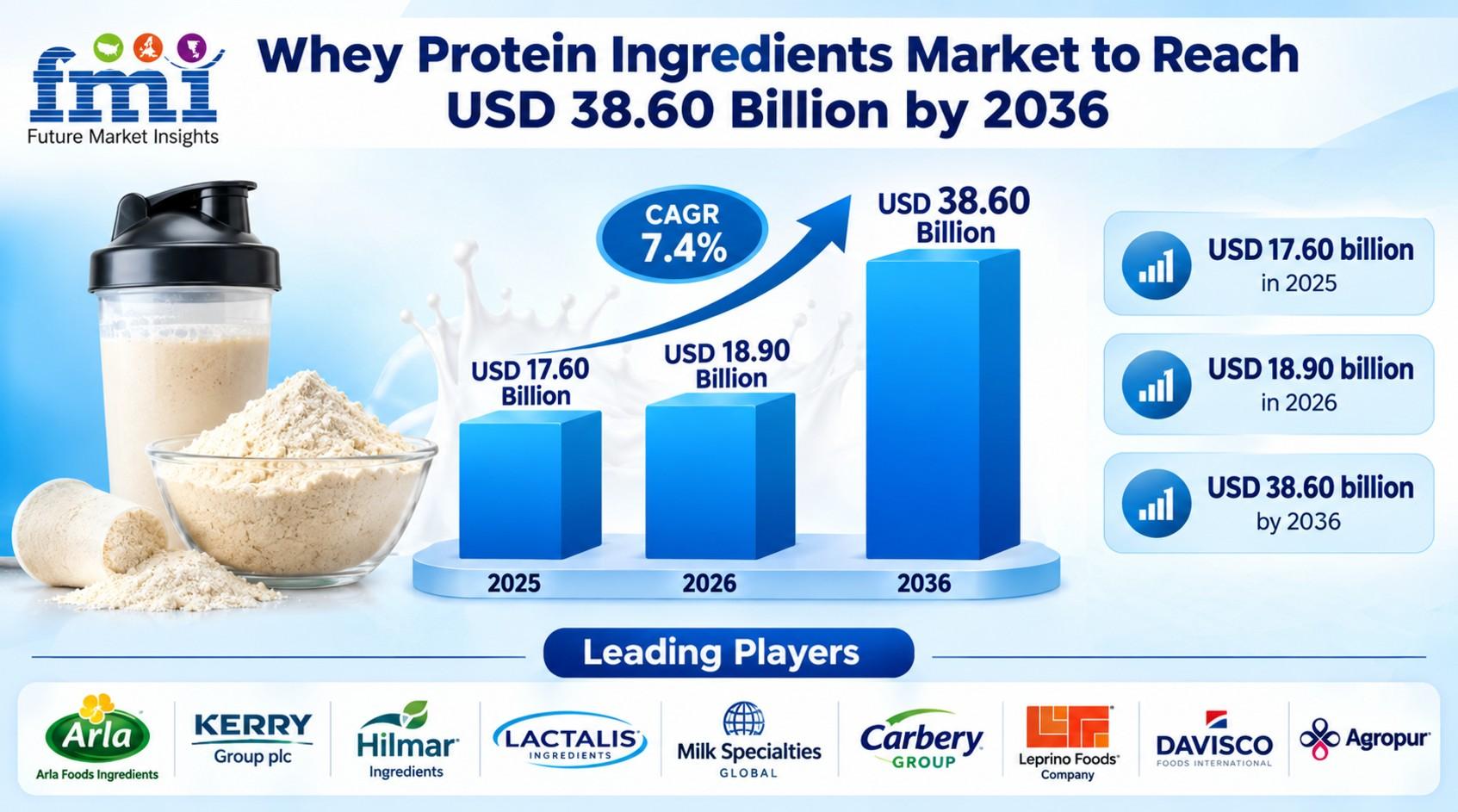
The global whey protein ingredients market is undergoing sustained structural expansion as commercial dairy refiners, sports nutrition manufacturers, and clinical nutrition formulators upgrade baseline protein specifications, according to latest insights by Future Market Insights. Driven by the global sports nutrition density race, tightening Codex Alimentarius whey-to-casein ratio standards for infant formula, and rising functional food fortification across dairy and bakery matrices, dairy-derived protein fractions including whey protein concentrate (WPC), whey protein isolate (WPI), demineralized whey, and hydrolyzed whey remain the benchmark for protein bioavailability and complete amino acid delivery.
The global market, valued at USD 17.60 billion in 2025, is projected to reach USD 18.90 billion in 2026. Advancing at a Compound Annual Growth Rate (CAGR) of 7.4% over the ten-year forecast period, total market valuation is anticipated to achieve USD 38.60 billion by 2036, delivering an absolute incremental opportunity of USD 19.70 billion.
Request a Sample Report: https://www.futuremarketinsights.com/reports/sample/rep-gb-22860
Market Performance Overview (2026–2036)
To map out the leading product types, core application sectors, primary distribution channel segments, and regional growth vectors guiding this USD 19.70 billion market expansion, key segment allocations highlight where global commercial demand is concentrated:
· Whey Protein Concentrate (WPC) Segment (36.9% share): Commands the baseline volume share in 2026, favored for its cost-effective protein-to-cost ratio, natural dairy lipid profile, and versatile functional performance across mainstream food and beverage applications.
· Whey Protein Isolate (WPI) & Hydrolyzed Grades: Represent the highest value-generating segments, where protein concentration, ultra-low lactose levels, and rapid digestive absorption command prices higher than standard concentrates.
· Dairy Products Type Segment (34.7% share): Dominates functional food application demand in 2026, driven by high-protein yogurts, fortified milks, and dairy beverages.
· Sports Nutrition Application Segment (38.9% demand share): Serves as the primary consumer-facing demand engine, where active fitness consumers and athletes seek high-protein powders, RTD shakes, and energy bars for muscle protein synthesis and recovery.
· China & India Regional Leadership: Lead national growth rates at 10.0% CAGR and 9.3% CAGR respectively through 2036, driven by expanding infant nutrition demand, urbanization, rising fitness culture, and heavy import reliance on Western cheese processing clusters.
Technical Drivers and Upstream Processing Shifts
The commercial expansion and premiumization of whey protein ingredients across industrial food processing and nutraceutical sectors are propelled by three primary industry catalysts:
Upstream Cheese Whey Economics and Fractionation Allocation
Every kilogram of cheese manufacturing generates approximately 9 liters of liquid whey by-product. Dairy processors utilize advanced cross-flow microfiltration, ultrafiltration (UF), and ion-exchange chromatography to fractionate this stream. Processors dynamically allocate raw whey streams across or demineralized whey powder based on forward-contract pricing spreads and high-margin nutritional demand.
Sports Nutrition Protein Density Race
Global sports nutrition brands are competing to increase protein density per serving while reducing carbohydrates, fats, and lactose. This formulation shift drives disproportionate demand for ultra-pure Whey Protein Isolate (WPI) and enzymatically pre-digested Hydrolyzed Whey Protein, which ensure rapid blood amino acid delivery and post-exercise muscle recovery without gastrointestinal heaviness.
Regulatory Standards in Pediatric and Clinical Nutrition
Regulatory bodies, including Codex Alimentarius and national food safety authorities, enforce specific whey-to-casein ratios (typically 60:40) in infant formulas to mirror human breast milk composition. Demineralized whey and specialized alpha-lactalbumin fractions are essential standardized ingredients required to hit these legal bio-equivalency thresholds.
Industrial Constraints & Supply Chain Governance
Dairy processors, ingredient blenders, and procurement directors navigate specific operational hurdles:
· Upstream Raw Whey Supply Bottlenecks: Total whey protein supply is fundamentally governed by global cheese manufacturing volumes. Raw milk yield fluctuations, seasonal bovine calving cycles, and 12-to-18-month lead times for membrane filtration and spray-drying capital projects restrict rapid supply expansion.
· West-to-East Trade Flow Vulnerability: The vast majority of raw whey processing infrastructure is concentrated in Europe and North America, while demand growth is fastest in Asia-Pacific. Asian buyers face import tariff volatility, maritime shipping lead times, and allocation risks during periods of tight Western milk output.
Regional Growth Profile
Regional demand reflects intensive infant formula and fitness nutrition adoption in Asia alongside high-value functional fractionation in North America and Europe:
· China (10.0% CAGR): The global growth frontrunner, driven by massive demand for demineralized whey and WPI in premium infant formula lines, rapid sports nutrition e-commerce growth, and dairy co-manufacturing partnerships.
· India (9.3% CAGR): Spurring rapid volume expansion through urban fitness adoption, protein-fortified dairy innovations, and investments in domestic membrane filtration infrastructure.
· Germany (8.5% CAGR) & France (7.8% CAGR): Lead European demand, supported by advanced cheese processing clusters, high-purity medical and clinical nutrition formulations, and clean-label high-protein dairy beverages.
· United Kingdom (7.0% CAGR): Expanding through convenient ready-to-drink (RTD) protein shakes, functional snacking bars, and hybrid plant-dairy protein blends.
· United States (6.3% CAGR): Represents a mature, high-volume production and consumption powerhouse, anchored by large-scale cheese processing facilities, advanced WPI manufacturing, and widespread retail penetration of sports supplements.
· Brazil (5.6% CAGR): Growing through the modernization of domestic dairy processing and rising consumer spending on fitness nutrition.
Competitive Landscape
The global whey protein ingredients landscape is dominated by integrated dairy cooperatives, multinational nutritional ingredient corporations, and specialized whey fractionators.
Key market participants profiled in the report include Arla Foods Ingredients, Kerry Group plc, Hilmar Ingredients, Lactalis Ingredients, Milk Specialties Global, Carbery Group, Leprino Foods Company, Davisco Foods International, and Agropur. Leading players compete by optimizing membrane fractionation yields, expanding bioactive peptide R&D (such as lactoferrin and osteopontin enrichment), securing multi-year supply contracts with global infant nutrition brands, and deploying advanced instantization/lecithination technologies for superior powder dispersibility.
Exclusive Discounts on Full Report: https://www.futuremarketinsights.com/reports/whey-protein-ingredients-market
Frequently Asked Questions
What is the projected valuation of the global whey protein ingredients market by 2036?
The global whey protein ingredients market is projected to reach USD 38.60 billion by 2036, expanding from an estimated baseline valuation of USD 18.90 billion in 2026 at a CAGR of 7.4%.
Why does Whey Protein Concentrate (WPC) lead the Distribution Channel segment?
Whey Protein Concentrate accounts for a 36.9% market share in 2026 because it delivers the optimal balance of protein concentration, natural dairy flavor, functional emulsification, and cost-in-use across high-volume dairy, bakery, and beverage manufacturing.
What is the primary raw material source for whey protein ingredients?
Whey protein ingredients are extracted directly from liquid whey, which is the primary natural by-product generated during commercial cheese and casein manufacturing from cow's milk.
FMI Custom Research: Strategic Intelligence for Confident Decision-Making
In today's rapidly evolving business environment, leadership teams need clear, actionable intelligence tailored to their strategic objectives. FMI's Custom Research solutions are designed around specific business questions, enabling executives to evaluate growth opportunities, validate investments, assess competitive dynamics, and reduce uncertainty before making critical decisions.
Key Executive Benefits
· Decision-Ready Insights: Research tailored to your specific business challenges, growth plans, and investment priorities.
· Reduced Strategic Risk: Validate market opportunities, customer demand, and competitive positioning before committing resources.
· Market Entry Confidence: Assess opportunity size, regulatory barriers, channel dynamics, and competitive landscapes with precision.
· Competitive Advantage: Gain proprietary intelligence unavailable through syndicated reports or internal datasets.
· Faster Growth Decisions: Accelerate expansion, product development, portfolio optimization, and investment planning.
· Primary Market Validation: Access real-world customer, buyer, and stakeholder insights that support high-confidence decision-making.
Business Impact
FMI helps organizations transform market complexity into strategic clarity, enabling leadership teams to identify growth opportunities faster, optimize resource allocation, strengthen competitive positioning, and make high-stakes business decisions with confidence.
To explore how FMI Custom Research can support your strategic priorities, connect with our team at - sales@futuremarketinsights.com
About Future Market Insights (FMI)
Future Market Insights (FMI) delivers actionable, decision-focused market intelligence that goes beyond traditional research reports. The company provides:
· In-depth pricing and cost benchmarking analysis
· Demand forecasting based on real industry inputs
· Procurement and buyer behavior insights
· Supply chain and trade flow intelligence
· Technology and application trend analysis across industries
FMI follows a robust bottom-up research methodology, combining insights from industry experts, procurement leaders, manufacturers, and technical professionals to ensure accurate and practical market intelligence.

 English
 Arabic
 Spanish
 Portuguese
 Deutsch
 Turkish
 Dutch
Dutch
 Italiano
 Russian
 Romaian
 Portuguese (Brazil)
 Greek
Greek
