


Chili Sauce Market to Reach USD 6.26 Billion by 2036
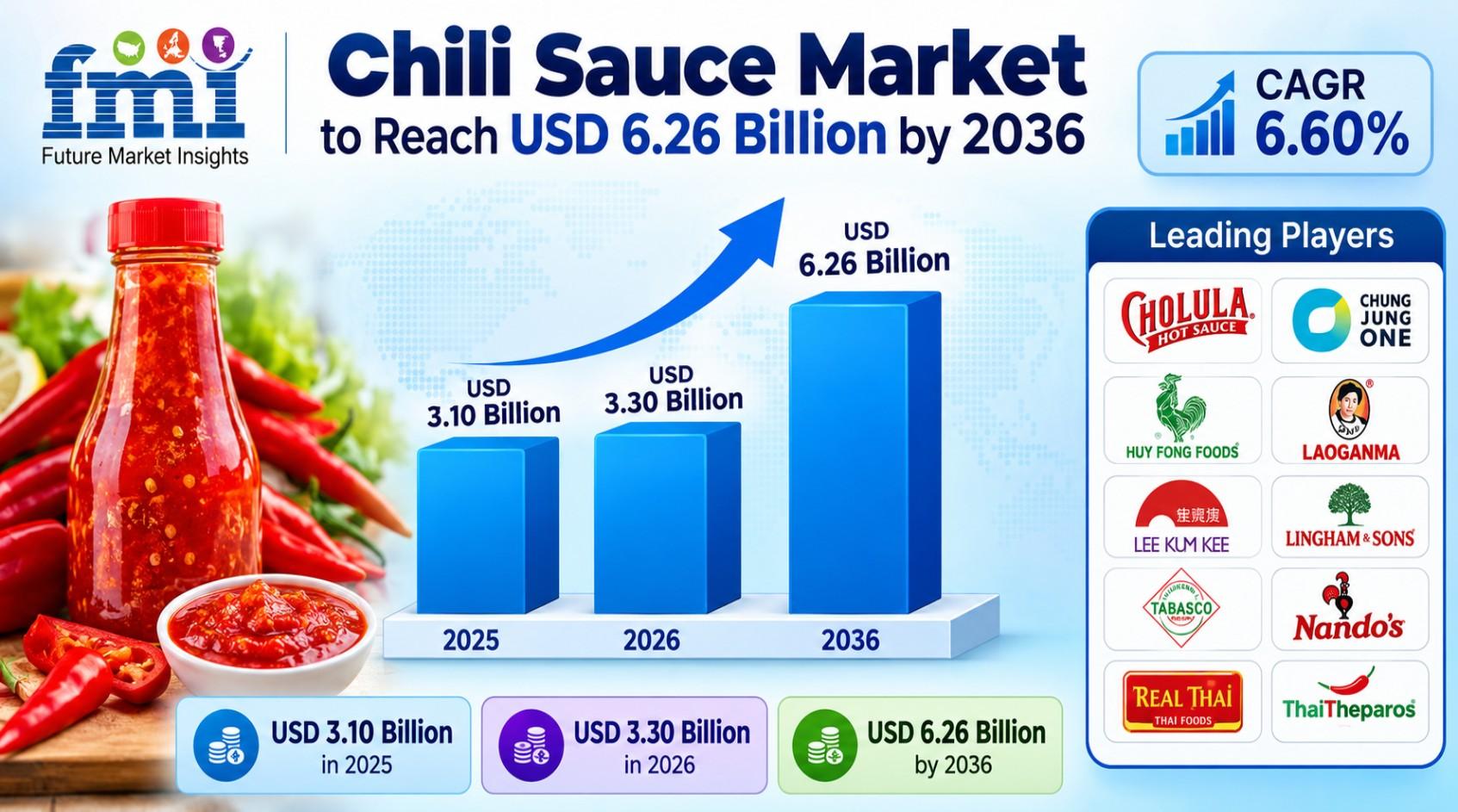
The global chili sauce market has expanded from its traditional Asian and Latin American strongholds into a globally mainstream condiment category across retail and foodservice sectors, according to latest insights by Future Market Insights. Driven by rising consumer appetite for bold, exotic flavor profiles, the globalization of street food culture, and the incorporation of clean-label, preservative-free recipes into convenience meals, chili sauces are securing permanent placement in household refrigerators and restaurant supply chains worldwide.
The global market, valued at USD 3.10 billion in 2025, is projected to reach USD 3.30 billion in 2026. Advancing at a Compound Annual Growth Rate (CAGR) of 6.60% over the ten-year forecast period, total market valuation is anticipated to achieve USD 6.26 billion by 2036, delivering an absolute incremental opportunity of USD 2.96 billion.
Request a Sample Report: https://www.futuremarketinsights.com/reports/sample/rep-gb-25634
Market Performance Overview (2026–2036)
To map out the key heat intensities, dominant packaging formats, primary retail distribution channels, and regional growth vectors guiding this USD 2.96 billion market scale-up, key segment allocations highlight where global commercial demand is concentrated:
· Mild Product Type Segment (42.7% share): Commands the heat intensity category in 2026, serving as the primary, balanced entry point that introduces chili condiments to broad consumer demographics (including children, older adults, and markets with lower spice tolerance) without overwhelming heat.
· Medium & Very Hot Segments (57.3% combined share): Represent vital core and high-growth segments, with very hot sauces gaining momentum via viral social media heat challenges and artisanal pepper connoisseur communities.
· Bottles Packaging Segment (46.0% share): Dominates packaging choices over jars, pouches, and sachets, favored for shelf visibility, precise pour and squeeze control, and refrigerator-door storage convenience.
· Hypermarkets and Supermarkets Channel (46.3% share): Represents the primary retail sales channel, supported by dedicated condiment aisle fixtures, in-store sampling promotions, and expanding private-label varieties.
· China & India Regional Leadership: Lead national growth rates at 8.90% CAGR and 8.30% CAGR respectively through 2036, driven by rich culinary traditions of chili-based cooking sauces, rising middle-class disposable income, and expanding modern trade retail footprints.
Technical Drivers and Product Shifts
The commercial expansion and premiumization of chili sauce across retail and dining channels are propelled by three primary industry catalysts:
Globalization of Ethnic Cuisines and Casual Dining
The worldwide popularity of Mexican, Thai, Vietnamese, Korean, and Sichuan culinary formats has turned chili sauce into an everyday tabletop condiment. Foodservice chains (QSRs and casual dining) drive high-volume bulk and single-serve sachet demand to standardize flavor profiles across kitchen workflows.
Clean-Label, Low-Sodium, and Fruit-Infused Formulations
Manufacturers are reformulating sauces to meet clean-label expectations by removing synthetic thickeners, artificial food colorants, and chemical preservatives. Concurrently, brand owners are introducing low-sodium, non-GMO, organic, and fruit-infused blends (e.g., mango-habanero, pineapple-jalapeño, smoked chipotle) to capture health-conscious and adventurous consumers.
Artisanal Fermentation and E-Commerce Brand Discovery
Digital platforms and direct-to-consumer (DTC) ecosystems allow craft and small-batch chili sauce producers to monetize single-origin pepper sourcing (e.g., ghost pepper, Carolina Reaper, peri-peri) and barrel-aging stories, commanding premium prices that traditional mass-market grocery brands cannot match.
Industrial Constraints & Supply Chain Risks
Chili sauce processors, agricultural ingredient suppliers, and procurement teams navigate specific operational hurdles:
· Raw Pepper Harvest Seasonality and Crop Spikes: Fresh chili pepper yields and prices are vulnerable to adverse weather patterns, regional droughts, and pest outbreaks in major cultivating hubs, impacting baseline production costs and inventory planning.
· Sensory and Viscosity Consistency Across Batches: Natural agricultural variance in capsaicin concentration and moisture content requires continuous Scoville Heat Unit (SHU) calibration and pH/viscosity adjustments to ensure uniform consumer taste and shelf stability.
Regional Growth Profile
Regional demand reflects rapid culinary modernization in Asian growth hubs alongside steady premiumization across Western condiment markets:
· China (8.90% CAGR): The global growth frontrunner, supported by traditional domestic consumption (e.g., Laoganma), instant noodle seasoning demand, and expanding modern supermarket/e-commerce distribution.
· India (8.30% CAGR): Spurring rapid volume growth through rising household convenience cooking, QSR fast-food franchise proliferation, and regional flavor diversification (sweet, tangy, and fiery profiles).
· Germany (7.60% CAGR) & France (6.90% CAGR): Lead European demand, driven by rising interest in ethnic cuisines, organic certifications, and clean-label non-GMO condiment sourcing.
· United Kingdom (6.30% CAGR): Expanding through gastropub menu integrations, sustainable recyclable packaging adoption, and street food flavor influences.
· United States (5.60% CAGR): Represents a mature, high-value demand center driven by ethnic diversity, home meal kit integrations, and widespread retail availability of Mexican and Asian hot sauces.
· Brazil (5.00% CAGR): Growing through domestic food processing modernization and the integration of native pepper varieties into retail condiments.
Competitive Landscape
The global chili sauce landscape operates on a two-tier competitive structure comprising multinational food and condiment corporations alongside specialized artisanal craft hot sauce makers.
Key market participants profiled in the report include Cholula Hot Sauce, Chung Jung One, Huy Fong Foods, Laoganma, Lee Kum Kee, Lingham & Sons, McIlhenny (Tabasco), Nando’s, Real Thai (Thai Foods), and ThaiTheparos. Leading players compete by securing reliable raw pepper contract farming networks, developing ergonomic squeeze bottles with precision caps, expanding foodservice portion-pack lines, and launching limited-edition gourmet blends.
Exclusive Discounts on Full Report: https://www.futuremarketinsights.com/reports/chili-sauce-market
Frequently Asked Questions
What is the projected valuation of the global chili sauce market by 2036?
The global chili sauce market is projected to reach USD 6.26 billion by 2036, expanding from an estimated baseline valuation of USD 3.30 billion in 2026 at a CAGR of 6.60%.
Why does the Mild product type segment hold a 42.7% market share?
Mild chili sauces lead in 2026 because they provide an approachable, balanced flavor profile that introduces chili taste to broad demographics, children, and consumers with lower spice tolerance across non-traditional markets.
What packaging format dominates chili sauce retail sales?
Bottles account for a 46.0% market share in 2026, as glass and squeezable PET bottles offer superior shelf visibility, controlled dispensing, and convenient refrigerator-door storage for everyday home use.
FMI Custom Research: Strategic Intelligence for Confident Decision-Making
In today's rapidly evolving business environment, leadership teams need clear, actionable intelligence tailored to their strategic objectives. FMI's Custom Research solutions are designed around specific business questions, enabling executives to evaluate growth opportunities, validate investments, assess competitive dynamics, and reduce uncertainty before making critical decisions.
Key Executive Benefits
· Decision-Ready Insights: Research tailored to your specific business challenges, growth plans, and investment priorities.
· Reduced Strategic Risk: Validate market opportunities, customer demand, and competitive positioning before committing resources.
· Market Entry Confidence: Assess opportunity size, regulatory barriers, channel dynamics, and competitive landscapes with precision.
· Competitive Advantage: Gain proprietary intelligence unavailable through syndicated reports or internal datasets.
· Faster Growth Decisions: Accelerate expansion, product development, portfolio optimization, and investment planning.
· Primary Market Validation: Access real-world customer, buyer, and stakeholder insights that support high-confidence decision-making.
Business Impact
FMI helps organizations transform market complexity into strategic clarity, enabling leadership teams to identify growth opportunities faster, optimize resource allocation, strengthen competitive positioning, and make high-stakes business decisions with confidence.
To explore how FMI Custom Research can support your strategic priorities, connect with our team at - sales@futuremarketinsights.com
About Future Market Insights (FMI)
Future Market Insights (FMI) delivers actionable, decision-focused market intelligence that goes beyond traditional research reports. The company provides:
· In-depth pricing and cost benchmarking analysis
· Demand forecasting based on real industry inputs
· Procurement and buyer behavior insights
· Supply chain and trade flow intelligence
· Technology and application trend analysis across industries
FMI follows a robust bottom-up research methodology, combining insights from industry experts, procurement leaders, manufacturers, and technical professionals to ensure accurate and practical market intelligence.

 English
 French
 Spanish
 Portuguese
 Deutsch
 Turkish
 Dutch
Dutch
 Italiano
 Russian
 Romaian
 Portuguese (Brazil)
 Greek
Greek
