


Lemonade Market to Reach USD 20.17 Billion by 2036
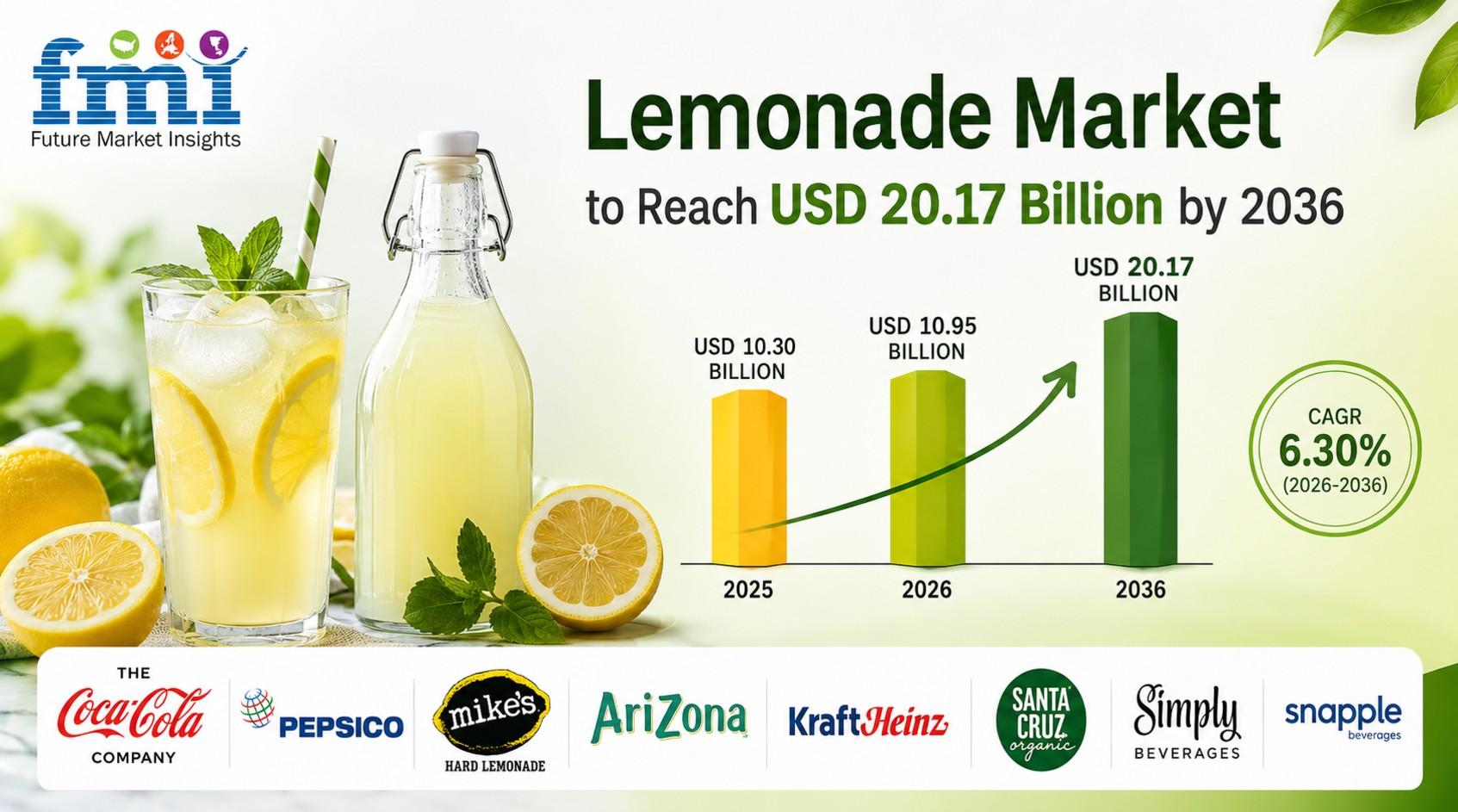
The global lemonade market is undergoing a structural phase of premiumization and flavor innovation, evolving from a seasonal commodity into a year-round, value-added beverage category, according to latest insights by Future Market Insights. Driven by time-constrained on-the-go consumption habits, rising consumer demand for "better-for-you" reduced-sugar alternatives, and the successful integration of functional ingredients (such as vitamins and botanicals), the market is moving toward sophisticated product architectures that compete effectively with functional waters and premium iced teas.
The global market, valued at USD 10.30 billion in 2025, is projected to reach USD 10.95 billion in 2026. Advancing at a Compound Annual Growth Rate (CAGR) of 6.30% over the ten-year forecast period, total market valuation is anticipated to achieve USD 20.17 billion by 2036, delivering an absolute incremental opportunity of USD 9.22 billion.
Request a Sample Report: https://www.futuremarketinsights.com/reports/sample/rep-gb-25718
Market Performance Overview (2026–2036)
To map out the key product types, primary packaging formats, retail distribution channels, and regional growth vectors guiding this USD 9.22 billion market expansion, key segment allocations highlight where global commercial demand is concentrated:
· Unflavored Product Type Segment (54.2% share): Commands the core of the market in 2026, driven by the enduring consumer preference for the traditional, authentic lemon profile as a refreshing baseline.
· Ready-To-Drink (RTD) Format Segment (62.7% share): Dominates the product format landscape in 2026, satisfying modern "grab-and-go" convenience expectations in convenience stores, vending machines, and foodservice channels.
· Bottle Packaging Segment (48.9% share): Leads packaging choices, though aluminum cans are rapidly growing due to consumer associations with premium craft positioning and enhanced recyclability.
· Supermarkets/Hypermarkets Channel (46.0% share): Serves as the primary retail discovery and purchasing point, where fixture placement near high-traffic dairy or chilled juice aisles drives impulse and planned weekly purchases.
· China & India Regional Leadership: Lead national growth rates at 8.50% CAGR and 7.90% CAGR respectively through 2036, supported by the adoption of Western-style RTD beverages among urban youth and expanding specialty drink shop distribution networks.
Technical Drivers and Premiumization Shifts
The expansion and diversification of the lemonade market across retail and digital channels are propelled by three primary industry catalysts:
Reformulation for Reduced-Sugar and Calorie Control
In response to global sugar taxes, front-of-pack nutritional labeling (e.g., Nutri-Score), and public health reformulations, manufacturers are heavily investing in stevia-based sweetening, fruit-juice blending, and high-intensity natural sweetener integration to maintain flavor profiles while drastically reducing calorie counts.
Flavor and Botanical Innovation
Brand owners are differentiating their portfolios through "gourmet-adjacent" flavor profiles. Botanical and herbal infusions (lavender, ginger, turmeric, hibiscus, rose, elderflower) transform traditional lemonade into sophisticated, functional beverage options that cater to the evolving tastes of adult consumers and "teetotaler" drinkers seeking premium non-alcoholic alternatives.
Sustainability and Packaging Modernization
Sustainability is becoming a core procurement requirement. Manufacturers are shifting from single-use virgin PET plastic bottles toward aluminum cans (which offer superior recyclability rates) and carton packaging to align with environmental ESG mandates and consumer preferences for eco-friendly brands.
Industrial Constraints & Supply Chain Risks
Beverage processors, lemon extract suppliers, and retail brand managers navigate specific operational hurdles:
· Citrus Feedstock Price Volatility: Reliance on global lemon harvests leaves manufacturers vulnerable to severe price spikes caused by climate-driven crop failures, droughts, or pest outbreaks in major growing regions (Mediterranean, California, South America).
· Consistency in Flavor Profiles: Standardizing the taste of "natural" lemon across high-volume production batches is technically complex due to the inherent chemical variability in citrus oils and juice concentrates, necessitating rigorous batch-to-batch sensory and analytical quality control.
Regional Growth Profile
Regional demand reflects rapid urban convenience adoption in Asia alongside mature, health-conscious premiumization in Western markets:
· China (8.50% CAGR): The global growth frontrunner, supported by the integration of Western RTD beverage formats in urban retail and the massive expansion of specialty tea/beverage chains offering fresh-made lemonade.
· India (7.90% CAGR): Spurring rapid volume growth through the formalization of the organized snack/beverage retail sector and urban consumer adoption of RTD refreshments.
· Germany (7.20% CAGR), France (6.60% CAGR), & United Kingdom (6.00% CAGR): Lead European demand, where growth is anchored by clean-label ingredient requirements, reduced-sugar reformulation, and the rise of sparkling/carbonated lemonade variants.
· United States (5.40% CAGR): Represents a mature, high-value demand center driven by premium cold-pressed, organic, and functional (probiotic/vitamin) line extensions in mainstream grocery.
· Brazil (4.70% CAGR): Expanding through domestic fruit-processing modernization and the integration of diverse regional citrus profiles into commercial beverage lines.
Competitive Landscape
The global lemonade market is shaped by a mix of multinational beverage conglomerates, domestic regional bottlers, and agile, clean-label startup brands.
Key market participants profiled in the report include The Coca-Cola Company, PepsiCo, Mike’s Hard Lemonade, Arizona Beverages, The Kraft Heinz Company, Santa Cruz Organic, Simply Beverages, and Snapple Beverages. Leading players compete by leveraging extensive global distribution networks, launching seasonal flavor-limited editions, and investing in high-margin sparkling or functional (e.g., probiotic-fortified) product line extensions.
Exclusive Discounts on Full Report: https://www.futuremarketinsights.com/reports/lemonade-market
Frequently Asked Questions
What is the projected valuation of the global lemonade market by 2036?
The global lemonade market is projected to reach USD 20.17 billion by 2036, expanding from an estimated baseline valuation of USD 10.95 billion in 2026 at a CAGR of 6.30%.
Why does Ready-To-Drink (RTD) command a 62.7% share in the product format segment?
RTD formats dominate in 2026 because they fulfill immediate consumer expectations for convenience, portability, and "grab-and-go" utility in high-traffic convenience store and foodservice environments.
What is the primary flavor category in the market?
Unflavored (traditional) lemonade holds a 54.2% share in 2026, as it remains the foundational, authentic, and versatile profile that serves as the standard against which brand quality and value are measured.
FMI Custom Research: Strategic Intelligence for Confident Decision-Making
In today's rapidly evolving business environment, leadership teams need clear, actionable intelligence tailored to their strategic objectives. FMI's Custom Research solutions are designed around specific business questions, enabling executives to evaluate growth opportunities, validate investments, assess competitive dynamics, and reduce uncertainty before making critical decisions.
Key Executive Benefits
· Decision-Ready Insights: Research tailored to your specific business challenges, growth plans, and investment priorities.
· Reduced Strategic Risk: Validate market opportunities, customer demand, and competitive positioning before committing resources.
· Market Entry Confidence: Assess opportunity size, regulatory barriers, channel dynamics, and competitive landscapes with precision.
· Competitive Advantage: Gain proprietary intelligence unavailable through syndicated reports or internal datasets.
· Faster Growth Decisions: Accelerate expansion, product development, portfolio optimization, and investment planning.
· Primary Market Validation: Access real-world customer, buyer, and stakeholder insights that support high-confidence decision-making.
Business Impact
FMI helps organizations transform market complexity into strategic clarity, enabling leadership teams to identify growth opportunities faster, optimize resource allocation, strengthen competitive positioning, and make high-stakes business decisions with confidence.
To explore how FMI Custom Research can support your strategic priorities, connect with our team at - sales@futuremarketinsights.com
About Future Market Insights (FMI)
Future Market Insights (FMI) delivers actionable, decision-focused market intelligence that goes beyond traditional research reports. The company provides:
· In-depth pricing and cost benchmarking analysis
· Demand forecasting based on real industry inputs
· Procurement and buyer behavior insights
· Supply chain and trade flow intelligence
· Technology and application trend analysis across industries
FMI follows a robust bottom-up research methodology, combining insights from industry experts, procurement leaders, manufacturers, and technical professionals to ensure accurate and practical market intelligence.

 English
 Arabic
 Spanish
 Portuguese
 Deutsch
 Turkish
 Dutch
Dutch
 Italiano
 Russian
 Romaian
 Portuguese (Brazil)
 Greek
Greek
