


What Is the Future of Digital Lending and Loan Comparison in India?
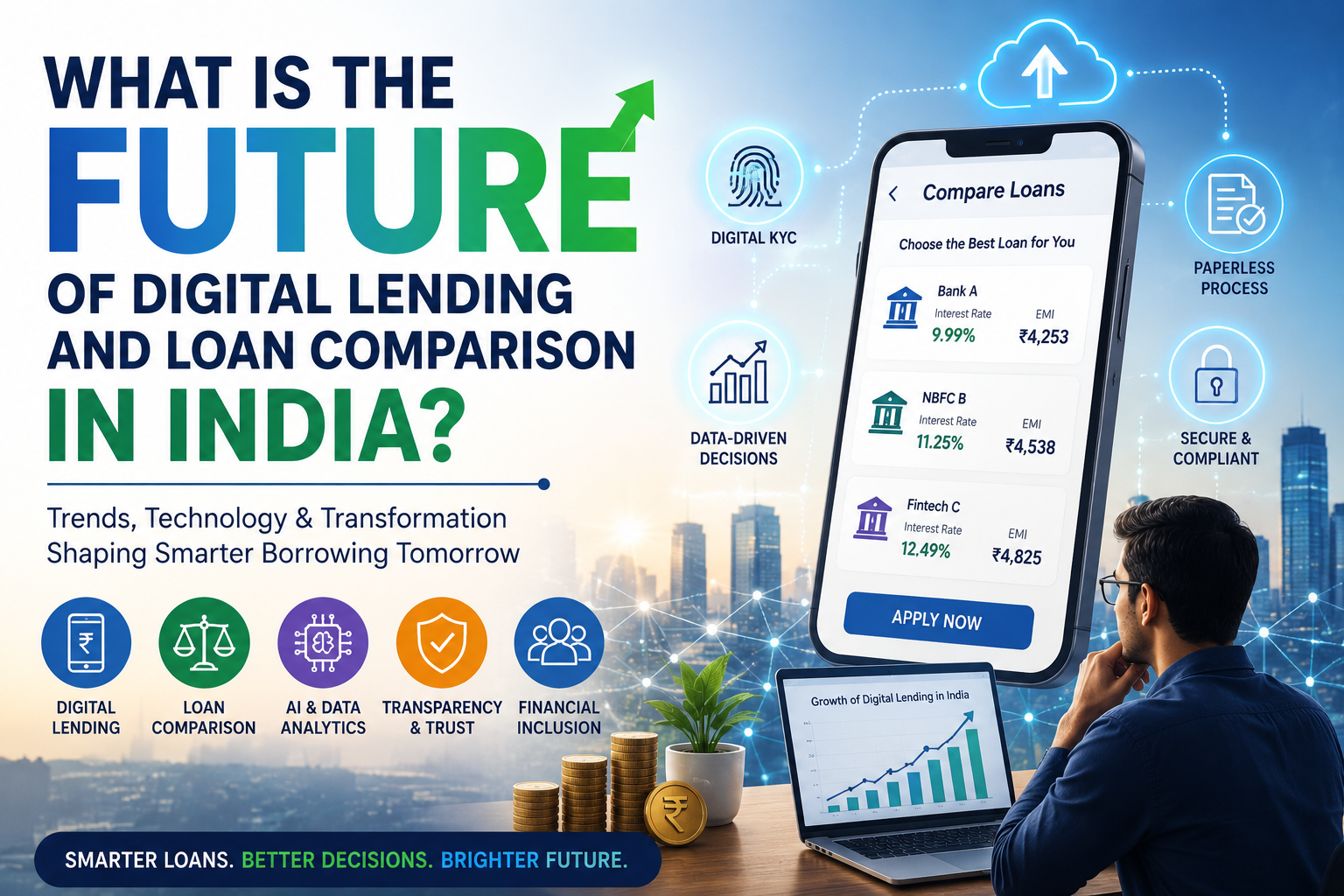
The way Indians borrow money is changing rapidly. Loan applications that once required branch visits, physical paperwork, and long waiting periods can now be started from a smartphone. At the same time, borrowers are no longer limited to checking one bank or lender at a time. Digital platforms can help users discover, compare, and understand multiple loan options from different providers.
This transformation raises an important question: What is the future of digital lending and loan comparison in India?
The future is likely to be shaped by faster digital processes, better data connectivity, artificial intelligence, personalized loan offers, stronger regulation, and greater transparency. Loan comparison platforms could increasingly become an important part of the borrowing journey by helping consumers compare interest rates, APR, EMIs, fees, tenure, and eligibility before choosing a lender.
India already has an evolving regulatory framework for digital lending, while technologies such as Account Aggregator infrastructure are creating new ways to share financial information securely with customer consent.
What Is Digital Lending?
Digital lending refers to the use of technology to facilitate activities such as loan applications, verification, credit assessment, approval, documentation, disbursement, and repayment.
Instead of completing the entire process through a physical branch, borrowers may be able to complete many steps digitally.
Digital lending can offer several potential advantages:
- Faster application processing
- Digital KYC and verification
- Online document submission
- Automated credit assessment
- Faster communication
- Digital loan agreements
- Online repayment
- Greater accessibility
RBI describes Digital Lending Apps as applications that can facilitate lending services on behalf of regulated entities such as banks and NBFCs, including through Lending Service Providers.
However, convenience is only one part of the story. The future of digital lending will also depend on whether borrowers can understand who is actually providing the loan, how much it costs, and how their data is being used.
Why Is Loan Comparison Becoming More Important?
Imagine you need a ₹1 lakh personal loan.
Instead of visiting five lenders individually, a digital comparison platform could potentially allow you to review multiple offers in one place.
You might compare:
| Factor | Lender A | Lender B | Lender C |
|---|---|---|---|
| Interest Rate | 14% | 16% | 15% |
| APR | Check offer | Check offer | Check offer |
| EMI | Check offer | Check offer | Check offer |
| Processing Fee | Check offer | Check offer | Check offer |
| Tenure | 24 months | 24 months | 18 months |
| Total Repayment | Check offer | Check offer | Check offer |
The idea is simple:
More information → Better comparison → More informed borrowing decisions
RBI's Working Group on Digital Lending recommended a regulatory framework for web-aggregators of loan products, with the goal of improving transparency and helping borrowers compare available loan offers and make informed choices.
That makes loan comparison more than just a convenience feature. It can become an important part of consumer decision-making.
1. Personalized Loan Offers Will Become More Common
One major development in the future of digital lending is personalization.
Instead of displaying exactly the same offers to every visitor, platforms may increasingly use information such as:
- Income
- Employment type
- Loan amount
- Desired tenure
- Credit history
- Existing obligations
- Financial behaviour
- Loan purpose
to identify potentially relevant offers.
For example, a salaried employee looking for a ₹2 lakh personal loan may see a different set of options from a self-employed borrower looking for business financing.
The result could be a more relevant personalized loan comparison experience.
However, personalization should remain transparent. Borrowers should understand why an offer is being shown and what information is being used.
2. Artificial Intelligence Could Transform Loan Assessment
Artificial intelligence and machine learning are already influencing financial services, and their role in lending is likely to expand.
AI could help lenders and platforms with:
- Fraud detection
- Document analysis
- Risk assessment
- Customer support
- Application processing
- Eligibility analysis
- Personalized recommendations
For borrowers, this could mean faster decisions.
But AI-driven lending also creates important questions around model accuracy, fairness, explainability, privacy, and governance.
RBI has been examining model-risk management in credit, including governance, oversight, development, deployment, and validation of credit models.
So the future of AI in digital lending will not simply be about making decisions faster. It will also be about making those decisions responsibly.
3. Account Aggregators Could Make Loan Applications Easier
Another important piece of India's digital lending infrastructure is the Account Aggregator (AA) framework.
Account Aggregators can enable customers to share financial information with authorized financial institutions based on explicit consent.
RBI's framework requires customer consent for sharing financial information and includes mechanisms for managing and revoking consent.
This could make the loan application process more efficient.
Instead of repeatedly uploading multiple documents, eligible borrowers may be able to securely share relevant financial information through consent-based systems.
This could be particularly useful for:
- Small businesses
- Self-employed professionals
- First-time borrowers
- Customers with multiple financial accounts
RBI has also highlighted the potential of Account Aggregators for small borrowers and MSMEs, including cash-flow-based lending.
4. Cash-Flow-Based Lending Could Expand Access
Traditional lending often relies heavily on conventional documents and established credit histories.
Digital infrastructure can make it easier to evaluate a borrower's actual financial cash flow.
For example, a self-employed person may not receive a monthly salary, but their bank transactions and other permitted financial information may demonstrate consistent business income.
This could support the growth of cash-flow-based lending in India.
For borrowers with limited traditional credit histories, better financial-data infrastructure could potentially make credit assessment more comprehensive.
However, access to more data does not mean lenders should collect everything available. RBI's digital lending framework requires data collection to be need-based and based on prior, explicit consent.
5. Loan Comparison Will Move Beyond Interest Rates
One of the biggest changes in loan comparison is likely to be a shift away from simply asking:
"Which lender has the lowest interest rate?"
Instead, borrowers may increasingly compare:
- Interest rate
- APR
- EMI
- Loan tenure
- Processing fee
- Total repayment
- Prepayment terms
- Late-payment charges
- Disbursement amount
- Other applicable costs
This is important because a loan with the lowest advertised interest rate is not necessarily the cheapest overall.
The Key Facts Statement (KFS) framework is designed to provide key loan information, including the all-in cost of credit in a simple and understandable format. RBI's framework defines APR as the annual cost of credit that includes the interest rate and associated charges.
Future loan comparison platforms can make this information easier to understand by presenting offers side by side.
6. Transparency Will Become a Competitive Advantage
As digital lending grows, trust will become increasingly important.
Borrowers want to know:
Who is actually lending me the money?
How much will I repay?
What fees apply?
What happens if I miss an EMI?
Who has access to my data?
RBI has introduced measures aimed at improving transparency in digital lending, including requirements relating to APR disclosure, consent-based data collection, privacy policies, and data handling.
RBI has also worked toward a public directory of Digital Lending Apps to help customers verify claims about an app's association with regulated entities.
This means legitimate platforms may increasingly compete not just on speed, but on transparency and trust.
7. Safer Digital Lending Could Become the Standard
The growth of digital lending also brings risks.
Fraudulent apps, misleading advertisements, excessive data collection, hidden charges, and aggressive recovery practices can damage consumer trust.
RBI advises consumers to verify whether a digital lending app is associated with an RBI-regulated bank or NBFC through the regulated entity's website and warns against downloading apps received through SMS or social-media links.
The future therefore needs a balance:
Digital convenience + responsible lending + consumer protection
A loan application being completed in five minutes is not useful if the borrower doesn't understand the loan they're accepting.
8. Regional and Vernacular Lending Platforms Could Grow
India's digital lending audience is not limited to major metropolitan cities.
As internet and smartphone access expand, digital financial services can increasingly reach borrowers in smaller cities and towns.
Future loan comparison platforms may therefore offer:
- Regional-language interfaces
- Localized loan information
- Simple financial explanations
- Voice-based assistance
- Regional SEO
- City-specific loan resources
This could make loan information easier to understand for borrowers who are not comfortable navigating complex financial terminology in English.
The opportunity is particularly significant for first-time borrowers who may need education as much as they need access to credit.
9. Loan Comparison Platforms Could Become Financial Decision Engines
Today's comparison platforms may primarily help users discover lenders.
Tomorrow's platforms could potentially do much more.
A borrower might enter:
Loan requirement: ₹1,50,000
Purpose: Personal expense
Monthly income: ₹45,000
Preferred tenure: 24 months
The platform could then organize potentially relevant offers based on:
- Eligibility
- Estimated EMI
- APR
- Total repayment
- Fees
- Tenure
- Other disclosed terms
Instead of simply showing a list of lenders, the platform could help users understand the differences between them.
This is where loan comparison in India could evolve from a search tool into a broader financial decision-support system.
10. Competition Could Improve the Borrowing Experience
Greater transparency can increase competition among lenders.
If borrowers can easily compare multiple offers, lenders may have stronger incentives to compete on:
- Interest rates
- Processing fees
- Customer experience
- Approval speed
- Flexible repayment options
- Transparency
- Service quality
Competition does not guarantee that every borrower will receive a lower rate, because pricing depends on individual risk and lender policies.
But easier comparison can make it harder for borrowers to remain unaware of alternative options.
What Will Borrowers Need to Watch Out For?
The future of digital lending will bring convenience, but borrowers will still need to remain careful.
Before accepting an online loan, check:
1. Actual Lender
Identify the bank or NBFC providing the credit.
2. Interest Rate
Understand the actual rate offered to you.
3. APR
Compare the annualized cost of credit.
4. EMI
Make sure the repayment fits your budget.
5. Total Repayment
Look beyond the monthly payment.
6. Processing Fees
Check all applicable charges.
7. Data Permissions
Understand what information is being collected and why.
8. Key Facts Statement
Review the KFS where applicable.
9. Loan Agreement
Read the final terms before accepting.
10. Repayment and Recovery Terms
Understand what happens if you miss a payment.
What Does the Future Hold for Digital Lending in India?
The future of digital lending in India is likely to be increasingly data-driven, automated, personalized, and regulated.
Several technologies and systems could work together:
AI + Account Aggregator + Digital KYC + Open APIs + Automated underwriting + Loan comparison platforms
This could create a borrowing experience where consumers spend less time filling out paperwork and more time comparing actual loan costs.
At the same time, regulation will remain important. Digital lending needs to grow without sacrificing consumer privacy, transparency, responsible credit assessment, or financial stability.
Final Thoughts
The future of digital lending and loan comparison in India looks increasingly connected.
Borrowers may be able to discover loans faster, share financial information through consent-based systems, receive more personalized offers, and compare the complete cost of borrowing before making a decision.
Loan comparison platforms could play an especially important role by bringing multiple offers into one place and making complicated financial information easier to understand.
But the future should not be measured only by how quickly someone can get a loan.
The bigger goal should be better borrowing decisions.
A successful digital lending ecosystem should help consumers answer three basic questions:
Is this lender legitimate?
What will this loan actually cost me?
Can I comfortably repay it?
If technology, regulation, lenders, and comparison platforms continue moving in that direction, India's lending ecosystem could become not only faster, but also more transparent, accessible, and consumer-focused.

 English
 Arabic
 French
 Spanish
 Portuguese
 Deutsch
 Turkish
 Dutch
Dutch
 Russian
 Romaian
 Portuguese (Brazil)
 Greek
Greek
