


Why Women's Motorcycle Race Suits Fit Differently: 7 Fit Checks That Keep Your Armor in Place
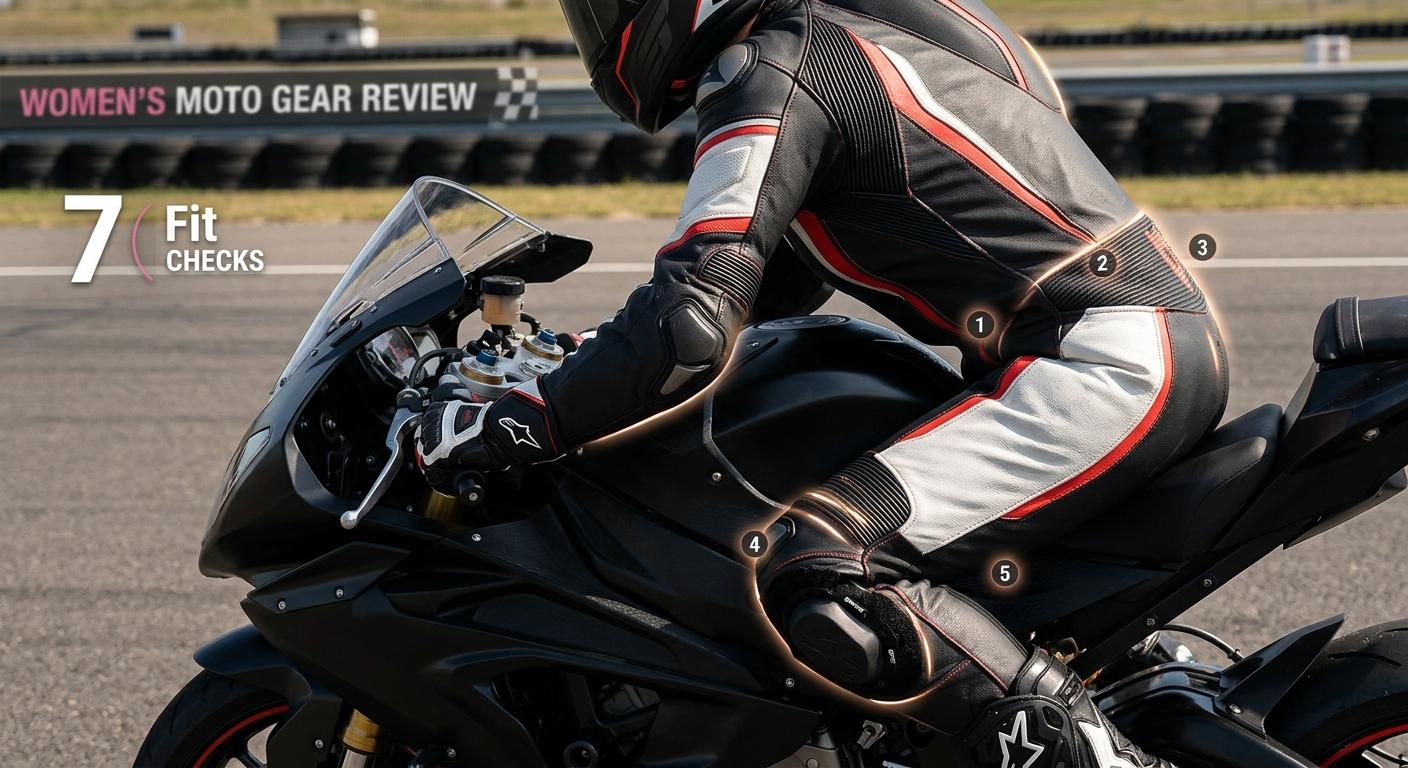
A suit can match every number on the size chart and still betray you halfway through a ride. The shoulder armor rotates toward the back. The knee pads sit an inch below the kneecap. The waist seam bunches somewhere around the ribs instead of the waist. None of that shows up in a mirror at the shop. It shows up twenty minutes into a ride, once the body has actually moved through the positions a suit needs to hold.
This happens to women riders far more often than it should, and it isn't because women's bodies are harder to fit. It's because most suits, even ones labeled women's, are still built by shrinking a men's pattern rather than starting from different proportions altogether.
Why This Isn't Just a Smaller Size Problem
Height and weight charts assume that two bodies of the same size are shaped the same way. They usually aren't. Women tend to carry more curve through the hip relative to the waist, a shorter rise between the waist and the crotch seam, and a narrower shoulder line relative to the chest, none of which shows up on a chart that only tracks height and chest size.
That gap is exactly what gear built specifically around women's proportions is meant to close, by starting the pattern from a different shape rather than scaling a men's cut down to a smaller number.
It sounds like a small distinction, cutting a new pattern instead of resizing an old one, but it's the difference between armor that lands where a joint actually is and armor that lands where a joint would be on a differently proportioned body.
Why Fit Directly Affects Whether the Armor Actually Works
CE-rated armor is only effective sitting exactly where it was designed to sit, directly over the elbow, the knee, the shoulder, the spine. A pad that's an inch off in any direction isn't offering partial protection. In a fall, it's often offering none at all to the joint it was supposed to cover, while padding a patch of muscle that was never at risk in the first place.
This is why fit matters more on a race suit than almost any other piece of clothing a rider owns. A jacket that sits slightly wrong is a comfort issue. A race suit that sits slightly wrong is a protection issue, and it usually only becomes obvious in the moment it was supposed to help.
The 7 Fit Checks Worth Running Before You Buy
These are the checks worth doing in the fitting room or the moment a suit arrives, before tags come off and before it's too late to exchange.
1. Does the Waist Seam Sit at Your Actual Waist?
On a suit cut for a longer male torso, the waist seam often lands closer to the lower ribs on a woman with a proportionally shorter torso. Sit on the bike, lean forward into riding position, and check where the seam falls. If it rides up toward the ribs rather than staying at the natural waist, the torso length is wrong, not just the size. A seam that migrates upward under load will keep migrating every time you ride, since nothing about that movement changes once the leather is broken in.
2. Does the Suit Gap at the Waist to Clear Your Hips?
Suits sized up to accommodate hip room often leave visible gapping at the waist, since the pattern doesn't taper the way an hourglass proportion needs it to. That gap isn't just a fit issue, it's slack fabric that can shift the entire lower half of the suit during a slide, taking the hip and knee armor with it.
3. Can Your Arm Rotate Without Dragging the Elbow Armor?
Raise your arm out to the side and rotate it through a full riding range of motion. On a suit with the wrong shoulder width or armhole placement, the elbow armor drags around the arm as you move instead of staying anchored over the elbow joint. If the pad visibly rotates away from the elbow during normal arm movement, it will almost certainly be out of position by the time a fall happens.
4. Does the Zip Line Sit Flat Without Pulling Across the Chest?
A front zip that pulls or gaps across the chest is doing more than looking wrong in photos. It signals the panel is fighting the body's shape, which pulls the whole upper suit slightly off its intended alignment, including the shoulder armor sitting just above it.
5. Do the Knee Pads Line Up With Your Actual Kneecap?
Bend the knee into a full riding tuck, not just a standing bend. Suits cut for a longer male inseam frequently place the knee armor slightly below where a shorter leg's kneecap actually sits once the leg is bent. Standing checks miss this every time, since the pad can look correctly placed until the leg is folded into an actual riding position. If a shop only lets you check fit standing up, ask to test it seated or crouched before deciding, since that's the position the armor actually needs to protect.
6. Does the Hip Armor Sit on the Hip Bone, Not Below It?
Because women's hip curvature tends to sit differently relative to the waist, hip armor built into a men's pattern can land slightly low, protecting the upper thigh more than the hip bone itself. Check this seated in riding position rather than standing upright, since the pad's position shifts noticeably between the two.
7. Does the Back Protector Still Cover You When You're Tucked Forward?
A shorter torso means the back protector has less vertical space to work with before it either rides up under the shoulders or leaves the lower back exposed. Tuck forward into a full riding crouch and check whether the protector still spans from the base of the neck down past the lower back, not just when standing straight.
A few warning signs tend to show up together when a suit has failed several of these checks at once.
• Armor pads that visibly shift position between standing and a full riding tuck
• Persistent gapping or pulling at the waist, chest, or underarm seams
• A back protector that rides up noticeably when leaning forward onto the tank
This Isn't Unique to Motorcycle Gear
The same pattern shows up well beyond motorcycling. A systematic review of protective equipment fit published through the National Institutes of Health examined this exact problem across several occupational fields and found that standard unisex sizing consistently fails to account for the range of women's torso and chest proportions, a finding that held across military, healthcare, and industrial gear built on the same base assumptions as most racing suits.
That pattern matters here because it confirms the fit problem isn't a motorcycling quirk or a single brand's oversight. It's what happens whenever protective gear gets designed around one default body shape and then resized rather than rebuilt for a different one.
Testing Fit at Home When You Can't Try Before You Buy
A lot of women order race suits online, especially once they need a size or cut that isn't stocked locally. Without a fitting room, the seven checks above still work, they just need to be done off the bike using a few household substitutes for riding position.
Sitting on a low stool or the edge of a couch with knees bent mimics the seated riding posture well enough to check waist seam placement and knee pad alignment. Leaning forward over a table edge approximates the tucked-forward position needed to check back protector coverage. It isn't a perfect substitute for time on the bike, but it catches the most common fit failures, torso length, knee alignment, and back coverage, well before the suit sees its first ride.
Photographing each position from the side, rather than relying on how the suit feels in the moment, also makes it much easier to spot armor sitting slightly off target. Fit problems are often more visible in a still photo than they are standing in front of a mirror trying to judge your own alignment.
What to Do If a Suit Fails Multiple Checks
One failed check is often a minor alteration. A tailor familiar with race leather can usually adjust waist taper or shorten a torso panel without touching the armor pockets. Several failed checks at once usually means the base pattern itself wasn't built around female proportions, and no amount of alteration will fully correct armor placement that was wrong from the pattern stage.
The scale of this problem isn't limited to motorcycling. A 2024 Department of Labor review of protective equipment fit cited a national safety survey finding that a large share of women report their protective equipment fits poorly, enough that regulators have started treating fit itself as a safety standard rather than a comfort preference.
For riders who keep running into the same failed checks across multiple brands, the more reliable path is usually a suit built from measurements taken in riding position rather than standing measurements alone, which is where a lot of the torso and knee alignment problems get solved before they ever reach the fitting stage.
Getting It Right Before the First Ride
None of these seven checks take more than a minute each, and doing them before a suit is broken in is far easier than discovering a problem mid-season. A suit that passes all seven won't just feel better. It will actually do the job the armor inside it was designed to do, in the moment that job matters most.
The difference between a suit that merely fits the size chart and one that fits the body wearing it usually isn't visible until the bike is moving. Running these checks in the shop, or before ordering online, is the only way to catch it while it's still easy to fix.

 English
 Arabic
 French
 Spanish
 Portuguese
 Deutsch
 Turkish
 Dutch
Dutch
 Italiano
 Russian
 Romaian
 Greek
Greek
