


Choosing Between a SaaS Marketing Agency and an In-House Team
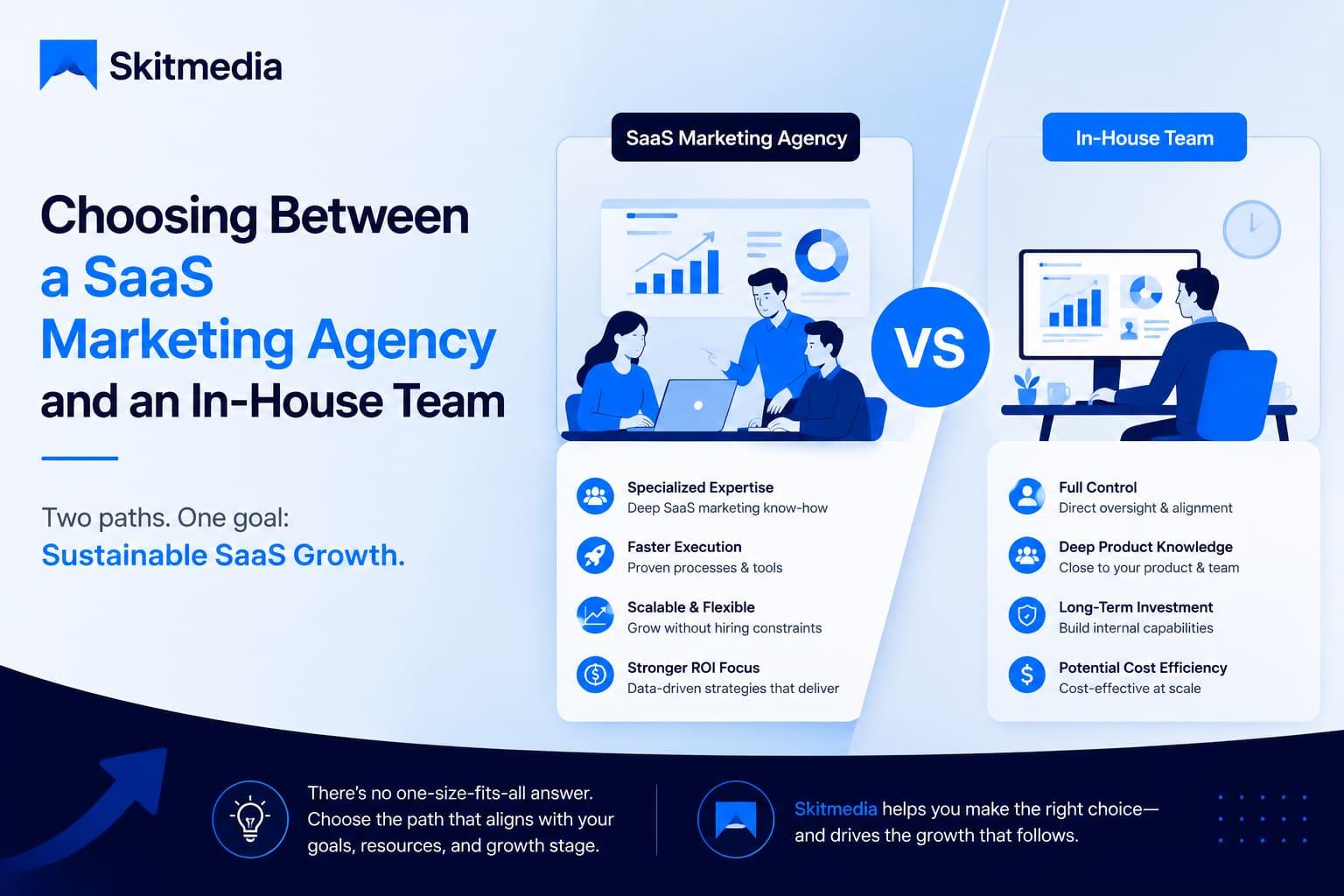
Building a great SaaS product is only the first step toward creating a successful business. Without a strong marketing strategy, even an innovative product can struggle to attract customers, generate demand, and achieve sustainable growth.
For SaaS startups, one of the biggest marketing decisions is whether to build an in-house marketing team or partner with a SaaS marketing agency.
Both options have advantages, but the right choice depends on your budget, growth stage, marketing requirements, and long-term goals. Let's compare both approaches to help you determine which is the better fit for your SaaS business.
Read Blog: https://skitmediastudio.com/blog/saas-marketing-agency-vs-in-house-marketing-team-which-is-better/
What Is a SaaS Marketing Agency?
A SaaS marketing agency is a specialized marketing partner that helps Software as a Service businesses attract, convert, and retain customers.
Unlike a general marketing agency, a SaaS-focused team understands the unique characteristics of subscription-based businesses, including recurring revenue, customer acquisition cost, churn, customer lifetime value, product adoption, and retention.
A specialized SaaS marketing agency may have experts across SEO, paid advertising, content marketing, conversion rate optimization, analytics, email marketing, and demand generation.
This allows SaaS businesses to access multiple areas of expertise without hiring individual specialists for every function.
What Is an In-House Marketing Team?
An in-house marketing team consists of employees who work directly for the SaaS company. The company decides which roles to hire based on its marketing requirements and business objectives.
For example, an in-house team may include a marketing manager, SEO specialist, content writer, paid media specialist, designer, and marketing analyst.
The biggest advantage is that these employees work closely with the company and can develop a deep understanding of its product, customers, brand, and internal processes. However, building a complete team requires significant investment in recruitment, salaries, training, tools, and employee benefits.
Benefits of Hiring a SaaS Marketing Agency
1. Get Access to Multiple Specialists
One of the biggest advantages of working with a SaaS marketing agency is access to a diverse team of specialists.
A single agency may have SEO professionals, paid media experts, content strategists, designers, conversion specialists, and marketing analysts working together.
With an in-house team, hiring every specialist separately can take considerable time and increase costs. An agency gives SaaS companies access to these capabilities without requiring a large internal team.
2. Control Marketing Costs
Building a complete in-house marketing department can become expensive, particularly for early-stage SaaS companies.
The costs go beyond salaries. Businesses may also need to cover recruitment, employee benefits, training, software subscriptions, equipment, and other operational expenses.
Partnering with a SaaS marketing agency can provide access to a broader range of expertise under a predictable engagement model. This can make specialized marketing more accessible for startups that are not ready to build a large internal department.
3. Scale Marketing More Easily
SaaS companies often experience changing marketing requirements as they grow. A startup may initially focus on SEO and content, then expand into paid advertising, email marketing, conversion optimization, or new acquisition channels.
An agency can adjust its resources according to these changing requirements.
For example, if a company launches a new product or enters a new market, the agency can allocate additional specialists or resources without the company having to recruit an entirely new team.
4. Focus on Business Outcomes
Effective SaaS marketing should focus on more than traffic, impressions, or clicks. The real objective is to contribute to measurable business growth.
A specialized agency can build campaigns around metrics such as qualified leads, conversion rates, customer acquisition cost, customer lifetime value, recurring revenue, and retention.
This outcome-focused approach helps SaaS companies understand which marketing activities are contributing to growth and where resources should be optimized.
When an In-House Marketing Team Makes Sense
Although agencies offer several advantages, an in-house team can be the right choice for established SaaS businesses with sufficient resources.
An internal team can provide:
-
Deeper day-to-day knowledge of the product
-
Direct communication with other internal departments
-
Greater control over brand messaging
-
Faster access to internal data and resources
-
Long-term ownership of marketing processes
If a SaaS company has a large marketing budget and enough demand to support multiple full-time specialists, building an in-house team can be a valuable long-term investment.
Can SaaS Companies Use Both?
Yes. A hybrid model can combine the strengths of an in-house team and a specialized SaaS marketing agency.
For example, an internal marketing team can manage brand strategy, product positioning, and coordination with sales and customer success teams, while an agency handles specialized functions such as SEO, PPC, content, CRO, or marketing analytics.
This approach can be particularly useful for growing SaaS companies that need specialized expertise without building a large internal team for every marketing function.
Final Verdict: SaaS Marketing Agency vs. In-House Team
There is no universal answer to which option is better. The right choice depends on your company's stage, resources, internal capabilities, and growth objectives.
For early-stage SaaS companies, partnering with a specialized SaaS marketing agency can provide access to experienced specialists, established processes, and scalable resources without the cost of building a large internal team.
For larger SaaS businesses with established marketing operations, an in-house team may provide greater control and deeper integration with the organization.
For many growing SaaS companies, however, a hybrid approach can offer the best of both worlds.
The key is to choose the model that gives your business the right combination of expertise, flexibility, cost efficiency, and measurable growth

 Arabic
 French
 Spanish
 Portuguese
 Deutsch
 Turkish
 Dutch
Dutch
 Italiano
 Russian
 Romaian
 Portuguese (Brazil)
 Greek
Greek
