


How E-commerce Businesses Can Recover Abandoned Carts With WhatsApp
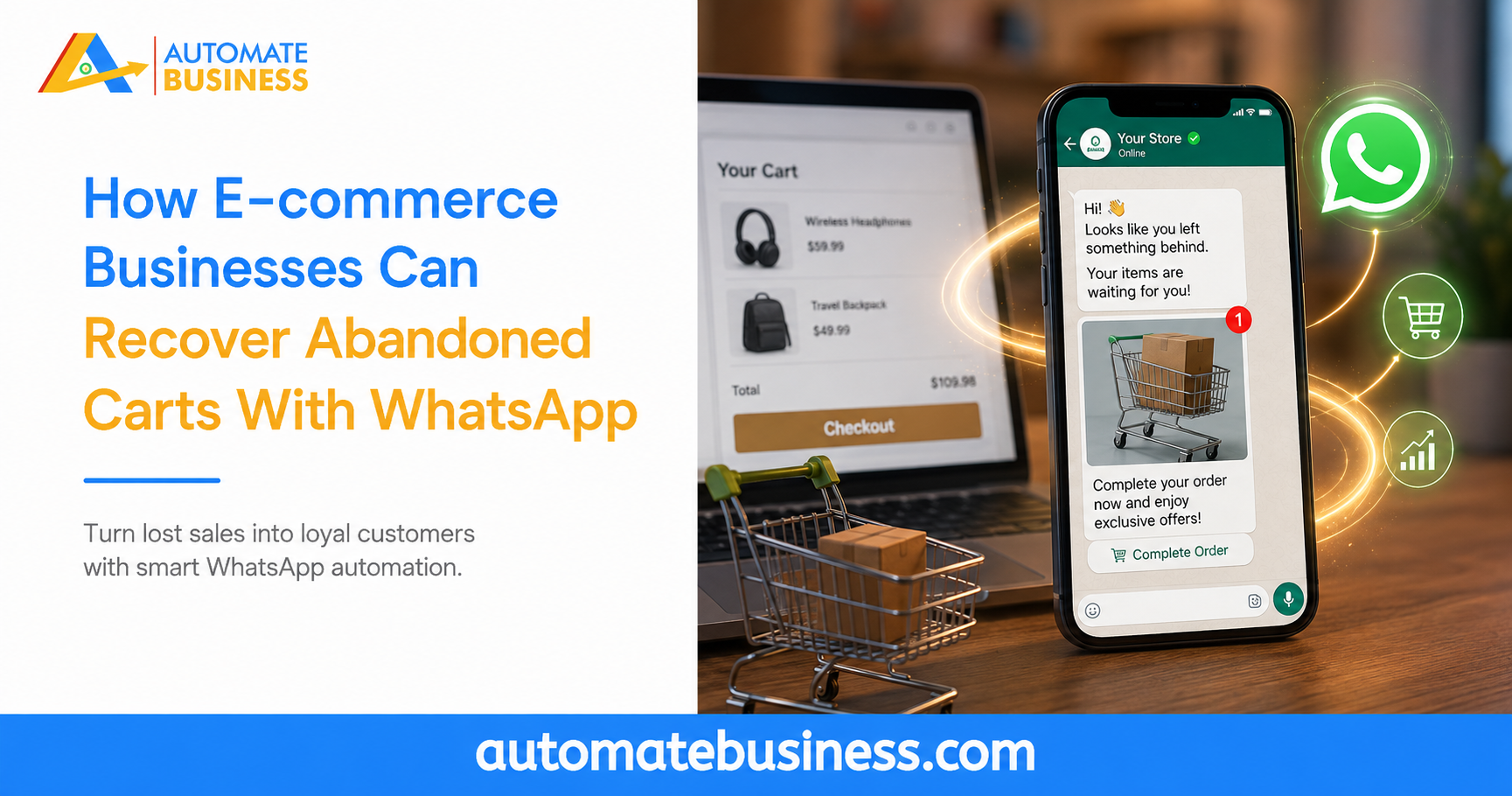
Abandoned carts are the most expensive problem in e-commerce and the most underestimated. A buyer visits your store, browses your catalogue, adds products to their cart, and leaves without completing the purchase. For most e-commerce businesses in India, this happens with more than 70% of potential transactions. The products were chosen. The intent was there. The sale did not happen not because the buyer changed their mind, but because nobody followed up.
Email recovery campaigns exist. Push notifications exist. Retargeting ads exist. But in India, where WhatsApp is the primary digital communication channel for over 500 million people, none of these channels comes close to the open rates, response rates, and conversion impact of a well-timed WhatsApp message.
Automate Chats WhatsApp Marketing by Automate Business is built specifically to help businesses capture this opportunity at scale. Built on the official WhatsApp Business API and backed by Meta Business Partner certification, it enables e-commerce businesses to send automated abandoned cart recovery messages, personalized product reminders, and re-engagement campaigns all through WhatsApp, at the moment when the buyer is most likely to complete their purchase. For e-commerce businesses serious about recovering revenue that is currently slipping away, this is where the effort should begin.
Why Abandoned Cart Recovery Matters More Than Acquiring New Customers
Acquiring a new customer costs five to seven times more than re-engaging one who already showed purchase intent. An abandoned cart customer is not a cold lead they found the store, evaluated the product, and made an active decision to add it to their cart. Their purchase intent is significantly higher than someone who simply clicked on an ad.
When that buyer abandons the cart, they are not making a permanent decision. A meaningful percentage complete their purchase within 24 hours of a personalized, well-timed reminder especially when it arrives through a channel they are already actively using.
In India, that channel is WhatsApp. WhatsApp messages see open rates above 90% far exceeding email, SMS, or push notifications. For Indian e-commerce businesses with a WhatsApp-first customer base, building a cart recovery strategy on any other channel is leaving significant revenue behind.
How WhatsApp Cart Recovery Works The Mechanics
A WhatsApp abandoned cart recovery system works by connecting your e-commerce platform to the WhatsApp Business API and triggering automated messages when a cart abandonment event occurs.
The trigger is the cart abandonment itself. When a buyer adds items to their cart and does not complete the purchase within a defined window typically 30 to 60 minutes the system identifies the event, retrieves the buyer's WhatsApp number and cart details, and initiates the recovery sequence.
The first message is typically sent one to two hours after the abandonment personalized with the buyer's name, referencing the specific products left in the cart, and including a direct checkout link. The tone is helpful rather than pushy. If the first message does not result in a completed purchase within 12 to 24 hours, a second message goes out with an additional incentive a limited-time discount, free shipping, or a product-specific assurance. A third message at the 48-hour mark serves as the final touch, referencing stock availability or an expiring offer.
Each message is an approved WhatsApp Business API template pre-approved by Meta to ensure delivery without the risk of the business number being flagged. Automate Chats manages template creation, approval submission, and campaign scheduling within one platform.
Crafting WhatsApp Messages That Recover Carts What Works
The mechanics of delivery are only part of the equation. The message itself its tone, timing, content, and call to action determines whether the buyer returns or ignores the reminder entirely.
The most effective WhatsApp cart recovery messages share four characteristics. The first is personalization. A message addressing the buyer by name and referencing the specific product they left behind converts significantly better than a generic notification. When the message says "Hi Priya, you left behind the Blue Floral Kurti (Size M) it is still waiting for you," that specificity builds confidence.
The second is timing. The highest conversion window is within the first two hours of abandonment when the purchase is still fresh in the buyer's mind. Messages sent after 24 hours still convert, but at lower rates.
The third is a frictionless call to action. The message must include a direct link back to the cart with all items intact not the homepage. Every additional step the buyer has to take reduces conversion probability.
The fourth is value addition in the second or third message. Buyers who did not respond to the first message need a new reason to complete the purchase a discount code, free shipping, or a return policy reassurance. Automate Chats supports AI-powered template creation with dynamic variables for buyer name, product details, cart value, and personalized offer codes.
Setting Up an Abandoned Cart Recovery Sequence on WhatsApp
A three-message recovery sequence is the industry standard for WhatsApp cart abandonment each message serving a distinct purpose.
The first message, sent within two hours of abandonment, is the reminder. Its purpose is to bring the cart back to the buyer's attention in a warm, non-pressurising way, making the return-to-cart action effortless. This message alone typically recovers a meaningful portion of recoverable carts.
The second message, sent 12 to 24 hours later if no purchase was completed, introduces urgency or incentive a limited-time discount, a note about low stock levels, or free delivery above a certain order value. This message targets price-sensitive buyers who were interested but hesitant.
The third message, sent at the 48-hour mark, is brief and final acknowledging that the buyer may have moved on, but leaving the door open. A well-crafted final message notes that the cart will expire soon or offers a small additional discount as a one-time gesture.
After the three-message sequence, buyers who still have not converted move to a broader re-engagement campaign periodic catalogue updates, new arrival notifications, or seasonal offers through WhatsApp broadcast campaigns.
Beyond Cart Recovery WhatsApp for the Full E-commerce Customer Journey
WhatsApp cart recovery is high-impact, but it is one part of a larger opportunity. E-commerce businesses using the WhatsApp Business API can automate communication at every customer journey stage.
Order confirmation messages build trust immediately after purchase. Shipping update notifications reduce customer support queries. Post-delivery review requests sent 24 hours after confirmed delivery generate authentic product reviews that improve future conversion.
Re-engagement campaigns for customers who have not purchased in 30, 60, or 90 days segmented by purchase history and product category preference bring inactive customers back with relevant offers rather than generic broadcasts.
Automate Chats enables all of these workflows through one platform a shared team inbox, a broadcast campaign manager, a visual chatbot builder for automated first-response handling, and detailed analytics showing delivery rates, read rates, and click-through rates for every message sent.
Why WhatsApp Business API Is the Right Infrastructure for E-commerce Recovery
Not all WhatsApp messaging tools are equal. Some tools send messages through unofficial WhatsApp automation methods that violate Meta's terms of service and risk permanent bans on the business number. For an e-commerce business where WhatsApp is a primary customer communication channel, a banned number is an operational crisis.
The WhatsApp Business API is Meta's official channel for business messaging at scale it supports approved templates, broadcast campaigns to opted-in contacts, and automated workflows without the risk of account suspension. Automate Chats is built entirely on the WhatsApp Business API and operates as a Meta Business Partner, ensuring that every message sent is compliant, delivered reliably, and backed by the infrastructure designed for business use at scale.

 English
 Arabic
 French
 Spanish
 Portuguese
 Turkish
 Dutch
Dutch
 Italiano
 Russian
 Romaian
 Portuguese (Brazil)
 Greek
Greek
