


How Mobile App Developers in Riyadh Can Turn a Business Idea Into a Market-Ready App
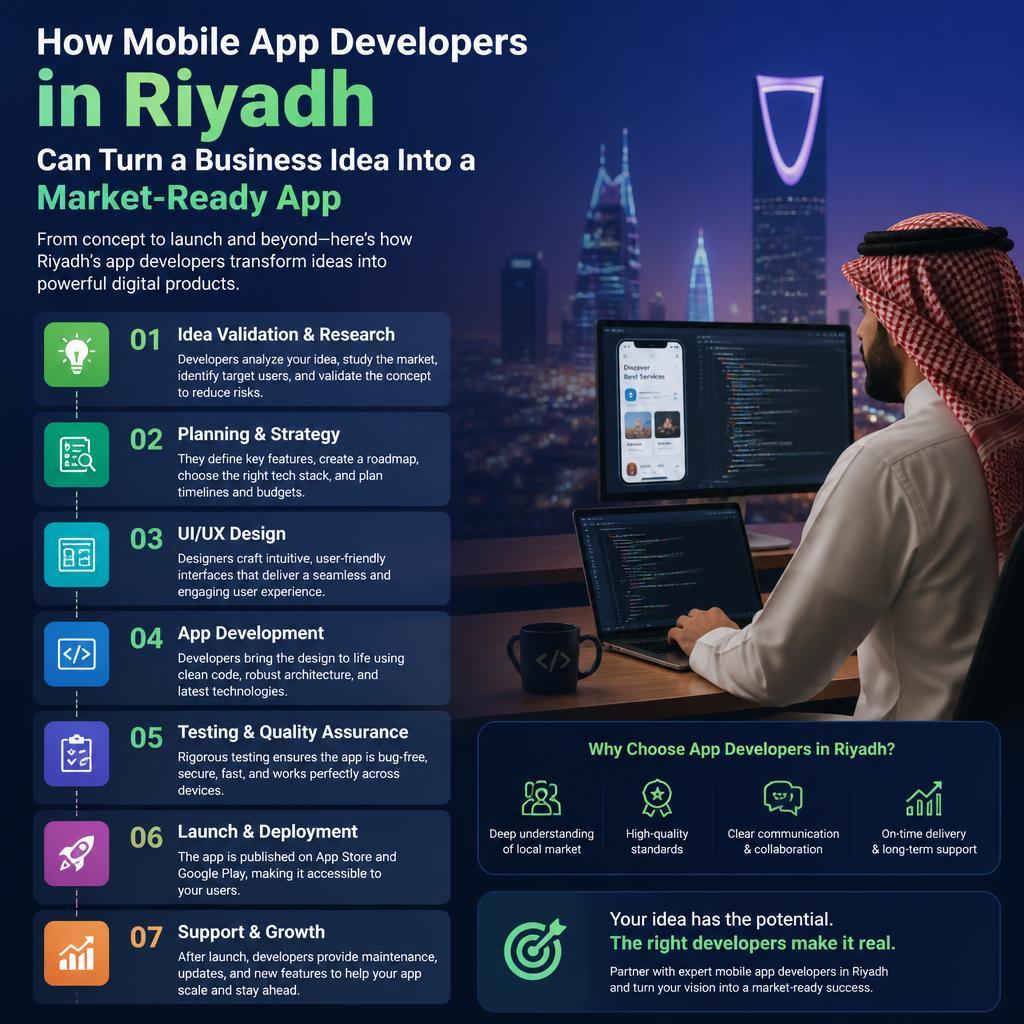
A promising business idea is only the beginning. Turning that concept into a mobile product that people actually want to use requires research, planning, design, engineering, testing, and a clear launch strategy. For entrepreneurs and companies in Riyadh, Saudi Arabia, working with experienced mobile app developers in Riyadh can help transform an early concept into a structured digital product.
From a simple service-booking idea to a sophisticated marketplace, logistics platform, healthcare solution, or e-commerce application, the development journey involves many decisions. The strongest results usually come from treating the app as a business product rather than simply a piece of software.
This guide explains how a business idea can progress from an initial concept to a market-ready mobile application.
Start by Defining the Business Opportunity
Before designing screens or choosing a programming framework, determine what your application is actually going to solve.
A useful starting point is to identify:
- The problem customers currently face
- Who experiences that problem
- Existing alternatives
- Why customers would choose your solution
- How the business will generate value
- What makes the concept different
For example, an entrepreneur might notice that customers struggle to find reliable local services. The resulting application could connect customers with service providers, manage bookings, process payments, and provide notifications.
The idea becomes much stronger when the problem, audience, and expected outcome are clearly defined.
Research the Saudi Market
An application intended for Riyadh should be planned around its intended users and market conditions.
Research can help reveal:
- Customer preferences
- Competitor offerings
- Existing mobile solutions
- Pricing expectations
- Common purchasing behaviour
- Service gaps
- Frequently requested features
Don't assume that an idea is unique simply because it hasn't been seen in your immediate network. Search app stores, review competing products, examine customer feedback, and identify weaknesses that your product could address.
For businesses targeting a broader Saudi Arabia audience, consider whether the application can eventually expand beyond Riyadh without requiring a complete technical rebuild.
Turn the Idea Into a Clear Product Concept
Once the opportunity has been researched, convert the original idea into a defined product.
Create a simple product document describing:
Target Users
Who will use the application?
Core Problem
What specific issue does it solve?
Main Solution
How will the application address that issue?
Essential Features
What must the first version include?
Business Objective
What outcome should the application generate?
Future Direction
What could the product become after the initial release?
This document gives mobile app developers in Riyadh a practical foundation for understanding the project.
Build an MVP Instead of Everything at Once
One of the most common mistakes businesses make is trying to launch an application with every imaginable feature.
A better option may be creating a Minimum Viable Product, or MVP.
An MVP contains the core functionality needed to test the concept with real users.
For example, a marketplace application might initially include:
- User registration
- Seller profiles
- Product listings
- Search
- Product details
- Cart
- Checkout
- Order management
Advanced analytics, loyalty programs, sophisticated recommendations, and additional automation can potentially follow once the product has been validated.
The objective is not to create an incomplete application. It is to focus the first release on the functionality that matters most.
Create User Journeys Before Designing Screens
A market-ready application should have logical navigation.
Before creating the visual interface, map out how users will move through the product.
For example:
Open App → Register → Discover Service → Select Option → Confirm Request → Pay → Receive Confirmation
Each step should have a clear purpose.
User journeys can reveal unnecessary screens, confusing processes, and missing functionality before developers begin extensive implementation.
For applications serving Riyadh customers, businesses may also need to consider Arabic and English experiences, location services, local payment methods, and regionally relevant workflows.
Design the Interface Around Real Users
Once user journeys are established, the UI/UX design process can begin.
This may involve:
- Wireframes
- Interactive prototypes
- Navigation structures
- Visual design
- Design systems
- Responsive layouts
- Accessibility considerations
- Usability reviews
A professional mobile app development company in Riyadh should be able to explain why particular design decisions are being made rather than simply producing attractive screens.
Good design helps users understand what to do next.
A customer shouldn't need instructions to discover how to book a service, add an item to a cart, track an order, or contact support.
Choose Technology Based on the Product
Technology selection should come after the requirements are understood.
Depending on the project, developers may consider:
Native Android and iOS
Useful when an application requires deep platform-specific functionality or highly specialized performance.
Flutter
A practical option for certain businesses that want applications across multiple platforms while sharing significant development resources.
React Native
Suitable for some cross-platform products where reusable components and a JavaScript-based development environment align with the project.
Backend Infrastructure
The backend may manage:
- User accounts
- Databases
- APIs
- Authentication
- Payments
- Notifications
- Business logic
- Administrative dashboards
- Third-party integrations
The best technology stack is the one that supports the application's current requirements while leaving room for sensible future development.
Build the Backend Alongside the App
The visible mobile interface is only one part of the product.
Behind it may be a complex system responsible for processing requests, storing information, authenticating users, sending notifications, and connecting external services.
For example, a delivery application may require:
Customer App + Driver App + Admin Dashboard + Backend + Maps + Payment Gateway + Notification System
Planning these components together helps create a more reliable ecosystem.
Integrate the Services Your Business Already Uses
A new mobile application often needs to communicate with existing business software.
Possible integrations include:
- CRM systems
- ERP platforms
- Payment gateways
- Inventory management
- Accounting systems
- Maps
- SMS services
- Email platforms
- Analytics tools
- Cloud services
Before development begins, create an integration list and identify which systems have available APIs.
This can prevent unexpected technical obstacles later.
Treat Security as a Development Requirement
Security shouldn't be added immediately before launch.
Depending on the application, developers may need to address:
- Authentication
- Authorization
- Secure API communication
- Data encryption
- Access permissions
- Payment security
- Session management
- Secure storage
- Error handling
Applications handling personal information, financial transactions, healthcare data, or business records require particularly careful planning.
Businesses operating in Saudi Arabia should also review the legal and regulatory requirements relevant to their specific industry and data practices.
Test the Product With Realistic Scenarios
A market-ready application needs more than a successful build.
Quality assurance should examine how the application behaves under realistic conditions.
Testing can include:
Functional Testing
Does every feature work as intended?
Device Testing
Does the interface work correctly across supported devices and screen sizes?
Performance Testing
Does the application remain responsive under expected usage?
Integration Testing
Do APIs and external services communicate correctly?
Usability Testing
Can users complete important tasks without confusion?
Security Testing
Are authentication, permissions, and sensitive workflows appropriately protected?
Finding problems before launch is considerably better than discovering them through customer complaints.
Prepare for App Store Submission
An application isn't market-ready until its distribution requirements are addressed.
Businesses need to prepare elements such as:
- App name
- Description
- Screenshots
- App icon
- Privacy information
- Category
- Store metadata
- Required permissions
- Support information
The application should also comply with the relevant policies of the platforms where it will be distributed.
Launch With a Feedback Strategy
Launching the app is not the final stage.
Once users begin interacting with the product, their feedback can reveal:
- Confusing features
- Missing functionality
- Performance issues
- Unexpected user behaviour
- New opportunities
- Frequently requested improvements
Use this information to prioritize future releases.
A product roadmap can then be divided into:
Immediate fixes → Important improvements → New capabilities → Long-term expansion
This approach helps prevent development decisions from being based entirely on assumptions.
Measure Whether the App Is Actually Working
Downloads alone don't determine whether an application is successful.
Depending on the business model, useful measurements could include:
- Active users
- Registration completion
- Conversion rate
- Repeat usage
- Orders
- Bookings
- Customer retention
- Average transaction value
- Feature engagement
- Support requests
For example, an e-commerce company may care more about completed purchases and repeat customers than total downloads.
Choose measurements that connect directly to the business objective.
Why Local Development Expertise Can Be Useful
Businesses searching for mobile app developers in Riyadh may benefit from working with a team familiar with the local market when the product is specifically intended for Saudi customers.
This can be particularly relevant for applications involving:
- Arabic interfaces
- Local payment options
- Riyadh-based services
- Delivery operations
- Transportation
- Location functionality
- Regional customer expectations
However, local presence alone shouldn't determine the decision. Portfolio quality, technical expertise, communication, project management, and long-term support should also be evaluated.
How Five Programmers Can Help Transform an Idea
Five Programmers helps businesses develop mobile products through services that can include product planning, UI/UX design, Android and iOS development, Flutter and React Native solutions, backend engineering, API integration, testing, deployment, and post-launch improvements.
For organizations looking for mobile app development services in Riyadh, the goal should be to build technology around a clearly defined business opportunity rather than simply creating an application because mobile is popular.
A strong development partnership can help identify technical requirements, prioritize functionality, design user journeys, select an appropriate technology stack, and prepare the product for real-world use.
A Simple Roadmap From Idea to Market
The complete journey can be summarized as:
Business Idea
↓
Market Research
↓
Product Definition
↓
MVP Planning
↓
User Journey Mapping
↓
UI/UX Design
↓
Technology Selection
↓
Development
↓
Testing & Refinement
↓
App Store Preparation
↓
Launch
↓
User Feedback & Optimization
Following a structured process gives businesses greater visibility into what needs to happen at every stage.
Frequently Asked Questions
How long does it take to turn a business idea into a mobile app?
The timeframe depends on the application's feature set, number of platforms, design requirements, integrations, testing scope, and technical complexity. A focused MVP generally requires less development than a feature-rich enterprise platform.
Should I validate my app idea before development?
Yes. Market research, competitor analysis, customer interviews, prototypes, or a limited MVP can help determine whether the proposed solution addresses a genuine need before significant resources are committed.
Can one app support both Android and iOS?
Yes. Businesses can choose native development for each platform or consider cross-platform technologies such as Flutter and React Native, depending on their technical requirements.
What happens if the app needs new features after launch?
Post-launch development can introduce new functionality, performance improvements, integrations, security updates, and interface enhancements based on customer feedback and changing business requirements.
Take Your Business Idea From Concept to Launch
A strong mobile product begins long before development starts. The most important work happens when businesses define the problem, understand their audience, validate the opportunity, prioritize features, and create a roadmap for sustainable growth.
For entrepreneurs and organizations in Riyadh, Saudi Arabia, choosing capable mobile app developers in Riyadh can help turn an early concept into a practical application built around real customer and business requirements.
If you have a mobile product idea that you're ready to explore, Contact Us or Get a Free Quote Today and take the first step toward transforming your concept into a market-ready digital experience.

 English
 Arabic
 French
 Spanish
 Portuguese
 Turkish
 Dutch
Dutch
 Italiano
 Russian
 Romaian
 Portuguese (Brazil)
 Greek
Greek
