


How Can I Compare Interest Rates From Different Loan Providers?
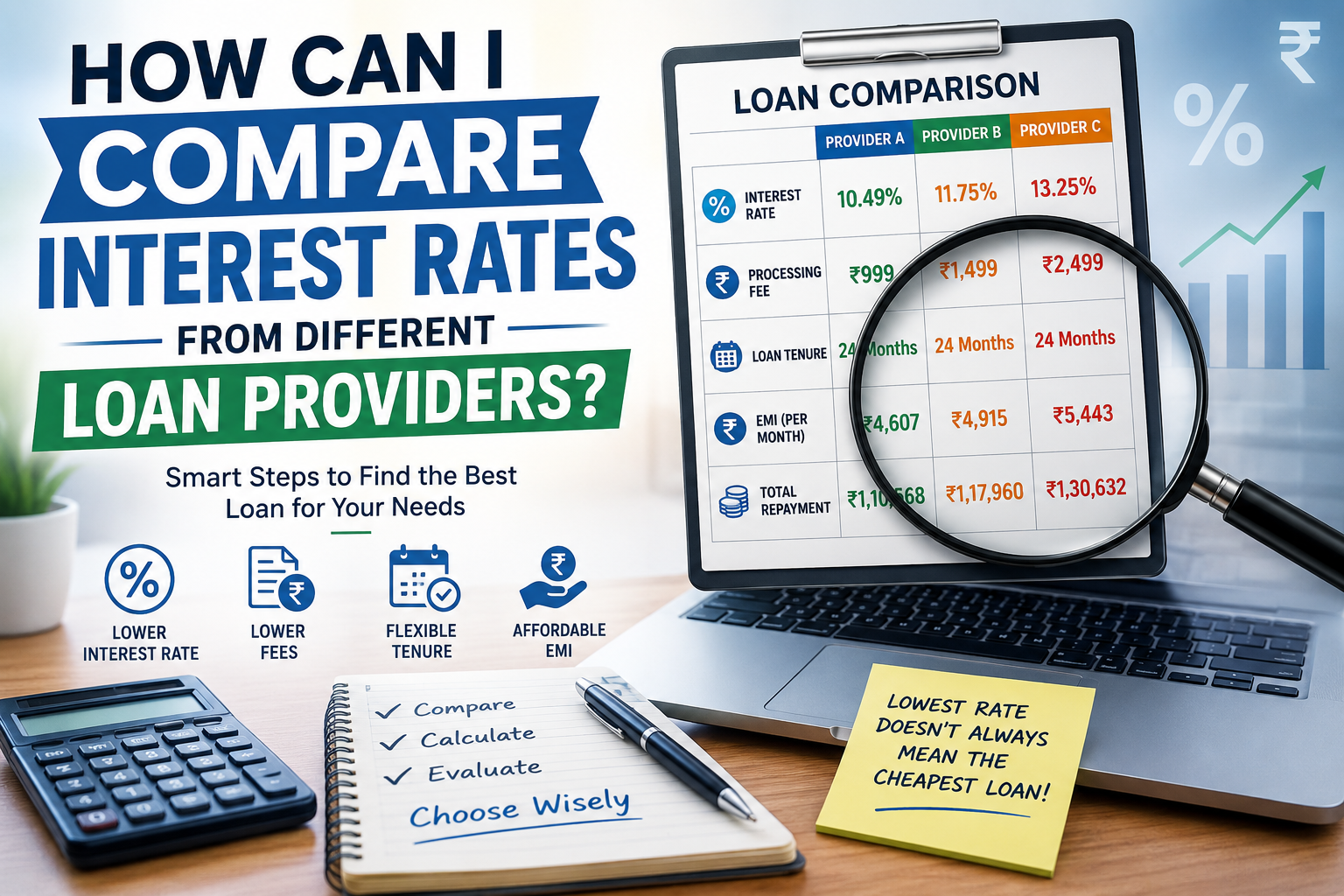
Comparing loan offers can look simple at first. One lender may advertise a 10% interest rate, another may offer 12%, while a third may promote a low EMI. But choosing the cheapest loan is not as easy as picking the lowest percentage.
If you are searching for how to compare interest rates from different loan providers, you need to look beyond the advertised interest rate. The actual cost of borrowing can also depend on the APR, processing fee, loan tenure, EMI, repayment schedule, prepayment terms, and other applicable charges.
Whether you are comparing a personal loan, instant loan, education loan, vehicle loan, or business loan, understanding these factors can help you make a more informed borrowing decision.
Why Should You Compare Interest Rates From Different Loan Providers?
The interest rate directly affects the cost of borrowing. Even a small difference in the rate can change your total interest when the loan amount or repayment period is large.
For example, imagine two lenders offer a ₹1 lakh personal loan.
- Loan Provider A: 14% annual interest
- Loan Provider B: 17% annual interest
At first glance, Provider A appears cheaper. However, if Provider A charges a significantly higher processing fee or other applicable charges, the overall difference may be smaller than expected.
This is why comparing loan interest rates should involve looking at the complete cost of the loan.
A good comparison should answer three questions:
How much am I borrowing?
How much will I pay every month?
How much will I pay in total?
1. Start With the Same Loan Amount
The first step when comparing interest rates from different loan providers is to use the same loan amount.
For example, compare:
Loan amount: ₹1,00,000
rather than comparing one lender's ₹50,000 offer with another lender's ₹1,50,000 offer.
Using the same principal makes it easier to understand how the interest rate and fees affect the total borrowing cost.
If you are comparing personal loan interest rates, enter the same loan amount into each lender's calculator where available.
2. Compare the Interest Rate
The interest rate is an important starting point.
Suppose you are comparing three personal loan providers:
| Loan Provider | Interest Rate |
|---|---|
| Provider A | 14% |
| Provider B | 16% |
| Provider C | 18% |
Provider A appears to have the lowest interest rate.
However, don't stop here.
You should also check whether the rate is:
- Fixed or variable, where applicable
- Reducing-balance or another methodology
- Applicable to your specific profile
- The final rate or simply an advertised starting rate
The rate displayed in an advertisement may not necessarily be the rate you personally receive.
3. Check Whether the Rate Is Reducing-Balance or Flat
This is particularly important when comparing loan interest rates.
Under a reducing-balance structure, interest is generally calculated on the outstanding principal. As you repay the principal, the outstanding balance falls.
With a flat-rate structure, interest may be calculated using the original principal for the stated period.
Because the calculation method differs, two loans with similar-looking percentages may have very different costs.
Therefore, don't compare percentages without understanding how the lender calculates interest.
Always check the loan agreement and applicable loan documentation for the actual methodology.
4. Compare APR, Not Just the Interest Rate
One of the most useful ways to compare loan offers is to look at the Annual Percentage Rate (APR).
APR provides a broader representation of the annualized cost of credit because it can incorporate the interest rate and applicable charges associated with the credit facility.
For applicable regulated digital loans, borrowers receive APR information through the required disclosures.
For example:
Loan A
- Interest rate: 15%
- Processing fee: ₹2,000
Loan B
- Interest rate: 16%
- Processing fee: ₹500
Loan A has the lower interest rate, but its higher processing fee affects the overall cost.
Therefore, when comparing loan interest rates from different lenders, check the APR and applicable fees rather than focusing on the headline rate alone.
5. Compare Processing Fees
Processing fees are another important part of the borrowing cost.
Suppose you apply for a ₹1 lakh loan.
One lender charges:
₹1,000 processing fee
Another charges:
₹3,000 processing fee
Even if the second lender offers a slightly lower interest rate, the higher upfront charge could affect the overall cost.
Also check whether applicable taxes are charged on fees.
Don't assume that a loan advertised with a low interest rate is automatically cheaper.
6. Compare Loan EMI
Your loan EMI tells you how much you need to repay periodically.
For a standard reducing-balance loan, EMI is commonly calculated using:
EMI = P × R × (1 + R)ⁿ ÷ [(1 + R)ⁿ − 1]
Where:
- P = Principal amount
- R = Monthly interest rate
- N = Number of monthly payments
For example, changing the interest rate or tenure can change the EMI.
However, the lowest EMI isn't necessarily the cheapest loan.
A lender may offer a lower EMI simply because the loan has a longer tenure.
7. Compare Loan Tenure
Loan tenure is the length of time you have to repay the loan.
Consider a hypothetical ₹1 lakh personal loan.
A shorter tenure could mean:
- Higher EMI
- Lower total interest
- Faster repayment
A longer tenure could mean:
- Lower EMI
- Higher total interest
- Longer repayment period
This creates an important trade-off.
When comparing loan interest rates, always compare loans using the same tenure where possible.
Otherwise, you may mistakenly think one loan is cheaper simply because it has been spread over a longer period.
8. Calculate Total Repayment
The total repayment amount can provide a clearer picture of the actual borrowing cost.
A simplified calculation is:
Total repayment = Total EMI payments + applicable charges
For example, suppose:
EMI = ₹5,000
Tenure = 24 months
Total EMI payments:
₹5,000 × 24 = ₹1,20,000
If you borrowed ₹1,00,000, the difference between the principal and EMI payments represents the interest component, before considering other applicable costs.
When comparing personal loan offers, look at the total amount you will pay rather than just the monthly EMI.
9. Check Prepayment and Foreclosure Charges
Some borrowers repay their loans early.
Before accepting an offer, check the lender's terms regarding:
- Part-prepayment
- Full repayment
- Foreclosure
- Minimum lock-in period
- Applicable charges
The rules and charges can vary depending on the loan product and lender.
If you expect to repay your loan early, these terms could affect which loan is more suitable.
10. Check Late-Payment Charges
Your comparison should also include the consequences of missing an EMI.
Review:
- Penal charges
- Late-payment charges
- Additional applicable costs
- Credit-reporting consequences
For applicable regulated loans, important charges should be disclosed in the relevant loan documentation.
Never choose an EMI that is difficult to afford simply because the interest rate looks attractive.
11. Check the Key Facts Statement
For applicable regulated loans, the Key Facts Statement (KFS) is an important document to review before accepting credit.
It provides key information about the loan in a standardized format.
Depending on the product, you may find details such as:
- Loan amount
- Interest rate
- APR
- EMI
- Tenure
- Repayment schedule
- Fees
- Penal charges
- Other applicable terms
If you are comparing multiple loan providers, reviewing their applicable KFS documents can make the comparison much easier.
12. Don't Compare Only Advertised Rates
Search online for best personal loan interest rates, and you may see advertisements showing extremely attractive rates.
For example:
"Personal loans starting at 10.5%!"
The important word is starting.
The rate you actually receive can depend on factors such as:
- Credit profile
- Income
- Employment
- Loan amount
- Tenure
- Existing obligations
- Lender's internal policies
Therefore, ask for the actual rate applicable to your application before comparing offers.
Example: Comparing Two Loan Providers
Suppose you need a ₹2 lakh personal loan for 24 months.
Provider A
- Interest rate: 14%
- Processing fee: ₹2,000
- Tenure: 24 months
Provider B
- Interest rate: 15%
- Processing fee: ₹750
- Tenure: 24 months
Provider A has the lower interest rate.
But Provider B has a substantially lower processing fee.
To make the right comparison, calculate:
EMI + total interest + applicable fees = overall borrowing cost
The provider with the lowest interest rate may not always have the lowest total cost.
Use a Loan Comparison Checklist
Before choosing a lender, create a simple comparison table.
| Factor | Provider A | Provider B | Provider C |
|---|---|---|---|
| Loan amount | ₹1 lakh | ₹1 lakh | ₹1 lakh |
| Interest rate | Check offer | Check offer | Check offer |
| APR | Check documents | Check documents | Check documents |
| Tenure | Check offer | Check offer | Check offer |
| EMI | Check offer | Check offer | Check offer |
| Processing fee | Check offer | Check offer | Check offer |
| Other charges | Check terms | Check terms | Check terms |
| Total repayment | Check offer | Check offer | Check offer |
| Prepayment terms | Check terms | Check terms | Check terms |
| Late-payment charges | Check terms | Check terms | Check terms |
This simple approach makes comparing loan interest rates from different lenders much more objective.
Does Credit Score Affect Your Interest Rate?
It can.
Lenders may consider your credit history and other factors when assessing your application.
A borrower with a strong credit profile may receive different pricing from someone with limited or weaker credit history.
However, credit score is not the only factor.
Lenders can also consider:
- Income
- Employment
- Existing debt
- Loan amount
- Tenure
- Banking information
- Internal risk policies
If you have no established credit history, don't assume every lender will automatically reject you. Eligibility varies between lenders.
Compare Loans Based on Affordability
The cheapest loan on paper may not always be the best choice if the EMI is too high for your monthly budget.
Before accepting a loan, calculate your:
- Monthly income
- Essential expenses
- Existing EMIs
- Household commitments
- Emergency savings
- New loan EMI
A loan should fit into your budget without making it difficult to manage essential expenses.
Remember:
Loan eligibility is not the same as loan affordability.
Be Careful When Comparing Online Loan Providers
Digital lending has made it easier to discover and compare loan offers, but borrowers should still verify the actual lender.
Before submitting personal information, check:
- Actual lender name
- Official website
- Applicable regulatory information
- Loan agreement
- Key Facts Statement
- APR
- Processing fee
- Privacy policy
- Customer support
Never share sensitive authentication information such as your OTP, UPI PIN, banking password, or card PIN with someone claiming to arrange a loan.
Be cautious of advertisements promising guaranteed loans, regardless of credit profile.
What Is the Best Way to Compare Loan Interest Rates?
A practical comparison process looks like this:
Step 1: Decide the amount you need
Don't borrow more than necessary.
Step 2: Use the same loan amount
This creates a fair comparison.
Step 3: Compare interest rates
Check the actual rate offered to you.
Step 4: Compare APR
Look at the broader annualized cost.
Step 5: Compare processing fees
Include applicable fees and taxes.
Step 6: Compare EMI
Make sure the EMI is affordable.
Step 7: Compare tenure
Check how long you will remain in debt.
Step 8: Compare total repayment
This shows the overall payment obligation.
Step 9: Check other charges
Review late-payment and prepayment terms.
Step 10: Read the loan documents
Confirm the final terms before accepting the offer.
Final Thoughts
Knowing how to compare interest rates from different loan providers can help you avoid choosing a loan based solely on an attractive advertisement or low EMI.
The interest rate is important, but it is only one part of the borrowing cost.
When comparing personal loans or other credit products, consider the complete picture:
Interest rate + APR + EMI + tenure + processing fees + other applicable charges + total repayment
A loan with a slightly higher interest rate could potentially be more suitable if its other costs are lower, while a loan with a very low advertised rate may become expensive because of fees or a long repayment period.
For applicable regulated loans, carefully review the Key Facts Statement, APR, repayment schedule, and loan agreement before accepting the offer.
Most importantly, choose a loan that you genuinely need and can comfortably repay.
Don't ask only, "Which lender has the lowest interest rate?"
Ask the better question:
"Which loan gives me an affordable EMI and the lowest reasonable overall cost for my situation?"
That is the comparison that matters.

 English
 Arabic
 French
 Spanish
 Portuguese
 Turkish
 Dutch
Dutch
 Italiano
 Russian
 Romaian
 Portuguese (Brazil)
 Greek
Greek
