For many companies, a mobile application is no longer just another digital channel. It can become a central part of how customers discover services, place orders, make bookings, communicate with businesses, and manage their accounts. For business owners in Riyadh, Saudi Arabia, choosing the right development team is therefore an important strategic decision.
However, finding suitable mobile app developers in Riyadh involves more than comparing quotations. Business owners need to consider product goals, technical capabilities, user experience, security, scalability, communication, and long-term maintenance.
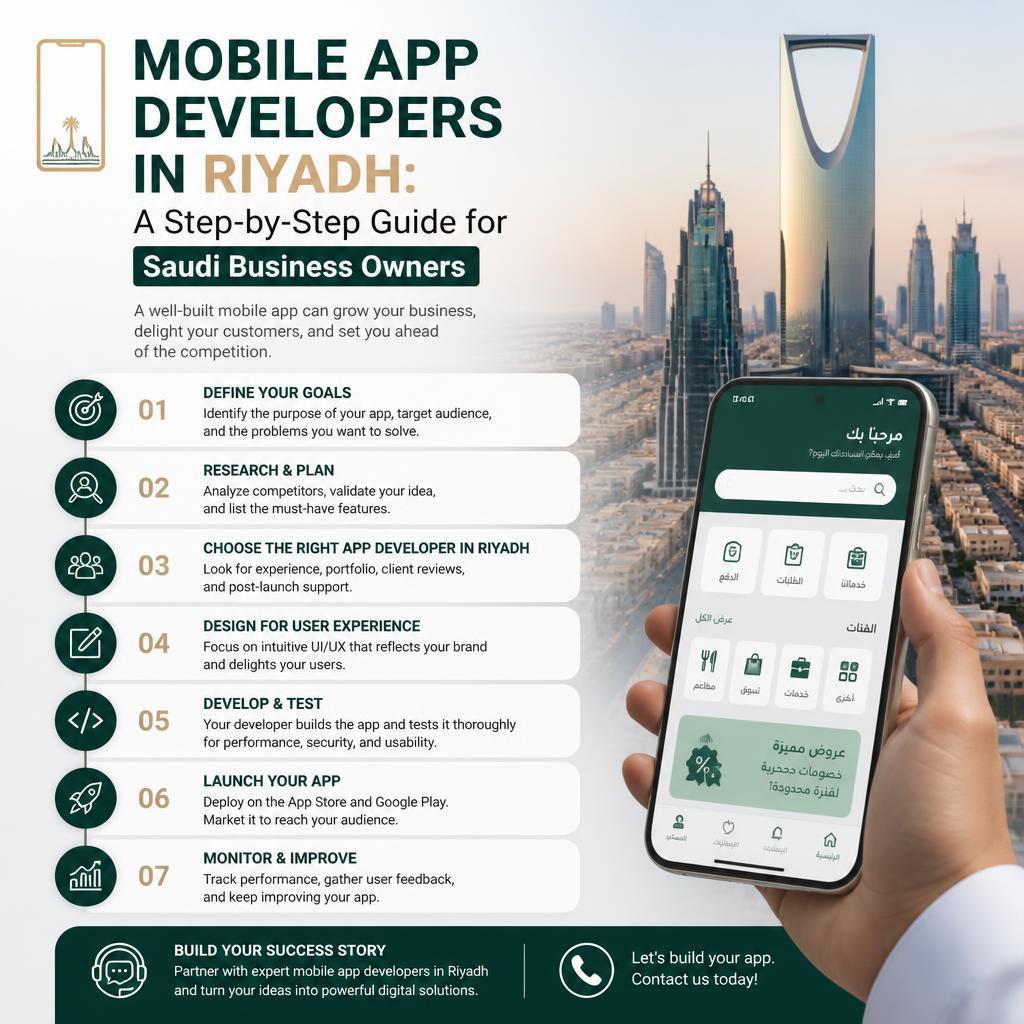
This step-by-step guide explains how Saudi businesses can approach the process from the initial idea to selecting a development partner and preparing an application for launch.
Step 1: Start With the Business Problem
Before contacting any developer, define what your application is supposed to accomplish.
Instead of beginning with:
“I need an Android and iPhone app.”
Start with:
“What problem will this application solve for my customers or employees?”
For example, a business may want an application to:
- Accept online orders
- Manage appointments
- Coordinate deliveries
- Display property listings
- Connect buyers and sellers
- Manage field employees
- Provide digital payments
- Offer loyalty rewards
- Track vehicles or shipments
- Deliver online learning
A clearly defined purpose makes later decisions about features, technology, and budget considerably easier.
Step 2: Understand Your Target Users
A successful application is designed around the people who will actually use it.
For businesses operating in Riyadh, identify whether your audience consists primarily of consumers, corporate customers, employees, vendors, drivers, healthcare professionals, students, or another group.
Consider:
- What do users need to accomplish?
- How frequently will they use the application?
- Which features are essential?
- What could make the experience frustrating?
- Do users need Arabic, English, or both?
- Will they primarily use Android or iOS devices?
Understanding these details helps mobile app developers in Riyadh create more relevant user flows rather than simply adding a long list of features.
Step 3: Separate Essential Features From Future Ideas
One of the easiest ways to complicate an application project is trying to launch every possible feature simultaneously.
Create three categories:
Essential
Features required for the first release.
Useful
Features that improve the product but aren't necessary for launch.
Future
Ideas that can be introduced after the application gains users and feedback.
This approach can help businesses develop a focused MVP instead of spending the initial budget on functionality that may later prove unnecessary.
For example, an e-commerce startup might initially need:
- Registration
- Product browsing
- Search
- Cart
- Checkout
- Payment
- Order tracking
Advanced recommendation engines, sophisticated loyalty systems, or additional automation could potentially follow later.
Step 4: Decide Which Platforms You Need
The next decision is whether your application should target Android, iOS, or both.
Android
Android can be important when your customer base includes a wide range of devices and price segments.
iOS
iOS can be appropriate when your target audience heavily uses Apple's ecosystem or when platform-specific functionality is important.
Cross-Platform
Technologies such as Flutter and React Native can allow businesses to develop applications for multiple platforms using shared development approaches.
There isn't one universally correct choice. The best option depends on your users, functionality, performance expectations, budget, integrations, and long-term product plans.
A knowledgeable mobile app development company in Riyadh should explain these trade-offs rather than simply recommending its preferred technology.
Step 5: Research Potential Development Companies
Once your requirements are reasonably clear, begin comparing potential providers.
Search for mobile app developers in Riyadh and create a shortlist based on relevant capabilities rather than rankings alone.
Review each company's:
- Portfolio
- Industry experience
- Technology expertise
- UI/UX work
- Development methodology
- Testing process
- Client communication
- Maintenance services
- Security practices
- Project engagement models
Look particularly for projects that resemble your application's complexity.
A team that has built a basic informational application may not necessarily be the right fit for a sophisticated logistics, marketplace, healthcare, or financial platform.
Step 6: Examine Their Previous Work Carefully
A portfolio should tell you more than whether a company can produce attractive screens.
When reviewing previous applications, ask:
Was the product similar to yours?
Did it require comparable integrations?
Was it designed for a similar audience?
Does the interface appear intuitive?
Does the application demonstrate scalable functionality?
If possible, ask the development company to explain the challenges they encountered in comparable projects and how those challenges were addressed.
This gives you a better understanding of their actual problem-solving ability.
Step 7: Evaluate UI/UX Before Development Begins
A mobile application should be easy to understand from the first interaction.
The design process may involve:
- User-flow planning
- Wireframes
- Prototypes
- Interface design
- Interaction patterns
- Usability reviews
- Design refinement
For businesses serving customers in Riyadh, design may also need to accommodate bilingual interfaces, different reading directions, regional payment experiences, and locally relevant customer journeys where applicable.
Don't select a developer simply because their designs look visually impressive. Ask how they make those designs functional and intuitive.
Step 8: Discuss the Technology Stack
Technology should support your application objectives.
Depending on the project, your development partner might recommend:
- Kotlin for Android
- Swift for iOS
- Flutter for cross-platform development
- React Native for cross-platform applications
- Node.js or other backend technologies
- Cloud services
- REST or GraphQL APIs
- Third-party integrations
Ask the developer why each technology is being recommended.
For instance, Flutter app development may make sense when shared development across platforms is valuable, while native development may be preferable for applications requiring extensive platform-specific capabilities.
The right answer should come from your project requirements rather than whichever framework happens to be popular.
Step 9: Clarify the Development Cost
Mobile application pricing can vary dramatically.
A simple application with a small feature set and a complex enterprise platform with multiple user roles, integrations, dashboards, payments, real-time tracking, and advanced security requirements cannot reasonably have the same development budget.
When requesting proposals, ask for a breakdown covering:
- UI/UX design
- Frontend development
- Backend development
- APIs
- Third-party integrations
- Testing
- Deployment
- Maintenance
- Additional features
Don't compare only the final quotation. Compare what each proposal includes.
Step 10: Establish a Realistic Timeline
Development schedules depend on scope.
A straightforward MVP may require significantly less time than a multi-platform application with extensive integrations and complex workflows.
Ask prospective mobile app developers in Riyadh to divide the project into milestones.
A typical sequence could include:
Discovery → Design → Development → Testing → Deployment → Post-launch Support
A milestone-based plan gives business owners clearer visibility into progress.
Be cautious of promises such as “we can build everything in a few days” when the proposed application includes substantial functionality. Fast delivery is useful only when quality and requirements remain intact.
Step 11: Ask About Testing and Security
Testing should be integrated into development rather than postponed until the final day.
A professional QA process may evaluate:
- Functional behaviour
- Device compatibility
- Screen responsiveness
- Application performance
- Network conditions
- Authentication
- Payment flows
- API behaviour
- Error handling
- Usability
Security deserves similar attention.
Depending on your application, discuss secure authentication, authorization, encrypted communication, data protection, API security, and appropriate access controls.
If your application handles customer or business-sensitive information, security should be discussed from the planning stage.
Step 12: Understand Post-Launch Responsibilities
Your relationship with the development team shouldn't necessarily end when the application reaches the app stores.
After launch, you may need:
- Bug fixes
- OS compatibility updates
- Performance optimization
- Security updates
- New features
- Analytics improvements
- UI refinements
- Backend maintenance
Ask what support is included in your agreement and what services are billed separately.
A clear post-launch arrangement can make future planning much easier.
Step 13: Check Communication and Ownership
Technical expertise isn't enough if communication becomes difficult.
Before signing a contract, clarify:
- Who will be your primary contact?
- How often will progress be reported?
- How will feedback be documented?
- How will change requests be handled?
- Who owns the source code?
- How will credentials and project assets be transferred?
- What happens when the project ends?
These details can prevent misunderstandings later.
Step 14: Think About the Saudi Market From Day One
A mobile product intended for Saudi Arabia should be planned with its intended market in mind.
Depending on the application, relevant considerations may include:
- Arabic and English language support
- Local customer expectations
- Payment integrations
- Location services
- Delivery workflows
- Regional business processes
- Customer support
- Data and security requirements
For businesses specifically targeting Riyadh, understanding the local audience can help shape everything from onboarding to navigation and service delivery.
How Five Programmers Can Support Your App Project
Five Programmers provides mobile application development support for businesses that want to transform digital ideas into functional products. Its development capabilities can cover planning, UI/UX, Android and iOS applications, Flutter and React Native solutions, backend development, integrations, testing, deployment, and ongoing improvements.
For companies searching for mobile app development services in Riyadh, the key objective should be finding a partner that can understand the business problem first and then recommend a suitable product and technology strategy.
A Simple Checklist Before You Hire
Before making your final decision, make sure you can answer “yes” to most of these questions:
- Does the team understand your business objective?
- Have they built comparable applications?
- Can they explain their technology recommendation?
- Do they have a structured UI/UX process?
- Is testing included?
- Are security requirements discussed?
- Is pricing clearly explained?
- Are milestones documented?
- Is post-launch support available?
- Are ownership and source-code terms clear?
- Can they communicate effectively throughout the project?
If several answers are unclear, ask additional questions before signing an agreement.
Frequently Asked Questions
What should Saudi business owners prepare before hiring app developers?
Prepare a basic description of the business problem, target users, preferred platforms, essential features, required integrations, approximate budget, and desired launch objectives.
Are local mobile app developers better for Riyadh businesses?
Local market familiarity can be useful, particularly when an application requires regional workflows or bilingual experiences. However, technical expertise, relevant experience, communication, and development quality should remain major selection factors.
Should a startup build an MVP first?
For many startups, beginning with a focused MVP can be practical because it allows the business to validate the core idea before investing in a larger feature set. The right approach depends on the product and business model.
What happens after a mobile app is launched?
Post-launch work may include maintenance, bug fixes, security updates, operating-system compatibility, performance optimization, analytics improvements, and new feature development.
Turn Your App Idea Into a Real Product
Building a mobile application requires careful decisions long before the first line of code is written. By defining the business problem, understanding users, prioritizing features, evaluating developers, choosing appropriate technology, and planning for long-term support, Saudi business owners can create a much stronger foundation for their digital product.
If you're looking for mobile app developers in Riyadh to discuss a new application, modernization project, or custom business solution, now is the right time to start with a clear project brief and professional consultation.
Contact Us or Get a Free Quote Today and take the next step toward building a mobile application designed for your business and customers in Riyadh, Saudi Arabia.




 English
 Arabic
 French
 Spanish
 Portuguese
 Deutsch
 Turkish
 Dutch
Dutch
 Russian
 Romaian
 Portuguese (Brazil)
 Greek
Greek
