


Indian Retail Industry 2026-2034: Size, Share, Growth Analysis & Market Outlook
How is India Retail Industry Performing?
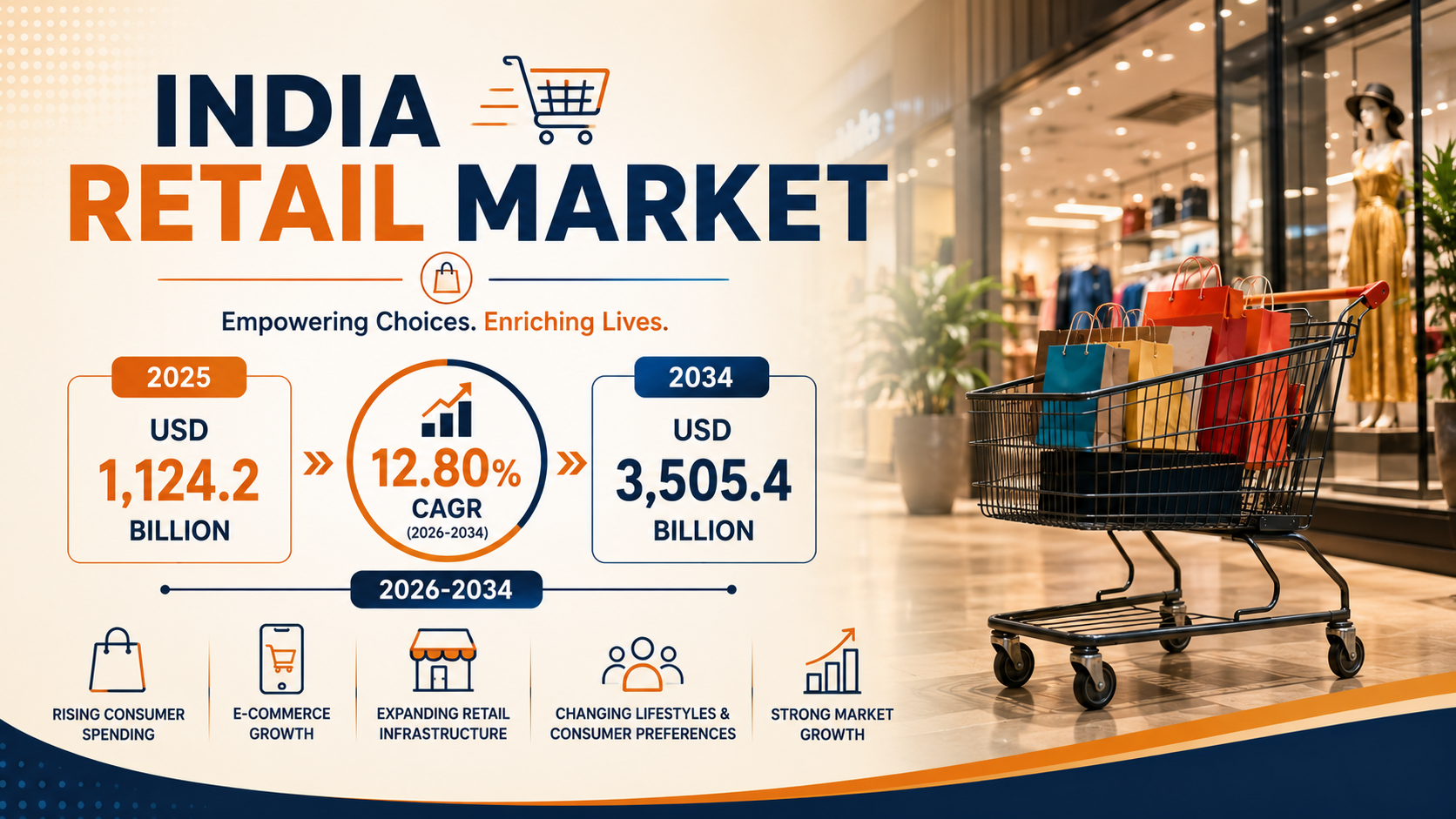
India's retail market stands as one of Asia's most expansive and fastest-growing consumer sectors, encompassing Food and Beverages, Personal and Household Care, Apparel Footwear and Accessories, Furniture Toys and Hobby, Electronic and Household Appliances, and other product categories, distributed through Supermarkets and Hypermarkets, Convenience Stores, Specialty Stores, Online Stores, and other channels across North India, West and Central India, South India, and East and Northeast India. The India retail market size reached USD 1,124.2 Billion in 2025 and is projected to reach USD 3,505.4 Billion by 2034, growing at a CAGR of 12.80% during 2026-2034.
India's retail sector is experiencing extraordinary expansion driven by income growth, urbanization, digital adoption, increased consumer spending, and government reforms. The rise of the middle class, rapid growth of e-commerce, infrastructural development, foreign investments, and the consumer trend toward branded merchandise are collectively reshaping the market. The convenience of shopping from home, competitive pricing, wider product ranges, and fast delivery options available through online channels have considerably accelerated market growth, while digital payment methods including UPI and mobile wallets have added further momentum. Rapid urbanization is concentrating purchasing power in metropolitan and emerging tier-2 and tier-3 city markets, creating new addressable demand across all product categories.
Food and Beverages anchors the largest product segment, while Online Stores are among the fastest-growing distribution channels driven by e-commerce expansion. North India leads the regional market driven by rising disposable incomes and cultural affinity for luxury goods and organized retail expansion in Delhi, Chandigarh, and surrounding cities.
Market Statistics At-A-Glance
-
Market Size (2025): USD 1,124.2 Billion
-
Projected Size (2034): USD 3,505.4 Billion
-
CAGR (2026–2034): 12.80%
-
By Product: Food and Beverages drives the largest product segment, powered by growing demand for convenience foods, rising health consciousness, expansion of food delivery services, and increased availability of premium and organic products across organized retail and quick-commerce platforms.
-
By Distribution Channel: Supermarkets and Hypermarkets hold the largest channel share, driven by the appeal of one-stop shopping, competitive pricing, wide product variety, and the convenience of organized retail experiences, while Online Stores represent the fastest-growing channel powered by widespread internet access, home delivery, and ease of digital payments.
-
By Region: North India leads the regional market, driven by rapid urbanization, rising disposable incomes, cultural affinity for luxury goods, and the growth of organized retail hubs in Delhi, Chandigarh, and surrounding metropolitan areas with strong consumer spending power.
What Growth Factors Are Driving India Retail Market Growth?
Rising Disposable Incomes and Expanding Middle Class:
The primary growth engine for India's retail market is the rapidly expanding middle class with increasing disposable income enabling greater consumer expenditure across all retail categories. India's per-capita income crossed USD 2,600 in FY 2024-25, fueling spending on branded apparel, premium food products, personal care, and electronics. This income growth, combined with easy access to consumer financing and aspirational brand consciousness, is driving procurement decisions toward higher-value product categories and organized retail formats that were previously accessible only to upper-income segments. The expanding affluent consumer cohort is expected to grow from 60 million to 100 million by 2027, creating a massive structural tailwind for premium and luxury retail segments throughout the forecast period.
Rapid E-Commerce Growth and Digital Adoption:
The explosive growth of e-commerce in India is fundamentally reshaping retail distribution dynamics. Online shopping platforms and niche e-commerce portals have changed how consumers buy, with the trend rapidly reaching tier-2 and tier-3 towns where traditional retail variety was previously limited. In September 2025, Amazon expanded its ultra-fast delivery service Amazon Now to Mumbai alongside Bengaluru and Delhi, promising deliveries within 10 minutes and supported by over 100 micro-fulfilment centers, reporting 25% month-on-month order growth and higher shopping frequency among Prime members. Digital payment methods including UPI and mobile wallets have added additional momentum, with Indian consumers increasingly comfortable conducting high-value transactions through digital platforms and expecting seamless omnichannel integration across their retail journeys.
Government Reforms and FDI Policy Liberalization:
Government policy support through liberalized FDI norms and consumer-friendly regulatory reforms has significantly accelerated organized retail expansion in India. Policy frameworks enabling multinational retailers and foreign brands to establish direct operations have created a more competitive and sophisticated retail ecosystem. In August 2024, Dubai-based Apparel Group announced plans to open 750 new stores in India over the next three years, while in September 2025, Italian fashion retailer OVS announced its India entry with a flagship store at Pacific Mall, New Delhi, reflecting sustained international retailer confidence in India's retail growth trajectory driven by regulatory accessibility and large addressable market potential.
Evaluate Market Opportunity with the India Retail Market Report
What Are the Latest Emerging Trends in India Retail Market?
Rapid Expansion of E-Commerce into Tier-2 and Tier-3 Cities:
The growth of e-commerce in India has been consistently upward, with the trend fast reaching smaller cities where product variety was historically limited. In September 2025, TechnoSport announced the opening of its 21st exclusive brand outlet in Kolkata and targeted 50 outlets nationwide by year-end, targeting Tier-2 and Tier-3 markets with affordable performance-driven activewear, reflecting how both online and physical retail formats are simultaneously penetrating underserved geographic markets. The omnichannel approach, where brick-and-mortar retailers supplement physical stores with digital presence, is becoming the standard operating model as retailers recognize that Indian consumers increasingly research online before purchasing in-store or vice versa.
Increasing Presence and Sophistication of Organized Retail:
Traditional unorganized retail dominated by small family-owned shops is systematically giving way to organized formats including supermarkets, hypermarkets, and large retail chains offering superior consumer experiences. In September 2025, Korean-inspired lifestyle brand Uni Seoul announced a partnership with LiteStore to open 25 offline stores across metros within a year, with plans to scale to 500 outlets over five years, while in September 2024, Malabar Gold and Diamonds opened its 14th Delhi NCR store reinforcing premium jewelry retail expansion. Rising disposable incomes, aspirations of the expanding middle class, and consumer preference for branded merchandise and quality assurance are continuously strengthening the organized retail format's competitive position against traditional kirana store networks.
Sustainability and Eco-Friendly Retail Practices Gaining Momentum:
The retail market in India is increasingly shifting toward sustainable and environmentally friendly practices as both consumers and companies prioritize environmental responsibility. Retailers are adopting biodegradable, recyclable, and reusable packaging to reduce plastic waste and focusing on responsibly sourced raw materials. Several major brands have embraced circular economy principles through product recycling schemes, buy-back programs, and refurbishment offerings. Increased awareness among consumers of climate change and corporate social responsibility is driving demand for organic, cruelty-free, and locally produced products, particularly in food, fashion, and personal care, creating new commercial opportunities for sustainability-positioned brands while raising consumer expectations across the broader retail ecosystem.
How will India Retail Market Evolve in the Coming Years?
India's retail market is poised for exceptional and sustained growth through 2034, driven by deepening digital penetration, continued urbanization, and the ongoing formalization of the retail sector attracting both domestic and international investment. The expansion of e-commerce presents substantial opportunities to reach untapped markets in tier-2 and tier-3 cities, while the emergence of innovative retail formats including omnichannel approaches and specialized stores offers meaningful differentiation possibilities. Increasing consumer demand for personalized and sustainable products is creating new growth avenues, while quick-commerce and ultra-fast delivery are reshaping consumer expectations around convenience and speed.
The market is projected to grow from USD 1,124.2 Billion in 2025 to USD 3,505.4 Billion by 2034, at a CAGR of 12.80%. Investment is concentrated in e-commerce infrastructure, quick-commerce fulfilment networks, premium branded retail expansion, digital payment integration, and sustainable product portfolio development. Organizations investing in omnichannel capabilities, tier-2 and tier-3 city penetration, and AI-driven personalized shopping experiences are best positioned to outperform in India's dynamic retail landscape through 2034.
How Is India's Retail Market Segmented?
➤ By Product
-
Food and Beverages
-
Personal and Household Care
-
Apparel, Footwear and Accessories
-
Furniture, Toys and Hobby
-
Electronic and Household Appliances
-
Others
➤ By Distribution Channel
-
Supermarkets and Hypermarkets
-
Convenience Stores
-
Specialty Stores
-
Online Stores
-
Others
➤ By Region
-
North India
-
West and Central India
-
South India
-
East and Northeast India
Competitive Landscape - IMARC Group
The competitive landscape of the India retail market is highly dynamic, characterized by the presence of a diverse range of players including global retail giants, domestic chains, and emerging e-commerce platforms. The market is further fragmented by regional and niche players catering to specific consumer preferences and local demands. Retailers are leveraging technology, data analytics, and omnichannel strategies to gain competitive edge. The landscape is also influenced by evolving consumer behaviors emphasizing convenience, personalized experiences, and sustainability, compelling retailers to continuously adapt and differentiate in this fast-evolving market.
Request Customized Data Tailored to Your Interest
Note: If you require any specific information not covered within this report's scope, we will provide it as part of the customization.
Recent Developments:
-
September 2025: Amazon expanded its ultra-fast delivery service Amazon Now to Mumbai alongside Bengaluru and Delhi, promising deliveries of essentials within 10 minutes, supported by over 100 micro-fulfilment centers and reporting 25% month-on-month order growth, positioning the service as a key driver of convenience in India's retail ecosystem.
-
September 2025: Italian fashion retailer OVS announced its India entry with a flagship store opening at Pacific Mall, New Delhi, showcasing its retail concept spanning everyday wear to premium lines such as PIOMBO, underscoring the growing appeal of international fashion brands in India's organized retail market.
-
September 2025: Korean-inspired lifestyle brand Uni Seoul announced a partnership with Bengaluru-based LiteStore to open 25 offline stores across metros within a year, with plans to scale to 500 outlets over the next five years, accelerating its offline-first strategy across India's competitive lifestyle retail market.
Frequently Asked Questions
How big is the retail market in India?
➤ The market reached USD 1,124.2 Billion in 2025, underpinned by income growth, rapid urbanization, digital adoption, rising consumer spending, government policy reforms, the growing middle class, e-commerce expansion, and increasing consumer preference for branded merchandise across organized retail formats.
What is the projected growth rate of the India retail market?
➤ The India retail market is projected to exhibit a CAGR of 12.80% during 2026-2034, reaching USD 3,505.4 Billion by 2034, driven by e-commerce expansion reaching tier-2 and tier-3 cities, rising disposable incomes growing the addressable consumer base, continued FDI liberalization attracting international brands, and rapid growth of digital payment infrastructure enabling seamless omnichannel retail transactions.
What are the key factors driving the India retail market?
➤ Key drivers include rising disposable incomes and an expanding middle class with growing brand consciousness, rapid e-commerce growth driven by smartphone penetration and UPI payment adoption, government reforms liberalizing FDI in retail attracting international players, urbanization concentrating purchasing power in metro and tier-2 markets, and consumer preference shifting toward organized retail formats offering quality assurance and consistent shopping experiences.
About Us:
IMARC Group is a global management consulting firm that helps ambitious changemakers create a lasting impact. The company offers comprehensive market assessment, feasibility studies, incorporation support, regulatory assistance, branding and strategy services, and procurement research.
IMARC Group
134 N 4th St. Brooklyn, NY 11249, USA
Email: sales@imarcgroup.com
Tel: (D) +91 120 433 0800
United States: +1-201-971-6302

 English
 Arabic
 French
 Spanish
 Deutsch
 Turkish
 Dutch
Dutch
 Italiano
 Russian
 Romaian
 Portuguese (Brazil)
 Greek
Greek
