


How Does Routine AC Maintenance Dubai Keep Your Cooling System Running Efficiently?
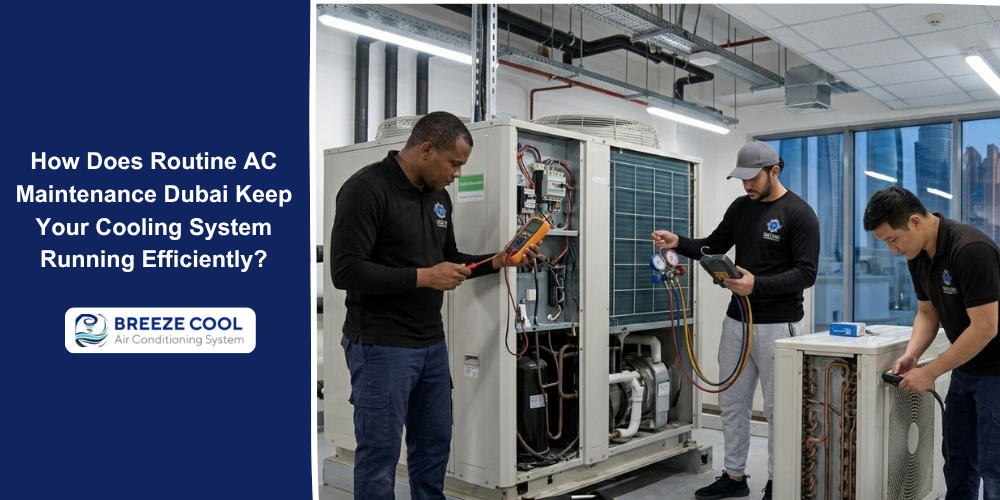
Dubai residents who run their air conditioning systems twelve or more hours a day through a long summer and wonder why efficiency drops, bills rise, and breakdowns happen tend to look for the answer in the wrong place. Most assume the unit is simply aging, or that high electricity bills are unavoidable in a hot climate. In reality, the single most common cause of reduced cooling efficiency in Dubai properties is the absence of routine AC maintenance Dubai carried out to the right standard at the right intervals.
The connection between what a properly structured maintenance visit does and what changes on the next DEWA bill is not complicated once it is understood, and it is the kind of understanding that saves a significant amount of money, discomfort, and inconvenience across the life of a cooling system. This blog explains specifically how routine aircon maintenance in Dubai improves system efficiency, what each maintenance action does to the system's performance, and why the best AC maintenance company in Dubai takes a diagnostic approach rather than a surface clean. The relationship between AC maintenance services in Dubai and sustained cooling efficiency is not theoretical; it is measurable, and Breeze Cool's approach is built around making that measurement visible to every property owner after every visit.
Why Efficiency Is the Correct Way to Measure Maintenance Value
When most people think about AC maintenance services in Dubai, they think about breakdown prevention. That is a legitimate value; the cost of avoiding a compressor failure in August significantly exceeds the cost of two annual maintenance visits. But the efficiency dimension of a properly maintained system is equally important and more immediately measurable.
A clean, correctly calibrated AC system operating with the correct refrigerant charge and unobstructed airflow reaches the set temperature faster, maintains it with fewer compressor restarts, and draws less electricity per hour of operation than a system that has accumulated a single season of Dubai's operating environment without professional attention. That difference shows up on the DEWA bill every month during peak summer, and in Dubai's tiered tariff structure, where higher consumption is charged at progressively higher rates per unit, the efficiency gap between a maintained and unmaintained system compounds with every additional unit of electricity consumed.
According to DEWA's energy efficiency guidelines, air conditioning accounts for approximately 70 to 80 percent of total residential electricity consumption during Dubai's summer months. The quality of maintenance, and whether it actually addresses the causes of efficiency loss rather than cleaning what is visible, is the most direct variable within a property owner's control when it comes to managing that figure.
What Efficiency Loss Actually Looks Like in a Dubai AC System
Efficiency loss in a Dubai AC system does not usually happen suddenly. It accumulates over a season through the combination of several factors, each of which adds a small but compounding load to the compressor, the component whose operating hours and current draw determine the monthly electricity bill.
The second factor is evaporator coil fouling. The evaporator coil is the surface across which the refrigerant absorbs heat from the indoor air. As dust and biofilm accumulate on the coil fins, which, in Dubai's combination of dust and coastal humidity, happens faster than most property owners realise, an insulating layer builds between the air and the refrigerant. Heat transfer becomes progressively less efficient. The compressor must run longer cycles to achieve the same result. The efficiency loss from a fouled evaporator coil is one of the largest single contributors to excess electricity consumption in Dubai apartments and villas, and it is the one most commonly missed by maintenance visits that do not include a chemical coil wash.
The third factor is refrigerant pressure shortfall. Every Gree, Midea, and O General model specifies a refrigerant type and an exact charge weight for that unit. When the charge drops below specification due to a slow leak that may not produce obvious symptoms for months, the compressor runs at a higher load per cycle to compensate for the reduced pressure. Even a ten to fifteen percent shortfall from the correct charge weight affects how efficiently the compressor reaches the set temperature. Over a Dubai summer, with the compressor running twelve or more hours per day, that shortfall accumulates into a measurable monthly electricity cost increase.
The fifth factor is electrical component wear. Capacitors that are beginning to degrade force the compressor motor to draw higher current on each start cycle. A loose electrical connection adds resistance that generates heat and draws additional current. These are efficiency losses that do not produce obvious symptoms; the unit continues to cool, the noise level does not change noticeably, but they register on the electricity meter every operating hour.
How Each Maintenance Action Addresses Efficiency Loss
The value of a maintenance visit from Breeze Cool comes from the specific connection between each maintenance action and one or more of the efficiency loss factors described above. This is not a theoretical connection — it is the mechanism through which a maintenance visit translates to a lower DEWA bill.
The chemical evaporator coil wash is the single maintenance action with the most direct impact on efficiency in Dubai's operating environment. A dry brush or compressed air clean removes surface dust but does not penetrate the fin structure where biofilm and compacted dust create the insulating layer. Breeze Cool's maintenance visits include a chemical foam wash of the evaporator coil as a standard component on every visit. The foam penetrates the fin structure, dissolves biological material and compacted dust, and drains through the condensate system. After a chemical coil wash, heat transfer at the evaporator surface is restored toward the unit's original specification, reducing the compressor's required run time per cycle directly.
Refrigerant pressure checking against the manufacturer's specification for the specific brand and model, not a generic fill to rough pressure, confirms whether the charge is within the range that allows the compressor to operate efficiently. If it is below specification, Breeze Cool technicians identify the source of the loss before recharging. Recharging a leaking system without sealing the leak restores efficiency temporarily but does not address the cause. The recharge itself uses the brand-specified refrigerant type at the documented charge weight, R32 for Midea units that specify it, and the correct type and weight for Gree and O General models, respectively. A correctly charged system allows the compressor to reach the set temperature in the designed number of cycles per hour.
Condenser coil cleaning restores the outdoor unit's ability to reject heat to the outside environment efficiently. A clean condenser coil releases heat at its designed rate, keeping compressor operating temperatures and pressures within the range the unit was designed for. When the compressor operates within its designed pressure and temperature range, its current draw per operating hour is lower than when it operates above those parameters due to condenser restriction.
Capacitor testing and replacement where degradation is identified prevents the compressor motor from drawing excess current on each start cycle. Breeze Cool technicians test capacitor condition with appropriate equipment rather than visually inspecting them — early-stage capacitor degradation does not produce visible signs but does affect current draw and, over time, compressor motor wear. Replacing a capacitor that is beginning to degrade during a scheduled maintenance visit costs significantly less than replacing a compressor that has accumulated motor winding damage from thousands of abnormal start cycles.
Condensate drain flushing ensures the drainage system flows freely from the indoor unit to its discharge point. A partially blocked drain creates back-pressure that affects the indoor unit's ability to extract humidity from the air. In Dubai's summer humidity, the condensate system handles a significant volume of water per operating hour — a blocked or partially blocked drain system reduces the efficiency of the dehumidification process and can cause standing water in the drain pan that supports biological growth on the evaporator coil.
The Breeze Cool Maintenance Visit — What Actually Happens
Knowing what a properly structured maintenance visit covers is useful for evaluating whether a company's service justifies its price. A professional Breeze Cool AC maintenance company in Dubai visit covers the following, in sequence.
The visit begins with a diagnostic check of operating pressures at both the high and low sides of the system, and an electrical condition assessment of the main components. This diagnostic happens before any cleaning begins — because without knowing the system's baseline condition, the technician cannot confirm whether the maintenance has actually restored the system to correct operating parameters afterward.
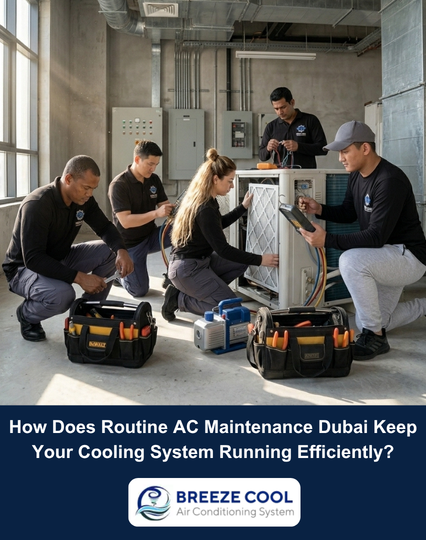
Following the diagnostic, filters are cleaned or replaced depending on their condition. The evaporator coil receives a chemical foam wash. The condenser coil is inspected and cleared of dust and debris. Refrigerant pressures are checked against the manufacturer's specifications and recharged if below specification, using the brand-specific refrigerant type and charge weight. The condensate drain is flushed from the indoor unit to the discharge point. Electrical connections are inspected and tightened. Capacitor condition is tested with appropriate equipment. The thermostat is calibrated against the actual indoor temperature to confirm accuracy. For ducted systems, airflow is checked at every ceiling vent to confirm balanced distribution.
The visit ends with a written service report documenting operating pressures before and after the visit, refrigerant condition, electrical findings, and any recommended follow-up actions. This report is issued to the property owner at handover and maintained on file to support manufacturer warranty claims.
How Often Routine Maintenance Should Be Scheduled in Dubai
The recommended maintenance frequency in Dubai differs from guidance written for cooler climates, because the operating environment is fundamentally more demanding. A system that runs three to five months per year at moderate load in Europe can go twelve months between services without significant efficiency loss. A system running twelve hours per day for seven months at ambient temperatures above 45°C cannot.
For most Dubai apartments with split units, twice per year is the appropriate minimum — once in March or April before peak summer, and once in October or November after peak season. The pre-summer visit is the most important of the two. It prepares the system for the most demanding period of its operating year and ensures the compressor enters June in the best possible condition.
For coastal properties in Dubai Marina, JBR, or Palm Jumeirah, a third visit in July addresses salt deposit accumulation on condenser coils that accelerates between the pre-summer and post-summer visits. For villas with ducted central systems, the same twice-yearly schedule applies to the system servicing, with a duct inspection recommended every two to three years to check the condition of internal duct surfaces and insulation. For older systems that are eight or more years old, quarterly visits make practical sense — the components most likely to affect efficiency are approaching the end of their designed life, and more frequent inspection catches developing issues before they become failures.
What the Best AC Maintenance Company in Dubai Does Differently
The aircon maintenance company in Downtown Dubai includes companies that provide a genuine diagnostic service and companies that provide a filter wipe and a visual inspection in twenty minutes and call it maintenance. The efficiency outcomes these two approaches produce are not comparable.
The best AC maintenance company in Dubai carries out a diagnostic check before any cleaning begins, uses a chemical coil wash on the evaporator rather than a surface clean, tests capacitor condition with equipment rather than visual inspection, checks refrigerant pressures against brand-specific manufacturer values, and issues a written service report at the end of every visit. These are not optional extras — they are the components of a maintenance visit that actually address the causes of efficiency loss.
Breeze Cool's differentiation is practical. Their technicians carry brand-specific refrigerants for Gree, Midea, and O General systems on their service vehicles — not a single generic type charged to rough pressure. They include a chemical coil wash on every visit as a standard component. They test capacitor condition with appropriate equipment on every visit. They document operating pressures before and after each visit, providing the property owner with a record of the system's condition and the improvement the visit produced.
For property owners evaluating AC maintenance companies in Dubai, the most useful question to ask is not about price. It is about what the visit actually covers. A company that does not include a chemical coil wash, does not check operating pressures, and does not issue a written service report after the visit is not providing the service that produces the efficiency improvement that justifies the cost. Breeze Cool's maintenance visits are structured around the actions that actually move the efficiency number — and the written service report at the end of every visit documents exactly what those actions produced.
Real Example — AC Maintenance Dubai, Jumeirah Village Circle, April 2026
A Jumeirah Village Circle apartment owner contacted Breeze Cool after noticing electricity bills had risen for two consecutive summers. The two Midea split units had not received professional maintenance since installation three years earlier. The owner had cleaned the filters once himself but had not had a professional visit.
Breeze Cool's technician carried out an operating pressure check on both units before beginning any cleaning. Both evaporator coils had significant biofilm and compacted dust on the fin surfaces — visible through the indoor unit access panels. One unit had a refrigerant pressure reading twelve percent below the Midea R32 specification. The condensate drain on the second unit was sixty percent blocked.
After a chemical coil wash on both units, refrigerant recharge on the first unit to the correct Midea R32 specification at the documented charge weight, and drain flush on the second, operating pressures on both units were confirmed within Midea specifications. The technician also identified an ageing capacitor on one unit showing early degradation on testing, and replaced it during the same visit.
The following month's combined DEWA bill dropped from AED 760 to AED 520 — a reduction of AED 240 on two split units in a two-bedroom apartment. Both units are now on an annual maintenance contract with Breeze Cool. The owner confirmed the cooling in both rooms felt noticeably more consistent than it had for the previous two summers.
How Routine Maintenance Supports Manufacturer Warranty Coverage
Most leading AC brands, including Gree, Midea, and O General, require documented evidence of regular professional maintenance as a condition of warranty claims. A compressor that fails on an unmaintained unit may result in a warranty claim being rejected by the manufacturer or their authorised service centre, regardless of the unit's age within the warranty period.
Breeze Cool issues a written service report after every maintenance visit, documenting the date of service, the work carried out, refrigerant condition, electrical findings, and operating pressures. For units still within the manufacturer warranty period, this documentation is the evidence that regular maintenance was performed to the standard the warranty requires. It is a practical safeguard that costs nothing beyond what the maintenance visit itself costs — and it transforms the maintenance record into a warranty protection document that the property owner can rely on if a major component fails within the warranty period.
Final Words
Routine AC maintenance in Dubai that genuinely keeps a cooling system running efficiently requires more than a filter change and a visual check. It requires a diagnostic approach that identifies what is actually causing the system to consume more electricity than it should, followed by targeted actions — chemical coil wash, refrigerant recharge to brand specification, condenser clean, capacitor testing, drain flush — that directly address those causes. The result is measurable in operating pressures restored to specification, in compressor run time reduced, and in DEWA bills that reflect a system running at the efficiency the manufacturer designed it for. Breeze Cool provides AC maintenance services in Dubai for Gree, Midea, and O General systems built on exactly this approach, with every visit documented and reported to the property owner. Contact Breeze Cool to schedule a maintenance visit before the summer season begins.
FAQs
1. How does AC maintenance in Dubai specifically improve cooling efficiency rather than just preventing breakdowns?
By addressing the physical causes of efficiency loss directly. A chemical evaporator coil wash removes the insulating layer of dust and biofilm that reduces heat transfer — restoring the coil's ability to extract heat from the indoor air in the cycle time it was designed for. A refrigerant recharge to manufacturer specification restores the compressor's efficiency per cycle. A condenser coil cleaning restores the outdoor unit's heat rejection efficiency. Each of these actions reduces the number of operating hours the compressor needs per day to maintain the set temperature, which is what electricity consumption directly tracks. Breeze Cool's maintenance visits address all of these causes as standard components of every visit.
2. What does Breeze Cool's AC maintenance company in Dubai include that a standard service does not?
A chemical coil wash of the evaporator as a standard component rather than an optional extra. Refrigerant pressure checks against brand-specific manufacturer values for Gree, Midea, and O General — not a generic fill to rough pressure. Capacitor testing with appropriate equipment rather than visual inspection. A written service report documenting operating pressures before and after the visit, refrigerant condition, and electrical findings. These are the components of a maintenance visit that actually move the efficiency number — and Breeze Cool includes all of them on every scheduled visit.
3. How often should aircon maintenance in Dubai be scheduled to maintain peak efficiency?
Twice per year for most Dubai residential properties — once before summer in March or April, and once after peak season in October or November. The pre-summer visit is the most important because it prepares the compressor for the most demanding operating period of the year. For coastal properties, a third mid-summer visit in July addresses salt deposit accumulation on condenser coils. For older systems or high-occupancy properties, quarterly visits maintain efficiency more consistently. Breeze Cool offers fixed-schedule annual contracts covering the recommended visit frequency for each property type.
4. What makes Breeze Cool the best AC maintenance company in Dubai for Gree, Midea, and O General systems specifically?
Brand-specific training and equipment. Each of these brands specifies a refrigerant type and charge weight that differs from the others. Breeze Cool technicians carry brand-specific refrigerants on their service vehicles and charge to the documented manufacturer weight rather than approximating to rough pressure. The coil cleaning agents are selected for compatibility with each brand's evaporator fin alloy composition. Commissioning pressure ranges are checked against brand-specific values rather than generic AC benchmarks. This level of brand-specific attention is what produces a consistently maintained system rather than one that is serviced generically and operates below its designed efficiency.
5. How do AC maintenance services in Dubai from Breeze Cool affect the monthly DEWA electricity bill?
Directly and measurably. A fouled evaporator coil forces the compressor to run longer cycles per hour. A refrigerant charge below specification adds further run time. A restricted condenser coil increases the compressor's current draw per operating hour. For a unit with all three issues, the combined effect on the DEWA bill can be AED 150 to AED 400 per month per unit during peak summer. In Dubai's tiered tariff structure, that excess consumption falls into higher-rate bands where each additional unit of electricity costs more. A Breeze Cool maintenance visit that addresses all three causes restores the system to its rated efficiency and reduces consumption — moving the household back into a lower tariff band and reducing the effective rate paid on every unit consumed.
Customer Testimonials
FAQ 6: Did Breeze Cool's routine AC maintenance in Dubai make a noticeable difference to your electricity bills over two summers?
We moved into a villa in The Springs with an existing O General ducted system that had been maintained by a different company annually. The cooling was always adequate, but the summer DEWA bills had been running at around AED 1,380 per month, which felt high for the property. When we switched to Breeze Cool for the pre-summer service, the technician started with a pressure check before touching anything. He found the refrigerant on two zones was below the O General specification — something the previous company had apparently not been checking — and the condenser coils had not been properly cleaned. After the refrigerant was recharged and a thorough condenser clean, alongside the standard coil wash and drain flush, the first full summer bill averaged AED 1,050 per month. That is AED 330 per month less for five summer months — AED 1,650 across the season. The annual maintenance contract with Breeze Cool costs considerably less than that saving. We have been with them since, and the bills have stayed at the lower level.
FAQ 7: How did Breeze Cool's approach to Gree AC maintenance in Dubai identify an issue that had been missed for two years?
We have a two-bedroom apartment in Dubai Marina with two Gree split units. For the previous two summers, one of the bedrooms had always been noticeably less comfortable than the other despite the units being the same model. A previous maintenance company had been servicing both units annually and had never flagged anything wrong. When Breeze Cool came for our first visit, the technician's pressure check found the problematic bedroom unit had a refrigerant pressure reading seventeen percent below the Gree R32 specification. He also found the evaporator coil on that unit had not received a chemical wash in some time — surface cleaning had been done, but the fin structure had significant biofilm accumulation. After a chemical coil wash and recharge to the correct Gree specification, the bedroom has cooled as consistently as the other one for the first time. The combined DEWA bill dropped by AED 180 the following month. The correct diagnosis in one visit resolved something two years of standard maintenance had not addressed.
FAQ 8: What was your experience with Breeze Cool's aircon maintenance in Dubai for an older system that was approaching end of useful life?
Our villa in Mira Oasis has a Midea ducted system that is eleven years old. We had been advised by two other companies to replace the entire system. Before committing to that cost, we contacted Breeze Cool for an honest assessment. The technician carried out a full diagnostic rather than immediately agreeing with the replacement recommendation. He found the system had significant coil fouling, a refrigerant shortfall on two zones, and two capacitors that were degrading. After a thorough chemical coil wash, refrigerant recharges to the correct Midea specification, and capacitor replacements, the system's operating pressures returned to specification. The following summer, the system ran normally throughout peak season without a fault. Our DEWA bill during that summer was AED 290 lower per month than the previous summer with the same system in poor condition. The full maintenance service cost AED 1,100. A system replacement had been quoted at AED 18,000. We have been on a quarterly maintenance contract with Breeze Cool since then, and the system has continued to perform within its original specification.

 Arabic
 French
 Spanish
 Portuguese
 Deutsch
 Turkish
 Dutch
Dutch
 Italiano
 Russian
 Romaian
 Portuguese (Brazil)
 Greek
Greek
