


US Smart Manufacturing Investments Fuel Machine Automation Controller Market Growth
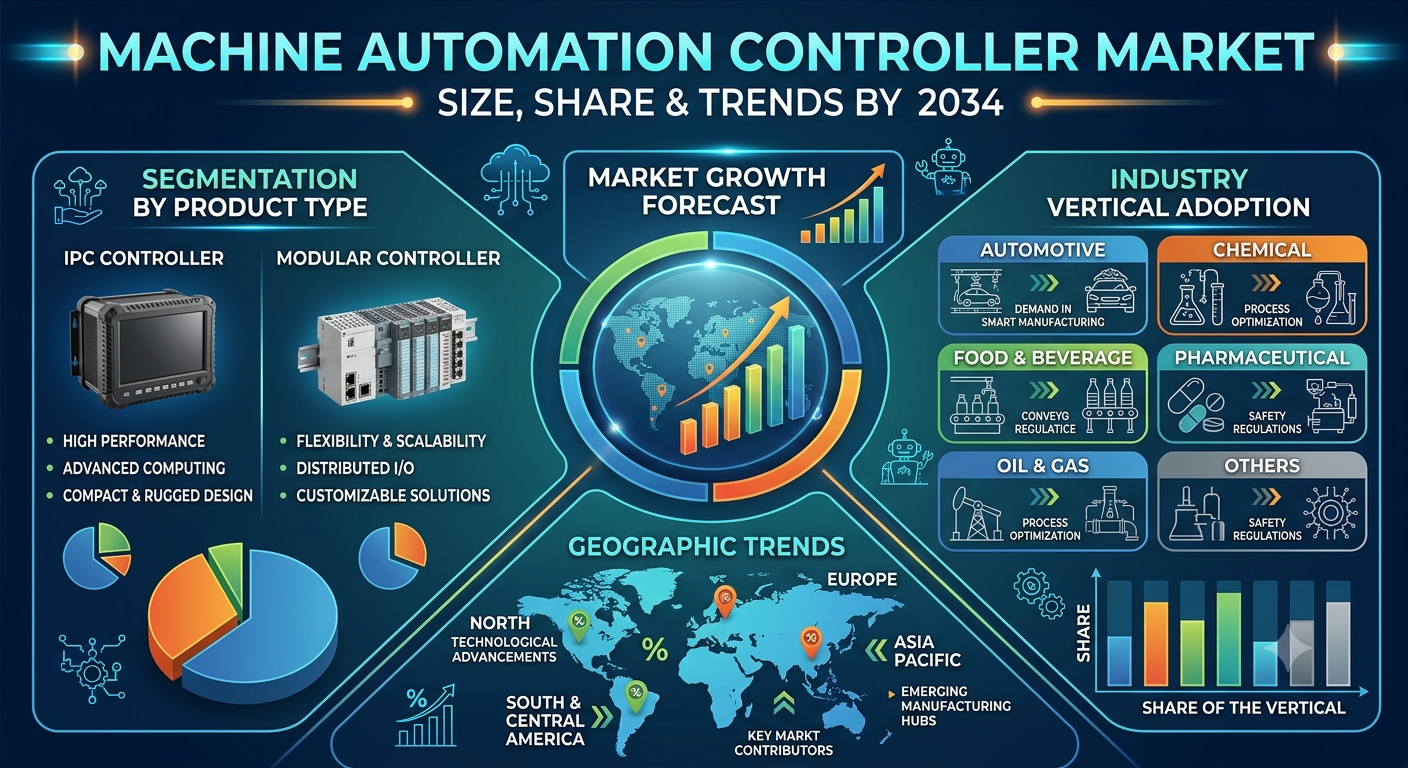
North America is emerging as an important region for industrial automation as manufacturers accelerate investments in smart factories, robotics, connected machinery, and digitally integrated production environments. The United States, in particular, is strengthening its manufacturing capabilities through investments in semiconductors, automotive production, electronics, food processing, logistics, data-center infrastructure, and advanced industrial equipment. These developments are increasing the need for reliable control technologies capable of coordinating machines, processing operational data, managing motion, and enabling real-time production decisions. Machine automation controllers are becoming a critical component of this transformation because they connect machinery, sensors, drives, robots, and industrial software while improving productivity and operational consistency. The growing emphasis on reshoring, workforce productivity, supply-chain resilience, energy efficiency, and advanced manufacturing is creating additional opportunities for controller manufacturers and automation solution providers across the US and Canada. Recent industry developments reinforce this trend: US industrial robot installations increased 11% year over year to 38,000 units in 2025, according to preliminary International Federation of Robotics data.
The Machine Automation Controller Market Share is projected to grow from US$45.58 billion in 2025 to US$61.35 billion by 2034, representing a CAGR of 3.78% from 2026 to 2034. The overall addressable opportunity is estimated at US$496.11 billion during 2026–2034. Within North America, the United States is expected to remain a major contributor as manufacturers modernize legacy facilities and deploy advanced automation across production and logistics operations. US manufacturing technology orders reached US$2.19 billion during the first four months of 2026, up 28.9% from the same period of 2025, with additional automation contributing to increasingly sophisticated machinery investments.
Download Sample PDF Link: https://www.theinsightpartners.com/sample/TIPRE00006224
US Manufacturing Modernization Supports Automation Controller Demand
The modernization of US manufacturing facilities is one of the most significant regional growth drivers. Manufacturers are increasingly replacing aging control architectures with programmable, networked, and software-enabled systems capable of supporting flexible production. This trend is particularly relevant for automotive, semiconductor, electronics, aerospace, food and beverage, pharmaceuticals, and industrial equipment manufacturers.
The United States is also experiencing increasing investment in domestic production capacity. Manufacturing expansion linked to semiconductor facilities, electrical equipment, data centers, and other infrastructure-intensive industries is creating demand for automated production systems. US manufacturers continue to invest in facilities, automation, and technology despite economic uncertainty, with productivity, competitiveness, and operational resilience influencing capital allocation decisions.
Key Market Drivers in North America
Increasing Adoption of Robotics and Flexible Automation
Robotics is a major catalyst for automation controller adoption in the US. Industrial robots require sophisticated control systems to coordinate movement, speed, positioning, safety functions, sensors, and production workflows.
According to the International Federation of Robotics, US industrial robot installations reached 38,000 units in 2025, an 11% increase from the previous year. Automotive remained the largest adopter, while food-sector installations increased significantly, demonstrating that automation is expanding beyond traditional heavy manufacturing.
This expansion creates opportunities for high-performance controllers capable of coordinating robots, conveyors, machine vision systems, automated guided vehicles, and other equipment within integrated production environments.
Labor Shortages and Workforce Productivity
Persistent workforce challenges are another important driver. North American manufacturers are increasingly using automation to address labor availability, improve productivity, and reduce dependence on repetitive manual processes.
Automation controllers enable manufacturers to automate tasks such as assembly, inspection, packaging, material handling, and machine operation. This allows employees to focus on higher-value activities such as supervision, maintenance, programming, quality management, and process optimization.
The shift toward workforce augmentation is particularly important in North America, where manufacturers are increasingly evaluating automation based on measurable productivity and return-on-investment outcomes. Research involving more than 600 North American manufacturing executives indicates that AI, workforce transformation, automation, and intelligent infrastructure are reshaping factory investment decisions.
Reshoring and Supply-Chain Resilience
Reshoring is creating another structural opportunity for automation suppliers. US companies are seeking greater control over production and supply chains, encouraging investment in domestic manufacturing capacity.
Automated production can help US manufacturers remain competitive by improving throughput, quality, consistency, and utilization. Modern controllers are particularly valuable for new production facilities because they can provide centralized coordination while supporting distributed machine architectures and real-time data exchange.
The expansion of advanced manufacturing linked to semiconductors, electrical equipment, data centers, and other strategic industries is further strengthening the need for automated production infrastructure.
Industry 4.0 and Industrial AI Accelerate Controller Innovation
North American factories are moving beyond conventional automation toward connected and intelligent production. Machine automation controllers increasingly need to communicate with cloud platforms, edge devices, industrial networks, sensors, robots, and manufacturing execution systems.
Industrial AI is adding another layer of opportunity. A 2026 Cisco report on industrial AI identifies robotics and autonomous systems, process automation, industrial connectivity, advanced sensors, edge computing, and digital twins among important technologies supporting AI-enabled manufacturing.
For controller manufacturers, this means future products will increasingly combine control, connectivity, data processing, cybersecurity, and analytics capabilities. Edge-based processing can enable faster decisions close to production equipment, while AI-supported analytics can help identify equipment anomalies and optimize production parameters.
North American Competitive Landscape
The regional competitive environment includes global automation companies with substantial operations, engineering capabilities, and customer networks across the United States and Canada. Key players include Siemens AG, Rockwell Automation, Inc., Schneider Electric SE, Mitsubishi Electric Corporation, ABB Ltd., Honeywell International Inc., Emerson Electric Co., Omron Corporation, Bosch Rexroth AG, and Beckhoff Automation GmbH & Co. KG.
Companies are strengthening their North American presence through product development, local manufacturing, engineering investments, software integration, partnerships, and expansion of automation portfolios. For example, FANUC America announced a planned US$90 million investment in a new 840,000-square-foot facility in Michigan, supporting potential expansion of US robot manufacturing capabilities and technologies including physical AI, virtual commissioning, and digital twins.
Opportunities Across Automotive, Electronics, Logistics, and Data Centers
Automotive manufacturing will remain a significant application area for machine automation controllers in North America. Electric vehicles, battery manufacturing, advanced assembly systems, and automated inspection are increasing the complexity of production environments.
Electronics and semiconductor manufacturing also represent significant opportunities because these industries require highly precise, reliable, and synchronized automation. Meanwhile, logistics and warehousing are rapidly adopting automated material-handling technologies. In North America, warehouse operators are increasing automation investments in response to labor costs and demand for faster fulfillment.
The expansion of US data centers is also indirectly supporting industrial automation demand. Growing data-center infrastructure investment is driving demand for generators, cooling equipment, electrical systems, and construction materials, creating additional requirements for automated manufacturing capacity.
Future Outlook
The North American outlook remains positive as US manufacturers continue transitioning toward intelligent, flexible, and connected production environments. Machine automation controllers are expected to evolve from conventional machine-control components into intelligent platforms that combine real-time control with networking, edge computing, AI, cybersecurity, and data analytics.
The combination of reshoring, robotics adoption, labor pressures, smart-factory investment, and industrial AI will remain central to regional demand. Manufacturers that modernize legacy facilities with scalable automation architectures can improve productivity while creating more resilient and adaptable operations.
Globally, the Machine Automation Controller Market is forecast to reach US$61.35 billion by 2034, rising from US$45.58 billion in 2025 at a CAGR of 3.78%. North America, led by the United States, is positioned to remain a key technology and investment hub as manufacturers pursue automation-led productivity and digital transformation.
About The Insight Partners
The Insight Partners is a global market research and consulting firm providing actionable intelligence across technology, industrial, semiconductor, healthcare, energy, telecommunications, and other industries. Its research helps businesses and industry stakeholders evaluate emerging technologies, competitive landscapes, growth opportunities, and strategic investment areas.
Contact Us
The Insight Partners
Email: sales@theinsightpartners.com
Phone: +1-646-491-9876
Website: https://www.theinsightpartners.com
Related Reports -
Submarine Fiber Cable Market Demand, Share & Growth by 2034
Aircraft Wiring Harness Market Dynamics and Trends by 2030
SCADA Oil and Gas Market Size, Trends & Growth by 2034

 English
 Arabic
 French
 Spanish
 Portuguese
 Deutsch
 Dutch
Dutch
 Italiano
 Russian
 Romaian
 Portuguese (Brazil)
 Greek
Greek
