


Why Healthcare Clinic Tasks Get Delayed — And How to Fix Them
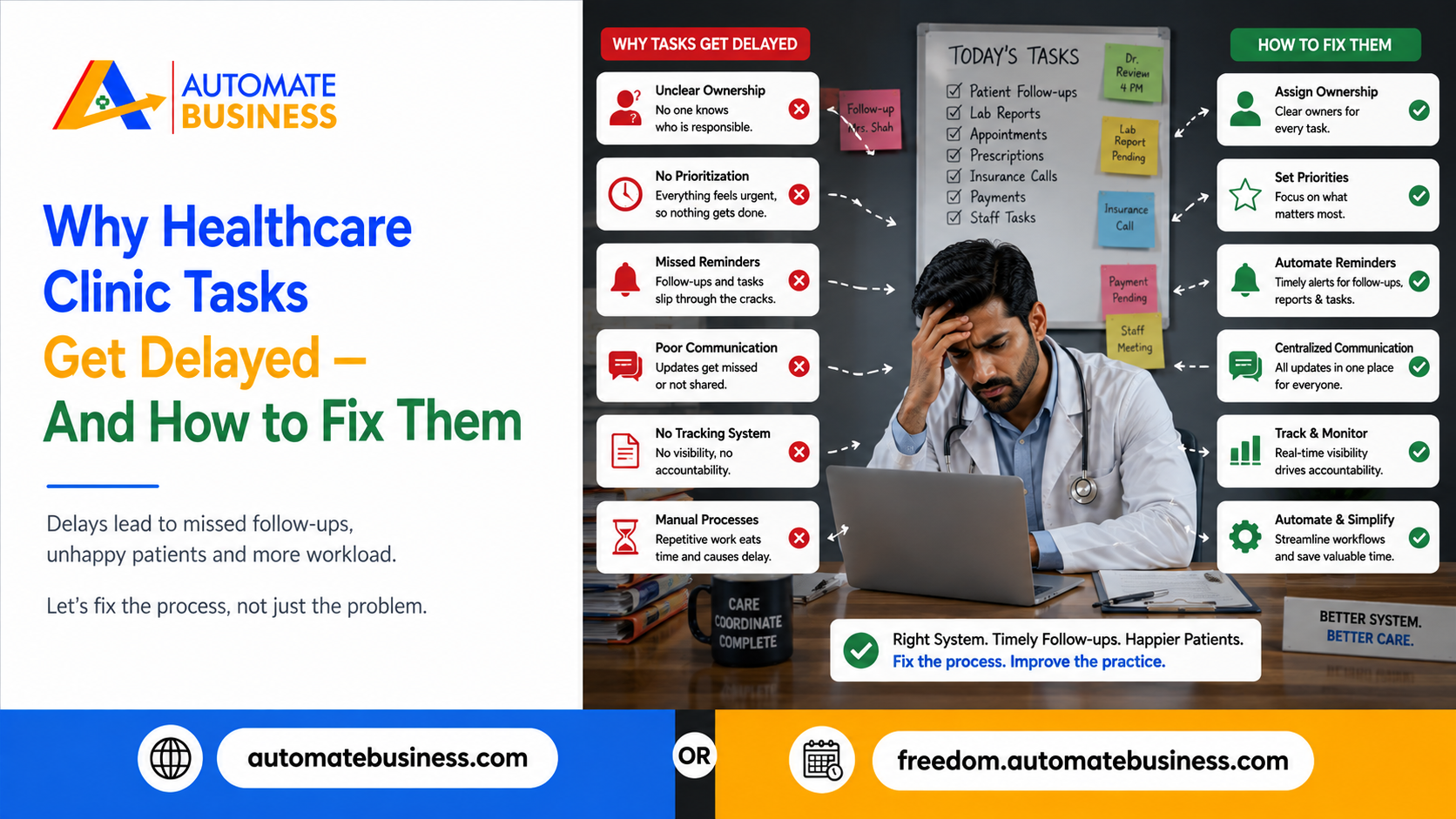
The Follow-Up Problem Is Not a People Problem
In healthcare, the stakes of operational failure are higher than in almost any other business. A missed follow-up call isn't a lost sales opportunity it's a patient whose condition may be going unmonitored. A forgotten lab result communication isn't a delayed report it's a person waiting anxiously for information that should have reached them two days ago. A skipped medication review isn't an admin oversight it's a clinical gap that can have real consequences for the patient's health.
And yet, in most healthcare clinics across India from small general practices to multi-specialist outpatient centers the system managing all of this critical operational work is a combination of WhatsApp group messages, verbal handoffs between staff, paper registers, and individual staff memory.
This is where Automate Task Management from Automate Business enters the picture. Built specifically for growing teams that need clarity, accountability, and consistent follow-through, it replaces the informal, memory-dependent management system that causes follow-ups to be missed with structured task assignment, automatic WhatsApp reminders, real-time dashboards, and documented accountability across the entire clinical and administrative team.
This blog explains why follow-ups keep failing in clinic environments, what a structured system fixes, and how healthcare teams can implement it without disrupting their existing workflow.
Why Patient Follow-Ups Keep Getting Missed in Clinics
Before fixing the problem, it's important to understand precisely why it happens because the answer is systemic, not personal.
The first reason is that follow-ups are rarely assigned to one specific person with a documented deadline. After a consultation, a doctor may mention that someone should call the patient in three days to check on their medication response. That instruction enters a WhatsApp group or a verbal exchange between two staff members. Nobody writes down who exactly is responsible. Three days later, the front desk assumed the nurse would call, the nurse assumed the receptionist would handle it, and the patient received no call from anyone.
The second reason is that reminder mechanisms are entirely manual. Even when a follow-up is informally assigned, the reminder for it depends on the staff member personally checking a list they created, a note they made, or a WhatsApp message they pinned. When their day gets busy and in a clinic, every day gets busy personal reminder systems fail. There is no automated mechanism independently ensuring that Thursday's follow-up actually fires on Thursday regardless of what else is happening.
The third reason is that missed follow-ups aren't immediately visible. In a verbal and spreadsheet-based clinic environment, a follow-up that was supposed to happen on Monday is not obviously overdue on Tuesday unless someone specifically checks for it. The task isn't flagged anywhere automatically. Nobody is alerted. The patient waits, and the clinic doesn't know the gap exists until the patient calls to ask or, worse, doesn't come back.
What Automate Task Management Provides That Clinics Currently Don't Have
Automate Task Management directly addresses each of the three failure points above through a connected set of features designed for teams that need reliable, consistent follow-through without adding administrative burden.
Structured task creation with a single named owner. Every follow-up task created in Automate Task Management requires a title, description, assignee, due date, and priority before it is saved. There is no group assignment one person is named, and that person's name is permanently attached to the task with a timestamp. When the call needs to happen by Thursday, one specific staff member is assigned, the deadline is documented, and the task is visible in the dashboard at all times. The ambiguity that allows "I thought someone else was doing it" to become a recurring explanation is structurally eliminated.
For follow-ups involving multiple steps schedule the call, make the call, record the outcome, escalate if no answer sub-tasks carry the same accountability logic through every step. Each sub-task has its own assignee, its own deadline, and its own status, so the follow-up chain doesn't lose ownership at any point in the sequence.
Automatic WhatsApp and email reminders no manual nudge required. The most impactful feature for any healthcare clinic is the automated reminder system. When a task's reminder date arrives, Automate Task Management sends an automatic notification through WhatsApp and email to the assigned staff member without any supervisor, administrator, or doctor having to trigger it. For a Thursday follow-up, the reminder goes out Wednesday evening. If the follow-up isn't completed by Thursday afternoon, an overdue reminder fires automatically and continues until the task is marked complete.
Because the reminders go through WhatsApp the channel clinic staff are already checking throughout the day they reach the right person at the right moment without requiring any behavior change. Staff don't need to check a new app or monitor a separate dashboard to know what's due. The reminder arrives where they already are.
Real-time dashboard visibility for clinic administrators. The clinic manager or medical director opens the Automate Task Management dashboard and sees every task across the entire team all follow-ups, all administrative tasks, all lab result communications filtered by status, assignee, patient category, or deadline. An overdue follow-up appears as overdue on the dashboard the moment its due date passes. No checking registers. No asking staff members individually. No discovering on Friday that a Monday follow-up was never completed.
The dashboard's List and Kanban views allow the administrator to manage the full operational picture of the clinic in a single screen who has too many open tasks today, which tasks are at risk, where immediate intervention is needed without conducting a status-gathering meeting every morning.
Recurring Clinical Tasks That Should Run Themselves
Beyond individual patient follow-ups, healthcare clinics have a significant volume of recurring operational tasks that need to happen on a consistent schedule. These are the tasks most likely to become unreliable as the clinic grows because they depend on someone remembering to trigger them every cycle, and that memory becomes less reliable as the team and patient volume expand.
Post-consultation follow-up calls for patients on chronic condition management should not require a coordinator to manually create a new task every week or every month. In Automate Task Management, a recurring task configured for the appropriate interval weekly, fortnightly, monthly, or custom creates itself automatically, assigns to the right staff member, and sends a WhatsApp reminder on schedule. Once set up, the coordinator's responsibility shifts from creating and remembering the follow-up to completing it and marking it done.
Medication review reminders for patients on long-term prescriptions, appointment confirmation calls for the following week's schedule, equipment sterilization and maintenance logs, staff certification renewal tracking, and monthly compliance documentation are all categories of recurring clinical and operational work that benefit from the same automation. Each is configured once with a schedule, an assignee, and reminder settings and from that point forward, runs automatically without requiring any administrative overhead to maintain.
Holiday-skip logic in Automate Task Management ensures that recurring tasks automatically reschedule to the next working day when they fall on a public holiday or clinic closure without any administrator manually adjusting the schedule. Time zone-aware delivery ensures reminders reach staff at the appropriate local time even for clinics operating across multiple locations.
Role-Based Access That Reflects the Clinic's Structure
Not every staff member in a healthcare clinic needs to see every task, and not every staff member should be able to assign work across the entire team. Automate Task Management provides role-based access that maps to how clinical teams actually operate.
The clinic administrator or medical director operates at admin level full visibility across all tasks, all staff members, and all patient follow-up categories. They can create tasks, configure recurring schedules, review dashboard scoring, and access workspace activity logs that show the complete timeline of every task update.
Doctors and senior clinical staff operate at manager level able to assign tasks to nurses, coordinators, and front desk staff following a consultation, review the status of tasks they've assigned, and receive completion confirmations without needing to follow up personally.
Nursing staff, front desk coordinators, and administrative team members operate at member level seeing their own assigned tasks clearly, receiving WhatsApp reminders automatically, marking tasks complete, and adding notes to the task record when relevant. They're not overwhelmed by tasks belonging to other departments or roles.
Custom roles handle specialist positions a lab technician who needs visibility into sample collection tasks but not billing administration, or a pharmacy coordinator who manages prescription follow-ups but not appointment scheduling. The access structure supports the work without creating confusion.
Making Every Patient Interaction More Reliable With One System
The impact of consistent task management in a healthcare clinic isn't limited to individual follow-ups. When every task has a clear owner, an automatic reminder, and a documented completion record, the entire patient experience becomes more reliable.
Patients receive follow-up calls when they were promised. Lab results are communicated within the expected window. Medication reviews happen on the clinical schedule, not when someone remembered to add it to the day's task list. Appointment reminders go out consistently because the task for sending them was configured as a recurring item, not re-created manually each week.
This reliability accumulates into something clinics spend significant effort and marketing budget trying to build: patient trust. A patient who receives consistent, timely follow-through from their clinic doesn't just continue attending they refer family members and colleagues. The operational system becomes the foundation of the patient relationship, not just the background infrastructure.
Automate Task Management delivers this foundation by replacing the informal, memory-dependent operational layer that most clinics currently run on with structured ownership, automatic WhatsApp reminders, recurring task automation, and real-time visibility across the full clinical and administrative team.
The Clinic That Remembers Earns the Patient Who Returns
Patient retention in healthcare is built on one thing more than any other: the feeling that the clinic remembers them, cares about their progress, and follows through on what it said it would do. A follow-up call that happens when promised, a medication review that occurs on schedule, a test result that's communicated promptly these aren't exceptional service. They're the baseline expectation of modern healthcare.
The clinics that consistently meet this expectation aren't necessarily the ones with the most experienced staff or the most advanced equipment. They're the ones with the best operational systems where every follow-up is assigned, every reminder fires automatically, every overdue task is immediately visible, and no patient falls through the gap because a busy day meant someone forgot to check the register.
Automate Task Management provides that system. The follow-up happens because the system makes it happen not because someone remembered. Start managing patient follow-ups with Automate Task Management

 English
 French
 Spanish
 Portuguese
 Deutsch
 Turkish
 Dutch
Dutch
 Italiano
 Russian
 Romaian
 Portuguese (Brazil)
 Greek
Greek
