


Tumblers Market Outlook: The Shift Toward Insulation, Portability and Personalization
The Tumbler Is Becoming Part of the Daily Consumption Economy
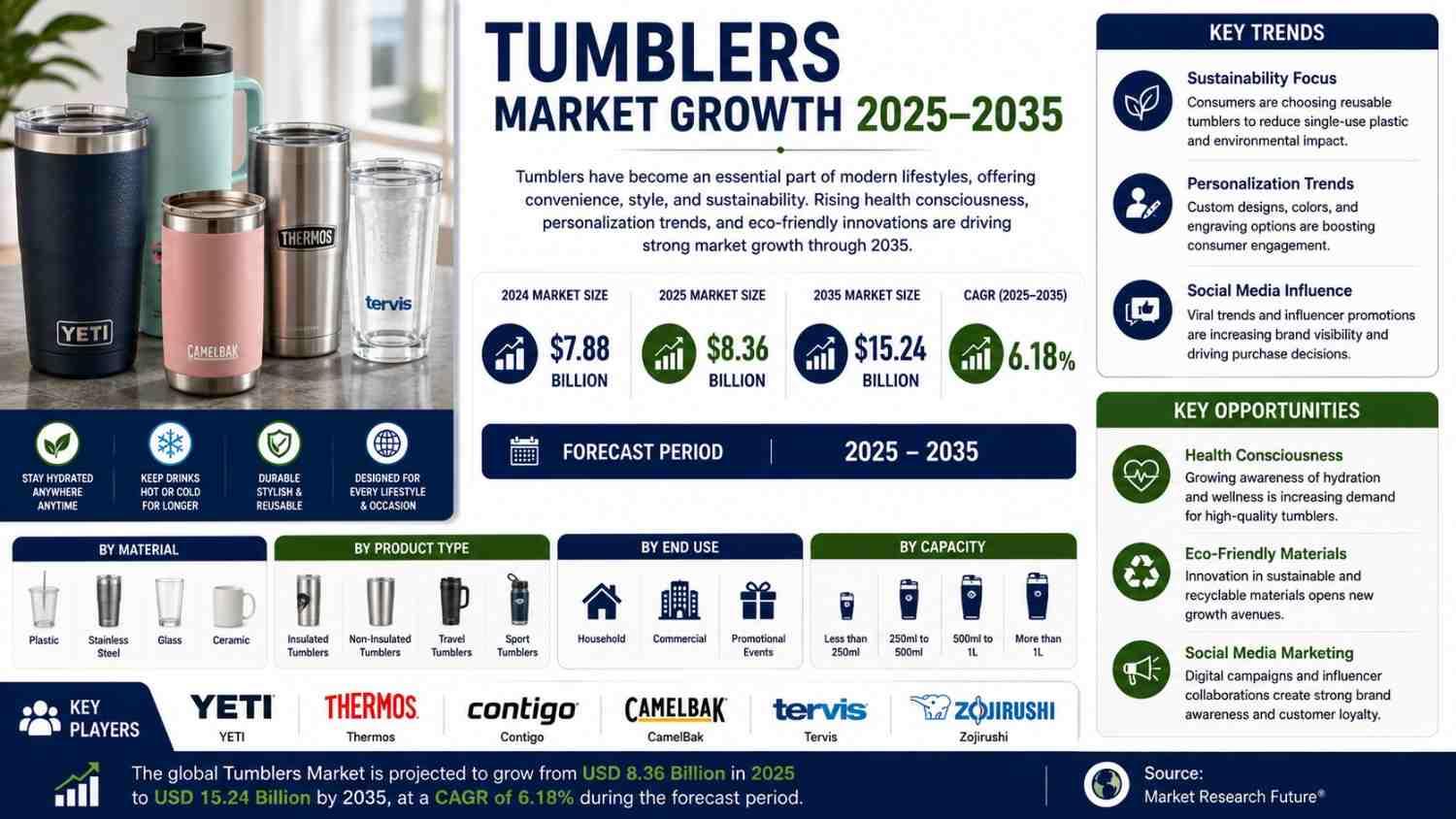
A reusable tumbler now sits at the intersection of hydration, mobility, design and sustainability, making it far more commercially relevant than a conventional drinking container. The global Tumblers Market Outlook was valued at USD 7.88 billion in 2024 and reached USD 8.36 billion in 2025. It is projected to reach USD 15.24 billion by 2035, expanding at a CAGR of 6.18% from 2025 to 2035. Sustainability, personalization and social-media influence are changing consumer preferences, while health consciousness and demand for eco-friendly materials are creating additional avenues for market development.
The important question is no longer whether consumers need something to drink from. It is why they increasingly prefer a dedicated reusable product for different moments of the day.
Daily Routines Are Creating Repeat Demand
The strongest foundation for the market is frequency of use.
A tumbler can accompany a consumer from the morning commute to the office, from the workplace to the gym and from home to weekend travel. Because the product is repeatedly visible and repeatedly handled, small improvements in convenience can have a meaningful influence on purchasing decisions.
This helps explain the variety of formats in the market.
Travel tumblers are designed around mobility, while sport tumblers address active lifestyles. Insulated products focus on maintaining beverage temperature, whereas non-insulated options can provide simpler and often lighter solutions.
The consumer is therefore not necessarily buying one universal product.
Someone may want a compact tumbler for coffee, a larger model for water and a sport-oriented option for exercise. This creates opportunities for brands to expand consumption through product portfolios rather than relying solely on replacement purchases.
Capacity Is Becoming a Behavioral Choice
The capacity categories in the market reflect different patterns of consumption.
Products below 250 ml can serve limited-volume uses, while 250 ml to 500 ml formats can fit conventional personal consumption. The 500 ml to 1 liter category is particularly relevant to everyday hydration, commuting and workplace use. Products exceeding 1 liter appeal to consumers who want to minimize refilling during long periods away from home.
Capacity therefore represents more than a technical specification.
It reflects how consumers structure their day.
A person who spends several hours outdoors may value a large-capacity product, while a commuter may prefer something compact enough to fit conveniently into a bag or vehicle holder.
Manufacturers that design around these situations can create clearer product identities and reduce direct price comparison between otherwise similar products.
Insulation Has Raised the Functional Standard
Temperature retention has become one of the strongest reasons to choose a premium tumbler.
An insulated product can preserve the temperature of a beverage for longer periods, making it useful during commuting, travel, exercise and outdoor activities. This feature can justify a higher price because the consumer can connect the technology with a tangible daily benefit.
Stainless steel has become particularly relevant in this area because of its association with durability and thermal-performance-oriented products.
However, insulation also increases product complexity.
Additional construction requirements can raise manufacturing costs, weight and price. Manufacturers must therefore ensure that the performance benefit is sufficiently clear to justify the premium.
The competition is increasingly about value rather than simply adding features.
Sustainability Is Creating Both Demand and Scrutiny
The sustainability trend has expanded the consumer conversation around reusable drinkware, but it has also made environmental claims more complicated.
A reusable tumbler can help reduce reliance on disposable beverage containers when it is used frequently and retained for a long period. Yet the environmental equation also includes material extraction, manufacturing energy, packaging, transportation and end-of-life handling.
This creates a responsibility for manufacturers to think beyond the point of sale.
Durability becomes particularly important.
A product that remains functional for years can spread its manufacturing impact across many uses. By contrast, a product purchased primarily as a short-lived trend item may not deliver the same lifecycle advantages.
Eco-friendly materials can therefore create an opportunity, but the strongest sustainability propositions will likely combine responsible material choices with product longevity.
Personalization Is Expanding the Addressable Consumer Base
Personalization gives the market another growth mechanism.
A standard tumbler can become more valuable to consumers when they can choose colors, patterns, graphics or customized identifiers. This makes the product feel less like generic household equipment and more like a personal accessory.
The effect extends into commercial purchasing.
Companies and event organizers can customize tumblers for promotional campaigns, employee programs and branded merchandise. The same product category can therefore generate both consumer and institutional demand.
Personalization also changes manufacturing requirements.
More variations can complicate inventory management and production planning. Businesses need flexible manufacturing and fulfillment systems if they want to offer customization without allowing operational costs to erase the additional value.
Social Media Is Making Design More Commercially Important
Tumblers are naturally suited to visual marketing.
A distinctive silhouette, finish or color can be easily displayed in lifestyle photographs and short videos. Consumers can encounter products while browsing fitness, travel, productivity or fashion content rather than actively searching for drinkware.
This expands the role of design.
A technically strong product still needs visual appeal if it is competing in social-media-driven channels. At the same time, brands must avoid building their entire strategy around temporary online trends.
The challenge is to convert attention into lasting product relevance.
Companies that combine recognizable design with dependable performance have a stronger chance of turning social exposure into sustained demand.
Materials Create Different Competitive Positions
Plastic, stainless steel, glass and ceramic serve different parts of the market.
Plastic offers advantages in weight and design flexibility. Stainless steel supports durability-focused and insulated formats. Glass can appeal to consumers seeking a particular aesthetic or drinking experience, while ceramic remains relevant in household and lifestyle settings.
No single material is likely to dominate every use case.
Instead, the market can expand through material specialization.
A consumer who wants a rugged travel product may choose stainless steel, while another looking for a lightweight everyday tumbler may prefer plastic. This diversity gives manufacturers multiple ways to target consumer needs.
It also makes material communication increasingly important in retail.
Household Demand Is Only One Part of the Opportunity
The end-use structure includes household consumption, commercial applications and promotional events.
Household demand is driven by everyday use, hydration, travel and lifestyle preferences. Commercial demand can emerge from offices, hospitality, fitness businesses and other organizations that need reusable drinkware for operational or customer-facing purposes.
Promotional events create another route to volume.
Customized tumblers can serve as branded merchandise while remaining useful after an event ends. This can increase the practical value of promotional products compared with purely decorative items.
For manufacturers, serving these segments requires different approaches to pricing, customization and order volume.
Regional Markets Reflect Different Consumption Patterns
The global market includes North America, Europe, South America, Asia Pacific, and the Middle East and Africa.
North America is well suited to premium insulated and high-capacity products, particularly where outdoor activity, commuting and lifestyle branding influence demand.
Europe offers opportunities connected with sustainability, reusable consumption and design-conscious purchasing. Environmental considerations can influence both consumers and businesses when selecting materials.
Asia Pacific combines a large consumer base with strong manufacturing capabilities and diverse income levels. This supports both affordable mass-market products and premium lifestyle categories.
South America and the Middle East and Africa offer opportunities as modern retail, hospitality and fitness-related consumption develops.
These regional differences make localization important. Product size, material, pricing and marketing need to reflect local behavior rather than assuming that one global format will perform equally well everywhere.
Competition Is Moving Beyond Product Availability
The market includes YETI, Thermos, Contigo, CamelBak, Tervis and Zojirushi.
Their positions demonstrate how brands can differentiate within the same broad category.
YETI has built a strong association with durable outdoor-oriented products. Thermos is recognized for temperature-retention drinkware. Contigo emphasizes practical portable products, while CamelBak has a strong connection with hydration and active use.
Tervis demonstrates how customization and design can become part of the product proposition. Zojirushi emphasizes engineered thermal performance and functional product design.
The competitive lesson is that consumers need a reason to choose one tumbler over another.
Brand recognition can attract attention, but product performance, durability, design and relevance to a particular lifestyle determine whether that attention becomes a purchase.
The Market's Biggest Opportunities Are Closely Connected
Health consciousness, sustainable materials and digital marketing are not separate trends.
They can reinforce each other.
A reusable tumbler positioned around hydration can appeal to health-conscious consumers. If that product also uses a credible sustainable material and is promoted through fitness-oriented social content, it can address several demand drivers simultaneously.
This creates room for focused product niches.
Manufacturers may find opportunities in products designed specifically for commuters, athletes, travelers, office workers or environmentally conscious consumers rather than trying to make one product suitable for everyone.
What Could Disrupt the Growth Story
The market faces several constraints.
Material costs can influence retail pricing, particularly for stainless steel and more sophisticated constructions. Premium insulation and customization can further increase production complexity.
Product saturation is another challenge. As more brands enter the category, similar shapes and capacities can make differentiation difficult.
Sustainability claims can also create reputational risk if they are not supported by credible product-lifecycle information.
Finally, social-media trends can be short-lived. Brands that overreact to temporary demand may end up with excess inventory or product lines that quickly lose relevance.
Market Outlook
The tumbler market's projected expansion to USD 15.24 billion by 2035 reflects a deeper shift in consumer behavior.
The category is benefiting because one product can solve multiple modern consumption problems: carrying beverages conveniently, maintaining temperature, supporting hydration routines, replacing disposable alternatives and expressing personal style.
The most durable opportunities will likely come from products that integrate these benefits rather than treating them as isolated trends.
The future of the market will therefore depend less on simply producing more tumblers and more on understanding the occasions, routines and preferences that make consumers carry them every day.
Another Trending Topics
Tert Butylhydroquinone Market
Test Lane Market
Tetrafluoroethane Refrigerant Market

 Arabic
 French
 Spanish
 Portuguese
 Deutsch
 Turkish
 Dutch
Dutch
 Italiano
 Russian
 Romaian
 Portuguese (Brazil)
 Greek
Greek
