


Fermented Mineral Ingredients Market to Reach USD 2.5 Billion by 2036
The global fermented mineral ingredients market is undergoing a structural transition as formulators across dietary supplement, functional food, and medical nutrition sectors shift baseline specifications away from synthetic inorganic salts (such as oxides and carbonates) toward biologically bound, food-state mineral complexes, according to latest insights by Future Market Insights. Driven by consumer intolerance for gastric side effects (e.g., acute nausea, constipation) and retail clean-label screening that penalizes synthetic chemical masking agents, microbial bioconversion is becoming the standard delivery mechanism for high-bioavailability trace minerals.
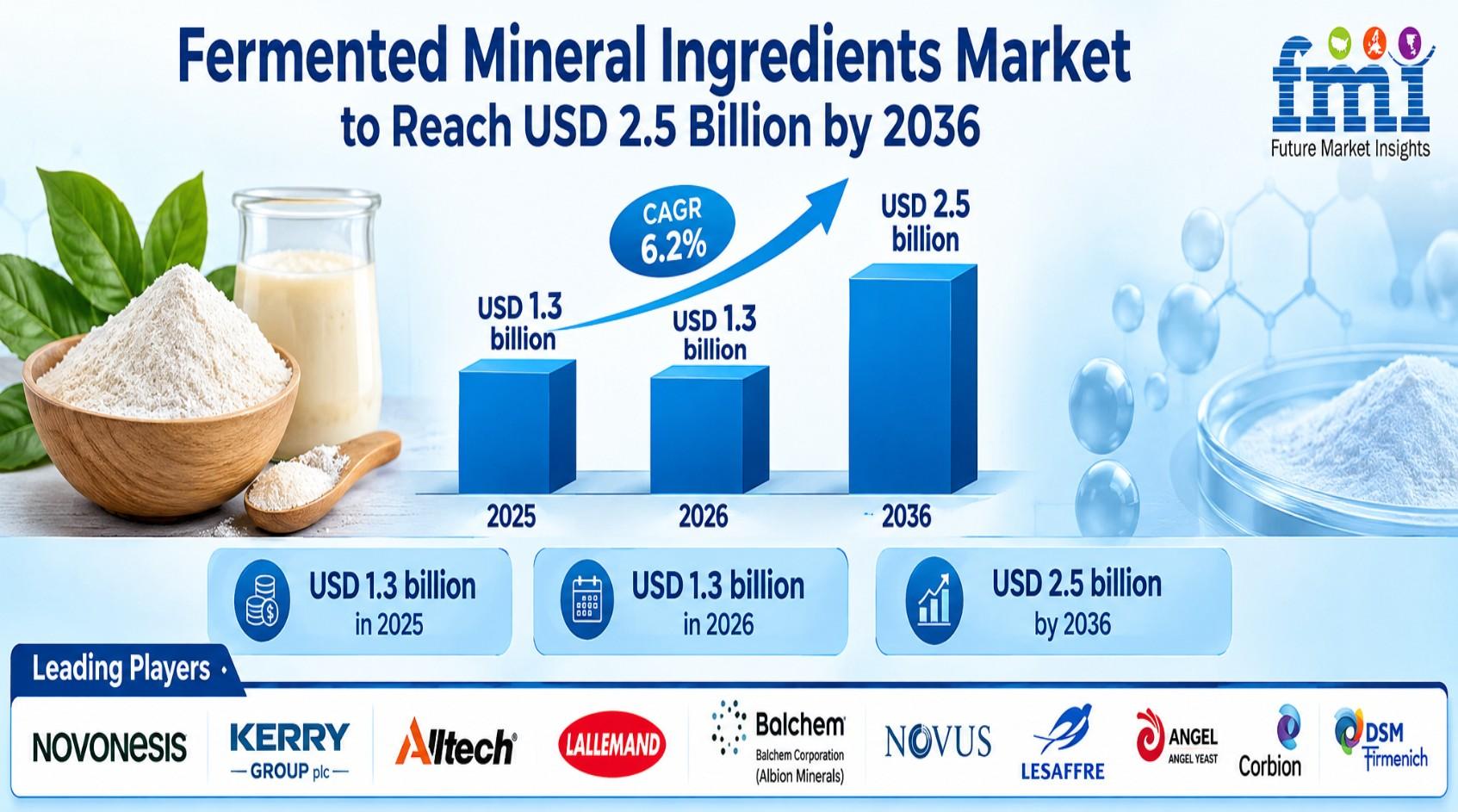
The global market, valued at USD 1.3 billion in 2025, is projected to reach USD 1.3 billion in 2026. Advancing at a Compound Annual Growth Rate (CAGR) of 6.2% over the ten-year forecast period, total market valuation is anticipated to achieve USD 2.5 billion by 2036, delivering an absolute incremental opportunity of USD 1.2 billion.
Request a Sample Report: https://www.futuremarketinsights.com/reports/sample/rep-gb-32295
Market Performance Overview (2026–2036)
To map out the key mineral elements, physical delivery formats, primary application sectors, and fermentation platforms guiding this USD 1.2 billion market expansion, key segment allocations highlight where commercial demand is concentrated:
· Zinc Mineral Segment (34.5% share): Commands mineral type revenue in 2026. Binding zinc to yeast peptides eliminates the severe acute nausea and gastric irritation routinely triggered by standard inorganic zinc oxides taken on an empty stomach.
· Powder Form Segment (68.2% share): Dominates physical format sales, as industrial spray-drying serves as the only commercially viable method to stabilize liquid-cultivated microbial biomass, guaranteeing 24-month ambient shelf life for international shipping.
· Dietary Supplements Application (45.8% share): Represents the primary commercial application in 2026, as premium vitamin and sports nutrition margin structures easily absorb the elevated per-kilogram cost of bio-transformed inputs.
· Yeast-Based Fermentation Process (52.1% share): Leads biological production platforms, benefiting from decades of established global regulatory safety dossiers (Saccharomyces cerevisiae) and massive existing commercial bioreactor capacity.
· India Regional Leadership (8.4% CAGR): Serves as the fastest-growing national market through 2036, driven by systemic upgrades in maternal anemia protocols moving away from harsh iron oxides toward highly tolerated bio-transformed iron matrices.
Technical Drivers and Formulation Shifts
The commercial expansion of fermented minerals across nutraceutical and functional food channels is propelled by three primary industry catalysts:
Mitigating Gastrointestinal Side Effects and Customer Churn
Standard inorganic mineral salts interact harshly with stomach acids, causing acute nausea and digestive distress the single largest driver of brand abandonment in the mineral supplements category. Cultivating minerals inside live microorganisms binds the elements to cellular amino acids and peptides, allowing the mineral to bypass gastric acid receptors and absorb gently through dietary peptide pathways.
Clean-Label Reformulation and Deck Simplification
Inorganic mineral salts introduce astringency and strong metallic off-notes, requiring formulators to add synthetic chemical masking agents, artificial sweeteners, and buffering salts. Fermented minerals possess a neutral, yeast-like flavor profile that allows brands to shorten their ingredient decks and qualify for premium "whole-food" retail shelf space.
Beverage and Dairy Suspension Stability
In liquid functional beverages and fortified plant-based milks, standard mineral salts frequently precipitate out of solution or cause protein coagulation during ultra-high-temperature (UHT) pasteurization. Biologically bound minerals remain stably suspended in liquid matrices without requiring synthetic chemical emulsifiers or stabilizers.
Industrial Constraints & Manufacturing Challenges
Nutraceutical brand owners, fermentation refiners, and contract manufacturers navigate specific operational hurdles:
· Hygroscopic Powder Handling in Contract Manufacturing: Fermented mineral biomass powders are aggressively hygroscopic. Contract manufacturing organizations (CMOs) must maintain strict ambient humidity controls and use moisture-barrier packaging during blending and encapsulation to prevent severe powder caking and machine jamming.
· Cost-in-Use Differential vs. Mined Salts: Producing minerals via precision fermentation bioreactors carries significantly higher capital and operational expenditures than mining commodity mineral carbonates, requiring brands to position finished products in premium tiers to protect gross margins.
Regional Growth Profile
Regional demand reflects high-velocity healthcare upgrades in Asian emerging economies alongside regulatory-driven clean-label adoption in Western markets:
· India (8.4% CAGR): The global growth frontrunner, driven by large-scale pharmaceutical and maternal healthcare initiatives replacing gastro-irritating iron salts with gentle fermented iron complexes to improve patient daily compliance.
· China (7.2% CAGR): Spurring rapid volume expansion as domestic dairy processors scale high-throughput calcium and zinc fortification in functional milks while investing heavily in domestic precision fermentation bioreactor capacity.
· Brazil (7.0% CAGR): Driven by high-value animal nutrition sectors adopting bioavailable trace minerals to optimize livestock feed conversion ratios and comply with environmental manure runoff limits.
· Japan (6.5% CAGR): Anchored by cultural familiarity with fermented foods and an aging demographic requiring easily digestible bone- and joint-health mineral supplements.
· Germany (6.1% CAGR) & United Kingdom (5.9% CAGR): Lead European demand, supported by stringent EFSA novel food bioavailability approvals, pharmacy retail curation of gentle-on-the-stomach vitamins, and clean-label organic standards.
· United States (5.8% CAGR): Represents a mature, high-value market driven by saturated direct-to-consumer (DTC) channels where brands use "fermented whole-food" claims to capture premium market share.
Competitive Landscape
The global fermented mineral ingredients landscape is heavily concentrated among industrial biotechnology specialists, global yeast refiners, and specialized human nutrition developers.
Key market participants profiled in the report include Novonesis, Kerry Group plc, Alltech Inc., Lallemand Inc., Balchem Corporation (Albion Minerals), Novus International, Lesaffre Group, Angel Yeast Co., Ltd., Corbion N.V., and DSM-Firmenich. Leading players compete by securing proprietary, high-uptake microbial strains, publishing peer-reviewed human bioavailability clinical dossiers, and investing in advanced fungal-mycelial fermentation platforms to break past traditional yeast mineral concentration ceilings.
Exclusive Discounts on Full Report: https://www.futuremarketinsights.com/reports/fermented-mineral-ingredients-market
Frequently Asked Questions
What is the projected valuation of the global fermented mineral ingredients market by 2036?
The global fermented mineral ingredients market is projected to reach USD 2.5 billion by 2036, expanding from an estimated baseline valuation of USD 1.3 billion in 2026 at a CAGR of 6.2%.
Why does Zinc lead the Mineral Type category?
Fermented zinc commands a 34.5% market share in 2026 because binding zinc to microbial peptides directly solves the severe gastric distress and acute nausea associated with standard zinc oxides, drastically reducing product return rates and consumer churn.
What is the functional difference between fermented minerals and chemical chelates?
Chemical chelates use synthetic chemical reactions to bind minerals to amino acids (e.g., bisglycinates), whereas fermented minerals are organically digested and incorporated into the cellular matrix of live microorganisms during biological fermentation, creating a food-state complex.
FMI Custom Research: Strategic Intelligence for Confident Decision-Making
In today's rapidly evolving business environment, leadership teams need clear, actionable intelligence tailored to their strategic objectives. FMI's Custom Research solutions are designed around specific business questions, enabling executives to evaluate growth opportunities, validate investments, assess competitive dynamics, and reduce uncertainty before making critical decisions.
Key Executive Benefits
· Decision-Ready Insights: Research tailored to your specific business challenges, growth plans, and investment priorities.
· Reduced Strategic Risk: Validate market opportunities, customer demand, and competitive positioning before committing resources.
· Market Entry Confidence: Assess opportunity size, regulatory barriers, channel dynamics, and competitive landscapes with precision.
· Competitive Advantage: Gain proprietary intelligence unavailable through syndicated reports or internal datasets.
· Faster Growth Decisions: Accelerate expansion, product development, portfolio optimization, and investment planning.
· Primary Market Validation: Access real-world customer, buyer, and stakeholder insights that support high-confidence decision-making.
Business Impact
FMI helps organizations transform market complexity into strategic clarity, enabling leadership teams to identify growth opportunities faster, optimize resource allocation, strengthen competitive positioning, and make high-stakes business decisions with confidence.
To explore how FMI Custom Research can support your strategic priorities, connect with our team at - sales@futuremarketinsights.com
About Future Market Insights (FMI)
Future Market Insights (FMI) delivers actionable, decision-focused market intelligence that goes beyond traditional research reports. The company provides:
· In-depth pricing and cost benchmarking analysis
· Demand forecasting based on real industry inputs
· Procurement and buyer behavior insights
· Supply chain and trade flow intelligence
· Technology and application trend analysis across industries
FMI follows a robust bottom-up research methodology, combining insights from industry experts, procurement leaders, manufacturers, and technical professionals to ensure accurate and practical market intelligence.

 English
 Arabic
 French
 Spanish
 Deutsch
 Turkish
 Dutch
Dutch
 Italiano
 Russian
 Romaian
 Portuguese (Brazil)
 Greek
Greek
