


Anti-Stress Feed Supplements Market to Reach USD 1,473.2 Million by 2036
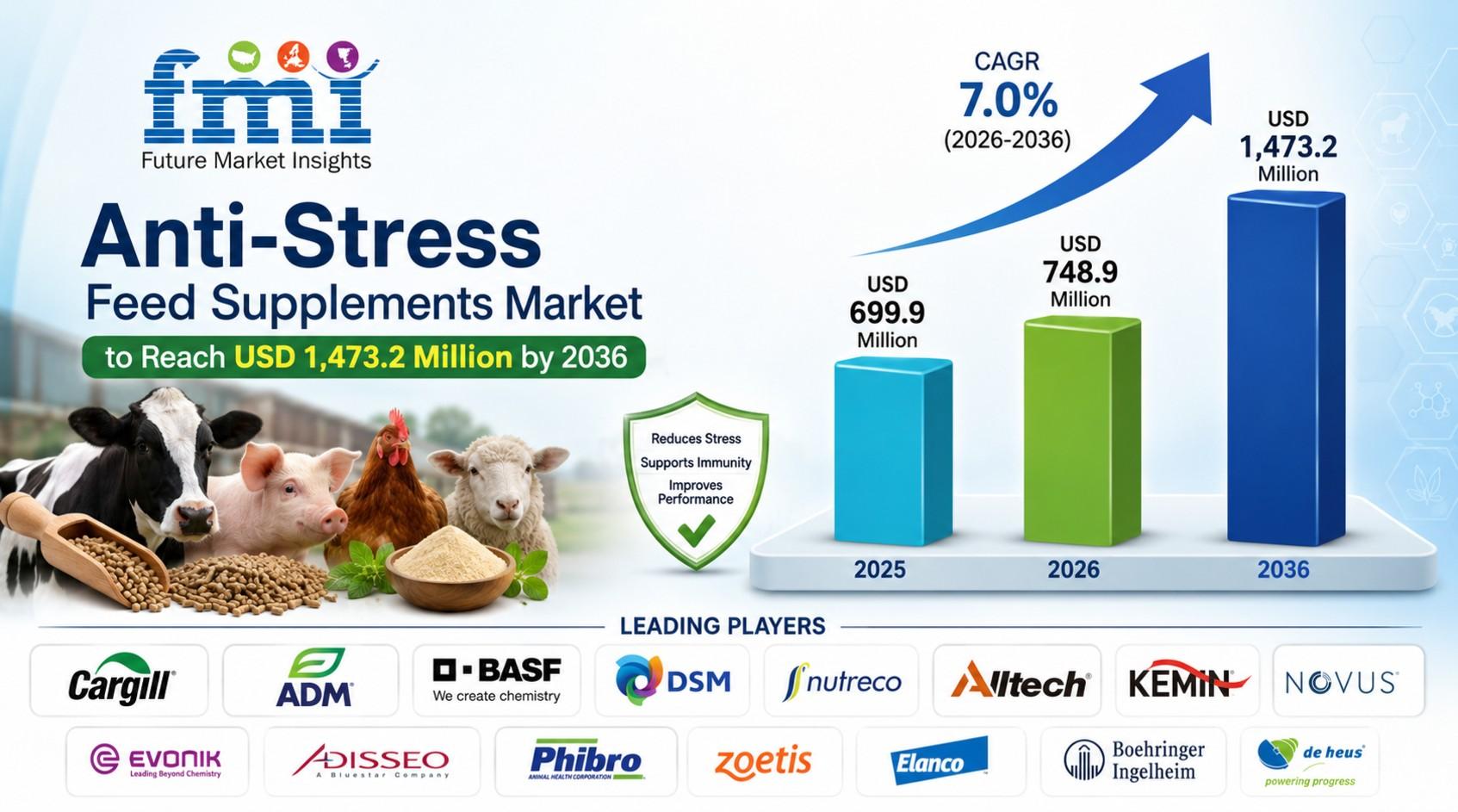
The global anti-stress feed supplements market is undergoing a fundamental shift from reactive, single-nutrient commodity additives to integrated, species-specific precision nutrition programs, according to latest insights by Future Market Insights. Driven by escalating heat stress events in tropical and subtropical livestock belts, intensive high-density housing systems, and tightening animal welfare regulatory mandates across major agricultural hubs, nutritional intervention is becoming essential to prevent production losses in commercial livestock.
The global market, valued at USD 699.9 million in 2025, is projected to reach USD 748.9 million in 2026. Advancing at a Compound Annual Growth Rate (CAGR) of 7.0% over the ten-year forecast period, total market valuation is anticipated to achieve USD 1,473.2 million by 2036, delivering an absolute incremental opportunity of USD 724.3 million.
Request a Sample Report: https://www.futuremarketinsights.com/reports/sample/rep-gb-19804
Market Performance Overview (2026–2036)
To map out the key supplement types, target livestock categories, physical delivery forms, and regional growth vectors guiding this USD 724.3 million market scale-up, key segment allocations highlight where commercial demand is concentrated:
· Poultry Livestock Segment (38.0% share): Commands the livestock category in 2026, reaching a projected valuation of USD 489.0 million by 2036. Commercial broilers and layers lack sweat glands and rely primarily on panting for thermoregulation, making them susceptible to heat stress at ambient temperatures above.
· Vitamins Type Segment (28.0% share): Represents the leading supplement category in 2026. Vitamin C and vitamin E provide essential antioxidant protection against oxidative stress, reducing cortisol-mediated immunosuppression and preserving feed conversion efficiency.
· Antioxidants & Amino Acids Segments: Represent high-growth secondary pillars. Antioxidants are projected to reach a 24.0% value share (USD 308.8 million) by 2036 growing at an 8.1% CAGR, while stress-responsive amino acids (tryptophan, threonine, methionine) support gut barrier integrity and serotonin synthesis.
· Liquid Delivery Formats: Gaining rapid adoption over dry premixes due to faster digestive absorption, uniform dosing via automated drinking-water lines, and immediate on-farm administration during sudden heat waves or transportation.
· India & China Regional Leadership: Lead national growth rates at 8.4% CAGR and 8.0% CAGR respectively through 2036, driven by tropical climate pressure, expanding commercial poultry integration, and rising stocking densities in modernized facilities.
Technical Drivers and Formulation Shifts
The commercial expansion of anti-stress feed supplements across livestock operations is propelled by three primary industry catalysts:
Heat-Stress Production Loss Economics
Sustained thermal stress reduces broiler growth rates by 12% to 15% and layer egg production by 10% to 20%. Economic losses from heat stress in global poultry operations exceed the total cost of supplement intervention by a factor of 5 to 8, establishing prophylactic anti-stress supplementation as a high-ROI operational investment during peak summer periods.
Transportation Stress and Shrink Reduction
Transporting livestock exposes animals to dehydration, temperature fluctuations, and handling stress that elevate mortality and cause carcass quality downgrades (e.g., PSE meat in swine). Pre- and post-transport nutritional protocols combining electrolytes, betaine, and vitamins significantly reduce live-weight shrink losses and death-on-arrival (DOA) rates.
Animal Welfare Directives and Audit Compliance
Regulatory frameworks such as the European Union’s Council Directive and retailer-mandated animal welfare certification schemes require producers to implement proactive measures against stress-induced suffering in confined housing. Documented anti-stress feed programs serve as verifiable compliance evidence during farm audits.
Industrial Constraints & Supply Chain Considerations
Livestock integrators and feed additive manufacturers navigate specific operational hurdles:
· Feedstock and Active Ingredient Cost Pressures: High-purity synthetic vitamins and specialized fermentation-derived amino acids face price volatility, forcing smaller feed mills to balance margin constraints against inclusion rates.
· Stability in Chilled and Liquid Drinking Lines: Formulating multi-component liquid supplements containing fat-soluble vitamins (vitamins A, D, E) alongside water-soluble electrolytes and organic acids requires advanced microemulsion technology to prevent precipitation and nozzle clogging in automated barn watering systems.
Regional Growth Profile
Regional demand reflects intensive commercial farming expansion in Asia and Latin America alongside welfare-driven compliance in Europe and North America:
· India (8.4% CAGR): The global growth frontrunner, driven by high ambient temperatures, rapid modernization of broiler/layer operations, and large-scale integration of commercial poultry farming.
· China (8.0% CAGR): Spurring rapid volume growth (reaching USD 226.5 million by 2036 with a 17.6% global share) as industrial livestock intensification and high stocking densities necessitate advanced stress mitigation and phytogenic feed additives.
· Brazil (7.6% CAGR): Driven by large-scale poultry and swine export sectors that require consistent carcass quality and uniform meat yield despite tropical climate challenges.
· United States (7.3% CAGR): Represents the largest baseline market (projected to reach USD 319.1 million by 2036 with a 24.8% global share), supported by precision farming technologies, automated data tracking in feedlots, and dairy heat-stress management in southern states.
· Germany (6.8% CAGR): Leading European market adoption (projected at USD 104.2 million by 2036), anchored by strict EU animal welfare compliance, organic farming standards, and antibiotic-reduction initiatives.
Competitive Landscape
The global anti-stress feed supplements landscape is moderately concentrated, featuring multinational agribusiness leaders (controlling 50–60% market share), regional specialty premixers, and agile phytogenic additive innovators.
Key market participants profiled in the report include Cargill Inc., Archer Daniels Midland Company (ADM), BASF SE, DSM Nutritional Products, Nutreco NV, Alltech Inc., Kemin Industries Inc., Novus International Inc., Evonik Industries AG, Adisseo France SAS, Phibro Animal Health Corporation, Zoetis Inc., Elanco Animal Health, Boehringer Ingelheim Animal Health, and De Heus Animal Nutrition. Leading players differentiate through proprietary gut-health formulations (e.g., Alltech's Viligen, Novus's CIBENZA EP150), precision nutrition digital tools, and strategic acquisitions of phytogenic specialists (such as Cargill's acquisition of Delacon).
Exclusive Discounts on Full Report: https://www.futuremarketinsights.com/reports/anti-stress-feed-supplements-market
Frequently Asked Questions
What is the projected valuation of the global anti-stress feed supplements market by 2036?
The global anti-stress feed supplements market is projected to reach USD 1,473.2 million by 2036, expanding from an estimated baseline valuation of USD 748.9 million in 2026 at a CAGR of 7.0%.
Why does Poultry dominate the Livestock category?
Poultry accounts for a 38.0% market share in 2026 because commercial broilers and layers lack sweat glands and are highly sensitive to thermal stress above, leading to severe reductions in feed conversion efficiency, egg laying rates, and immune defense.
What supplement type holds the largest market share?
Vitamins lead the market with a 28.0% share in 2026, as vitamin C and vitamin E provide essential antioxidant defenses to neutralize free radicals and suppress cortisol-driven immunosuppression during stress events.
FMI Custom Research: Strategic Intelligence for Confident Decision-Making
In today's rapidly evolving business environment, leadership teams need clear, actionable intelligence tailored to their strategic objectives. FMI's Custom Research solutions are designed around specific business questions, enabling executives to evaluate growth opportunities, validate investments, assess competitive dynamics, and reduce uncertainty before making critical decisions.
Key Executive Benefits
· Decision-Ready Insights: Research tailored to your specific business challenges, growth plans, and investment priorities.
· Reduced Strategic Risk: Validate market opportunities, customer demand, and competitive positioning before committing resources.
· Market Entry Confidence: Assess opportunity size, regulatory barriers, channel dynamics, and competitive landscapes with precision.
· Competitive Advantage: Gain proprietary intelligence unavailable through syndicated reports or internal datasets.
· Faster Growth Decisions: Accelerate expansion, product development, portfolio optimization, and investment planning.
· Primary Market Validation: Access real-world customer, buyer, and stakeholder insights that support high-confidence decision-making.
Business Impact
FMI helps organizations transform market complexity into strategic clarity, enabling leadership teams to identify growth opportunities faster, optimize resource allocation, strengthen competitive positioning, and make high-stakes business decisions with confidence.
To explore how FMI Custom Research can support your strategic priorities, connect with our team at - sales@futuremarketinsights.com
About Future Market Insights (FMI)
Future Market Insights (FMI) delivers actionable, decision-focused market intelligence that goes beyond traditional research reports. The company provides:
· In-depth pricing and cost benchmarking analysis
· Demand forecasting based on real industry inputs
· Procurement and buyer behavior insights
· Supply chain and trade flow intelligence
· Technology and application trend analysis across industries
FMI follows a robust bottom-up research methodology, combining insights from industry experts, procurement leaders, manufacturers, and technical professionals to ensure accurate and practical market intelligence.

 Arabic
 French
 Spanish
 Portuguese
 Deutsch
 Turkish
 Dutch
Dutch
 Italiano
 Russian
 Romaian
 Portuguese (Brazil)
 Greek
Greek
