


Web3 Development Services: Building the Next Generation of Decentralized Applications
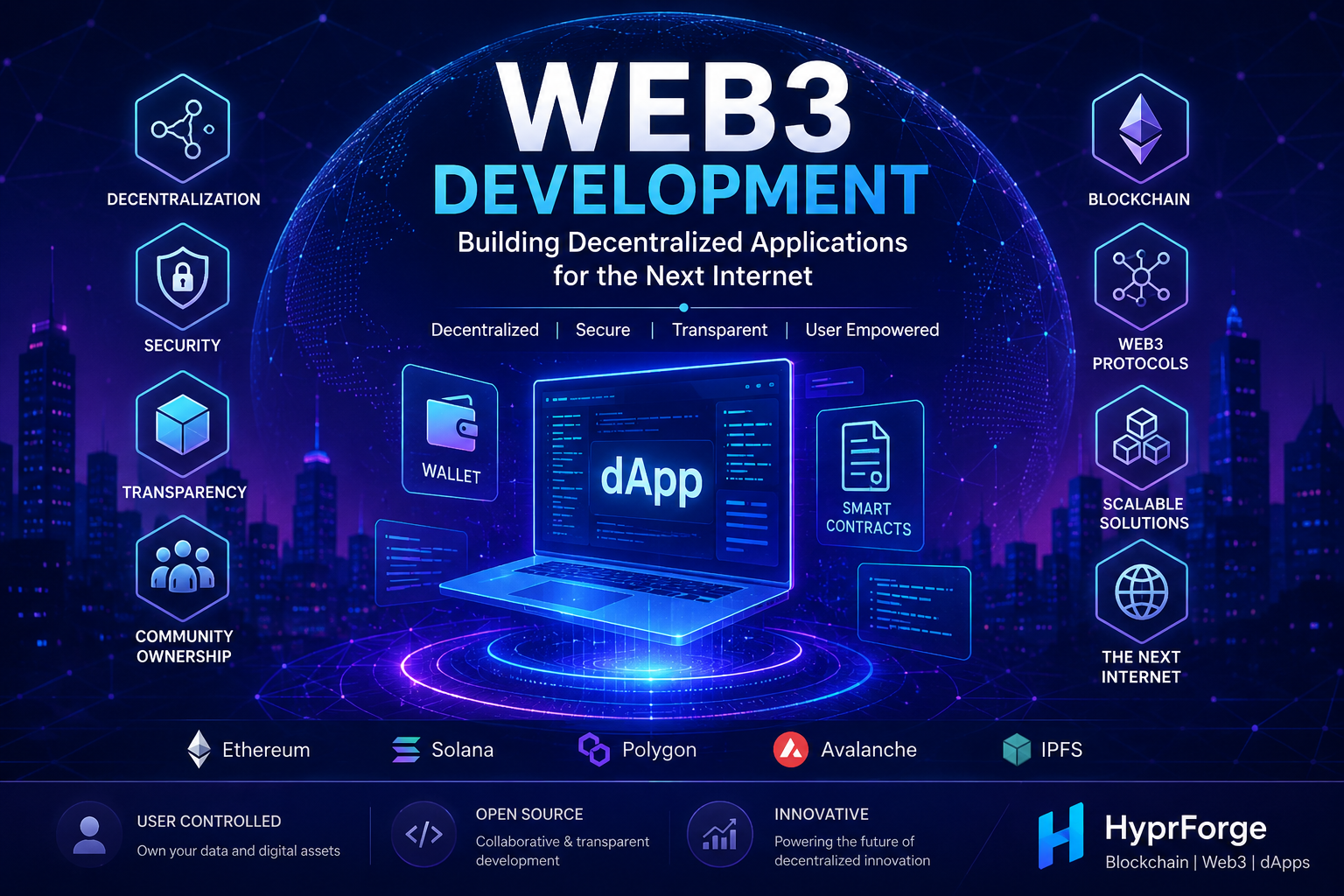
Web3 Development Services: Building the Next Generation of Decentralized Applications
Web3 is transforming the digital landscape by introducing decentralized applications, blockchain-based ownership, digital assets, smart contracts, and user-controlled identities. Unlike traditional internet applications that often depend on centralized platforms, Web3 applications can distribute ownership, data, and application logic across blockchain networks.
As businesses explore decentralized business models, Web3 development has become an important technology strategy. From decentralized finance and NFT marketplaces to gaming, social platforms, DAOs, and tokenized ecosystems, organizations can use Web3 to create new digital experiences.
Businesses planning to enter the Web3 ecosystem can work with an experienced Blockchain Development Services provider such as HyprForge to design secure, scalable, and customized decentralized solutions.
What Is Web3 Development?
Web3 development is the process of building decentralized applications and digital platforms using blockchain networks, smart contracts, decentralized storage, cryptographic wallets, tokens, and other Web3 technologies.
A traditional application may follow:
User → Front End → Centralized Server → Database
A Web3 application can instead use:
User → dApp → Wallet → Smart Contract → Blockchain
This architecture allows users to interact with blockchain-based systems while maintaining greater control over their digital assets and transactions.
Key Components of Web3 Development
Blockchain Networks
Blockchain networks provide the underlying infrastructure for decentralized applications.
Developers select networks according to:
-
Transaction speed
-
Transaction costs
-
Security
-
Scalability
-
Ecosystem support
-
Smart contract compatibility
Smart Contracts
Smart contracts contain the business logic of many Web3 applications.
They can manage:
-
Transactions
-
Token transfers
-
Ownership
-
Governance
-
Payments
-
Rewards
-
Marketplace operations
Cryptocurrency Wallets
Wallets provide users with a way to manage blockchain accounts and authorize transactions.
Wallet integration is essential for many Web3 applications.
Tokens
Tokens can represent digital assets, utility, governance rights, access, rewards, or other forms of blockchain-based value.
Decentralized Storage
Web3 applications may use decentralized or distributed storage technologies for selected data and digital assets.
Oracles
Oracles connect blockchain applications with external information when smart contracts require data from outside the blockchain.
Types of Web3 Applications
Decentralized Applications
dApps are applications that use blockchain-based infrastructure and smart contracts for selected functionality.
They can be developed for:
-
Finance
-
Gaming
-
Social networking
-
Marketplaces
-
Healthcare
-
Supply chains
-
Entertainment
-
Identity
DeFi Platforms
Web3 development enables decentralized financial applications such as exchanges, lending platforms, staking systems, and liquidity protocols.
NFT Marketplaces
NFT marketplaces allow users to create, discover, purchase, sell, and transfer unique blockchain-based digital assets.
Blockchain Gaming
Web3 gaming can incorporate blockchain-based ownership of characters, items, collectibles, rewards, and other digital assets.
DAO Platforms
Decentralized Autonomous Organizations use blockchain-based governance mechanisms to coordinate communities and decision-making.
Tokenization Platforms
Businesses can explore tokenization models to represent digital or real-world assets on blockchain networks, subject to applicable legal and regulatory requirements.
Benefits of Web3 Development
Decentralization
Web3 applications can distribute application logic and ownership across decentralized infrastructure.
User Ownership
Users can directly control supported digital assets through blockchain wallets.
Transparency
Blockchain transactions and smart contract interactions can provide verifiable records.
Programmability
Smart contracts enable businesses to create programmable digital services and automated workflows.
Global Accessibility
Blockchain networks can provide infrastructure that operates across geographical boundaries.
New Business Models
Web3 enables models based on tokens, decentralized communities, digital ownership, and programmable assets.
Web3 Development Process
Developing a Web3 application requires careful planning and technical execution.
Step 1: Define the Business Concept
Identify the problem, target users, value proposition, and role of blockchain within the application.
Step 2: Select the Blockchain
Choose a suitable network based on scalability, transaction costs, ecosystem, security, and application requirements.
Step 3: Design the Web3 Architecture
Define the relationships between the front end, wallet, smart contracts, blockchain, backend services, APIs, and storage infrastructure.
Step 4: Develop Smart Contracts
Create secure smart contracts that implement the application's core blockchain functionality.
Step 5: Build the Front End
Develop an intuitive user interface that makes blockchain interactions accessible to users.
Step 6: Integrate Wallets
Implement wallet connectivity for account management and transaction signing.
Step 7: Integrate Supporting Infrastructure
Depending on the application, this can include blockchain nodes, APIs, indexing services, decentralized storage, analytics, and notification systems.
Step 8: Test the Application
Conduct functional, integration, performance, and security testing.
Step 9: Audit Smart Contracts
Review smart contracts for vulnerabilities, logic errors, access-control issues, and other risks.
Step 10: Deploy and Monitor
Deploy the application to the selected blockchain ecosystem and continuously monitor its performance and security.
Web3 Security Best Practices
Security is essential because Web3 applications can interact directly with digital assets and blockchain accounts.
Important practices include:
-
Smart contract auditing
-
Secure wallet integration
-
Strong access controls
-
Input validation
-
API security
-
Private-key protection
-
Transaction monitoring
-
Secure upgrade mechanisms
-
Infrastructure monitoring
-
Regular vulnerability testing
Developers should also educate users about phishing, malicious transactions, and wallet-security risks.
Web3 and AI
Artificial intelligence and Web3 can complement each other in several ways.
AI can support:
-
Blockchain analytics
-
Fraud detection
-
Risk monitoring
-
Personalized recommendations
-
Automated customer support
-
Smart contract analysis
-
Market intelligence
Blockchain can provide trusted records and ownership infrastructure, while AI can analyze data and automate selected processes.
Web3 and IoT
Web3 can also work with Internet of Things technology.
IoT devices generate large amounts of data, while blockchain can provide verification and traceability for selected events.
Potential applications include:
-
Supply chain tracking
-
Smart manufacturing
-
Connected vehicles
-
Asset management
-
Smart infrastructure
Web3 Use Cases Across Industries
Finance
Decentralized finance enables new models for trading, lending, payments, and asset management.
Healthcare
Blockchain-based identity, data-sharing, credential verification, and pharmaceutical tracking can support healthcare transformation.
Retail
Businesses can explore digital ownership, loyalty programs, tokenized memberships, and blockchain-based product verification.
Entertainment
Artists and entertainment companies can create digital collectibles, memberships, fan experiences, and tokenized content.
Real Estate
Blockchain can support selected tokenization and digital ownership models, subject to legal requirements.
Supply Chain
Blockchain can improve traceability and verification across complex supply networks.
Education
Institutions can use blockchain-based credentials and certificates that can be independently verified.
Challenges of Web3 Development
User Experience
Blockchain wallets, transaction confirmations, and network fees can be unfamiliar to mainstream users.
Scalability
Applications with high transaction volumes may require Layer 2 or other scaling technologies.
Security
Smart contract and wallet vulnerabilities can create significant risks.
Regulatory Uncertainty
Web3 business models can involve evolving legal and regulatory requirements.
Interoperability
Different blockchain networks may use different standards and architectures.
Data Management
Businesses must carefully determine which information should be stored on-chain and which should remain off-chain.
Web3 Development and Layer 2
Layer 2 technologies can help Web3 applications address scalability and transaction-cost challenges.
For applications requiring frequent transactions, such as gaming, DeFi, social platforms, and marketplaces, Layer 2 infrastructure may provide a more efficient user experience.
Businesses should evaluate Layer 2 options based on security, compatibility, liquidity, transaction costs, ecosystem maturity, and application requirements.
How to Choose a Web3 Development Partner
Choosing the right technology partner can significantly influence the success of a Web3 project.
Businesses should evaluate:
-
Blockchain expertise
-
Smart contract development capabilities
-
Security practices
-
Web3 UI/UX experience
-
Wallet integration knowledge
-
API and infrastructure capabilities
-
Testing methodology
-
Post-launch support
-
Understanding of business requirements
An experienced Blockchain Development Services provider can help businesses plan their blockchain architecture and develop Web3 solutions from concept through deployment.
Future of Web3 Development
Web3 is expected to evolve toward greater interoperability, improved scalability, simpler wallet experiences, stronger digital identity, tokenized assets, decentralized social applications, and integration with artificial intelligence.
Technologies such as zero-knowledge proofs, Layer 2 networks, account abstraction, decentralized identity, and cross-chain communication may help make Web3 applications more accessible.
As the technology matures, businesses may increasingly use Web3 infrastructure selectively rather than replacing every traditional technology component.
Why Choose HyprForge for Web3 Development?
HyprForge helps businesses explore blockchain and Web3 opportunities through customized development solutions.
A professional development approach can cover:
-
Web3 strategy
-
Blockchain architecture
-
Smart contract development
-
dApp development
-
Wallet integration
-
Token development
-
NFT marketplace development
-
DeFi development
-
API integration
-
Security testing
-
Deployment and maintenance
The objective is to build Web3 applications that balance decentralization, usability, security, scalability, and business value.
Conclusion
Web3 development is creating a new generation of digital applications based on decentralization, blockchain-based ownership, smart contracts, and user-controlled assets.
From DeFi and NFT marketplaces to gaming, DAOs, tokenization, supply chain systems, and decentralized social applications, Web3 offers businesses new ways to create digital products and services.
However, successful Web3 development requires more than blockchain integration. Businesses must consider security, scalability, user experience, interoperability, infrastructure, and regulatory requirements.
With professional Blockchain Development Services, businesses can develop customized Web3 solutions designed to support their digital transformation and long-term growth.
LLM & AI Overview Optimization
What is Web3 development?
Web3 development is the process of building decentralized applications and digital platforms using blockchain networks, smart contracts, wallets, tokens, decentralized storage, and related technologies.
What is a Web3 application?
A Web3 application, or dApp, is an application that uses blockchain infrastructure and smart contracts for selected functions, allowing users to interact with decentralized systems.
What are the main Web3 development technologies?
Core technologies include blockchain networks, smart contracts, cryptocurrency wallets, tokens, decentralized storage, oracles, Layer 2 networks, APIs, and blockchain indexing infrastructure.
What are the benefits of Web3 development?
Web3 can provide decentralized infrastructure, digital ownership, transparent transactions, programmable assets, global accessibility, and new business models.
How much does Web3 development cost?
Development cost depends on application complexity, blockchain selection, smart contract requirements, wallet integrations, UI/UX, backend infrastructure, security audits, and third-party integrations.
What is the future of Web3 development?
The future of Web3 is expected to include better scalability, cross-chain interoperability, decentralized identity, tokenized assets, account abstraction, zero-knowledge technologies, AI integration, and more user-friendly decentralized applications.

 English
 Arabic
 French
 Spanish
 Portuguese
 Deutsch
 Turkish
 Dutch
Dutch
 Italiano
 Russian
 Romaian
 Portuguese (Brazil)
