


Mining Value Chain Optimization: How to Improve Efficiency from Pit to Port in 2026
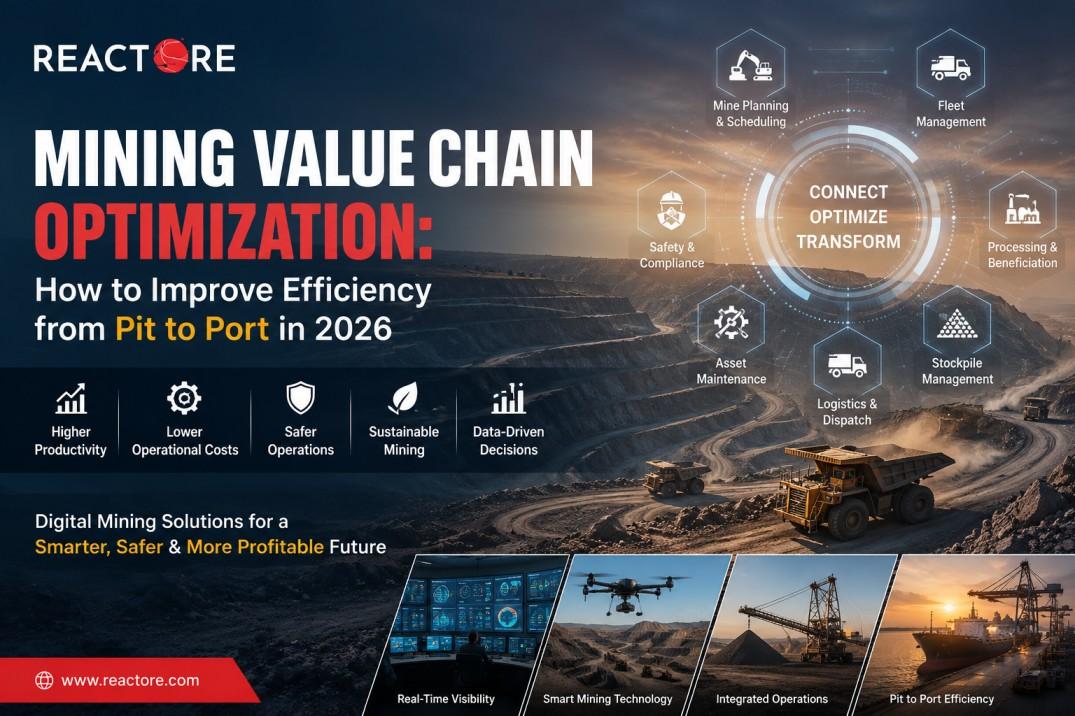
Mining companies in 2026 are under increasing pressure to produce more efficiently, control operating costs, improve safety, reduce environmental impact, and make faster decisions. However, many mining operations still depend on disconnected systems, spreadsheets, manual reporting, and separate software platforms for different stages of the operation.
This is where mining value chain optimization becomes critical.
From mine planning and extraction to processing, stockpile management, transportation, and final dispatch, every stage of the mining value chain affects the next. A delay in the pit can affect the plant. Poor stockpile visibility can affect blending. Equipment downtime can reduce production. Delayed logistics information can slow dispatch.
Modern Mining Value Chain Digital Solutions help connect these processes through real-time operational data, integrated workflows, automation, analytics, and intelligent decision-making.
Reactore's MineOne platform is designed to support digitalisation across the mining value chain, helping mining companies connect production, fleet management, asset maintenance, processing, logistics, safety, compliance, and other operational functions through an integrated digital environment.
What Is Mining Value Chain Optimization?
Mining value chain optimization means improving every connected activity involved in moving minerals from extraction to the customer while reducing waste, delays, costs, and operational risks.
The traditional mining value chain can include:
-
Mine planning and scheduling
-
Drilling and blasting
-
Material extraction
-
Loading and hauling
-
Fleet management
-
Crushing and processing
-
Stockpile management
-
Maintenance
-
Quality and grade management
-
Transportation and logistics
-
Weighbridge and dispatch
-
Safety and compliance
-
Environmental monitoring
The main challenge is that these activities are interconnected. Optimizing only one department does not necessarily improve the performance of the entire operation.
For example, increasing mine production without considering plant capacity can create stockpile congestion. Improving truck utilization without monitoring maintenance can increase equipment failures. Faster dispatch without accurate stockpile data can create reconciliation problems.
A modern Digital Mining Solution therefore focuses on connecting operational information and decisions across the entire value chain.
Why Mining Companies Need Digital Value Chain Optimization in 2026
Mining operations generate enormous amounts of operational data from vehicles, machines, sensors, weighbridges, ERP systems, SCADA systems, mobile applications, environmental monitoring systems, and other technologies.
The problem is not simply the availability of data. The problem is turning that data into useful operational decisions.
Common challenges include:
-
Data stored across multiple disconnected systems
-
Manual production and compliance reporting
-
Limited real-time visibility of equipment
-
Poor coordination between mining and processing teams
-
Unplanned equipment downtime
-
Inefficient fleet utilization
-
Difficult stockpile reconciliation
-
Delayed logistics and dispatch information
-
Safety information that is not available quickly enough
-
Difficulty integrating new digital technologies with legacy systems
Reactore's experience demonstrates the value of creating an integrated operational environment. In one multi-site bauxite mining case, its MineOne 360 platform connected information across 27 sites and integrated systems including SAP ERP, Datamine, and weighbridge infrastructure. The reported outcomes included 30% to 40% faster dispatch transactions and 15% to 25% improvement in stockpile reconciliation.
How Smart Mining Technology Improves the Pit-to-Port Process
Smart Mining Technology works best when it connects individual operational processes instead of treating them as isolated systems.
1. Improve Mine Planning and Scheduling
Effective optimization starts before material is extracted.
Mining companies need accurate information about production targets, available resources, equipment capacity, material movement, and processing requirements.
Digital planning and scheduling systems can help teams:
-
Create production schedules
-
Track planned versus actual production
-
Identify operational constraints
-
Coordinate equipment and personnel
-
Monitor shift performance
-
Adjust plans based on real-time conditions
Integrated planning helps mining managers respond faster when production conditions change.
2. Optimize Fleet Performance
Mining fleets represent a major operational cost. Trucks, loaders, excavators, dozers, and other equipment must be available and utilized effectively.
A Digital Mining Solution can combine fleet location, utilization, cycle times, fuel consumption, equipment status, and maintenance information.
This allows mine operators to identify:
-
Excessive idle time
-
Long haul cycles
-
Unproductive travel
-
Equipment bottlenecks
-
Fuel losses
-
Maintenance-related downtime
Reactore's MineOne includes fleet management and performance optimization capabilities designed to provide greater operational visibility.
3. Connect Production With Processing
The material extracted from the mine eventually reaches a processing plant. If production and plant operations are managed independently, operational inefficiencies can occur.
Integrated digital systems can connect mine production information with processing requirements.
This helps teams understand:
-
What material is being produced
-
Where material is located
-
What grade or quality is available
-
How much material is in stock
-
What the plant requires
-
Whether production is aligned with processing capacity
This creates better coordination between mining and processing teams.
4. Improve Stockpile Management
Stockpile visibility is essential for accurate production and inventory management.
Poor stockpile data can lead to:
-
Incorrect inventory estimates
-
Grade blending problems
-
Material losses
-
Delayed dispatch
-
Production planning errors
Modern Mining Value Chain Digital Solutions can integrate stockpile information, material tracking, production data, and dispatch information.
Reactore's MineOne portfolio includes profile stacking and stockpile management capabilities, supporting material tracking and automated stacker management.
5. Reduce Equipment Downtime
Unplanned equipment failure can interrupt the entire mining value chain.
Asset management and predictive maintenance technologies allow mining companies to monitor equipment condition and maintenance requirements.
Digital systems can help teams track:
-
Maintenance schedules
-
Equipment health
-
Work orders
-
Failure history
-
Spare parts
-
Maintenance costs
-
Asset availability
Reactore's MineOne includes enterprise asset management, CMMS, digital twin, and predictive maintenance capabilities.
6. Improve Logistics and Dispatch
The final stages of the value chain depend heavily on accurate logistics information.
A delay at dispatch can reduce the commercial efficiency of an otherwise productive mine.
Digital logistics systems can connect:
-
Stockpile information
-
Weighbridge transactions
-
Vehicle movements
-
Customer orders
-
Dispatch schedules
-
Inventory
-
Sales and distribution data
This creates better visibility from the mine site to the final destination.
7. Strengthen Safety and Compliance
Productivity cannot be separated from safety.
Modern Smart Mining Technology can support personnel tracking, geofencing, proximity detection, environmental monitoring, incident management, and compliance workflows.
Reactore provides solutions covering personnel and asset tracking, geotechnical and hydrological monitoring, environmental monitoring, SHERQ, and regulatory compliance.
The Role of AI, Digital Twins and Real-Time Analytics
Mining digitalisation is moving beyond basic dashboards.
In 2026, mining companies are increasingly looking toward technologies such as:
-
Artificial intelligence
-
Machine learning
-
3D digital twins
-
Predictive maintenance
-
IoT sensors
-
Real-time analytics
-
Low-code applications
-
Automated workflows
-
Remote monitoring
-
Advanced fleet optimization
A digital twin can provide a virtual representation of mining assets or operations and help teams understand current conditions and potential operational outcomes.
Reactore uses 3D digital twins within its mining digitalisation approach to improve visibility and support decision-making across mine and plant operations.
The important point is that AI should not operate independently from operational data. AI becomes more valuable when reliable information from production, maintenance, fleet, logistics, safety, and other systems is available through a connected digital environment.
How Reactore Helps Optimize the Mining Value Chain
Reactore has focused on mining digitalisation since 2013, developing integrated real-time software solutions designed specifically for mining operations.
Its MineOne platform covers multiple areas of the mining value chain, including:
-
Production planning and scheduling
-
Fleet management
-
Short interval control
-
Personnel and asset tracking
-
Geotechnical and hydrological monitoring
-
Plant processing and beneficiation
-
Asset maintenance
-
CMMS
-
Ventilation management
-
Environmental monitoring
-
Fuel management
-
Inventory management
-
Logistics management
-
Profile stacking
-
SHERQ and compliance
The key advantage is integration. Instead of creating another isolated application, MineOne is designed to connect operational information and existing technologies into a more unified digital environment.
Reactore also uses its Devum low-code application platform to develop customized digital applications. This approach can help mining companies adapt digital workflows to specific operational requirements instead of forcing every site into exactly the same process.
Data-Driven Results From Real Mining Operations
The value of digital mining technology should ultimately be measured through operational outcomes.
A Reactore case study involving a large Indian bauxite operation reported:
-
30% to 40% faster dispatch transactions
-
15% to 25% improved stockpile reconciliation
-
30% more load per hour
-
20% less loss
-
20% less tare weight discrepancy
-
80% to 100% automation of manual reporting
-
More than 90% operational data centralisation
The case involved 27 open-cast mining sites and integrations with SAP ERP, Datamine, and weighbridge systems. Reactore notes that results can vary depending on site conditions and implementation scope.
These results demonstrate an important principle: mining digitalisation should not be measured by the number of sensors, applications, or dashboards deployed. It should be measured by improvements in productivity, visibility, cost control, safety, decision-making, and operational reliability.
Future Outlook for Mining Value Chain Optimization
The future of mining will increasingly depend on connected operations.
Mining companies are likely to focus on:
-
AI-assisted operational decisions
-
Autonomous and semi-autonomous equipment
-
Real-time digital twins
-
Predictive asset management
-
Integrated mine-to-port logistics
-
Automated compliance reporting
-
Advanced environmental monitoring
-
Low-code digital applications
-
Cloud and edge computing
-
Connected control rooms
-
Cross-site operational intelligence
However, successful digital transformation will require more than buying new technology.
Companies need a clear digital strategy, reliable operational data, system integration, employee adoption, cybersecurity, and measurable business objectives.
The most successful approach is likely to be modular. Mining companies can begin with high-value operational problems and gradually expand digital capabilities across the value chain.
Why Choose Reactore for Digital Mining Solutions?
Reactore combines mining domain expertise with digital technology and software development capabilities.
Its value proposition is built around solving operational problems rather than simply supplying individual software tools.
Mining companies can benefit from:
-
An integrated approach to mining digitalisation
-
Solutions covering the entire value chain
-
Real-time operational visibility
-
Integration with existing systems
-
Customizable workflows
-
Fleet and asset optimization
-
Digital twin capabilities
-
Safety and compliance solutions
-
Data-driven decision support
-
Low-code application development
Reactore's MineOne platform has been developed specifically around mining operational requirements, while Devum provides the flexibility to build and customize additional applications.
Conclusion
Mining value chain optimization in 2026 is no longer simply about increasing production at the mine face. It is about connecting every stage of the operation, from planning and extraction to processing, stockpile management, logistics, dispatch, maintenance, safety, and compliance.
Mining Value Chain Digital Solutions can help companies replace fragmented information with connected operational intelligence. A Digital Mining Solution can improve visibility and decision-making, while Smart Mining Technology can help automate processes, optimize equipment, improve safety, and reduce operational inefficiencies.
Reactore's MineOne platform provides an integrated approach to mining digitalisation, covering multiple operational areas across the mining value chain. Its experience with multi-site mining operations and measurable operational outcomes makes it a strong option for companies looking to move from disconnected digital tools toward an integrated mine management environment.
For mining companies planning their next stage of digital transformation, the key question is no longer whether digital technology is necessary. The more important question is how effectively technology can connect the entire value chain and turn operational data into measurable business value.
Frequently Asked Questions
What is mining value chain optimization?
Mining value chain optimization is the process of improving interconnected mining activities from planning and extraction through processing, stockpile management, transportation, and final dispatch. The goal is to improve productivity, reduce costs and delays, increase visibility, and make better operational decisions.
What are Mining Value Chain Digital Solutions?
Mining Value Chain Digital Solutions are digital platforms, applications, analytics, integrations, and automation technologies that connect different stages of mining operations. They can cover planning, production, fleet management, processing, maintenance, logistics, safety, compliance, and dispatch.
What is a Digital Mining Solution?
A Digital Mining Solution uses software, data integration, automation, sensors, analytics, and other technologies to improve mining operations. A modern solution can provide real-time operational visibility and connect information from systems such as ERP, SCADA, fleet management, maintenance, mobile applications, and weighbridges.
How does Smart Mining Technology improve productivity?
Smart Mining Technology improves productivity by providing real-time information about equipment, production, material movement, maintenance, and operational performance. This allows mining teams to identify bottlenecks, reduce idle time, respond to problems faster, and improve resource utilization.
How can digital technology improve pit-to-port operations?
Digital technology can connect mine production, processing, stockpiles, logistics, weighbridges, inventory, and dispatch. This creates better visibility across the pit-to-port process and helps teams coordinate production and transportation more efficiently.
Can mining software integrate with existing ERP and operational systems?
Yes. Modern mining platforms can integrate with existing ERP, SCADA, PLC, fleet, weighbridge, maintenance, and other operational systems. Reactore's MineOne has been used with systems including SAP ERP, Datamine, and weighbridge infrastructure in a multi-site mining implementation.
How do digital twins help mining companies?
Digital twins create virtual representations of physical assets, mine environments, or operational processes. They can help teams visualize current conditions, analyze performance, support predictive maintenance, and make better operational decisions.
How can mining companies reduce equipment downtime?
Mining companies can reduce downtime by combining asset monitoring, maintenance planning, equipment health information, predictive maintenance, and historical failure data. Integrated asset management systems help maintenance teams identify problems earlier and coordinate maintenance activities with production requirements.
What are the major mining technology trends in 2026?
Important trends include artificial intelligence, digital twins, predictive maintenance, real-time analytics, autonomous equipment, IoT, connected control rooms, environmental monitoring, low-code applications, and integrated mine management platforms.
Why is real-time data important in mining?
Real-time data allows mining managers and supervisors to understand what is happening across operations without waiting for manually prepared reports. Faster access to accurate information can improve response times, production control, maintenance decisions, safety management, and logistics coordination.
Why should mining companies choose Reactore?
Reactore combines mining domain expertise with digitalisation, software integration, low-code application development, and operational technology. Its MineOne platform provides solutions across multiple stages of the mining value chain, while its Devum platform supports customized digital applications.

 English
 Arabic
 French
 Spanish
 Portuguese
 Deutsch
 Turkish
 Dutch
Dutch
 Russian
 Romaian
 Portuguese (Brazil)
 Greek
Greek
