


Hybrid Resources: The Smart Way to Combine On-Site Management with Offshore Talent
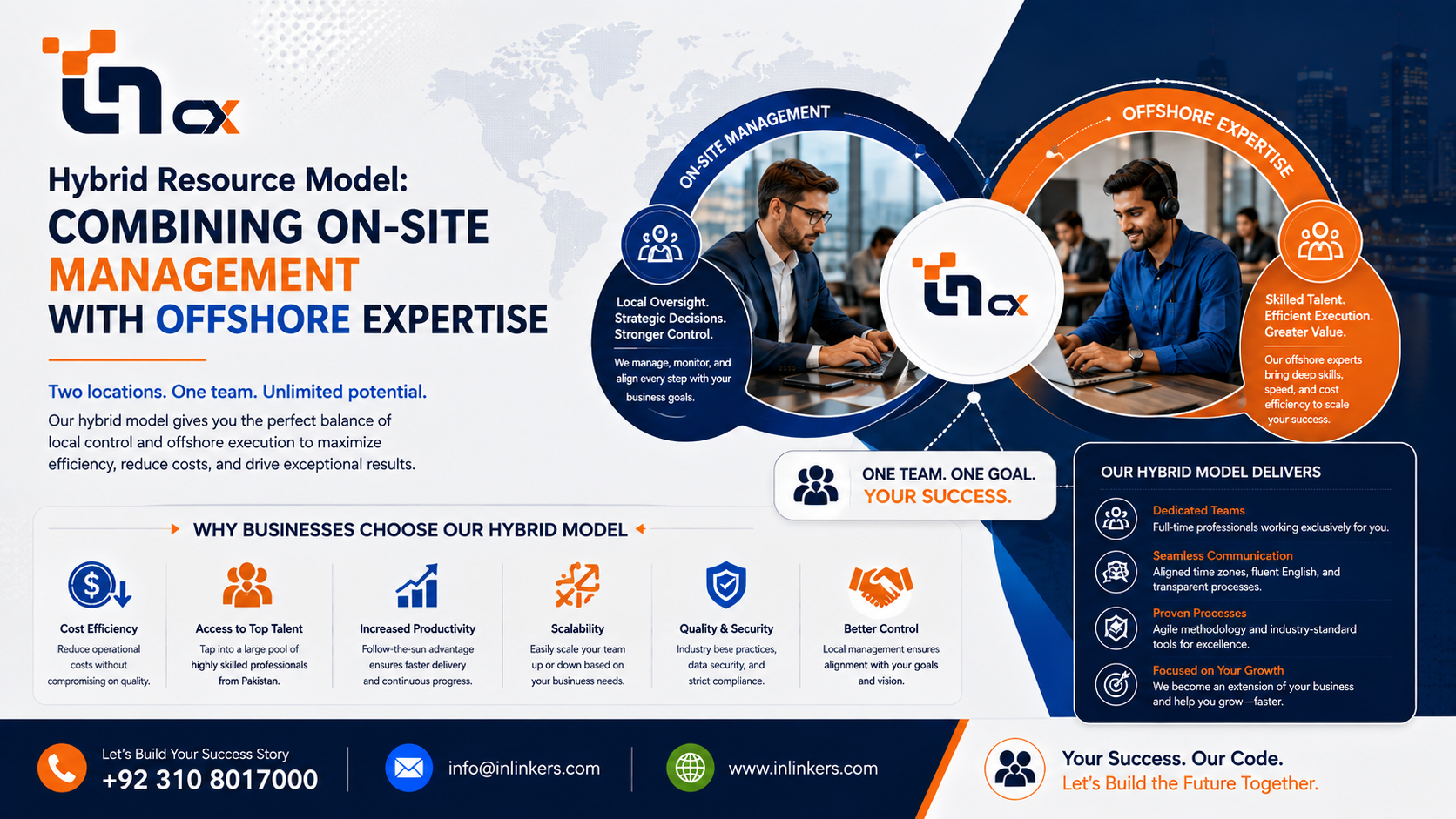
Businesses today need to balance three important priorities: quality, control and cost. Traditional in-house teams can provide strong communication and direct management, but they can also be expensive and difficult to scale. Fully offshore teams can reduce operational costs and provide access to a wider talent pool, but some companies worry about communication, visibility and accountability.
A hybrid resource model brings these approaches together.
The InLinkers CX Hybrid Resource Model combines an on-site project manager with a full offshore delivery team based in Pakistan. The project manager works in the client's location and time zone, while developers, analysts, designers, billers, call center agents and other delivery professionals operate from the company's Lahore operations center. InLinkers CX positions the model as a way to combine local management with offshore delivery economics.
What Are Hybrid Resources?
Hybrid resources are a combination of on-site and offshore professionals working together as one coordinated team.
Instead of choosing between an entirely local workforce and a completely remote team, businesses can assign key management or client-facing responsibilities to an on-site professional while placing the majority of delivery resources offshore.
For example, a technology company might have:
-
One on-site project manager
-
Three full-stack developers
-
One DevOps engineer
-
One QA engineer
-
One UI/UX designer
-
One data analyst
The project manager works directly with the client, while the technical delivery team works from Pakistan.
This structure creates a bridge between the client's internal organization and the offshore workforce.
How the InLinkers CX Hybrid Model Works
The InLinkers CX model places a dedicated project manager physically at the client's office and in the client's time zone. The offshore delivery team operates from the Lahore, Pakistan operations center.
The on-site manager becomes the primary communication and accountability point.
They can:
-
Attend internal meetings
-
Participate in standups
-
Communicate directly with stakeholders
-
Understand business requirements
-
Coordinate offshore resources
-
Monitor project progress
-
Escalate problems
-
Report performance
Meanwhile, the offshore team handles the majority of technical or operational work.
According to InLinkers CX, this structure is designed to address the communication problems that can sometimes occur in traditional offshore arrangements while maintaining lower delivery costs.
Why Businesses Are Choosing Hybrid Resources
Traditional outsourcing models are not always suitable for every business.
A company may want the cost advantages of offshore staffing but still need someone physically present to understand local requirements and communicate directly with management.
The hybrid approach addresses this need.
Businesses can gain:
Better Communication
The on-site project manager provides a direct communication channel between the client and offshore team.
Stronger Accountability
A local manager can monitor progress and address issues quickly.
Offshore Cost Efficiency
Most delivery professionals remain offshore, allowing companies to access Pakistan-based talent.
Easier Scaling
Additional offshore resources can be added without expanding the client's local office.
Greater Visibility
Clients can receive regular project updates and performance reports.
The InLinkers CX page states that its hybrid model provides weekly KPI reporting and allows offshore teams to scale in 7–14 days.
Hybrid vs. Fully On-Site Teams
A fully on-site team provides direct communication because everyone works in the same physical environment. However, maintaining a large local workforce can involve significant costs.
Expenses may include:
-
Salaries
-
Office space
-
Equipment
-
Benefits
-
Recruitment
-
HR administration
-
Training
-
Infrastructure
A hybrid model reduces the number of people who need to work on-site.
The project manager remains physically present, while the delivery team works from Pakistan.
InLinkers CX states that its hybrid model can cost approximately 60% less than fully on-site delivery, depending on the engagement.
Hybrid vs. Fully Offshore Teams
A fully offshore model can provide substantial cost benefits, but communication and management may require additional effort.
With a hybrid structure, the on-site project manager acts as a bridge.
They understand:
-
The client's culture
-
Business priorities
-
Internal processes
-
Stakeholder expectations
-
Local working environment
-
Project objectives
The offshore team can then receive clearer instructions and feedback.
This can reduce misunderstandings and help projects remain aligned with business expectations.
Hybrid Resources vs. Freelancers
Freelancers can be valuable for small projects and specialized short-term tasks. However, businesses with long-term requirements may need more structure.
A hybrid team can provide:
-
Dedicated management
-
Multiple specialists
-
Backup resources
-
Structured reporting
-
Centralized accountability
-
Long-term continuity
InLinkers CX compares its hybrid model with freelancer, fully offshore and fully on-site models, highlighting factors such as accountability, backup resources, reporting, communication and scalability.
What Types of Professionals Can Work in a Hybrid Team?
Hybrid resources are not limited to software development.
The model can be applied to different business functions.
Software Development
Teams can include frontend developers, backend developers, full-stack developers, mobile developers and software architects.
IT and DevOps
Businesses can use DevOps engineers, cloud professionals, system administrators and cybersecurity specialists.
Healthcare BPO
Healthcare organizations can combine an on-site manager with offshore medical billers, coders and accounts receivable specialists.
Insurance Operations
Insurance companies can use claims processors, policy administration professionals and data specialists.
Call Center Operations
Businesses can combine an on-site operations manager with offshore customer service agents and support teams.
Finance and Accounting
Accounting teams can include bookkeepers, accountants, financial analysts and accounts payable professionals.
Data Management
Companies can use data entry specialists, data processors, analysts and document management professionals.
The InLinkers CX website lists BPO, IT outsourcing, IT staffing, healthcare, mortgage, insurance, finance, accounting and data management among its service areas.
The On-Site Project Manager's Role
The on-site project manager is one of the most important components of the hybrid model.
Their responsibility is not simply to supervise the offshore team. They act as the connection between the client and delivery operation.
Their responsibilities can include:
-
Managing meetings
-
Defining priorities
-
Coordinating tasks
-
Monitoring deadlines
-
Communicating requirements
-
Resolving blockers
-
Reviewing performance
-
Reporting progress
-
Managing stakeholder communication
According to InLinkers CX, clients interview and approve the proposed on-site project manager and offshore team leads before the engagement begins.
How the Offshore Team Supports the Business
The offshore team provides the scale behind the on-site manager.
Depending on the project, the team can include developers, billers, call center agents, designers, analysts and other specialists.
The InLinkers CX model places these delivery resources within its Lahore operations center, with company infrastructure, backup resources and quality oversight.
This means the client does not have to manage every individual offshore resource independently.
Step-by-Step Hybrid Resource Process
A successful hybrid engagement requires structured onboarding.
Step 1: Discovery and Requirements
The provider first identifies the project scope, team size, required skills and on-site location.
Step 2: NDA and Proposal
InLinkers CX states that a mutual NDA is signed before project details are shared, followed by a custom proposal containing the team structure, pricing and onboarding timeline.
Step 3: Interview and Approval
The client interviews proposed resources and approves the people who will join the project.
Step 4: On-Site Manager Starts
The project manager joins the client's office and becomes part of internal meetings and communication systems.
Step 5: Offshore Team Goes Live
The Pakistan-based delivery team is onboarded and trained on the client's processes, tools and quality standards.
Step 6: Ongoing Reporting and Scaling
The model includes weekly KPI reports and monthly strategic reviews, while team size can be adjusted according to business requirements.
Transparency and Performance Tracking
Visibility is critical when working with remote teams.
InLinkers CX describes several transparency mechanisms, including:
-
Real-time project dashboards
-
Daily standups
-
Weekly KPI reports
-
Monthly strategic reviews
-
Time tracking
-
Project milestone monitoring
The company states that weekly reports cover output, quality, turnaround times, team utilization, blockers and upcoming priorities.
These processes allow businesses to understand how their teams are performing without relying solely on informal updates.
Built-In Backup Resources
Employee availability can affect project continuity.
If a key team member becomes unavailable, businesses may experience delays when there is no replacement.
The InLinkers CX hybrid model states that each offshore resource has an identified trained backup who can take over when required.
This can be particularly useful for businesses running critical operations where interruptions can affect customers or revenue.
Security and Intellectual Property Protection
Security should be considered before sharing source code, customer data, business processes, or confidential documentation with an external team.
The InLinkers CX model describes multiple layers of protection, including a company-level mutual NDA, additional confidentiality requirements for the on-site project manager and individual IP agreements for offshore team members.
Businesses should still conduct their own legal, security, compliance and data-protection review before beginning an engagement.
Hybrid Resources for Global Businesses
The InLinkers CX hybrid model is presented as available across six markets:
-
United States
-
United Kingdom
-
Australia
-
United Arab Emirates
-
Saudi Arabia
-
Canada
The offshore delivery operation remains in Lahore, while the on-site project manager can be placed in the client's market.
This structure can be useful for organizations that need local presence while also accessing international delivery talent.
Who Should Consider a Hybrid Resource Model?
A hybrid model may be suitable for businesses that:
-
Need an on-site point of contact
-
Want offshore delivery capacity
-
Have long-term projects
-
Need multiple specialists
-
Want to reduce operating costs
-
Need scalable teams
-
Require regular performance reporting
-
Want stronger oversight than traditional outsourcing
It can be particularly valuable for growing organizations that need to expand quickly without building a large local workforce.
Hybrid Resources for Technology Projects
Technology companies can use hybrid teams to support software development, cloud projects, mobile applications, AI initiatives, cybersecurity, QA and DevOps.
For example, a company launching a SaaS platform could have an on-site engineering manager working with stakeholders while a Pakistan-based team handles development, testing, DevOps and data work.
This creates a single coordinated team while distributing resources across locations.
Why Choose InLinkers CX?
InLinkers CX presents its hybrid resource model as a combination of local project management and Pakistan-based delivery. The company states that it has more than 10 years of experience serving global clients and provides BPO, IT outsourcing, staff augmentation and related services.
Its model emphasizes:
-
On-site project management
-
Offshore Pakistan delivery
-
Dedicated resources
-
Weekly KPI reporting
-
Backup resources
-
NDA and IP protection
-
Flexible scaling
-
Multi-region support
The company also states that its standard onboarding target is 14 days from signed contract to a live operational team, subject to service type and staff availability.
Conclusion
The hybrid resource model provides businesses with an alternative to choosing between expensive fully on-site teams and completely offshore operations.
By combining an on-site project manager with an offshore delivery team in Pakistan, businesses can maintain direct communication, improve accountability, access specialized professionals and potentially reduce operating costs.
The model can support software development, IT staffing, healthcare BPO, insurance operations, finance, customer support, data management and other business functions.
For organizations that need both local oversight and offshore capacity, hybrid resources can provide a practical structure for scaling teams while maintaining visibility and control.
InLinkers CX's model is built around this concept: the client receives an on-site management presence while the larger delivery team operates from Pakistan, supported by structured reporting, backup resources, security processes and scalable staffing.

 English
 Arabic
 French
 Spanish
 Portuguese
 Turkish
 Dutch
Dutch
 Italiano
 Russian
 Romaian
 Portuguese (Brazil)
 Greek
Greek
