


What Does an Interventional Cardiologist Actually Treat?
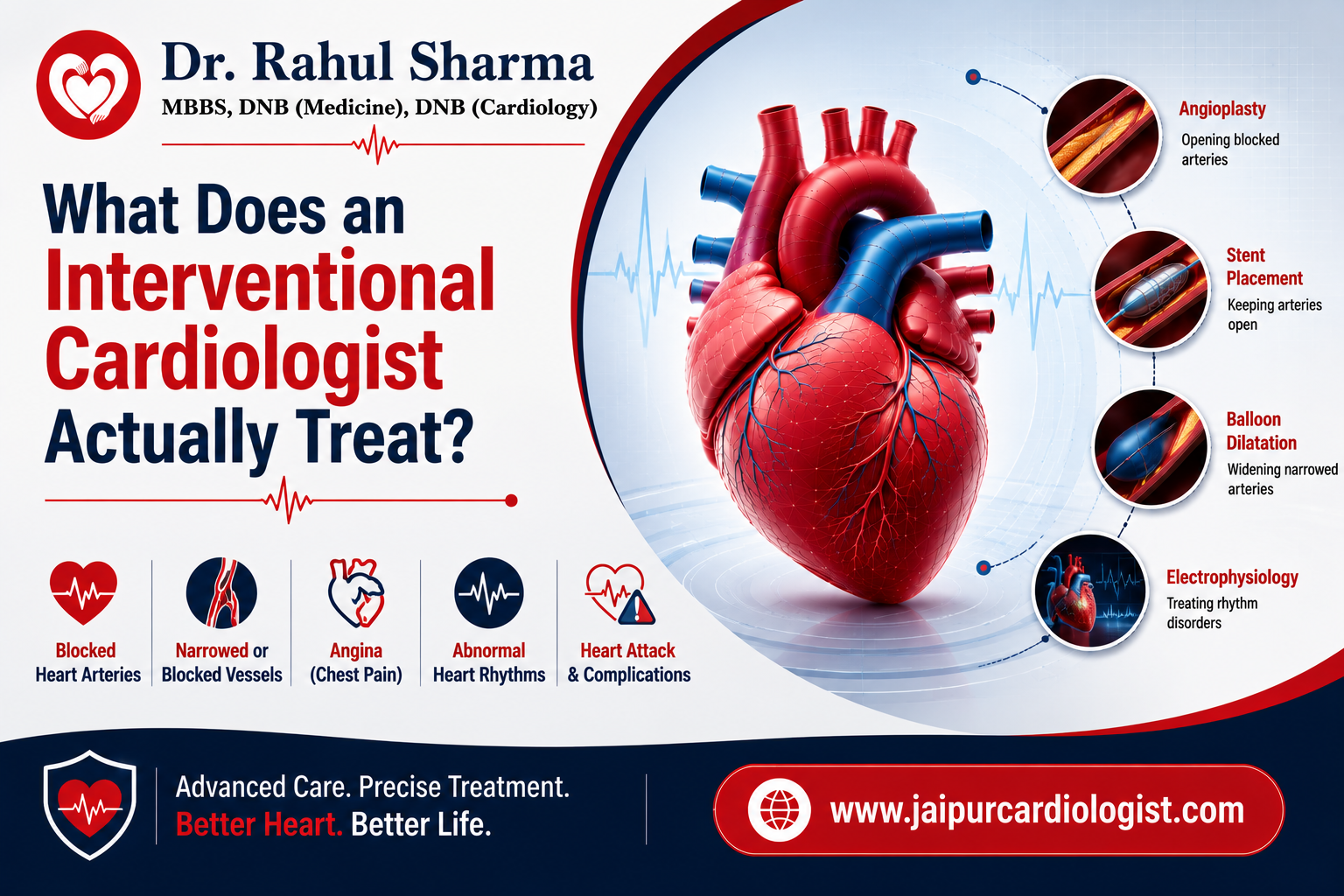
When people hear the term cardiologist, they often think about routine heart checkups, blood pressure management, ECG tests, or medicines. But cardiology has several specialized areas, and interventional cardiology focuses on treating certain heart and blood vessel problems through catheter-based procedures.
An Interventional Cardiologist in Jaipur is trained to diagnose and treat conditions affecting the coronary arteries and other blood vessels using minimally invasive techniques. Instead of making a large surgical incision, the doctor uses thin catheters, specialized instruments, and advanced imaging to reach the affected area.
This type of treatment can be particularly important when a patient has a significant coronary blockage, requires angioplasty, or needs urgent treatment during a heart attack.
Interventional Cardiology Is About More Than Angioplasty
Angioplasty is one of the best-known procedures performed by interventional cardiologists, but it is not the only part of their work.
Interventional cardiology involves diagnosing the cause of reduced blood flow, understanding the location and severity of blockages, deciding whether an intervention is necessary, and carrying out appropriate catheter-based treatment when required.
The specialist also needs to determine when a procedure is not necessary. Some patients can be managed effectively with medicines, lifestyle changes, and regular follow-up.
The decision should always be based on the patient's symptoms, investigations, coronary anatomy, overall health, and cardiovascular risk.
Coronary Angiography Helps Find Hidden Blockages
One of the important procedures associated with interventional cardiology is coronary angiography.
If a doctor suspects significant coronary artery disease, angiography can provide a detailed view of the arteries supplying blood to the heart. A thin catheter is introduced through a blood vessel and guided toward the heart. Contrast material is then used with specialized imaging to identify areas where blood flow may be restricted.
The results help the cardiologist understand whether there is a blockage, where it is located, and how severe it appears.
This information can then be used to decide whether the patient requires medication, further testing, angioplasty, or another treatment approach.
Coronary Angioplasty Treats Certain Artery Blockages
When a coronary artery is significantly narrowed and intervention is considered appropriate, angioplasty may be performed.
During the procedure, a catheter is guided to the narrowed portion of the artery. A small balloon can be inflated at the blockage to widen the passage and improve blood flow.
In many cases, a stent is then placed to support the artery and help keep it open.
The procedure is performed through a small access point in a blood vessel rather than through open-heart surgery.
For the right patient, angioplasty can help improve blood supply to the heart muscle and may reduce symptoms caused by restricted coronary blood flow.
What Does a Stent Actually Do?
A stent is a small mesh-like tube placed inside a narrowed artery.
After the blockage has been treated, the stent provides structural support to the artery and helps maintain an open passage for blood.
Modern coronary stents are commonly designed to release medication that helps reduce the risk of the artery becoming narrowed again.
However, receiving a stent does not mean that coronary artery disease has permanently disappeared. The disease process can affect other parts of the coronary circulation as well.
That is why medication, blood pressure control, cholesterol management, physical activity, healthy eating, and regular follow-up remain important after the procedure.
Interventional Cardiology Can Become Critical During a Heart Attack
Interventional cardiology plays an especially important role during certain heart attacks.
A heart attack can occur when a coronary artery becomes suddenly blocked, often because a blood clot forms over a ruptured cholesterol plaque. The affected portion of the heart muscle then receives inadequate oxygen.
The longer the artery remains blocked, the greater the potential for heart muscle damage.
In suitable patients, emergency coronary angiography can identify the blocked artery, followed by angioplasty and stent placement when appropriate. The objective is to restore blood flow as quickly as possible.
This is why timely Heart attack treatment in Jaipur can be critical when someone develops symptoms suggesting an acute heart attack.
Chest Pain Does Not Always Mean You Need a Procedure
A common misconception is that every patient with chest pain needs angioplasty.
That is not the case.
Chest discomfort can have many causes, including acidity, muscle problems, anxiety, lung conditions, and heart-related disease. Even among patients with coronary artery disease, the treatment approach varies.
An interventional cardiologist first evaluates the symptoms and relevant investigations. If the findings suggest that a significant blockage is responsible for the symptoms, an intervention may be considered.
If the blockage does not require a procedure, medical treatment and lifestyle management may be more appropriate.
Good interventional care therefore involves knowing when to perform a procedure and when not to.
Blood Pressure Still Matters in Interventional Cardiology
High blood pressure is one of the major risk factors associated with cardiovascular disease.
Over time, uncontrolled hypertension can damage blood vessels and increase the risk of coronary artery disease, heart attack, stroke, and heart failure.
Even after successful coronary intervention, blood pressure needs to remain under control to reduce future cardiovascular risk.
Patients who have persistent high blood pressure may need individualized Hypertension Treatment Doctor in Jaipur care involving regular monitoring, lifestyle changes, and medicines when required.
Controlling blood pressure is not separate from interventional cardiac care. It is part of protecting the heart and arteries over the long term.
Some Patients Need More Detailed Evaluation Before Treatment
Not every coronary blockage is straightforward.
Doctors may need to consider the number of affected arteries, the location of the narrowing, the length and complexity of the blockage, previous stents, heart function, diabetes, kidney health, and other medical conditions.
A detailed evaluation allows the cardiologist to decide whether angioplasty is suitable or whether another treatment strategy should be considered.
In complex cases, careful planning becomes particularly important because the safest treatment for one patient may not be the best option for another.
What Happens After an Interventional Procedure?
The procedure itself is only one part of cardiac treatment.
After angioplasty or stent placement, patients usually require prescribed medicines and follow-up care. These medicines may include treatment designed to reduce the risk of clot formation inside the stent, along with medicines for cholesterol, blood pressure, or other cardiovascular conditions.
Patients should take their medicines exactly as advised and should not discontinue them without discussing the decision with their cardiologist.
Lifestyle also remains important. Avoiding tobacco, maintaining a healthy weight, staying physically active as advised, following a heart-friendly diet, and controlling diabetes and blood pressure can all support long-term cardiovascular health.
Why Experience Matters in Interventional Cardiology
Interventional procedures require technical expertise as well as careful clinical judgement.
The doctor needs to understand the patient's symptoms, interpret imaging accurately, select suitable equipment, navigate the coronary anatomy safely, and respond appropriately if unexpected difficulties arise.
Experience also helps with treatment planning.
A skilled interventional cardiologist does not simply focus on opening an artery. The specialist considers the patient's entire cardiovascular condition and the likely long-term benefit of the proposed intervention.
Dr. Rahul Sharma's Approach to Interventional Cardiac Care
Dr. Rahul Sharma is an experienced Interventional Cardiologist in Jaipur with qualifications including MBBS, DNB (General Medicine), and DNB (Cardiology) and more than 20 years of experience in advanced cardiovascular care.
His clinical expertise includes coronary angiography, coronary angioplasty, stent placement, coronary artery disease management, chest pain evaluation, hypertension management, preventive cardiology, and emergency cardiac care.
Patients seeking Hypertension Treatment Doctor in Jaipur services can receive cardiovascular evaluation and individualized management aimed at controlling blood pressure and reducing long-term heart risk.
For patients experiencing symptoms of a possible heart attack, timely Heart attack treatment in Jaipur can include urgent cardiac evaluation and appropriate interventional treatment when indicated.
His approach combines clinical assessment, modern diagnostic techniques, minimally invasive procedures, medication management, and long-term preventive care.
When Should You Consider Seeing an Interventional Cardiologist?
You may be referred to an interventional cardiologist when investigations suggest significant coronary artery disease, when symptoms continue despite medical treatment, when angiography is required, or when an emergency coronary procedure may be necessary.
Patients who have been advised to undergo angiography or angioplasty can also benefit from understanding why the procedure has been recommended and what alternatives may exist.
The decision to proceed with an intervention should always be based on an individualized assessment rather than on the presence of a blockage alone.
Final Thoughts
An interventional cardiologist treats more than just blocked arteries. These specialists play an important role in diagnosing coronary disease, performing angiography, treating appropriate blockages with angioplasty and stents, and providing urgent catheter-based treatment during certain heart attacks.
At the same time, effective cardiac care does not end when a procedure is completed. Controlling hypertension, managing cholesterol and diabetes, taking prescribed medicines, avoiding tobacco, and maintaining a heart-friendly lifestyle remain essential.
For patients, the most important question is not simply whether an interventional procedure is available. It is whether that procedure is appropriate for their specific heart condition and whether it can provide a meaningful benefit.

 English
 Arabic
 French
 Spanish
 Portuguese
 Deutsch
 Dutch
Dutch
 Italiano
 Russian
 Romaian
 Portuguese (Brazil)
 Greek
Greek
