


Brewing Enzymes Market to Reach USD 936.02 Million by 2036
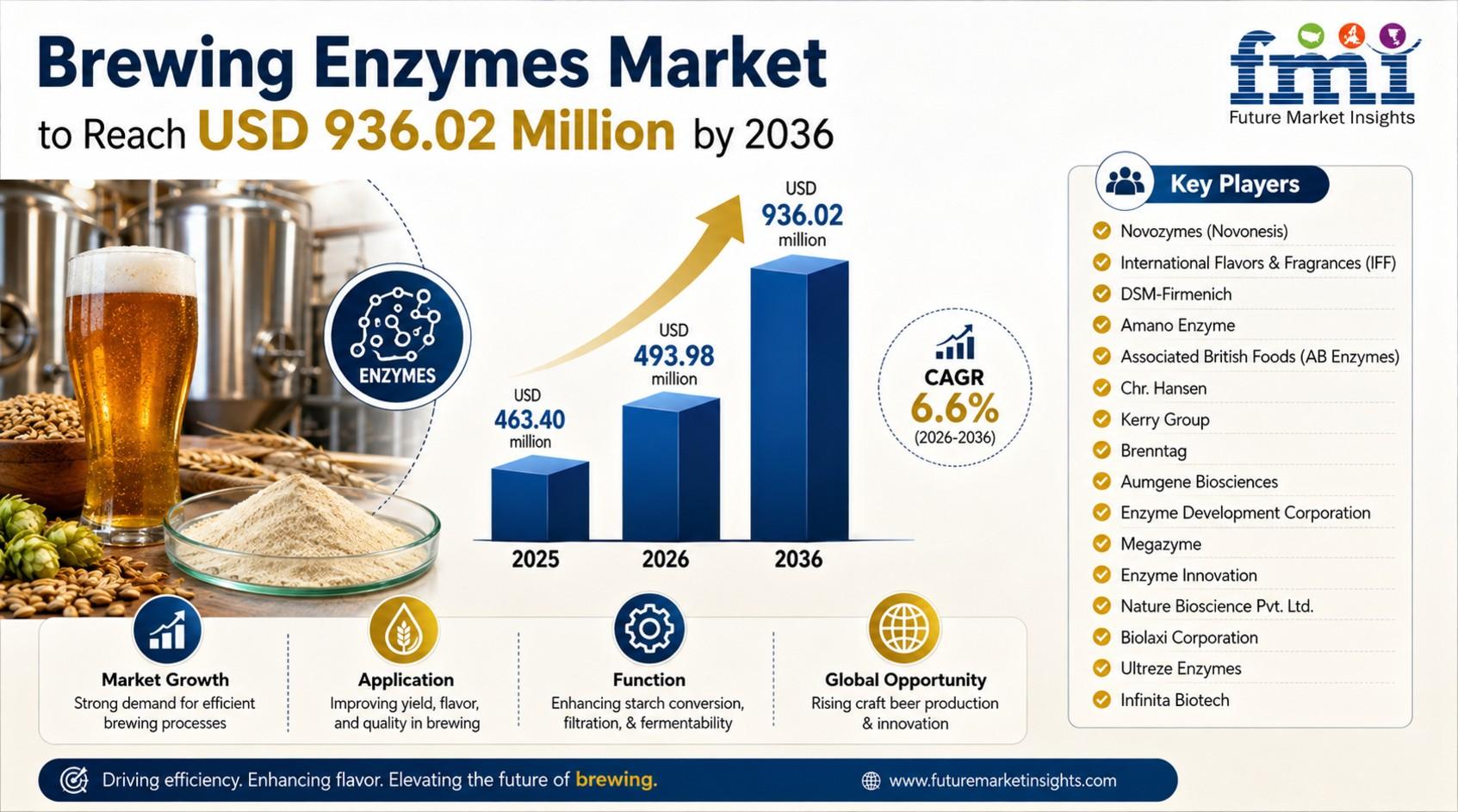
The global brewing enzymes market is expanding steadily as commercial breweries and microbreweries integrate specialized biocatalysts to optimize starch conversion efficiency, reduce energy consumption, and manage complex grain adjunct bills, according to latest insights by Future Market Insights. Driven by rising craft beer experimentation, the global surge in low-alcohol/alcohol-free (NABLAB) beer production, and the need to process cost-effective unmalted cereals (such as corn, rice, barley, and sorghum), enzyme preparations have evolved into essential process optimization tools.
The global market, valued at USD 463.40 million in 2025, is projected to reach USD 493.98 million in 2026. Advancing at a Compound Annual Growth Rate (CAGR) of 6.6% over the ten-year forecast period, total market valuation is anticipated to achieve USD 936.02 million by 2036, delivering an absolute incremental opportunity of USD 442.04 million.
Request a Sample Report: https://www.futuremarketinsights.com/reports/sample/rep-gb-14922
Market Performance Overview (2026–2036)
To map out the key enzyme types, biological sources, physical delivery formats, operational processes, and regional growth vectors guiding this USD 442.04 million market expansion, key segment allocations highlight where commercial demand is concentrated:
· Amylase Type Segment (34.6% share): Commands the product type category in 2026, serving as the foundational enzyme for hydrolyzing raw starches into fermentable sugars during mashing and cereal cooking.
· Microbial Source Segment (71.8% share): Leads biological origins over plant-derived sources due to superior enzymatic activity, thermal stability under high mashing temperatures, and scalable fermentation production.
· Liquid Form Segment (63.4% share): Dominates physical format sales, preferred by automated brewhouses for precise volumetric in-line dosing, dust-free handling, and instant dispersibility in wort.
· Mashing and Fermentation Process Segment (36.2% share): Represents the primary application stage, where enzymes break down starches, control residual dextrins, and accelerate diacetyl reduction during maturation.
· Beer Application Segment (82.5% share): Accounts for the vast majority of demand over wine and other fermented beverages, reflecting the sheer global volume of industrial and craft malt beverages.
· India Regional Leadership (6.1% CAGR): Serves as the fastest-growing national market through 2036, driven by rapid brewery infrastructure expansion and widespread adoption of local rice/corn adjuncts.
Technical Drivers and Brewing Innovation Shifts
The commercial scaling of brewing enzymes across industrial and craft beverage operations is propelled by three primary industry catalysts:
Adjunct Grain Flexibility and Cost Optimization
Faced with malt price volatility and local agricultural constraints, brewers are replacing expensive malted barley with unmalted grains (raw barley, rice, corn, sorghum, cassava). Exogenous enzymes specifically alpha-amylases, beta-glucanases, and xylanases reduce wort viscosity, prevent filter-bed blinding during lauter tun separation, and ensure complete saccharification.
Low-Alcohol and Alcohol-Free Beer (NABLAB) Formulations
The rapid consumer pivot toward moderation-led drinking requires exact wort sugar profiling. Brewers deploy specialized glucoamylases, amyloglucosidases, and glucose oxidases to control fermentable vs. non-fermentable sugar ratios, producing full-bodied low-ABV and dealcoholized beers without residual sweetness imbalances.
Accelerated Maturation and Accelerated Filtration
Enzymatic solutions such as acetolactate decarboxylase (ALDC, like Novozymes' Maturex) bypass the slow diacetyl rest phase during fermentation. By directly converting alpha-acetolactate into flavor-neutral acetoin, breweries reduce maturation tank residence time by days, effectively expanding cellar capacity without capital expenditure.
Supply Chain Constraints & Processing Challenges
Brewing enzyme suppliers and brewery procurement directors navigate specific operational hurdles:
· Supplier Traceability and Regulatory Documentation: Large commercial brewing conglomerates mandate strict documentation proving non-GMO expression hosts, batch-level enzyme activity reproducibility, and kosher/halal/FSSC 22000 certifications.
· Technical Know-How in Craft Operations: Smaller microbreweries often face operational challenges in managing exact temperature, pH, and contact-time windows required for optimal exogenous enzyme performance, necessitating supplier-provided technical service kits.
Regional Growth Profile
Regional demand reflects rapid brewing capacity expansion across developing Asian markets alongside specialty craft and low-alcohol innovation in Western economies:
· India (6.1% CAGR): The global growth frontrunner, driven by an expanding urban middle class, the rise of brewpubs, and high-volume industrial brewing utilizing local agricultural starch adjuncts.
· Japan (5.5% CAGR): Anchored by advanced multi-enzyme applications (from suppliers like Amano Enzyme and DSM) for precision fermentation management, zero-sugar lagers, and functional wellness beers.
· China (5.1% CAGR): The world's largest beer-producing nation by volume, actively modernizing commercial brewing efficiency and expanding premium/craft production lines.
· Brazil (4.2% CAGR): Supported by large-scale commercial lager breweries requiring consistent enzyme dosing for high-ratio corn adjunct grain bills.
· United States (3.4% CAGR): Represents a mature, high-value market where over 9,000 craft breweries utilize specialty enzymes for hazy IPAs (pectin and protein degradation), cold-mashing, and gluten-reduced beer lines.
Competitive Landscape
The global brewing enzymes landscape is moderately consolidated among multinational industrial biotechnology leaders, complemented by specialized regional enzyme formulators.
Key market participants profiled in the report include Novozymes (Novonesis), International Flavors & Fragrances (IFF), DSM-Firmenich, Amano Enzyme, Associated British Foods (AB Enzymes), Chr. Hansen, Kerry Group, Brenntag, Aumgene Biosciences, Enzyme Development Corporation, Megazyme, Enzyme Innovation, Nature Bioscience Pvt. Ltd., Biolaxi Corporation, Ultreze Enzymes, and Infinita Biotech. Industry leaders compete through proprietary multi-enzyme systems, on-site technical brewing trial support, and specialized enzyme cocktails for craft brewing styles.
Exclusive Discounts on Full Report: https://www.futuremarketinsights.com/reports/brewing-enzymes-market
Frequently Asked Questions
What is the projected valuation of the global brewing enzymes market by 2036?
The global brewing enzymes market is projected to reach USD 936.02 million by 2036, expanding from an estimated baseline valuation of USD 493.98 million in 2026 at a CAGR of 6.6%.
Why does Amylase command a 34.6% market share?
Amylase leads the enzyme category in 2026 because it is essential for hydrolyzing starch polymers into fermentable sugars (maltose, glucose) during mashing, enabling high-yield fermentation across both malted and unmalted grain bills.
What biological source dominates brewing enzyme production?
Microbial sources account for 71.8% of the market in 2026, as bacterial and fungal fermentation yields enzyme preparations with higher thermal stability, broader pH tolerance, and scalable manufacturing economics compared to plant extracts.
FMI Custom Research: Strategic Intelligence for Confident Decision-Making
In today's rapidly evolving business environment, leadership teams need clear, actionable intelligence tailored to their strategic objectives. FMI's Custom Research solutions are designed around specific business questions, enabling executives to evaluate growth opportunities, validate investments, assess competitive dynamics, and reduce uncertainty before making critical decisions.
Key Executive Benefits
· Decision-Ready Insights: Research tailored to your specific business challenges, growth plans, and investment priorities.
· Reduced Strategic Risk: Validate market opportunities, customer demand, and competitive positioning before committing resources.
· Market Entry Confidence: Assess opportunity size, regulatory barriers, channel dynamics, and competitive landscapes with precision.
· Competitive Advantage: Gain proprietary intelligence unavailable through syndicated reports or internal datasets.
· Faster Growth Decisions: Accelerate expansion, product development, portfolio optimization, and investment planning.
· Primary Market Validation: Access real-world customer, buyer, and stakeholder insights that support high-confidence decision-making.
Business Impact
FMI helps organizations transform market complexity into strategic clarity, enabling leadership teams to identify growth opportunities faster, optimize resource allocation, strengthen competitive positioning, and make high-stakes business decisions with confidence.
To explore how FMI Custom Research can support your strategic priorities, connect with our team at - sales@futuremarketinsights.com
About Future Market Insights (FMI)
Future Market Insights (FMI) delivers actionable, decision-focused market intelligence that goes beyond traditional research reports. The company provides:
· In-depth pricing and cost benchmarking analysis
· Demand forecasting based on real industry inputs
· Procurement and buyer behavior insights
· Supply chain and trade flow intelligence
· Technology and application trend analysis across industries
FMI follows a robust bottom-up research methodology, combining insights from industry experts, procurement leaders, manufacturers, and technical professionals to ensure accurate and practical market intelligence.

 English
 Arabic
 Spanish
 Portuguese
 Deutsch
 Turkish
 Dutch
Dutch
 Italiano
 Russian
 Romaian
 Portuguese (Brazil)
 Greek
Greek
