


Working with the Public Education System: Shikshagraha’s Approach as an Education Nonprofit Organisation
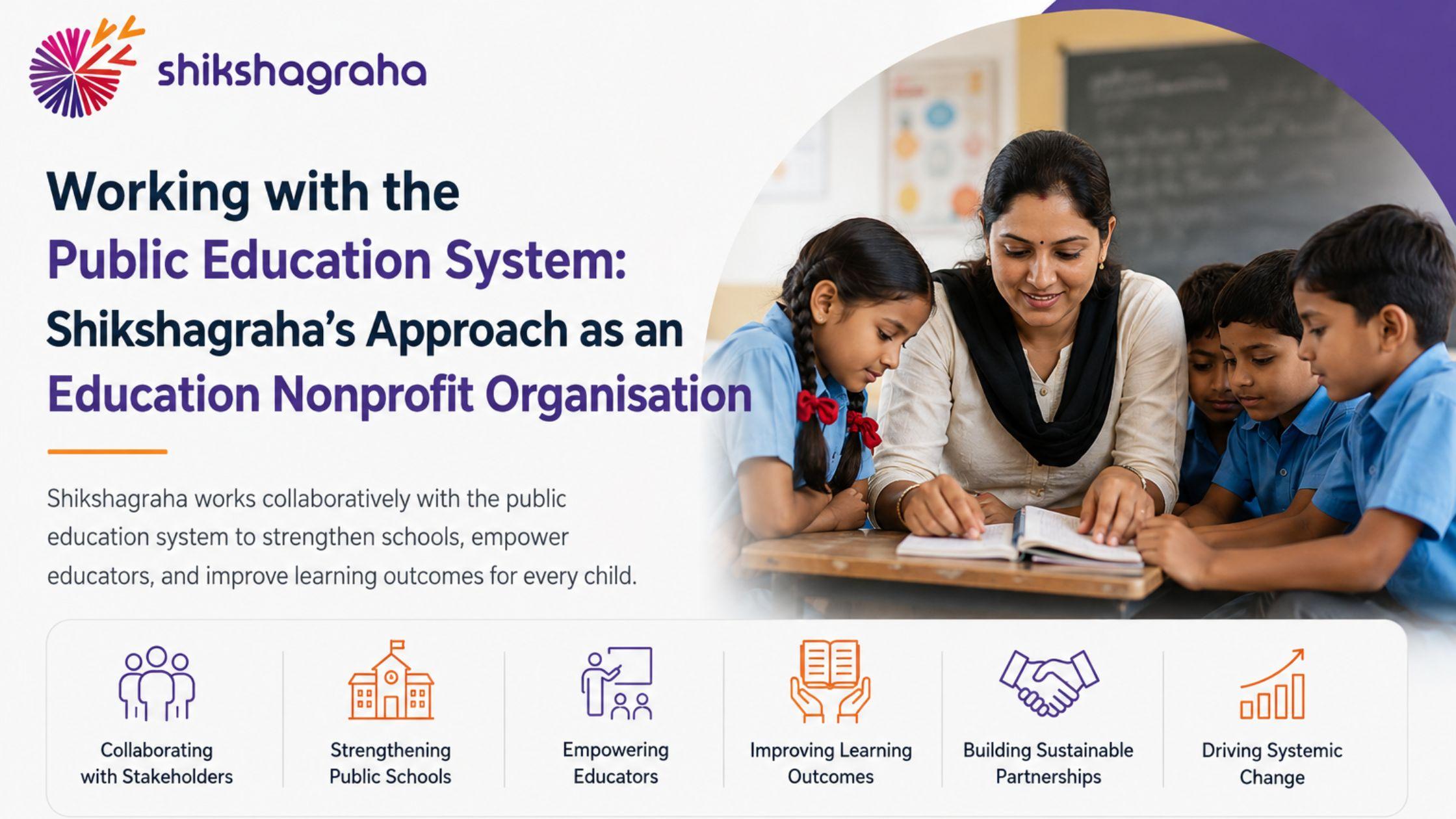
India’s public education system plays a vital role in creating opportunities for millions of children and shaping the country’s future. Improving public schools, however, requires more than individual interventions. It calls for sustained collaboration among teachers, school leaders, government institutions, communities, and organisations committed to strengthening education at scale. Shikshagraha works within this ecosystem to support meaningful and sustainable improvements in public education.
As an education nonprofit organisation, Shikshagraha focuses on strengthening the systems that enable public schools to provide better learning environments and outcomes for children. Rather than viewing education challenges in isolation, the organisation works alongside stakeholders to understand existing realities, identify opportunities for improvement, and encourage solutions that can be implemented effectively within the public education system.
Working with the Public Education System for Sustainable Change
Working with the public education system requires an approach that recognises the scale, diversity, and complexity of government schools. Public education involves multiple levels of decision-making, from education departments and district administrations to school leaders, teachers, students, and local communities.
Sustainable school improvement becomes possible when these stakeholders are supported to work towards shared goals. This means understanding the challenges faced by schools while also recognising the strengths, resources, and capabilities already present within the system.
Shikshagraha’s approach is centred on collaboration and system strengthening. By working with stakeholders rather than operating separately from them, the organisation seeks to contribute to improvements that can become part of regular education practices.
Key aspects of this approach include:
-
Understanding the needs and realities of public schools.
-
Supporting education leaders and stakeholders in strengthening implementation.
-
Encouraging collaboration across different levels of the education system.
-
Identifying practical approaches that can be adapted to local contexts.
-
Building capabilities that support long-term school improvement.
-
Using evidence and learning to inform education practices and decisions.
Why System-Level School Improvement Matters
A school does not operate independently. Its progress can be influenced by leadership, teacher capacity, administrative processes, community participation, infrastructure, policies, resources, and the wider education ecosystem.
For this reason, isolated interventions may provide temporary benefits but may not always create lasting change. System-level improvement focuses on strengthening the structures and processes that influence how schools function every day.
An effective approach considers questions such as:
-
How can school leaders create stronger learning environments?
-
How can teachers receive meaningful support?
-
How can education departments strengthen implementation?
-
How can communities participate more effectively in school development?
-
How can successful practices be adapted and sustained across schools?
Addressing these questions helps move the conversation from individual projects towards long-term public education transformation.
Shikshagraha: Strengthening the Foundations of Public Education
Shikshagraha brings together a commitment to public education improvement with a focus on collaboration, learning, and systemic change. Its work recognises that education transformation is a continuous process that requires stakeholders to learn from experience and adapt approaches according to changing needs.
The organisation’s work can be understood through a few important principles:
Collaboration: Lasting education reform requires different stakeholders to work together. Government institutions, educators, communities, and civil society organisations can contribute different perspectives and capabilities.
Context: Education challenges differ across regions, schools, and communities. Solutions need to consider local realities instead of relying on a single model for every situation.
Capability building: Sustainable improvement depends on strengthening the people and institutions responsible for delivering education. Developing leadership and implementation capabilities can help schools and education systems continue improving over time.
Evidence and learning: Continuous reflection and learning can help stakeholders understand what is working, what needs to change, and how successful approaches can be strengthened.
Scale: Public education serves a large and diverse population. Therefore, approaches need to consider how improvements can be sustained and adapted across different contexts.
The Role of an Education Nonprofit Organisation in System Transformation
An education nonprofit organisation can play an important role in bringing together knowledge, innovation, research, implementation support, and stakeholder collaboration. However, its role is most effective when it complements and strengthens the public education system rather than functioning as a parallel structure.
For public education to improve at scale, solutions need to be practical, locally relevant, and capable of becoming part of existing systems.
Nonprofit organisations can contribute by:
-
Bringing new perspectives to complex education challenges.
-
Supporting experimentation and learning.
-
Connecting stakeholders and facilitating collaboration.
-
Sharing knowledge and evidence from the field.
-
Supporting leadership and institutional capacity.
-
Helping identify approaches that can be adapted for wider implementation.
The goal is not simply to introduce new programmes. It is to help create stronger systems where schools and education stakeholders have the capacity to continuously improve.
From Individual Initiatives to Collective Action
Education transformation becomes stronger when different stakeholders move towards a common vision. Teachers bring classroom experience, school leaders understand school-level realities, government officials influence policy and implementation, communities provide local perspectives, and civil society organisations can contribute knowledge and support.
Bringing these perspectives together can help create more comprehensive solutions.
This collaborative mindset is particularly important in public education because improvements must ultimately benefit large and diverse groups of students. When stakeholders share learning and work towards common outcomes, individual efforts can contribute to broader system-level progress.
Building Stronger Schools Through Leadership and Collaboration
School leadership has an important role in creating an environment where teachers can collaborate, students can learn effectively, and improvement becomes part of the school culture.
Strong school leadership is not limited to administrative responsibilities. It also involves setting priorities, supporting teachers, encouraging innovation, understanding student needs, and building relationships with parents and communities.
Supporting school leaders therefore becomes an important part of broader education improvement.
At the same time, leadership cannot work in isolation. School leaders need enabling systems, appropriate support, useful information, and collaboration with education authorities and other stakeholders. This is why system-level approaches can help connect school-level improvement with wider education priorities.
Creating Sustainable Impact Through Partnership
Sustainability is one of the most important considerations in public education transformation. A successful initiative should not depend indefinitely on external support. Instead, it should strengthen the capabilities, processes, and relationships that allow improvements to continue.
For an education nonprofit organisation, this means focusing not only on immediate outcomes but also on how knowledge and capabilities can remain within the education ecosystem.
Partnerships can support this by:
-
Creating shared ownership of education initiatives.
-
Encouraging knowledge exchange between stakeholders.
-
Strengthening institutional capabilities.
-
Developing locally relevant solutions.
-
Supporting continuous monitoring and learning.
-
Building pathways for successful practices to reach more schools.
When stakeholders share responsibility for improvement, education transformation becomes a collective effort rather than the responsibility of a single organisation.
Looking Ahead: A Stronger Future for Public Education
India’s public education system has enormous potential to shape more equitable opportunities for children. Realising this potential requires continued collaboration, strong institutions, capable education leaders, empowered teachers, engaged communities, and approaches that respond to the realities of public schools.
Shikshagraha contributes to this broader vision by focusing on system strengthening, collaboration, and sustainable improvement. Its approach reflects the understanding that lasting education transformation cannot be achieved through isolated efforts alone.
Working with the public education system means listening to stakeholders, understanding local contexts, strengthening capabilities, and supporting solutions that can become sustainable within the system. It is a long-term process that depends on trust, partnership, learning, and collective action.
As an education nonprofit organisation, Shikshagraha demonstrates the importance of working collaboratively with the public education ecosystem to support meaningful and scalable change. By strengthening people, institutions, and processes, such efforts can help public schools become stronger places for teaching and learning.
The future of public education depends on collective commitment. When governments, educators, communities, civil society organisations, and other stakeholders work together with a shared purpose, improvements can move beyond individual schools and contribute to wider transformation. This collaborative spirit can help create a public education system where every child has the opportunity to learn, grow, and build a better future.

 English
 French
 Spanish
 Portuguese
 Deutsch
 Turkish
 Dutch
Dutch
 Italiano
 Russian
 Romaian
 Portuguese (Brazil)
 Greek
Greek
