


Education Leadership and School Improvement: A Practical Path to Better Schools | Mantra4Change
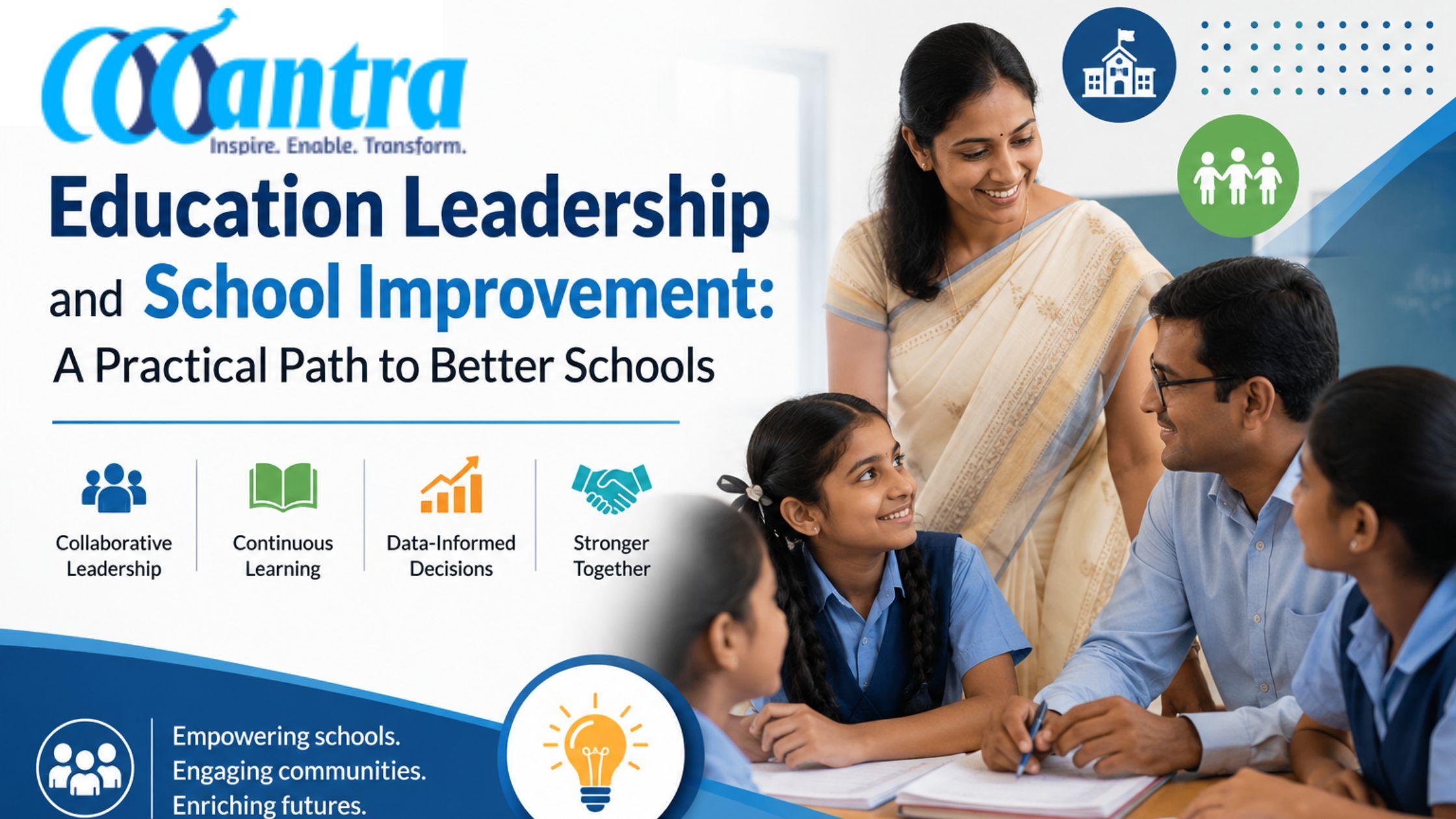
Strong schools are not built only through better infrastructure, new policies, or improved academic resources. Sustainable change begins with people who can understand challenges, bring communities together, and turn ideas into meaningful action.
This is where Education Leadership becomes essential. Effective leaders help schools create a shared vision, support teachers, understand student needs, and build an environment where continuous learning becomes part of everyday practice.
At the same time, meaningful School Improvement requires more than isolated interventions.
It depends on collective ownership, evidence-based decision-making, strong relationships, and consistent follow-through. When school leaders, teachers, parents, students, and communities work together, improvement becomes more practical, measurable, and sustainable.
Organisations such as Mantra4Change focus on strengthening education systems by enabling stakeholders to work collectively and create lasting improvements in schools. Rather than viewing school transformation as the responsibility of one individual, a collaborative approach encourages everyone connected to the school to contribute to its progress.
Education Leadership: Creating a Culture of Continuous Learning
Education leaders play a central role in shaping how a school responds to challenges. Their responsibility goes beyond administrative duties. They influence teacher motivation, student engagement, collaboration, decision-making, and the overall culture of the institution.
An effective leader does not simply provide instructions. They listen, identify challenges, encourage participation, and create opportunities for others to take ownership.
Some important qualities of effective education leaders include:
-
Clear vision: Establishing realistic goals that are understood by teachers, students, and the wider school community.
-
Collaborative decision-making: Encouraging teachers and stakeholders to participate in identifying problems and developing solutions.
-
Data-informed thinking: Using student performance, attendance, classroom observations, and other relevant information to understand areas that need attention.
-
Teacher development: Creating opportunities for teachers to strengthen their knowledge, skills, and classroom practices.
-
Student-centred leadership: Keeping student learning, wellbeing, participation, and development at the heart of school decisions.
-
Adaptability: Responding effectively to changing educational needs, policies, technologies, and community expectations.
Leadership becomes particularly powerful when it creates an environment where teachers feel comfortable discussing challenges. A school that encourages reflection can identify what is working, understand what needs to change, and experiment with better approaches.
This creates a cycle of continuous improvement rather than depending on occasional initiatives.
From Leadership to Meaningful School Improvement
School Improvement is most effective when leadership translates vision into consistent action. A school may have ambitious goals, but progress depends on how those goals are implemented in classrooms and across the wider school environment.
Improvement can begin by identifying the most important challenges instead of attempting to change everything at once. For example, a school may identify attendance, foundational learning, teacher collaboration, student participation, or parent engagement as priority areas.
Once the priority is identified, school teams can work through a structured process:
Identify → Understand → Plan → Implement → Review → Improve
This approach allows schools to move from assumptions to evidence-based action. Instead of asking only, “What should we do?”, teams can also ask, “What is happening now?”, “Why is it happening?”, and “How will we know whether the change is working?”
For example, if students are struggling with foundational literacy, the response should not immediately be limited to additional worksheets. School teams can examine classroom practices, learning gaps, attendance patterns, teaching resources, assessment methods, and opportunities for individual support.
The goal is to understand the underlying issue and develop a solution that fits the school's context.
This is where Mantra4Change represents an important perspective on education transformation: sustainable change can emerge when multiple stakeholders work together around a shared purpose. Collaboration can help schools move beyond individual efforts and develop stronger systems for identifying challenges, implementing solutions, and learning from results.
Building Stronger Schools Through Collective Action
A school functions as an ecosystem. Teachers influence students, school leaders support teachers, parents contribute to children's learning, and communities can provide valuable knowledge and resources. Therefore, lasting improvement cannot depend on one stakeholder alone.
Collective action creates opportunities for different perspectives to come together.
Teachers understand classroom realities. School leaders have a broader view of institutional priorities. Parents understand children's experiences outside school. Students can provide direct insights into their learning environment. Community organisations can contribute additional expertise and support.
Bringing these perspectives together can help schools develop more practical solutions.
For successful improvement initiatives, schools can focus on a few fundamental practices:
-
Establish a common understanding of the school's priorities.
-
Create regular spaces for teachers to collaborate and reflect.
-
Use evidence to identify learning and operational challenges.
-
Encourage students to participate in conversations about their learning.
-
Build constructive relationships with parents and communities.
-
Monitor progress regularly rather than waiting until the end of an initiative.
-
Celebrate small improvements while continuing to address larger challenges.
The role of leadership is to make these practices part of the school's culture. When collaboration becomes routine, improvement is no longer seen as a separate project. It becomes part of how the school operates.
Strengthening Teachers for Sustainable Change
Teachers are among the most important drivers of classroom-level transformation. Even the strongest strategy will have limited impact if educators do not have the necessary support, resources, time, and confidence to implement it.
Professional development should therefore go beyond one-time workshops. Teachers benefit from continuous opportunities to practice new approaches, discuss classroom experiences, receive feedback, and learn from colleagues.
Peer learning can be particularly valuable. A teacher who has successfully addressed a specific classroom challenge can share practical strategies with other educators. Similarly, classroom observations and collaborative planning can create opportunities for teachers to learn from one another.
School leaders can support this process by creating a safe environment where experimentation is encouraged. Not every new approach will produce immediate results, and that is part of the learning process.
A culture of reflection allows teachers to ask:
-
What worked well?
-
Which students benefited?
-
Which students still need support?
-
What could be changed?
-
What evidence can guide our next step?
Such questions transform professional development from a compliance activity into an ongoing learning process.
Measuring Progress Beyond Examination Results
Academic performance is an important indicator, but it should not be the only measure of school success. A comprehensive approach can also consider attendance, student participation, classroom engagement, teacher collaboration, parent involvement, and school culture.
The right indicators depend on the school's priorities.
If attendance is a challenge, leaders may track attendance patterns and understand the reasons behind absenteeism. If foundational learning is the focus, schools can monitor learning progress at regular intervals. If student participation is the priority, feedback mechanisms can help understand whether students feel heard and involved.
The purpose of measurement is not simply to produce numbers. It is to support better decisions.
Data should help school teams understand whether an intervention is producing the intended change and where adjustments may be required. When evidence is combined with the experiences of teachers, students, and families, it can provide a more complete picture of progress.
Creating Sustainable Change Through Shared Ownership
The strongest improvement initiatives are those that can continue even when a particular programme, project, or external support comes to an end. This requires building ownership within the school system.
Shared ownership develops when people understand not only what needs to change but also why the change matters.
Leaders can strengthen ownership by communicating goals clearly, involving teachers in planning, recognising contributions, and giving teams the space to make informed decisions. When people are trusted to contribute, they are more likely to take responsibility for outcomes.
This is also why Education Leadership and School Improvement should be viewed as interconnected priorities. Leadership provides direction, while improvement practices turn that direction into action. Neither works effectively in isolation.
The Role of Mantra4Change in Education Transformation
Mantra4Change highlights the importance of collaborative approaches to transforming schools and education systems. Sustainable transformation requires more than individual interventions; it requires stakeholders to understand challenges collectively and build solutions that can work within real school environments.
The journey toward better schools may look different for every community. However, the principles of collaboration, evidence, reflection, teacher empowerment, and shared ownership can provide a strong foundation.
When leaders create the right conditions, teachers become active contributors to improvement, students gain stronger learning opportunities, and communities become meaningful partners in the education process.
Conclusion: Leadership That Leads to Lasting Improvement
Transforming schools is a continuous journey rather than a one-time project. Education Leadership provides the vision, collaboration, and direction needed to move schools forward, while School Improvement provides the structured process for turning that vision into measurable action.
The most sustainable progress happens when school leaders, teachers, students, parents, and communities share responsibility for change.
By combining evidence with local knowledge, encouraging continuous learning, and creating a culture of collaboration, schools can build solutions that are both meaningful and sustainable.
The future of education depends not only on what schools teach but also on how effectively people work together to improve learning environments.
With collective action, thoughtful leadership, and a commitment to continuous improvement, every school can take meaningful steps toward better outcomes for every learner.

 English
 Arabic
 French
 Spanish
 Portuguese
 Deutsch
 Turkish
 Dutch
Dutch
 Italiano
 Romaian
 Portuguese (Brazil)
 Greek
Greek
