


The Electrification Effect on the Magnet Wire Market: Opportunities Across Motors and Transformers
Why the Future of Magnet Wire Depends on the Machines Around It
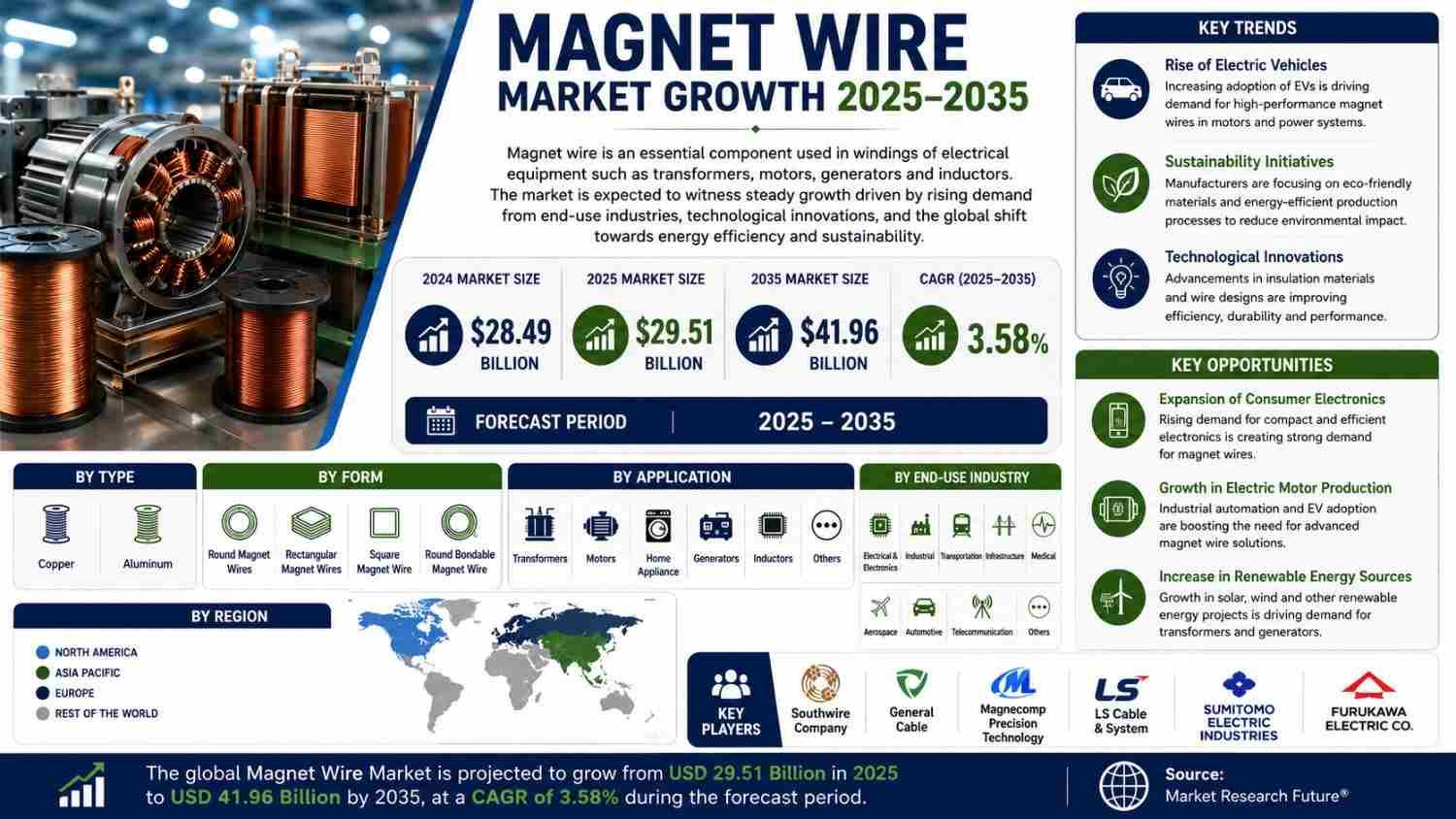
The magnet wire industry rarely receives the same attention as electric vehicles, renewable power or advanced electronics, yet each of these sectors depends on the electromagnetic systems that magnet wire helps build. The Magnet Wire Market Analysis reached USD 29.51 billion in 2025 after being valued at USD 28.49 billion in 2024 and is projected to reach USD 41.96 billion by 2035. At a CAGR of 3.58% over 2025-2035, the market reflects a broader industrial transition toward electrified equipment, efficient motors and more sophisticated power systems.
Every Electrified System Creates a Winding Requirement
The simplest way to understand magnet wire is to follow electricity into the machines that use it.
Electric motors convert electricity into movement. Generators convert mechanical energy into electricity. Transformers change voltage levels. Inductors manage electrical energy in electronic systems.
All of these systems depend on electromagnetic windings, and those windings require insulated conductive wire.
That relationship gives magnet wire a remarkably broad industrial footprint. A change in motor production affects demand. A new generation of renewable-energy equipment can affect demand. Increased appliance manufacturing can affect demand.
The material is therefore closely tied to the scale and sophistication of electrical equipment production.
Electrification Is Increasing Both Volume and Complexity
The important change is not simply that more electric machines are being built.
The machines themselves are becoming more demanding.
Electric vehicles are a clear example. Traction motors must deliver high power while remaining compact and efficient. Heat must be managed within a constrained space, and winding systems have to operate reliably under demanding conditions.
Industrial motors face a different challenge. They often run for thousands of hours, making efficiency and durability critical to operating economics.
Renewable-energy generators introduce another set of requirements related to reliability, power output and long operating cycles.
The result is an industry where magnet wire increasingly has to be engineered around the application.
EVs Are Accelerating Product Specialization
The expansion of electric mobility creates a particularly important opportunity because the motor is central to vehicle performance.
Motor manufacturers are looking for ways to increase power density and reduce losses. Conductor geometry becomes relevant because the amount and arrangement of active copper or aluminum inside the winding influence the design.
Rectangular and square magnet wires can be useful in selected high-density winding architectures. They can help engineers use available space more effectively, although manufacturing and winding processes must also accommodate their geometry.
This creates a potential shift in competitive value. The supplier offering the lowest-cost standard wire may not necessarily be the preferred partner for a technically demanding motor platform.
Consumer Electronics and Appliances Keep the Base Broad
It would be a mistake to view the market entirely through the EV lens.
Consumer appliances use motors in products ranging from refrigeration systems to washing machines and air-conditioning equipment. Electronics rely on inductive components, transformers and other electromagnetic devices.
The value of these applications lies in their scale. Individual devices may use relatively small amounts of magnet wire, but global production volumes create a broad recurring demand base.
Energy-efficiency requirements can also influence product design. Appliance manufacturers are continually balancing performance, energy consumption, size and cost, which can affect motor and winding specifications.
Renewable Energy Connects Wire Demand to Infrastructure Investment
Renewable energy introduces a different type of opportunity.
Wind power relies on generators. Solar installations depend on inverters and electrical equipment. Storage systems require power-conversion infrastructure. Grid modernization requires transformers and other electrical machinery.
As the power system becomes more distributed, electrical conversion and management become increasingly important.
This can create demand for magnet wire across multiple equipment categories rather than through renewable generation hardware alone.
The commercial implication is significant: suppliers can participate in energy-transition investment even without directly supplying solar panels, wind turbines or batteries.
The Material Debate Will Continue
Copper and aluminum remain the two central conductor materials.
Copper's conductivity makes it attractive where designers need strong electrical performance within limited space. Aluminum's lower density provides a different design advantage and can be useful where weight is an important consideration.
The decision involves multiple variables. Electrical performance, thermal behavior, mechanical properties, winding processes and equipment architecture all matter.
For manufacturers, this means that material substitution is rarely a simple response to commodity prices. A change in conductor material can require adjustments elsewhere in the electrical-machine design.
Manufacturing Precision Is Becoming a Competitive Asset
Magnet wire production demands consistent dimensions and reliable insulation.
As winding systems become more compact, manufacturing variations can become more consequential. Equipment manufacturers need wire that can run consistently through automated winding processes.
This favors producers with strong process control and quality systems.
Automation also has a second effect. As electrical-component manufacturing becomes more automated, customers increasingly expect predictable material behavior. A product that performs inconsistently can create downstream production losses.
Consequently, manufacturing reliability can become a competitive differentiator even when several suppliers offer technically similar products.
Sustainability Goes Beyond the Finished Electric Machine
Electric motors and renewable-energy systems can support lower operational energy consumption, but magnet-wire production still has its own environmental footprint.
Copper and aluminum extraction require significant resources. Manufacturing involves energy consumption and insulation materials. Scrap must be managed.
This creates several opportunities for improvement. Better conductor utilization can reduce waste. Recycling can recover valuable metals. More efficient production processes can reduce energy use.
Recovered materials are particularly relevant in a market where electrical equipment volumes are expanding. The larger the installed base becomes, the more important end-of-life recovery could become over time.
Regional Markets Are Built Around Different Industrial Ecosystems
Asia-Pacific has a strong position because of its large manufacturing base spanning electronics, appliances, automotive products and electrical equipment. The region's role in EV production adds further momentum.
North America combines industrial demand with investment in transportation electrification and renewable-energy infrastructure. Its opportunity lies across both mobility and power systems.
Europe has a substantial automotive and industrial ecosystem and strong emphasis on energy efficiency. These conditions support demand for advanced winding technologies.
Other regions can gain importance as industrialization and electrification increase. Their growth may be more closely tied to infrastructure and industrial equipment than to advanced automotive applications.
Understanding these differences matters because the same magnet-wire product can face very different demand conditions across regions.
The Competitive Field Is Broadening
Southwire Company, General Cable, Magnecomp Precision Technology, LS Cable & System, Sumitomo Electric Industries and Furukawa Electric Co. are among the companies participating in the market.
Their competitive positions depend on a combination of manufacturing capability, product range, technical expertise and geographic reach.
The industry is not simply competing for raw-material volume. Customers increasingly need products tailored to specific motors, transformers, generators and electronic components.
This makes customer engineering relationships increasingly important. Suppliers that understand how wire interacts with winding equipment and final-product requirements can differentiate themselves from purely volume-oriented competitors.
The Opportunity Pipeline Is Larger Than EVs
The most visible opportunity may be electric vehicles, but the broader pipeline is much larger.
Industrial motor production can expand as factories automate and improve energy efficiency. Renewable generation can increase demand for generators and transformers. Consumer appliances can continue to support large-scale motor demand. Electronics can create opportunities for specialized electromagnetic components.
These markets also interact. More renewable electricity supports electrification. More electrified equipment increases demand for motors and power electronics. Greater efficiency requirements encourage better component design.
Magnet wire sits inside this interconnected system.
Risks Will Come From Efficiency and Technology as Well as Costs
Growth does not automatically mean more material per machine.
A more efficient motor may use less conductor for the same output. Advanced winding designs may reduce material requirements. Changes in motor architecture could shift demand between round, rectangular and other wire formats.
Commodity-price volatility remains another risk. Copper and aluminum costs can affect production economics and purchasing decisions.
Supply-chain disruption can also become problematic because magnet wire is an essential but relatively small component of larger electrical-equipment systems.
The companies that manage these risks best will likely be those able to adjust product portfolios and manufacturing processes quickly.
What the Industry Could Look Like by 2035
The projected expansion to USD 41.96 billion by 2035 suggests a market benefiting from the long-term electrification of transportation, industry and energy infrastructure.
But the most important change may be qualitative rather than quantitative.
Magnet wire is moving from a relatively standardized input toward a more application-driven engineering material. EV motors, high-efficiency industrial machines, generators and compact electromagnetic systems can demand different combinations of conductor shape, insulation performance and material characteristics.
That shift can create higher-value opportunities even when overall volume growth remains moderate.
Market Outlook
The magnet-wire market provides a useful view of how electrification works beneath the headline technologies.
Electric vehicles cannot function without motors. Renewable-energy systems cannot deliver electricity without generators and conversion equipment. Industrial automation cannot operate without motors. Appliances cannot deliver their functions without electromagnetic components.
Each of these systems creates a downstream requirement for reliable winding materials.
The companies best prepared for the next decade will therefore be those that treat magnet wire not simply as a conductor but as an engineering component tied directly to machine efficiency, reliability and design flexibility. That is where the market's most meaningful competitive opportunities are likely to emerge.

 English
 Arabic
 Spanish
 Portuguese
 Deutsch
 Turkish
 Dutch
Dutch
 Italiano
 Russian
 Romaian
 Portuguese (Brazil)
 Greek
Greek
