


How to Protect Straight Hair From Heat Damage: A Smarter Styling Routine
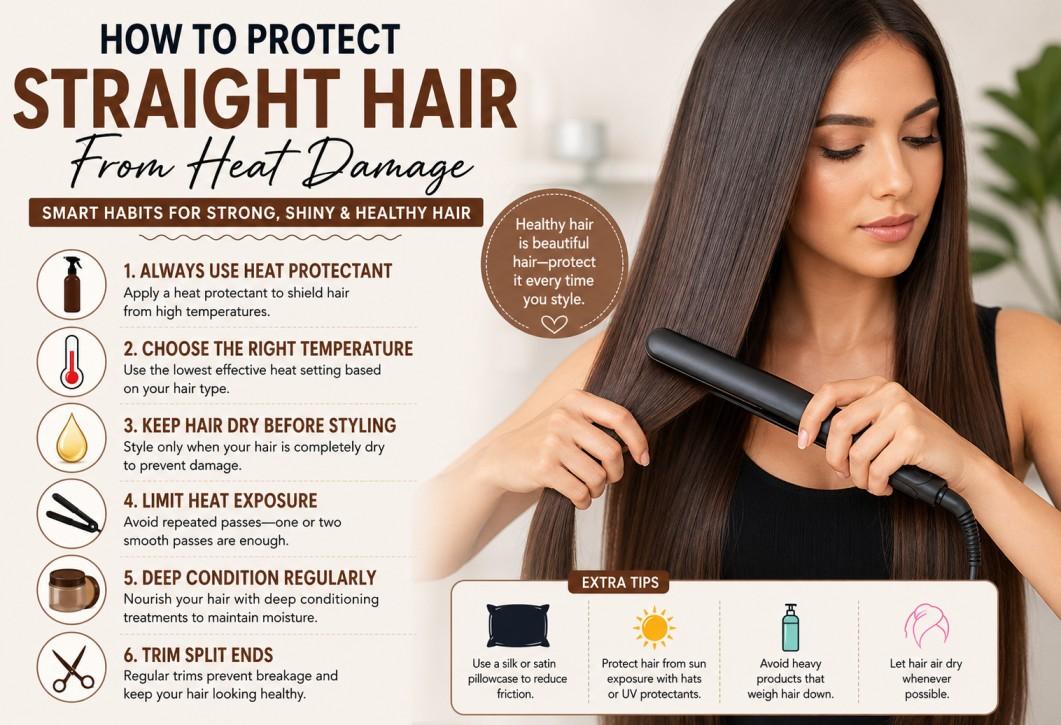
Straight hair is often associated with smoothness, shine, and easy styling. Yet anyone who regularly blow-dries, flat-irons, or heat-styles their hair knows that keeping that sleek finish can come with a price.
The problem is not heat styling itself. The real problem is uncontrolled heat exposure.
A flat iron used occasionally on well-prepared hair is very different from repeatedly pressing a hot tool over dry, fragile ends every morning. Likewise, a blow dryer used strategically is not the same as holding intense heat over one section until the hair is completely stripped of moisture.
If you want straight hair that continues to look healthy months from now—not just for the next few hours—you need to think beyond individual styling products.
The better question is:
How can you get the straight, polished result while asking as little as possible from the hair fiber?
That is the foundation of effective heat protection.
What Actually Makes Heat Styling Hard on Hair?
Hair is not living tissue once it emerges from the scalp. It cannot repair itself in the same way skin can heal. This is why repeated physical and chemical stress can gradually accumulate along the hair shaft.
Heat can contribute to changes in the hair's surface and internal structure. The more often hair is exposed to high temperatures, the more important your technique becomes.
Several variables determine how stressful a styling session can be:
- Temperature of the tool
- Length of time heat stays on one section
- Number of passes
- Whether the hair is wet or dry
- Condition of the hair before styling
- Previous chemical processing
- Frequency of heat styling
- Mechanical pulling during styling
This is an important distinction because temperature alone does not tell the whole story.
Someone who uses moderate heat carefully once a week may place less stress on their hair than someone who uses a lower setting every day and repeatedly works over the same sections.
The Heat-Damage Equation: Temperature × Time × Frequency
One practical way to rethink your routine is to consider three factors together:
Temperature × exposure time × frequency
You cannot always avoid heat, but you can control these variables.
If you increase temperature, reduce the amount of time the tool remains in contact with the hair.
If you need to style frequently, be especially conservative with temperature and technique.
If your hair is already fragile, reduce all three wherever possible.
This approach is much more useful than blindly following a single temperature recommendation because hair does not have one universal heat tolerance.
Fine hair, coarse hair, bleached hair, chemically treated hair, and previously damaged hair can behave very differently under the same styling conditions.
Start Before You Pick Up the Flat Iron
Many heat-protection mistakes happen before the styling tool is even switched on.
If your hair is tangled, unevenly dried, coated with too much product, or excessively dehydrated, you may compensate by using more heat.
That is where unnecessary damage begins.
A better preparation sequence is:
Cleanse → condition → gently detangle → partially or completely dry → apply appropriate thermal protection → section → style
Good preparation should make the final styling stage easier.
The goal is not to force stubborn hair into submission with a hotter tool. The goal is to create conditions where the tool needs to do less work.
Never Use a Standard Flat Iron on Damp Hair
If you're using a conventional flat iron, your hair should be completely dry before you begin.
This is one of the easiest rules to follow and one of the most important.
Damp hair contains water within the fiber. Applying a very hot styling surface before the hair is properly dry can create intense thermal stress.
If you're short on time, do not solve the problem by reaching for the straightener sooner.
Instead, improve your drying process.
Use a blow dryer at an appropriate setting, keep it moving, and work in manageable sections. Allowing some natural air-drying before blow-drying can also reduce the amount of time your hair spends under the dryer.
The American Academy of Dermatology recommends allowing hair to air-dry when possible and using the lowest heat setting necessary.
Your Flat Iron Does Not Need to Be at Maximum Heat
One of the most persistent myths in straight-hair styling is that higher temperature equals better results.
It doesn't.
A very hot flat iron may straighten a section rapidly, but faster results do not automatically mean healthier hair.
Instead, start lower and increase only if your hair genuinely requires it.
This is particularly important if your hair is:
- Fine
- Bleached
- Highlighted
- Chemically relaxed
- Previously heat damaged
- Naturally dry
- Prone to breakage
Healthy, coarse hair may tolerate styling differently from fragile, chemically processed hair. Rather than copying someone else's temperature setting, learn how your own hair responds.
The right temperature is the lowest setting that produces the result you want without requiring repeated passes.
One Good Pass Is Better Than Five Quick Ones
Here is a styling habit worth changing immediately: repeatedly running the flat iron over the same piece of hair.
It is tempting to think five quick passes are gentler than one slower pass.
Usually, that logic works against you.
Every pass adds another period of direct heat exposure. If the hair needs multiple passes, investigate why.
Perhaps the section is too large.
Perhaps the hair was not fully dry.
Perhaps the brush and tension technique needs improvement.
Perhaps the temperature is too low for the particular section.
Instead of automatically increasing the number of passes, correct the preparation or technique.
Divide the hair into smaller sections and move the tool smoothly and consistently.
The “Heat Protectant” Is Not a Permission Slip
Heat protectant deserves a place in a responsible styling routine, but it should not create false confidence.
Applying a thermal-protection product does not mean you can safely use maximum heat every day.
Think of heat protectant as one layer of risk reduction, not immunity from heat damage.
Choose a product specifically designed for thermal styling and follow its application instructions. Distribute it evenly rather than concentrating a large amount on the ends while leaving other areas untreated.
Also pay attention to product buildup.
If your hair feels coated, stiff, sticky, or unusually heavy, adding more styling product is unlikely to improve the result. Sometimes the better solution is to reset the hair and simplify the routine.
Straight Hair Needs More Than Moisture
Another common mistake is treating every heat-related problem as a moisture problem.
Conditioning can improve softness and manageability, but healthy hair care is broader than simply adding moisture.
Your routine should also reduce:
- Excessive brushing
- Aggressive detangling
- Tight hairstyles
- Frequent chemical processing
- Repeated hot-tool exposure
- Rough towel drying
- Unnecessary manipulation
This matters because heat damage rarely happens in isolation.
Hair that is repeatedly bleached, tightly pulled, aggressively brushed, and frequently straightened is experiencing several forms of stress at once.
Reducing the total load is often more effective than searching for one miracle product.
Build a “Heat Budget” for Your Hair
If you love straight styles, you do not necessarily need to eliminate them.
Instead, think about your weekly routine as having a heat budget.
For example, if you know you want a sleek hairstyle for an event on Saturday, avoid unnecessary high-heat styling on Wednesday and Thursday.
Between major styling sessions, choose options such as:
- Air-dried styles
- Loose braids
- Low-tension ponytails
- Hair wrapping
- Soft buns
- Protective nighttime routines
This simple change can dramatically reduce cumulative heat exposure without forcing you to abandon straight hairstyles.
Nighttime Protection Can Reduce Morning Heat
A surprising amount of heat styling happens because people are trying to recreate yesterday's hairstyle.
If your hair becomes flattened, tangled, or frizzy overnight, you may reach for a flat iron first thing in the morning.
Instead, protect the hairstyle while you sleep.
Depending on your hair type and styling method, consider wrapping the hair, using a smooth pillowcase, or securing the hair loosely rather than sleeping with it exposed to constant friction.
The objective is simple:
Preserve yesterday's work so you don't need to recreate it with today's heat.
That is a much smarter long-term strategy than repeatedly correcting the same areas every morning.
Watch Your Ends More Closely
If your hair is straight, the ends can reveal problems before the rest of the hairstyle does.
Look for:
- Tiny splits
- White dots
- Roughness
- Uneven ends
- Excessive tangling
- Short broken pieces
- Ends that refuse to look smooth
Do not try to solve severely damaged ends by repeatedly passing a flat iron over them.
That may temporarily make them appear smoother, but it does not restore the original structure of a damaged strand.
When ends are significantly split or broken, trimming may be the practical solution.
Heat Protection Is Even More Important for Hair Extensions
Human hair extensions can be heat styled, but they still require thoughtful handling.
Straight human hair extensions may look remarkably similar to natural hair, but they are not connected to your scalp and do not receive nourishment from your body's natural processes.
This means the way you care for them matters.
If you wear straight human hair extensions:
- Use thermal protection before heat styling.
- Avoid unnecessary high temperatures.
- Minimize repeated passes.
- Concentrate less manipulation around attachment areas.
- Condition the lengths appropriately.
- Avoid using excessive heat simply to revive an old style.
- Follow the care instructions supplied for the specific extension system.
The goal is to preserve the extension's softness, movement, and appearance for as long as possible.
What If Your Straight Hair Is Already Heat Damaged?
Do not respond to damaged hair by styling it harder.
If your hair suddenly feels rough, snaps easily, develops excessive split ends, or loses its normal elasticity, temporarily reduce or eliminate direct heat.
Focus on gentle handling and conditioning.
Avoid combining multiple aggressive treatments at the same time. For example, repeatedly heat styling hair that has recently undergone bleaching or chemical processing can create additional stress.
And remember an important reality:
Hair products can improve the appearance and feel of damaged hair, but they cannot turn a severely damaged strand back into completely undamaged hair.
The most effective repair strategy is often prevention of further damage while healthier hair grows.
If you are experiencing substantial breakage or hair loss rather than ordinary styling damage, professional evaluation is appropriate.
Five Heat-Styling Habits Worth Stopping
If you want a quick audit of your routine, start here.
Stop chasing maximum temperature
More heat is not a shortcut to healthier-looking hair.
Stop straightening damp sections
Dry the hair properly before using a conventional flat iron.
Stop repeatedly correcting the same strand
If one section needs endless passes, identify the underlying styling problem.
Stop making heat your everyday default
Give your hair days without direct heat.
Stop using products as an excuse for aggressive styling
A heat protectant should support a careful routine—not justify excessive temperature or frequency.
A Better Straight-Hair Routine in 7 Steps
For people who want a simple system rather than another complicated product list, use this sequence:
1. Prepare the hair
Start with clean, conditioned, manageable hair.
2. Detangle gently
Remove knots before applying direct heat.
3. Protect
Apply a suitable thermal-protection product as directed.
4. Dry completely
Do not flat iron damp hair with a conventional straightener.
5. Section strategically
Smaller, controlled sections usually require less repeated work.
6. Style efficiently
Use the lowest effective heat and minimize passes.
7. Leave it alone
Once the style is finished, avoid repeatedly touching, brushing, and reheating it.
That final step is often overlooked.
You do not need to keep “perfecting” already-straight hair throughout the day.
How Do You Know Your Routine Is Working?
Do not judge your heat-protection routine solely by how straight your hair looks immediately after styling.
Look at your hair several weeks later.
Healthy progress may look like:
- Fewer broken hairs
- Less roughness
- More manageable ends
- Reduced need for repeated passes
- Less frizz caused by dryness
- Better retention of length
- Hair that remains soft between wash days
The real test is sustainability.
A styling routine that produces a beautiful result today but leaves the hair increasingly fragile over the next few months is not a successful routine.
Frequently Asked Questions
What is the best way to protect straight hair from heat damage?
The most effective approach is to reduce total heat exposure. Use an appropriate heat protectant, start with completely dry hair, choose the lowest effective temperature, minimize passes, and avoid unnecessary daily heat styling.
Can heat protectant completely prevent heat damage?
No. Heat protectants can help reduce the effects of thermal styling, but they do not make unlimited heat exposure safe. Temperature, frequency, exposure time, and hair condition still matter.
How often should I straighten my hair?
There is no universal schedule that works for every person. However, less frequent heat styling generally means less cumulative thermal stress. The American Academy of Dermatology recommends limiting hot-tool use and aiming for once a week or less when possible.
Should I straighten my hair before or after it is completely dry?
For a conventional flat iron, straighten only after the hair is completely dry. If you are using a specialized wet-to-dry tool, follow that tool's manufacturer instructions.
Why does my hair need several flat-iron passes to become straight?
Multiple passes can indicate that the hair was not properly prepared, the sections are too large, the hair was not fully dry, or the styling technique needs adjustment. Rather than automatically increasing passes, troubleshoot the preparation process.
Can straight hair recover from heat damage?
Hair that has already been structurally damaged cannot simply be restored to its original condition. However, improving conditioning, reducing heat, handling hair gently, and trimming severely damaged ends can improve its appearance and help prevent additional breakage.
Is air-drying always better than blow-drying?
Not necessarily in every circumstance. Air-drying reduces direct heat exposure, but the overall effect also depends on how the hair is handled while wet. Gentle handling and avoiding excessive manipulation remain important.
Does straight hair need heat protection if I only use a blow dryer?
If your blow dryer is used with heat, a product specifically formulated for thermal protection can be a useful part of your routine. Also keep the dryer moving and avoid concentrating intense heat on one section for too long.
Can I use hair extensions with a straight-hair routine?
Yes. Human hair extensions can generally be styled, but they should be treated carefully. Use appropriate heat protection, avoid excessive temperatures and repeated passes, and take extra care around attachment areas.
The Bottom Line
Protecting straight hair from heat damage is not about finding one extraordinary product or memorizing a magic temperature.
It is about reducing unnecessary stress at every stage of styling.
Prepare the hair properly. Dry it completely before using a conventional flat iron. Use thermal protection. Choose the lowest effective temperature. Work in controlled sections. Avoid repeatedly passing over the same strand. Most importantly, stop treating heat styling as something your hair needs every day.
The smartest straight-hair routine is not the one that produces the hottest, fastest transformation.
It is the one that gives you the style you want while preserving the quality of your hair for the next styling session, the next month, and the next year.

 English
 Arabic
 French
 Spanish
 Portuguese
 Deutsch
 Turkish
 Italiano
 Russian
 Romaian
 Portuguese (Brazil)
 Greek
Greek
