


How Mineral Composition Affects Chima Pink Granite Slabs Appearance
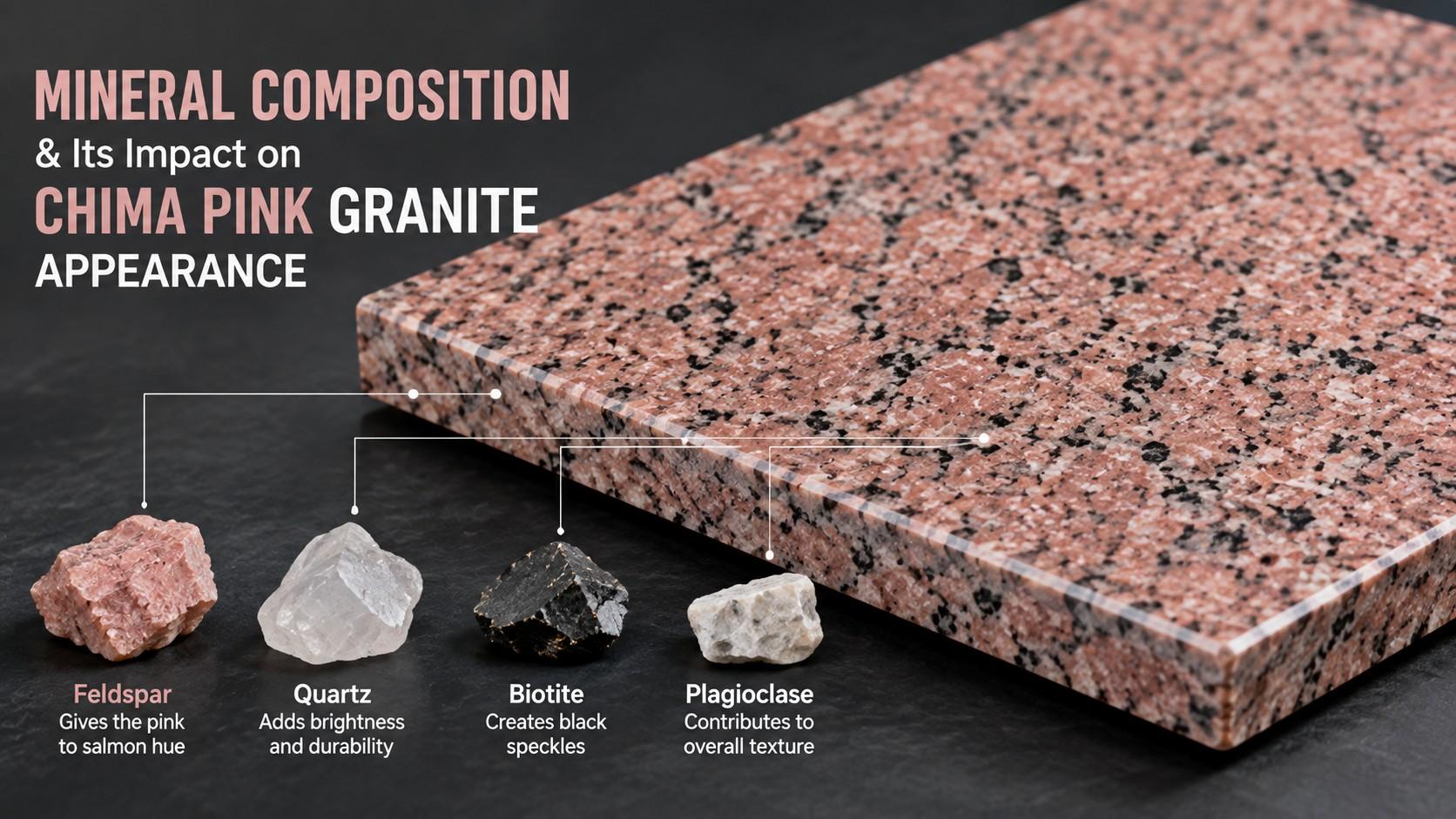
For commercial stone buyers, the appearance of Chima Pink Granite slabs is not simply a matter of a pink background and scattered dark grains. The visual character of the stone comes from the way its mineral constituents are distributed, the size and shape of individual crystals, and the way those crystals interact with cutting and polishing.
Chima Pink Granite is commercially described as an Indian granite with a pink base and combinations of white, cream, gray, and darker mineral grains. Trade descriptions identify quartz, feldspar, and mica among its principal mineral constituents.
For US importers, distributors, fabricators, architects, and project buyers, this relationship matters because mineral distribution can influence background color, speckle density, grain contrast, surface movement, polish response, and visual consistency between slabs. Understanding these characteristics before purchasing rough granite blocks or finished slabs makes it easier to define acceptable variation and reduce disputes between approved samples and delivered material.
The Mineral Makeup Behind Chima Pink Granite's Appearance
Granite is a crystalline igneous rock composed mainly of quartz and feldspar, with smaller quantities of minerals such as mica. The relative proportions and arrangement of these minerals help determine the rock's color and texture.
Commercial descriptions of Chima Pink Granite specifically identify quartz, feldspar, and mica in its composition. That provides a useful framework for understanding the visible appearance, although a supplier's commercial description should not be treated as a laboratory petrographic analysis. Exact mineral percentages can vary between quarry areas and blocks and should not be assumed without testing.
Feldspar and the pink background
Feldspar is particularly important when evaluating the overall pink character of granite. In granitic rocks, feldspar can occur in light pink, cream, white, or related tones, depending on mineral type and composition.
In Chima Pink Granite, the feldspar-rich portion of the stone contributes strongly to the visual base that buyers commonly describe as pink. Commercial product descriptions characterize the stone with a pink backdrop and relatively fine, speckled mineral distribution.
For a large commercial order, the key consideration is not simply whether the stone is "pink." The practical question is how stable that pink background remains across the selected block and subsequent slab production.
A block containing a relatively consistent distribution of light-colored feldspar can produce a calmer and more uniform slab appearance. Changes in mineral concentration can make some sections appear lighter, warmer, cooler, or more visually active.
Quartz and lighter mineral contrast
Quartz is generally clear to translucent or light-colored in granite and can create a contrasting crystalline appearance against feldspar-rich areas.
In Chima Pink Granite, quartz does not necessarily create a separate visible color field. Instead, its grain size, distribution, and relationship with neighboring minerals can influence the apparent texture of the polished surface.
This becomes more noticeable on large slabs than on small samples. A 4-by-4-inch sample may appear relatively uniform, while a full slab can reveal differences in grain density or localized mineral clusters that are impossible to evaluate from a small piece alone.
Mica and darker mineral accents
Mica occurs as sheet-like crystals and is commonly associated with darker or reflective mineral features in granite. The National Park Service notes that mica can produce sparkle in granitic surfaces, while darker minerals such as biotite commonly contribute darker visual grains.
Commercial descriptions of Chima Pink Granite frequently refer to black, gray, or dark speckling within the pink groundmass.
For buyers, these darker grains are significant because they establish much of the stone's visual contrast. A block with more concentrated dark mineral clusters may produce slabs that look substantially more active than slabs from another portion of the quarry.
This is why color approval based solely on the name "Chima Pink" can be inadequate for a high-volume project.
How Mineral Distribution Changes Slab Appearance
Mineral composition matters, but mineral distribution may be even more important from a purchasing perspective.
Two blocks can belong to the same commercial stone variety while producing slabs with noticeably different visual characteristics. The difference may come from changes in grain size, concentrations of dark minerals, localized mineral clusters, or transitions within the quarry formation.
Grain size affects visual scale
Chima Pink Granite is commonly described commercially as fine to medium grained, with a generally speckled texture.
Fine grain tends to create a tighter visual pattern. Larger crystals create more individually identifiable mineral features.
That distinction matters when specifying large slabs for US commercial projects. A designer may approve a sample because the background appears quiet, but a full-size slab could show larger mineral groupings that become more prominent when viewed from several feet away.
Dark mineral concentration affects contrast
A relatively even distribution of darker grains can produce a regular salt-and-pepper effect over the pink background. Concentrated dark mineral patches can introduce more visual movement.
Neither condition is automatically a defect.
For a natural stone buyer, the correct evaluation depends on the approved appearance standard. A commercial flooring program may tolerate greater visual variation than a countertop project requiring coordinated slab selection.
Mineral clustering affects perceived uniformity
Minerals do not necessarily occur in perfectly uniform proportions throughout a natural block. A section with greater feldspar concentration may appear lighter, while a section containing more darker minerals may appear visually stronger.
This is one reason Chima Pink Granite slabs should be evaluated as a batch rather than relying exclusively on a single slab image or hand sample.
A useful commercial comparison includes:
- Overall background tone
- Density of dark grains
- Relative white and cream mineral content
- Grain size
- Areas of concentrated mineral clustering
- Visual variation from one slab to the next
- Consistency across the proposed block lot
Why Cutting and Finishing Can Change the Visual Result
Mineral composition is established in the stone before processing, but fabrication determines how prominently those minerals are presented on the finished surface.
Sawing exposes the internal mineral structure
When a granite slab exporter & supplier converts a rough block into slabs, cutting reveals mineral relationships that may not be obvious on the external block surface.
The resulting slab can therefore show:
- More prominent crystal outlines
- Changes in grain density
- Localized mineral concentrations
- Subtle shifts in pink background intensity
- Natural internal features that were not visible on the block exterior
This is especially relevant when buyers select material from photographs taken before the block has been opened.
Polishing increases mineral contrast
A polished finish can make mineral boundaries easier to see because smooth, reflective surfaces increase the difference between translucent, light, and dark mineral grains.
Mica can contribute reflective points, while quartz and feldspar can present different levels of visual brightness depending on their orientation and surface condition. Granite's polished appearance therefore reflects both mineralogy and processing quality.
For US fabricators, the practical implication is simple: sample approval should be based on the intended finish, not merely on the raw stone appearance.
Honed and textured finishes produce a different reading
Chima Pink Granite is commercially offered in finishes including polished, honed, flamed, brushed, leathered, sandblasted, and other textured treatments, depending on supplier capability and order specification.
A honed surface generally reduces reflection, while textured finishes change how light interacts with individual mineral grains.
Therefore, a buyer comparing polished and honed samples should not expect identical visual contrast. The mineral composition has not changed, but the surface presentation of the minerals has.
What Mineral Variation Means When Buying Rough Granite Blocks
For a commercial buyer purchasing rough granite blocks, mineral composition becomes a block-selection issue rather than just a slab-appearance issue.
The external surface of a rough block does not always provide enough information about the internal visual structure. Slab production can reveal substantial differences as the block is opened through successive cuts.
Examine the block in relation to the intended order
Before approving a block for a US project, buyers should request available block photographs or video showing multiple sides and, where possible, representative processed slabs from the same quarry source or block family.
Questions worth asking the Indian granite exporter and supplier include:
- Is the proposed material from one quarry area or multiple sources?
- What range of pink background variation is expected?
- How consistent is the dark mineral distribution?
- Are the supplied slab photographs from the same block or from different blocks?
- Has the block shown visible fissuring or internal weakness?
- Is the requested finish available from the selected production line?
- Can sequential slabs from the same block be reviewed?
The objective is not to eliminate natural variation. It is to understand and document it before production.
Distinguish mineral variation from structural problems
Not every dark mark, line, or color change indicates a structural defect.
Mineral concentrations are inherent geological features. Fissures, cracks, or other discontinuities are a separate quality consideration.
A buyer should therefore distinguish:
Acceptable natural variation
- Changes in grain density
- Different concentrations of light or dark minerals
- Minor background shifts
- Normal crystalline variation
Potential structural concerns
- Open fractures
- Significant fissures
- Breakage-prone zones
- Features that affect slab yield or dimensional integrity
This distinction is especially important in bulk sourcing, where rejecting natural variation as a "defect" can create avoidable commercial disputes.
How US Buyers Can Set a Practical Appearance Standard
For a US project requiring multiple bundles or containers, a vague requirement such as "uniform Chima Pink Granite" may be insufficient.
A stronger specification defines the visual characteristics that actually matter.
Recommended approval criteria
Before placing a commercial order, buyers should establish:
- Base tone: preferred pink range and acceptable lighter or darker variation.
- Mineral contrast: acceptable level of black, gray, white, and cream speckling.
- Grain size: whether fine, medium, or mixed grain is acceptable.
- Pattern movement: acceptable level of clustering or irregular mineral distribution.
- Finish: polished, honed, flamed, leathered, or another specified treatment.
- Slab thickness: required nominal thickness and applicable dimensional tolerance.
- Batch relationship: whether slabs must come from the same block, quarry area, or matched production lot.
This is much more useful than approving only a single small sample.
Compare sequential slabs whenever possible
For a countertop distributor or large fabrication program, sequential slabs provide a better indication of how mineral composition presents throughout the block.
Photographing slabs under consistent lighting and from similar angles can also make comparisons more reliable.
For high-visibility applications, slab layout should be considered during fabrication. A concentrated mineral area may be entirely acceptable on one countertop but less desirable at the center of a large reception desk or feature wall.
Chima Pink Granite Slabs: Buyer Checklist Before Shipment
Before approving a commercial shipment, buyers should verify the following mineral-related characteristics:
- Approved pink background is represented across the production batch.
- Dark mineral density remains within the agreed visual range.
- No unexpected major changes in grain size appear between bundles.
- Any prominent mineral clusters have been reviewed where appearance is critical.
- Slabs intended for book-matched or visually coordinated areas have been identified separately.
- Surface finish produces the expected level of mineral contrast.
- Photos or videos represent actual production material rather than unrelated stock images.
- Final inspection is performed before container loading.
- Packing protects slabs from breakage during handling and ocean transportation.
The final point is particularly relevant to international procurement. Mineral composition determines appearance, but poor handling can turn an acceptable slab into a shipment problem through edge damage or breakage.
Practical Example: A US Commercial Countertop Order
Consider a US fabricator purchasing several bundles of Chima Pink Granite for a multifamily housing project.
The approved sample shows a relatively even pink field with fine dark speckling. During production, slabs from another section of the selected block display noticeably greater concentrations of darker minerals.
The material may still be genuine Chima Pink Granite, but the visual consistency no longer matches the original project expectation.
A better procurement process would have documented:
- Approved visual sample
- Acceptable background variation
- Approximate dark-speckle range
- Production lot or block reference
- Required finish
- Pre-shipment photographs
- Approval procedure for visibly different slabs
This creates an objective basis for evaluating variation before the container leaves India rather than after the material reaches the US.
Sourcing Chima Pink Granite From an Indian Exporter
When purchasing from an indian granite exporter, the most useful approach is to evaluate mineral appearance together with block and production information.
A qualified sourcing package should ideally allow the buyer to compare the approved sample with actual production material. For larger orders, representative slab images, block references, bundle identification, and pre-shipment inspection records can make quality control substantially clearer.
Commercial product listings currently identify Chima Pink Granite as an Indian material associated with Rajasthan, including the Jalore area, and show the stone available in block, slab, tile, and customized processed formats.
Exact geological composition, however, should not be inferred solely from a trade name. Where mineralogy is critical to a specification, laboratory petrographic or chemical testing is the appropriate route.
Conclusion
The appearance of Chima Pink Granite slabs is closely connected to the relationship between feldspar, quartz, mica, and other mineral constituents within the rock. Feldspar contributes strongly to the light pink character associated with the material, while quartz and darker minerals help shape grain contrast, speckling, and surface texture. General granite references confirm that mineral proportions and crystal characteristics have a major role in visible color and pattern.
For professional US buyers, the commercial lesson is that stone appearance should be evaluated at the block and batch level, not solely from a single sample. Mineral concentration, grain size, cutting direction, finishing method, and natural variation can all influence the final slab appearance.
When sourcing Chima Pink Granite, clear visual specifications, representative slab approval, block identification, and pre-shipment inspection provide a stronger basis for consistent procurement than color descriptions alone.
For current sourcing requirements, qualified buyers can request Chima Pink Granite rough blocks or slabs, production photographs and videos, available finishes and thicknesses, inspection details, and export quotation based on project specifications and required volume.

 English
 French
 Spanish
 Portuguese
 Deutsch
 Turkish
 Dutch
Dutch
 Italiano
 Russian
 Romaian
 Portuguese (Brazil)
 Greek
Greek
