


Plant Sterol Supplements Market to Reach USD 3.97 Billion by 2036
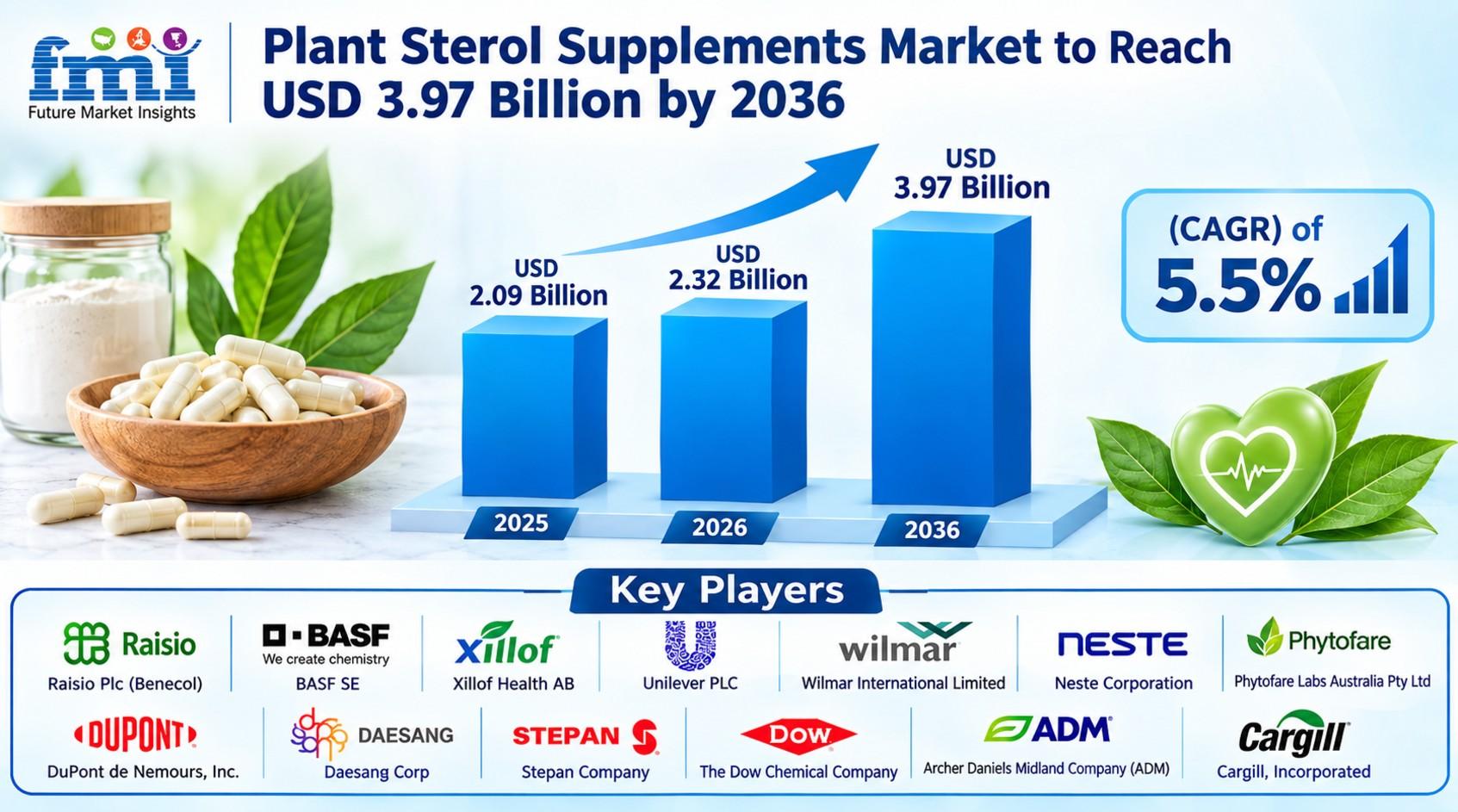
The global plant sterol supplements market is sustaining solid commercial expansion, according to comprehensive intelligence published by Future Market Insights. Driven by rising global cardiovascular disease (CVD) prevalence, aging demographics in developed economies, and widespread consumer adoption of non-prescription, evidence-based cholesterol management protocols, concentrated phytosterol supplements (beta-sitosterol, campesterol, stigmasterol) are securing broad placement across pharmacy, wellness retail, and direct-to-consumer (DTC) channels.
The global market, valued at USD 2.09 billion in 2025, is estimated to reach USD 2.32 billion in 2026. Advancing at a Compound Annual Growth Rate (CAGR) of 5.5% over the ten-year forecast period, total market valuation is projected to achieve USD 3.97 billion by 2036, delivering an absolute dollar expansion of USD 1.65 billion.
Request a Sample Report: https://www.futuremarketinsights.com/reports/sample/rep-gb-2503
Market Performance Overview (2026–2036)
To map out key retail distribution channels, active phytosterol compositions, and regional growth vectors guiding this USD 1.65 billion market expansion, key segment allocations highlight where commercial volume and revenue are concentrated:
· Pharmacies and Drugstores Distribution Channel (37.6% share): Represents the dominant sales channel in 2026, driven by the professional advisory role of pharmacists guiding consumers seeking clinically proven, over-the-counter LDL cholesterol reduction supplements.
· Health and Beauty Stores: Commands the second-largest retail position, capturing wellness-oriented consumers purchasing heart-health and preventative longevity formulations.
· Internet and Direct Selling: Represents the fastest-growing sales vector, leveraging subscription-based DTC models and personalized cardiovascular wellness education.
· China & India Regional Growth Leadership: Lead national expansion rates at 7.4% CAGR and 6.9% CAGR respectively through 2036, driven by rising urban dyslipidemia rates, pharmacy retail network densification, and government-supported preventative health initiatives.
Technical Drivers and Formulation Shifts
The commercial scaling of plant sterol supplements across retail and nutraceutical supply chains is propelled by three primary industry catalysts:
Regulatory-Approved Health Claims (EFSA, US FDA)
The European Food Safety Authority (EFSA) and the US FDA have established authorized health claims confirming that daily consumption of $1.5\text{--}3.0\text{ g}$ of plant sterols or stanols lowers blood LDL cholesterol by competitively inhibiting intestinal cholesterol absorption. These regulatory frameworks give supplement brand owners (such as Raisio Plc and BASF SE) legally validated on-pack messaging that drives consumer trust.
Preventative Gap Between Diet and Statin Therapy
With hypercholesterolemia and cardiovascular health concerns rising globally, plant sterol supplements are positioned as a first-line non-prescription intervention. Consumers managing mild-to-moderate hypercholesterolemia utilize plant sterols as an evidence-based lifestyle bridge before or alongside statin therapy, supported by clinical consensus from bodies such as the European Atherosclerosis Society (EAS).
Formulation Upgrades and Bioavailability Enhancements
Extractors are refining phytosterol purification from vegetable oil deodorizer distillates (VODD), grain processing, and tall oil to yield high-purity crystalline powders and esterified sterol formats. Formulators utilize microencapsulation and softgel solubilization technologies to enhance bioaccessibility, allowing high functional loads without gritty textures in chewables, gummies, and compact capsules.
Industrial Constraints & Sourcing Risks
Phytosterol refiners and supplement brand procurement managers navigate specific operational hurdles:
· Upstream Feedstock Availability and Tall Oil / Vegetable Oil Price Shifts: Commercial phytosterols are secondary co-products of vegetable oil refining (soy, canola, sunflower) and wood pulp tall oil processing. Fluctuations in edible oil crushing throughput and timber processing directly impact raw sterol availability and pricing.
· Health Claim Wording and Threshold Scrutiny: Regulatory bodies enforce strict daily active dosage thresholds ($>0.8\text{ g}$ free phytosterols for FDA claims; $1.5\text{--}3.0\text{ g}$ for EFSA LDL-lowering claims). Brands failing to maintain verified batch consistency risk non-compliance and product re-labeling mandates.
Regional Growth Profile
Regional demand reflects structured pharmacy advisory networks in Western Europe alongside massive preventive health adoption in Asia-Pacific and North America:
· China (7.4% CAGR): The fastest-growing global market, supported by rapid pharmacy chain expansion, aging population health policies, and rising domestic extraction capacity.
· India (6.9% CAGR): Driven by an escalating prevalence of dyslipidemia and lifestyle-related cardiovascular conditions across urban middle-class demographics.
· Germany (6.3% CAGR) & France (5.8% CAGR): Lead European demand under the EFSA qualified health claim framework, where pharmacy-guided cardiovascular self-care represents an established purchasing routine.
· United Kingdom (5.2% CAGR): Anchored by high penetration in national pharmacy chains (Boots) and expanding online DTC subscription brands.
· United States (4.7% CAGR; USD 819.6 Million in 2026): Represents a mature, high-value market driven by bulk ingredient suppliers (Cargill, ADM) feeding established contract manufacturing networks.
· Brazil (4.1% CAGR): Expanding through pharmacy-led cardiovascular education programs and local nutraceutical compounding.
Competitive Landscape
The global plant sterol supplements landscape features a combination of multinational agribusiness ingredient suppliers, specialized chemical extractors, and established consumer cardiovascular health brands.
Key market participants profiled in the report include Raisio Plc (Benecol), BASF SE, Xillof Health AB, Unilever PLC, Wilmar International Limited, Neste Corporation, Phytofare Labs Australia Pty Ltd, DuPont de Nemours, Inc., Daesang Corp, Stepan Company, The Dow Chemical Company, Archer Daniels Midland Company (ADM), and Cargill, Incorporated. Major players compete by securing sustainable vegetable oil distillate sourcing contracts, validating esterified sterol bioavailability, and partnering with national pharmacy chains for prominent shelf placement.
Exclusive Discounts on Full Report: https://www.futuremarketinsights.com/reports/plant-sterol-supplements-market
Frequently Asked Questions
What is the projected valuation of the global plant sterol supplements market by 2036?
The global plant sterol supplements market is projected to reach USD 3.97 billion by 2036, expanding from an estimated baseline valuation of USD 2.32 billion in 2026 at a CAGR of 5.5%.
Why do Pharmacies and Drugstores lead with a 37.6% market share?
Pharmacies lead distribution in 2026 because consumers seeking evidence-based cholesterol reduction rely on the professional credibility, product verification, and dosage guidance provided by licensed pharmacists.
What are the main active phytosterol compounds in these supplements?
Plant sterol supplements principally contain beta-sitosterol, campesterol, and stigmasterol, which competitively block the intestinal absorption of dietary and biliary cholesterol, reducing circulating LDL levels.
FMI Custom Research: Strategic Intelligence for Confident Decision-Making
In today's rapidly evolving business environment, leadership teams need clear, actionable intelligence tailored to their strategic objectives. FMI's Custom Research solutions are designed around specific business questions, enabling executives to evaluate growth opportunities, validate investments, assess competitive dynamics, and reduce uncertainty before making critical decisions.
Key Executive Benefits
· Decision-Ready Insights: Research tailored to your specific business challenges, growth plans, and investment priorities.
· Reduced Strategic Risk: Validate market opportunities, customer demand, and competitive positioning before committing resources.
· Market Entry Confidence: Assess opportunity size, regulatory barriers, channel dynamics, and competitive landscapes with precision.
· Competitive Advantage: Gain proprietary intelligence unavailable through syndicated reports or internal datasets.
· Faster Growth Decisions: Accelerate expansion, product development, portfolio optimization, and investment planning.
· Primary Market Validation: Access real-world customer, buyer, and stakeholder insights that support high-confidence decision-making.
Business Impact
FMI helps organizations transform market complexity into strategic clarity, enabling leadership teams to identify growth opportunities faster, optimize resource allocation, strengthen competitive positioning, and make high-stakes business decisions with confidence.
To explore how FMI Custom Research can support your strategic priorities, connect with our team at - sales@futuremarketinsights.com
About Future Market Insights (FMI)
Future Market Insights (FMI) delivers actionable, decision-focused market intelligence that goes beyond traditional research reports. The company provides:
· In-depth pricing and cost benchmarking analysis
· Demand forecasting based on real industry inputs
· Procurement and buyer behavior insights
· Supply chain and trade flow intelligence
· Technology and application trend analysis across industries
FMI follows a robust bottom-up research methodology, combining insights from industry experts, procurement leaders, manufacturers, and technical professionals to ensure accurate and practical market intelligence.

 English
 Arabic
 French
 Spanish
 Portuguese
 Deutsch
 Turkish
 Dutch
Dutch
 Russian
 Romaian
 Portuguese (Brazil)
 Greek
Greek
