


Chitosan Powder Market to Reach USD 7.38 Billion by 2036
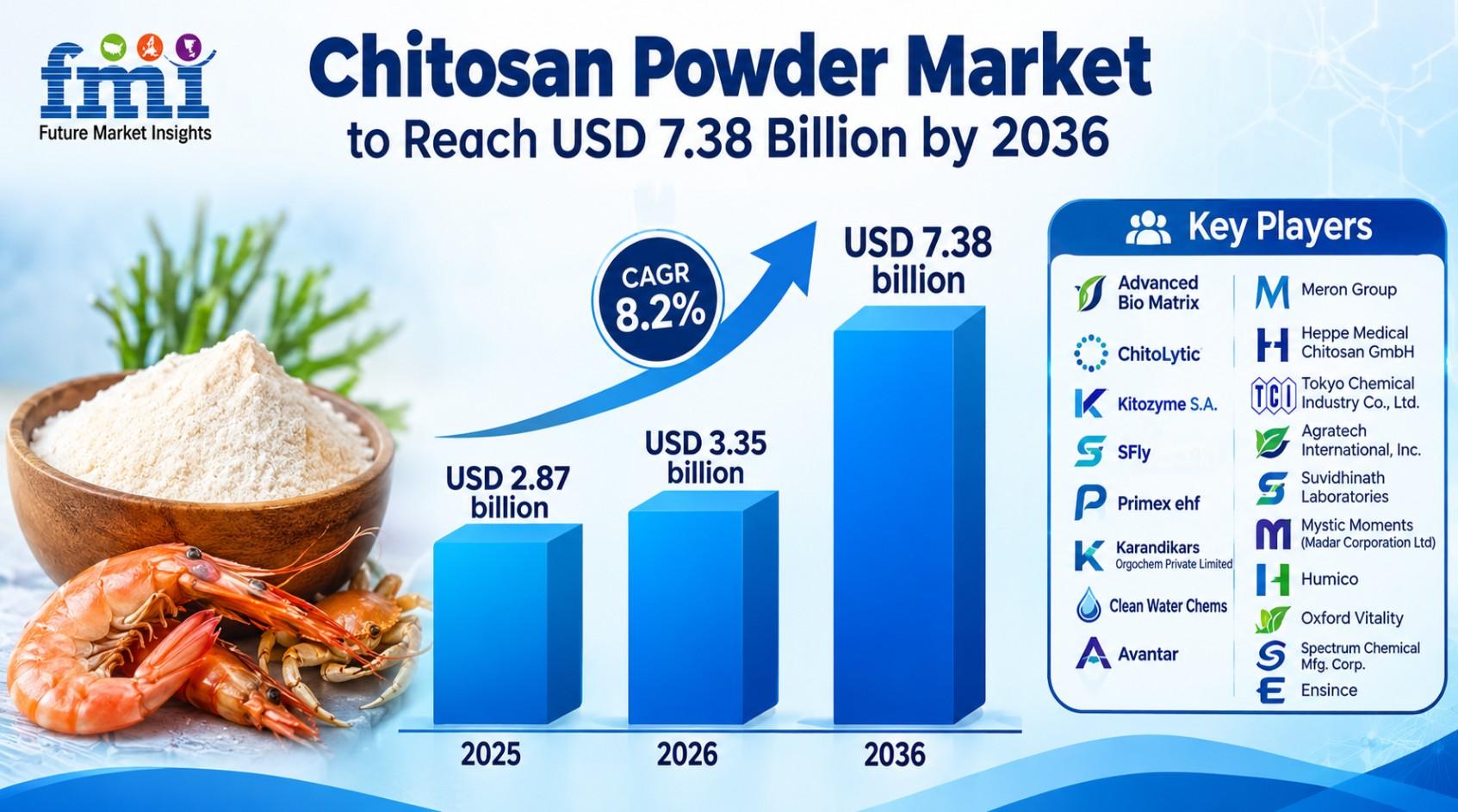
The global chitosan powder market is experiencing rapid multi-sector expansion, according to comprehensive intelligence published by Future Market Insights. Driven by pharmaceutical-grade demand for advanced drug delivery excipients and biomedical coatings, agricultural adoption of natural plant biostimulants under synthetic pesticide phase-outs, and personal care formulations shifting to biodegradable biopolymers under microplastic bans, chitosan is cementing its position as one of the highest-growth specialty biopolymers globally.
The global market, valued at USD 2.87 billion in 2025, is estimated to reach USD 3.35 billion in 2026. Advancing at a Compound Annual Growth Rate (CAGR) of 8.2% over the ten-year forecast period, total market valuation is projected to achieve USD 7.38 billion by 2036, generating an absolute dollar expansion of USD 4.03 billion.
Request a Sample Report: https://www.futuremarketinsights.com/reports/sample/rep-gb-9202
Market Performance Overview (2026–2036)
To map out key feedstock sources, purity grades, primary end-use sectors, and distribution pathways guiding this USD 4.03 billion market expansion, key segment allocations highlight where commercial volume and revenue are concentrated:
· Shrimp Feedstock Source Segment (46.7% share): Represents the dominant raw material source in 2026, leveraging established crustacean shell processing infrastructure and continuous supply across Asia-Pacific aquaculture hubs.
· Pharmaceutical Grade Segment (38.9% share): Commands the largest value share across grade categories, driven by high unit value procurement of defined molecular weight, low-endotoxin, and European Pharmacopoeia/USP-compliant grades for mucoadhesive drug delivery and wound-healing medical devices.
· Food and Beverage Industry End Use (31.6% share): Leads industrial end-use consumption, serving as an effective antimicrobial preservative, edible film-forming coating, clarifying agent, and functional dietary fiber.
· Direct Sales / B2B Distribution (42.3% share): Serves as the primary distribution route, as large-scale pharmaceutical, CPG food, and agrochemical manufacturers rely on multi-year contract agreements and direct supplier qualification audits.
· United States & Germany Regional Growth Leadership: The US market leads national growth at 6.9% CAGR (projected to represent 81.3% of North American sales by 2036), while Germany advances at 6.2% CAGR, driven by EU Medical Device Regulation (MDR 2017/745) biocompatibility requirements and strict agrochemical restrictions.
Technical Drivers and Formulation Shifts
The commercial scaling of chitosan powder across medical, agricultural, and consumer goods manufacturing is propelled by three primary industry catalysts:
Drug Delivery Systems, Mucoadhesion, and Medical Devices
High-purity pharmaceutical-grade chitosan exhibits unique polycationic properties, enabling cell membrane permeation, controlled nanoparticle drug encapsulation, and superior mucoadhesion. Biomedical developers incorporate chitosan into hemostatic wound dressings, surgical sponges, and oral/nasal drug delivery platforms, supported by FDA inactive ingredient acceptance and EU MDR 2017/745 Class II/III biocompatibility standards.
Biological Crop Protection and EU Basic Substance Approvals
Under EU Commission Implementing Regulation (EU) 2015/2046, chitosan hydrochloride is approved as a basic substance for plant protection under Regulation (EC) No 1107/2009. This regulatory clearance allows commercial growers to apply agricultural-grade chitosan as a natural biofungicide and systemic acquired resistance (SAR) elicitor within integrated pest management (IPM) and certified organic farming systems without violating synthetic residue limits.
Microplastic Restrictions and Clean-Label Personal Care
The EU REACH restriction on intentionally added synthetic polymer microplastics is redirecting cosmetic formulation chemistry toward biodegradable natural polymers. Personal care formulators increasingly specify cosmetic-grade chitosan for film-forming, conditioning, and anti-static properties across hair care and skin care emulsions.
Industrial Constraints & Sourcing Risks
Chitosan processors and industrial procurement teams navigate specific operational hurdles:
· Crustacean Shell Supply Concentration and Quota Risks: Raw shell availability remains heavily concentrated in Asia-Pacific seafood processing corridors (China, India, Southeast Asia). Seasonal fishing bans, aquaculture output fluctuations, and lack of traceable shell sourcing create spot-market price volatility for basic chitin feedstocks.
· Cost and Capex Barriers in Pharmaceutical Deacetylation: Achieving high degrees of deacetylation , ultra-low heavy metal content, and strict bioburden control requires extensive chemical/enzymatic washing, specialized cleanrooms, and stringent validation, creating substantial price premiums over industrial and water-treatment grades.
Regional Growth Profile
Regional demand reflects intensive biopolymer production and traditional medicine adoption in Asia alongside high-value pharmaceutical and agricultural integration in North America and Western Europe:
· United States (6.9% CAGR): The fastest-growing major national market, driven by biomedical device approvals, pharmaceutical nanoparticle development, and eco-friendly municipal/industrial wastewater flocculation programs.
· Germany (6.2% CAGR): Leads European adoption, anchored by medical device innovators (e.g., Heppe Medical Chitosan GmbH), strict chemical fungicide phase-outs, and REACH-compliant personal care reformulations.
· India (6.0% CAGR; USD 627.9 Million by 2036): Expanding rapidly across domestic biostimulant manufacturing, pharmaceutical excipient synthesis, and natural food preservation lines.
· China (5.8% CAGR; USD 680.0 Million by 2036): Functions as the world's largest chitosan manufacturing and processing powerhouse, supplying global export markets while driving domestic demand across clinical wound care, agriculture, and traditional therapeutic remedies.
· Japan (4.4% CAGR): Driven by high-purity analytical research reagents, functional nutraceutical fiber formulations, and specialty cosmetics.
Competitive Landscape
The global chitosan powder landscape features a tiered ecosystem of global biopolymer refiners, specialized medical-grade manufacturers, and agricultural biological suppliers.
Key market participants profiled in the report include Advanced Bio Matrix, Meron Group, ChitoLytic, Heppe Medical Chitosan GmbH, Kitozyme S.A., Tokyo Chemical Industry Co., Ltd., SFly, Primex ehf, Agratech International, Inc., Karandikars Orgochem Private Limited, Suvidhinath Laboratories, Clean Water Chems, Mystic Moments (Madar Corporation Ltd), Avantar, Humico, Oxford Vitality, Spectrum Chemical Mfg. Corp., and Ensince. Tier-1 players maintain market dominance by securing sustainable seafood shell traceability certifications, investing in green enzymatic deacetylation pathways, and providing validated DMF (Drug Master File) dossiers for pharmaceutical drug developers.
Exclusive Discounts on Full Report: https://www.futuremarketinsights.com/reports/chitosan-powder-market
Frequently Asked Questions
What is the projected valuation of the global chitosan powder market by 2036?
The global chitosan powder market is projected to reach USD 7.38 billion by 2036, expanding from an estimated baseline valuation of USD 3.35 billion in 2026 at a CAGR of 8.2%.
Why does Shrimp feedstock lead with a 46.7% market share?
Shrimp shells represent the primary raw material source in 2026 due to extensive commercial shrimp farming and processing infrastructure across Asia-Pacific, offering consistent biomass volumes for conversion into industrial, food, and pharmaceutical grades.
What is driving Pharmaceutical Grade demand to a 38.9% market share?
Pharmaceutical grade commands the largest value share due to the high unit pricing of ultra-pure, low-endotoxin chitosan specified as a biocompatible excipient in mucoadhesive drug delivery, gene therapy encapsulation, and surgical wound healing matrices.
FMI Custom Research: Strategic Intelligence for Confident Decision-Making
In today's rapidly evolving business environment, leadership teams need clear, actionable intelligence tailored to their strategic objectives. FMI's Custom Research solutions are designed around specific business questions, enabling executives to evaluate growth opportunities, validate investments, assess competitive dynamics, and reduce uncertainty before making critical decisions.
Key Executive Benefits
· Decision-Ready Insights: Research tailored to your specific business challenges, growth plans, and investment priorities.
· Reduced Strategic Risk: Validate market opportunities, customer demand, and competitive positioning before committing resources.
· Market Entry Confidence: Assess opportunity size, regulatory barriers, channel dynamics, and competitive landscapes with precision.
· Competitive Advantage: Gain proprietary intelligence unavailable through syndicated reports or internal datasets.
· Faster Growth Decisions: Accelerate expansion, product development, portfolio optimization, and investment planning.
· Primary Market Validation: Access real-world customer, buyer, and stakeholder insights that support high-confidence decision-making.
Business Impact
FMI helps organizations transform market complexity into strategic clarity, enabling leadership teams to identify growth opportunities faster, optimize resource allocation, strengthen competitive positioning, and make high-stakes business decisions with confidence.
To explore how FMI Custom Research can support your strategic priorities, connect with our team at - sales@futuremarketinsights.com
About Future Market Insights (FMI)
Future Market Insights (FMI) delivers actionable, decision-focused market intelligence that goes beyond traditional research reports. The company provides:
· In-depth pricing and cost benchmarking analysis
· Demand forecasting based on real industry inputs
· Procurement and buyer behavior insights
· Supply chain and trade flow intelligence
· Technology and application trend analysis across industries
FMI follows a robust bottom-up research methodology, combining insights from industry experts, procurement leaders, manufacturers, and technical professionals to ensure accurate and practical market intelligence.

 English
 Arabic
 French
 Spanish
 Portuguese
 Turkish
 Dutch
Dutch
 Italiano
 Russian
 Romaian
 Portuguese (Brazil)
 Greek
Greek
