


Why Every Growing Business Needs a Revenue Operations Platform
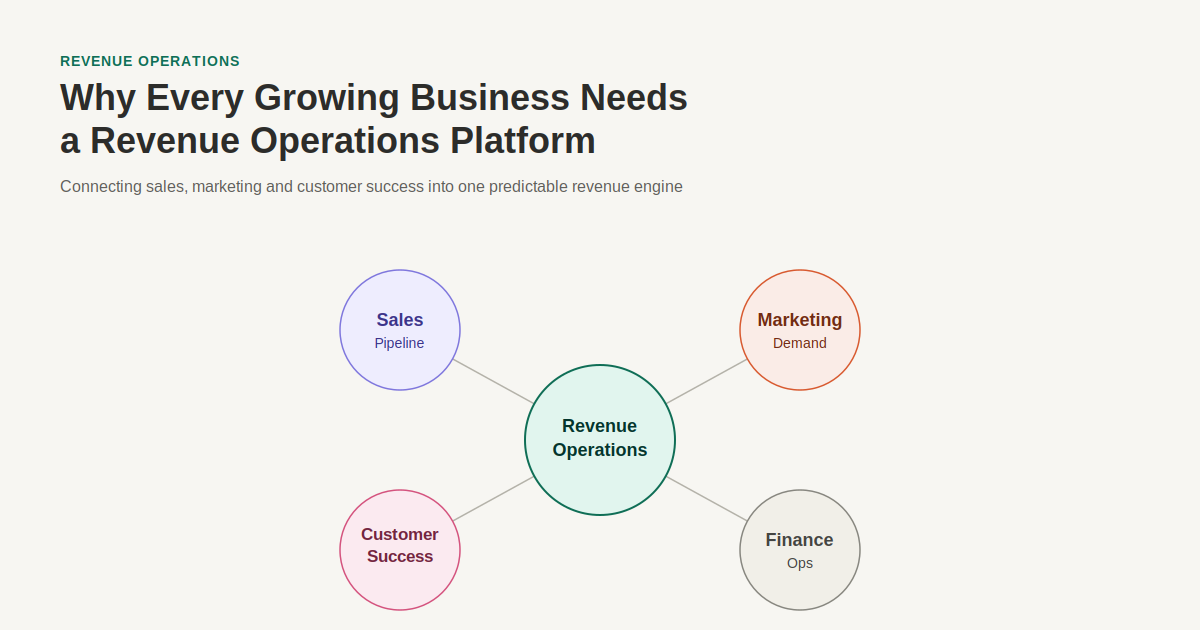
Revenue Operations Platform — if you're reading about one, chances are your company has hit that awkward growth stage where the tools that used to work just... don't anymore. Sales is in one system, marketing swears by another, and customer success is still tracking renewals in a spreadsheet someone built three years ago and everyone's afraid to touch. Nobody planned it this way. It just happened, deal by deal, hire by hire, tool by tool.
This is the moment most growing companies discover they don't actually have a revenue process — they have a revenue patchwork. Leads fall through cracks between marketing and sales. Forecasts get built on optimism rather than data. And when a customer churns, three different teams find out three different ways.
A Revenue Operations Platform exists to fix exactly this. It's not a magic fix, and it won't replace good judgment or a solid sales strategy. But it does give a growing business something rare: one shared version of the truth that sales, marketing, and customer success can all work from. That alone changes how a company operates.
Unify Sales, Marketing, and Customer Success Data — Instead of Guessing What the Other Team Knows
Here's a scenario that plays out constantly: a prospect downloads three whitepapers, attends a webinar, and gets nurtured for months before a rep ever picks up the phone. By the time the deal closes, that context is gone. The sales rep didn't see it. And six months later, when the account renews, customer success has no idea any of it happened either.
Centralizing this data doesn't just tidy things up cosmetically — it changes how teams actually behave. When a customer success manager can see the exact objections a prospect raised during the sales cycle, they stop reintroducing the product from scratch and start building on what's already been established. That's a small thing on paper. In practice, it's the difference between a customer who feels understood and one who feels like they're starting over with every new contact.
Improve Revenue Visibility Across the Customer Lifecycle
Ask most VPs of Sales how confident they are in this quarter's forecast, and you'll get a pause before the answer. That pause is the problem. It usually means the number came from a gut check in last week's pipeline review, not from data anyone could defend in a board meeting.
A revenue operations platform replaces that pause with something closer to certainty — or at least informed estimation. Real-time dashboards pull pipeline stage, deal velocity, and historical close rates into a single view, so a stalling deal shows up as a yellow flag in week three instead of a surprise in week twelve. Leaders stop reacting to problems after they've already cost the quarter.
Automate Repetitive Revenue Operations Tasks
Nobody joined a sales or marketing team because they love updating CRM fields. Yet that's where a shocking amount of the workweek disappears — routing leads manually, chasing approvals over Slack, re-entering the same contact information into four different tools.
Automation takes this off people's plates without anyone noticing the handoff happen. A lead comes in, gets scored, gets routed to the rep who owns that territory, and triggers a notification — all before a human has to think about it. It's not glamorous work, but removing it is one of the fastest ways to give a revenue team its time back.
Strengthen Sales Productivity and Deal Management
Reps don't lose deals because they're bad at selling. More often, they lose momentum because they're buried in administrative overhead — building quotes by hand, waiting on discount approvals, or double-checking pricing against three different spreadsheets.
This is where tools like Mobileforce earn their keep. By combining CPQ functionality with revenue operations workflows, a platform like this lets reps generate accurate, approved quotes on the spot instead of waiting a day for finance to sign off. Deal velocity picks up not because reps are working harder, but because the friction between "yes" and "signed" gets smaller.
Create More Accurate Revenue Forecasts
Forecasting is often treated like an art form when it should be treated like a math problem. The issue isn't that reps are bad at predicting the future — it's that they're predicting it from incomplete information, scattered across tools that don't talk to each other.
A revenue management platform pulls historical conversion data, current pipeline health, and deal-stage patterns into one model. The forecast that comes out the other end isn't perfect — nothing is — but it's built on evidence instead of optimism, which makes it something leadership can actually plan around.
Improve Customer Journey Alignment
Customers don't experience your org chart. They just experience a company — and when that company sends mixed signals (marketing promises one thing, sales sells another, and onboarding delivers a third), customers notice, even if they never say so directly.
A Revenue Operations Platform keeps everyone working from the same customer story. Marketing knows what messaging actually converts. Sales knows what was promised. Customer success picks up exactly where the relationship left off, instead of asking a new customer to reintroduce themselves. Over time, that consistency shows up in retention numbers more than any single tactic ever could.
Scale Revenue Operations Without Adding Unnecessary Complexity
Growth has a funny way of multiplying complexity faster than it multiplies revenue. New markets bring new processes. New hires bring new interpretations of "how we do things here." Left unmanaged, this is how a 50-person company ends up with the operational chaos of a much larger one — without any of the resources to match.
The fix isn't fewer processes; it's standardized ones. A revenue operations platform lets a company build a workflow once — for lead routing, deal approvals, renewal handoffs — and reuse it as the business expands into new territories or product lines, instead of reinventing it every time.
Connect CRM and Revenue Technology
A CRM is necessary, but it was never designed to run the entire revenue engine on its own. Quoting, contracts, marketing automation, and customer success tools usually live somewhere else entirely, which means someone, somewhere, is manually copying data between systems and hoping nothing gets lost in translation.
Mobileforce is built specifically to close that gap — connecting CPQ, workflow automation, and CRM data so that a quote generated in one system flows cleanly into the next, without a spreadsheet or a copy-paste job in between. Fewer manual steps means fewer places for errors to creep in.
Support Smarter, Data-Driven Revenue Growth
Most companies are sitting on more customer data than they realize — they just don't have a way to make sense of it. It sits in dashboards nobody checks daily, or reports that get built once a quarter and go stale within a week.
Revenue intelligence tools change that equation by surfacing patterns a human reviewer might miss: an account that's gone quiet and might be at renewal risk, or a segment of customers ready for an upsell conversation. The value isn't the data itself — it's turning that data into something a revenue team can actually act on before the moment passes.
Common Revenue Operations Challenges (and What Actually Fixes Them)
Even companies that know they need better RevOps run into the same handful of walls:
-
Data silos. The fix is genuinely simple to describe and hard to execute: centralize data into one platform every team can see, not just the one they own.
-
Poor CRM adoption. Reps avoid tools that feel like extra work. Automation that removes manual entry tends to solve adoption problems faster than any mandate from leadership does.
-
Disconnected technology. Prioritize platforms with real, native integrations — not ones that require a developer every time something needs to connect.
-
Manual workflows. Automate the routing, the approvals, the notifications — anything repetitive and rules-based doesn't need a human doing it by hand.
-
Inconsistent processes. Standardize playbooks across teams and regions so "how we do things" isn't a different answer depending on who you ask.
-
Inaccurate forecasting. Build forecasts from centralized pipeline data and historical trends, not from individual rep optimism.
-
Lack of cross-functional visibility. Shared dashboards, visible to sales, marketing, and customer success leadership alike, close this gap quickly.
-
Difficulty scaling operations. Build repeatable processes early, before growth forces you to build them reactively under pressure.
How to Choose the Right Revenue Operations Platform
There's no shortage of platforms claiming to solve all of this. A few questions tend to separate the ones worth evaluating from the ones that'll just add another login to your team's list:
-
Integration capabilities — Does it genuinely connect with your CRM, marketing automation, and finance stack, or does it require constant custom work?
-
Workflow automation — Can it handle routing, approvals, and notifications out of the box?
-
Analytics and reporting — Are the dashboards flexible enough to reflect metrics that actually matter to your business, not just generic templates?
-
Scalability — Will it hold up as you add headcount, regions, or product lines?
-
Ease of use — Will your team actually adopt it, or will it sit unused after the onboarding calls end?
-
Data quality and governance — Does it enforce clean data entry, or just store whatever gets typed in?
-
AI capabilities — Are the AI features producing real insight, or just automation dressed up with a new label?
-
CRM compatibility — Does it work alongside your existing CRM, or fight with it?
-
Security — Does it meet the compliance standards your business and customers require?
-
Implementation and ongoing support — Is there a real onboarding path, and will someone answer when something breaks six months from now?
Where Revenue Operations Is Headed
A few shifts are already reshaping what RevOps looks like, and they're worth watching closely over the next few years.
AI-powered revenue intelligence is getting better at flagging deal risk before a rep notices anything is wrong. Predictive analytics is tightening up forecasts that used to rely on guesswork. Workflow automation is moving past simple if-this-then-that routing into more conditional, judgment-like decision-making.
Meanwhile, no-code and low-code tools are putting workflow-building directly into the hands of RevOps teams, instead of requiring an engineering ticket for every small change. And quote-to-cash processes are steadily becoming more connected end-to-end, closing the gap between a signed deal and recognized revenue.
Conclusion
Growing businesses need a Revenue Operations Platform for the same reason they eventually need a real hiring process instead of word-of-mouth referrals — what worked at ten people quietly stops working at fifty. Disconnected systems and manual handoffs aren't a minor inconvenience once a company scales; they're the reason forecasts miss, customers slip through the cracks, and teams spend more time reconciling data than using it.
But it's worth saying plainly: no platform fixes a company on its own. The technology matters, but so do the people running it, the processes they follow, and the discipline to actually use clean, shared data instead of falling back on separate spreadsheets. Tools like Mobileforce can connect the pieces — CPQ, automation, CRM — but the alignment still has to be intentional.
Where this is all heading is toward less manual work and more informed decision-making, as AI and automation take over the parts of revenue operations that never needed a human doing them by hand. The businesses that build this foundation now won't be scrambling to retrofit it later, once growth has already outpaced what their systems can handle.
Frequently Asked Questions
What is a Revenue Operations Platform?
It's a centralized system that connects the data, processes, and technology used by sales, marketing, and customer success — so all three teams work from the same information instead of separate, disconnected records.
Why does a growing business need a RevOps platform?
Because the tools and processes that work for a small team break down as headcount and complexity grow. A RevOps platform prevents the data silos and inconsistent handoffs that usually show up right when a company can least afford them.
How does a Revenue Operations Platform improve sales productivity?
It cuts down the administrative work — manual quoting, approval delays, data entry — that eats into a rep's selling time, and surfaces which deals actually need attention right now.
What features should businesses look for in revenue operations software?
Real CRM integration, workflow automation that works out of the box, flexible analytics, and strong data governance are the ones that matter most. AI features are only useful if they produce insight, not just automation for its own sake.
How does RevOps technology support scalable revenue growth?
By letting a company build a process once and reuse it — for routing, approvals, forecasting — instead of rebuilding it every time the business adds a new team, region, or product line.

 English
 Arabic
 French
 Spanish
 Portuguese
 Deutsch
 Turkish
 Dutch
Dutch
 Italiano
 Russian
 Romaian
 Greek
Greek
