


SOC Managed Service Providers: Stronger Healthcare Security in India
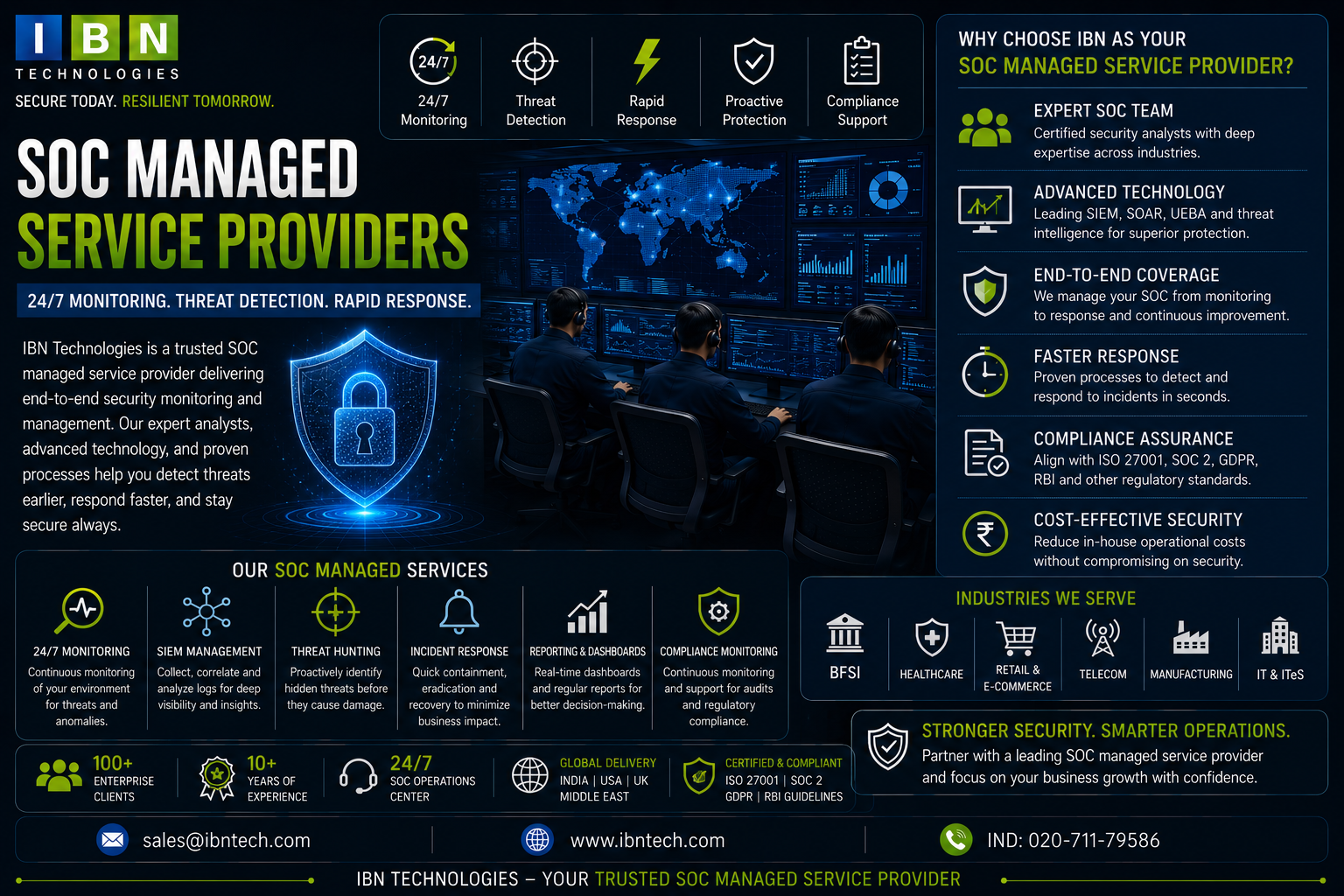
Why soc managed service providers Matter in Indian Healthcare
Healthcare organizations operate under a unique security requirement: sensitive information must be protected while technology remains available to support critical operations. Hospitals, clinics, diagnostic providers, healthtech companies, and pharmaceutical organizations can all have complex digital environments.
soc managed service providers give healthcare organizations access to dedicated security operations capabilities for monitoring, threat investigation, and incident response without requiring them to build every SOC function internally.
For healthcare leaders, the decision should be based on more than cybersecurity tooling. It should consider operational continuity, sensitive information, response readiness, compliance, and the organization's ability to maintain security visibility around the clock.
What Do SOC Managed Service Providers Do?
SOC managed service providers operate or support security operations for organizations through a combination of technology, security processes, and specialized personnel.
A managed SOC can collect and analyze security events, identify suspicious activity, investigate potential incidents, provide threat intelligence, and support escalation and response.
SIEM technology can help correlate security information from relevant systems, while SOC analysts provide the human investigation needed to understand what an alert actually means.
For healthcare organizations, this combination can connect technical security monitoring with broader risk-management and compliance objectives.
Why Healthcare Security Requires Continuous Attention
Healthcare systems do not necessarily follow conventional business hours.
Patient-facing services, hospital operations, administrative applications, digital platforms, and supporting infrastructure can remain active outside normal working schedules.
Security incidents can therefore develop at inconvenient times.
A compromised account might be used overnight. Suspicious activity could begin during a weekend. A ransomware incident could affect an important system when the usual security team is unavailable.
Continuous monitoring helps reduce the dependence on someone being available at the right moment.
IBN Technologies provides healthcare cybersecurity services addressing threats such as ransomware, PHI breach risks, legacy-system vulnerabilities, and compliance complexity. Its healthcare capabilities include 24/7 SOC and SIEM monitoring, VAPT, and related cybersecurity services.
How healthcare SOC services Support Security Operations
An effective managed SOC creates a structured process around security events.
Relevant information can be collected from appropriate endpoints, networks, cloud systems, identity environments, and security devices. Security tools can help identify potentially suspicious patterns, while analysts investigate significant events.
IBN Technologies' SOC/SIEM services include 24/7 monitoring, threat detection, threat intelligence, incident response, security-device monitoring, and compliance-driven reporting.
Its MDR capabilities add services including threat hunting, endpoint detection and response, forensic analysis, and threat containment.
The precise service combination should reflect the healthcare organization's environment and security priorities.
Why Healthcare Organizations May Not Build Everything Internally
An internal SOC can provide direct control, but healthcare organizations must consider the operational resources required to sustain it.
Security analysts need specialized expertise. Monitoring systems require configuration and maintenance. Detection rules require ongoing attention. Incident-response procedures must be tested and updated.
At the same time, healthcare IT teams have their own operational responsibilities.
They may support clinical applications, networks, user access, infrastructure, cloud services, and business systems. Asking the same team to provide comprehensive security monitoring can create competing priorities.
A managed SOC can provide an additional security operations layer while internal healthcare teams remain responsible for business decisions, remediation, governance, and technology ownership.
What Healthcare Leaders Should Examine Before Selecting a Provider
Healthcare organizations should evaluate managed SOC providers based on their actual operating environment.
Security visibility: Determine whether the provider can monitor the systems that matter most to the organization.
Sensitive information: Identify how monitoring supports systems that process patient and other confidential information.
Continuous coverage: Confirm the availability and operating model for after-hours monitoring.
Incident analysis: Understand how analysts investigate alerts and distinguish routine activity from potential threats.
Response: Establish how critical incidents are escalated and what support is available during an investigation.
Integration: Review compatibility with existing security tools and infrastructure.
Healthcare environment: Consider whether monitoring processes account for the operational sensitivity of healthcare systems.
Reporting: Determine whether reporting provides useful information to security, IT, executive, and compliance stakeholders.
Growth: Assess how the service will accommodate additional facilities, applications, users, and digital services.
A Healthcare Security Scenario
Consider an Indian healthcare provider operating multiple facilities with shared IT infrastructure.
The organization has endpoint security, network controls, identity management, and cloud applications. However, security monitoring is divided among different teams.
One evening, an employee account begins generating unusual authentication activity.
The internal IT team is already managing an operational issue and cannot immediately investigate the event. Without continuous monitoring, the suspicious activity could remain unresolved.
With a managed SOC, the event can be reviewed as part of an ongoing security-monitoring process. Analysts can examine the available context, determine whether further investigation is warranted, and escalate the issue according to established procedures.
The internal team can then make decisions concerning access, affected systems, operational continuity, and remediation.
The provider does not replace organizational accountability. It adds dedicated security operations capacity.
The Value of Managed SOC Services for Healthcare
A managed SOC can help healthcare organizations create greater consistency in security operations.
Continuous monitoring can reduce dependence on business-hour availability. Specialist analysts can provide additional expertise. Structured escalation can make incident handling more predictable. Security reporting can provide leadership with greater visibility into security events.
There can also be an important scalability advantage.
Healthcare organizations may add facilities, digital services, applications, cloud environments, or external partners over time. Security monitoring needs to evolve alongside these changes.
A managed model can provide an operational framework that adapts without requiring the organization to repeatedly build new internal security capabilities.
Healthcare SOC Provider Checklist
- Identify critical clinical and administrative systems.
- Map systems that store, process, or access sensitive information.
- Identify cloud, endpoint, network, and identity security data sources.
- Define events that require urgent investigation.
- Establish internal and provider responsibilities.
- Confirm continuous monitoring arrangements.
- Review incident escalation and communication procedures.
- Assess SIEM and security-tool integration capabilities.
- Define reporting requirements for security and compliance teams.
- Reevaluate SOC coverage when technology or operations change.
Compliance and Governance in Indian Healthcare
Security monitoring should form part of a broader compliance and governance program.
Depending on the organization's activities, data, customers, and contractual obligations, healthcare organizations may need to consider requirements and frameworks such as HIPAA, HITECH, ISO 27001, SOC 2, DPDPA, and other applicable obligations.
IBN Technologies' healthcare cybersecurity services address HIPAA and HITECH considerations and identify ISO 27001:2022 and SOC 2 Type II among its healthcare security and compliance areas. Its broader cybersecurity portfolio includes VAPT, SOC/SIEM, MDR, cybersecurity audit and compliance, and vCISO services.
A managed SOC can support compliance through monitoring, reporting, incident records, and security processes. It does not, by itself, make an organization compliant with every applicable regulation.
Making Security Monitoring Part of Healthcare Resilience
Healthcare cybersecurity requires a balance between protection and operational continuity. Security teams need visibility into threats without creating unnecessary disruption to systems that support essential services.
The right soc managed service providers can help Indian healthcare organizations maintain continuous security monitoring, investigate suspicious activity, strengthen incident-response readiness, and support broader security governance.
IBN Technologies combines SOC/SIEM, MDR, VAPT, healthcare cybersecurity, compliance, and strategic security services to address different organizational needs.
For healthcare CIOs, CISOs, CTOs, security managers, and compliance leaders, the best provider relationship should deliver more than alerts. It should create a dependable security operation with clear responsibilities, meaningful investigation, timely escalation, and the flexibility to evolve as healthcare technology changes.
Contact Us:
IND- 02067680404
IBN Technologies Ltd.
E-mail: - sales@ibntech.com

 English
 Arabic
 French
 Spanish
 Portuguese
 Deutsch
 Dutch
Dutch
 Italiano
 Russian
 Romaian
 Portuguese (Brazil)
 Greek
Greek
